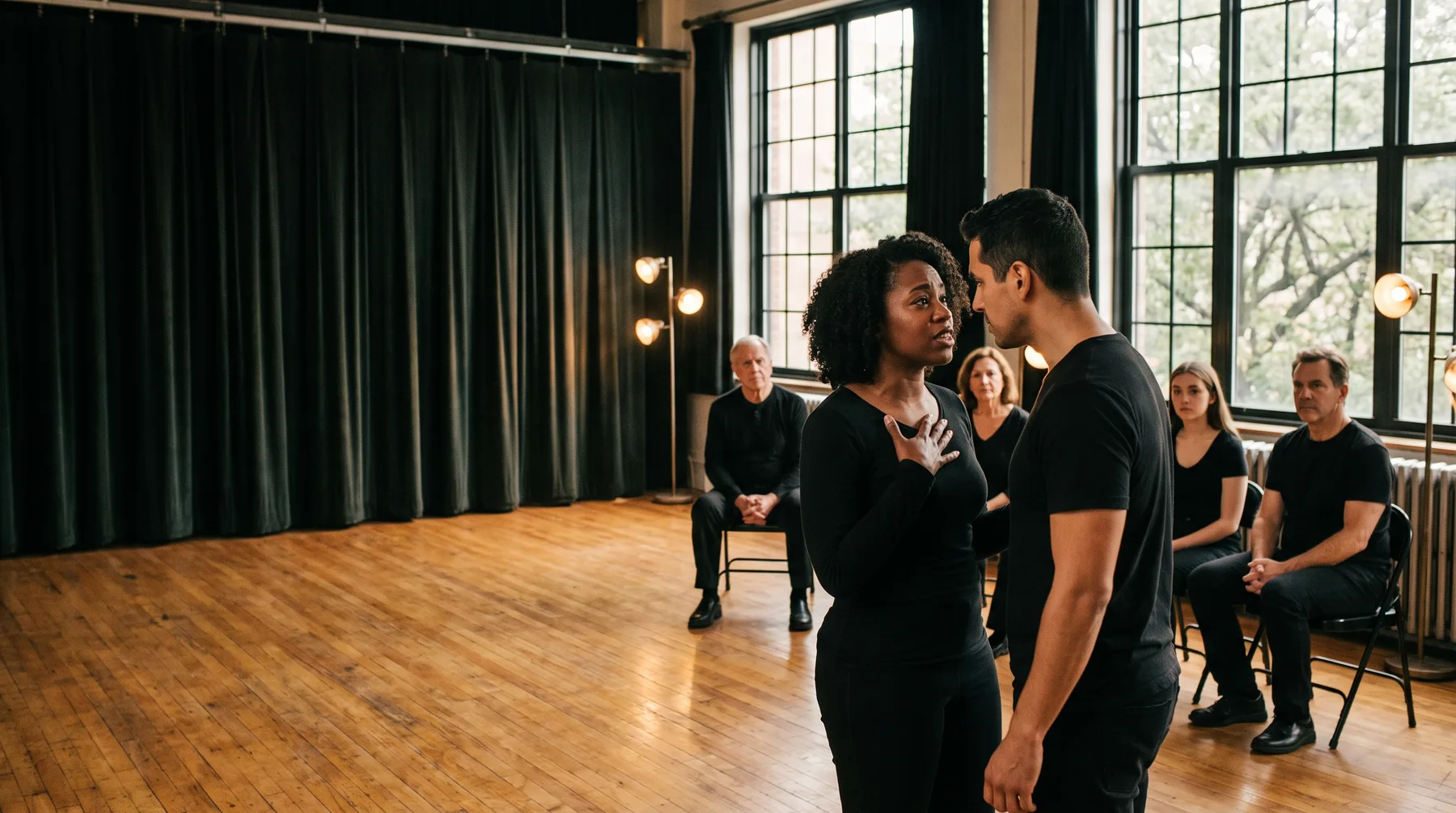
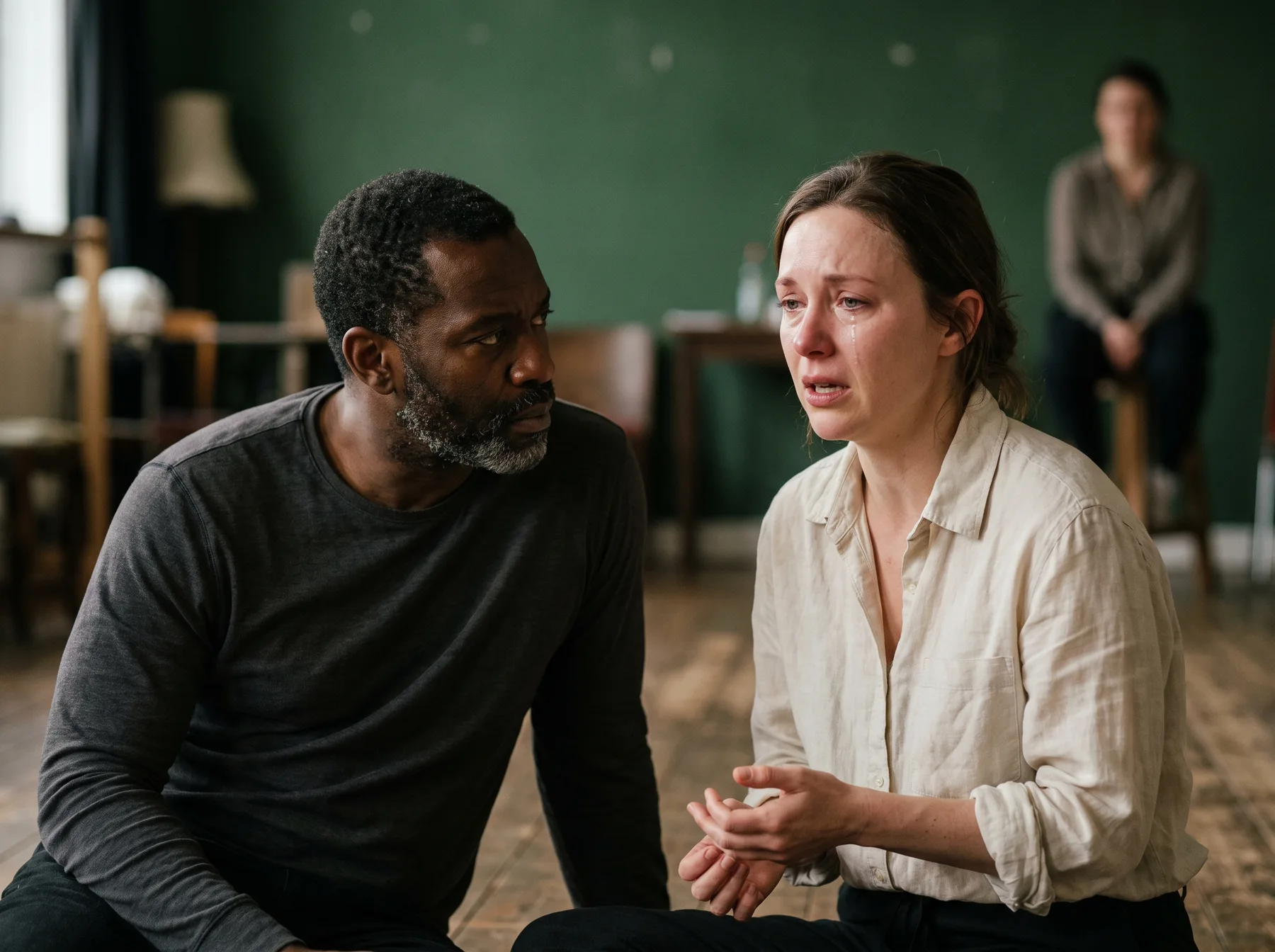
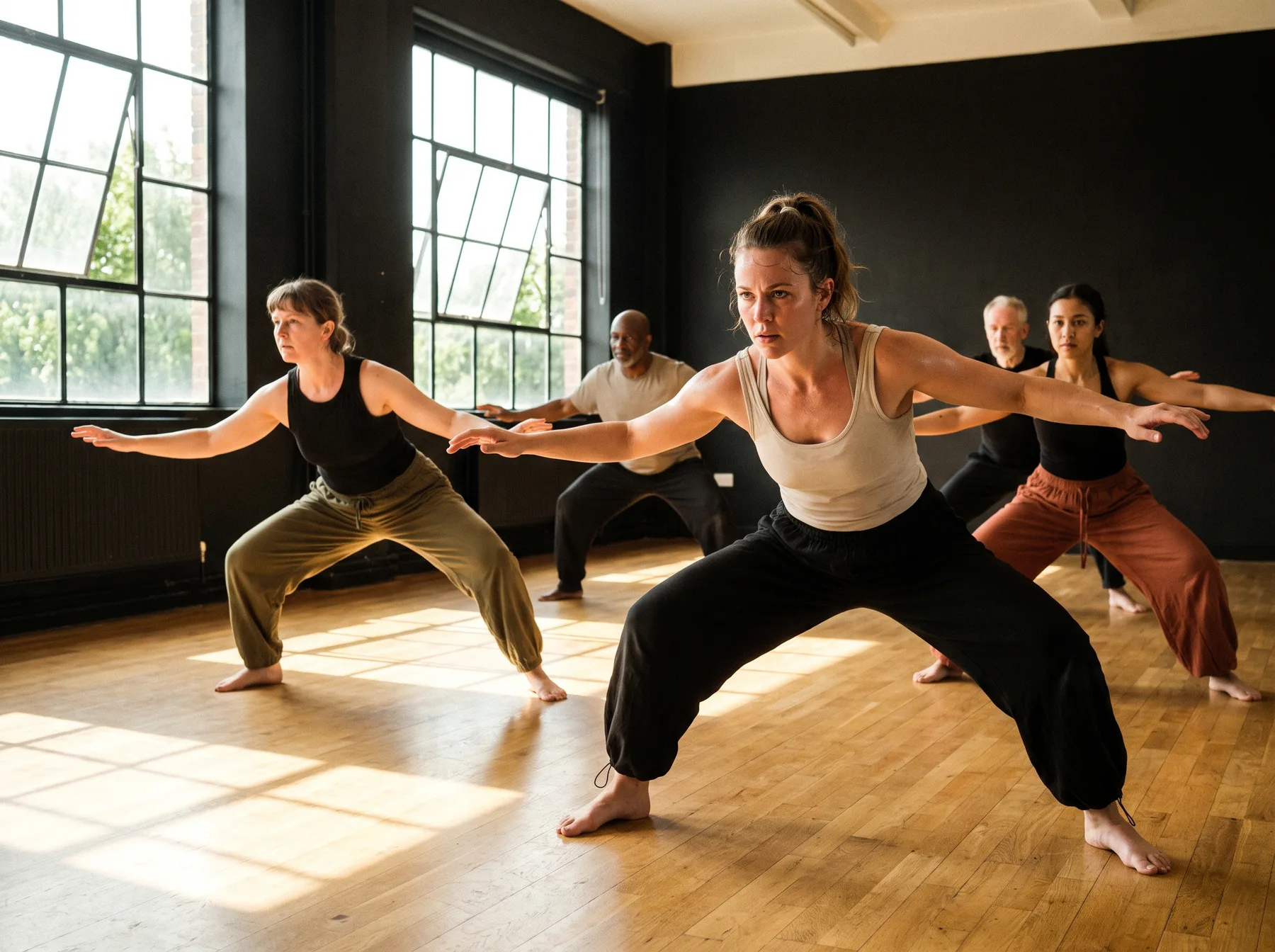
01
Stanislavski System
Konstantin Stanislavski, Russia
The system asks you to work out the circumstances, decide what the character wants, and do something about it. Read the scene for what is actually true in it, ask what this person wants and what they are doing to the other person to get it, cut the scene into small bits and give each bit one plain task. Then play the task in the circumstances and let the feeling turn up as a consequence rather than chasing it.
The reason nobody agrees what the system is has nothing to do with the work and everything to do with the books. He wrote in Russian; the Russian original of the first volume runs to roughly 575 pages and the English edition came out at 295, in larger type, two years before Russians could read any of it. English-speaking actors built a tradition on the shortened inner half. Jean Benedetti reunited both halves as An Actor’s Work in 2008.
Two pieces of vocabulary are worth correcting before you use them. He cut a scene into bits, not units, and gave each one a task; objective is his translator’s word and beat is nobody’s. And the common claim that he dropped emotion memory does not survive a look at the text: it is chapter nine of the manual he was still correcting when he died. What changed late in his life was how you reach it — through truthful physical action rather than by going after the feeling directly.
Who it suits: anyone who wants foundations. It is not a style but the grammar the other techniques are written in, which is why conservatories teach it first. What it demands: patience with a translation history, and the discipline to stop preparing and play the task.
The Stanislavski system — the full chapter →
02
Method Acting
Lee Strasberg, Actors Studio
Method acting is Lee Strasberg’s taught training system, run at the Actors Studio and at his own institute. It is a sequence, and the order is the part that gets lost. Relaxation comes first — you sit still in a chair. Then sense memory on ordinary things: a cup of tea, sunlight, a piece of fabric. Personal emotional memory arrives late and rests on everything before it. The private moment exercise sits in the same run.
Three different things share the name, and almost every argument about the Method is really an argument about which one is meant: Strasberg’s taught system, the loose American shorthand for psychologically detailed screen acting, and “going method” — the press description of staying in character off set. Only the first is a technique, and staying in character off set is not something Strasberg taught.
The student list is also less reliable than it looks. Marlon Brando trained with Stella Adler and resented the claim; Al Pacino is the clean case, studying with Strasberg and crediting him openly. On the question of psychological risk, our chapter grades the evidence rather than the reputation: there is a real precautionary consensus, and no actual measurement.
Who it suits: actors whose work is precise but bloodless and who want a graded route toward emotional material. What it demands: the sequence in order, and the knowledge that you never have to use your own trauma — declining is not a failure of nerve.
Method acting — the full chapter →
03
Stella Adler Technique
Stella Adler, New York
Adler’s technique starts from the script rather than from you. Establish the circumstances in detail, work out what the character is doing and why they are justified in doing it, and use your imagination to make all of it specific enough to affect you. Research is part of the job: she sent actors to books, paintings and history rather than to their own memories. The feeling arrives because the situation is vivid, not because you fetched it — and the character is supposed to be bigger than you are.
Her own contents page is the syllabus, and it runs in six parts: imagination, circumstances, actions, justification, character, text. A fact which has not passed through your imagination, she said, is a lie. Justification is the drill most worth stealing: take an action or a line and build circumstances that make it necessary.
The founding story is documented. She took leave from the Group Theatre, met Stanislavski in Paris on 3 July 1934 and worked with him for about five weeks, having told him his system made her hate acting. What she is constantly quoted as saying — that you must never use your own life — she did not say. She permitted your experience; what she refused was mining a memory for an emotion. Robert De Niro is a properly documented Adler actor.
Who it suits: actors whose imagination is their strongest muscle, or whose work has gone small and apologetic. What it demands: genuine appetite for text and research — and care, because two unaffiliated schools carry her name.
The Stella Adler technique — the full chapter →
04
Meisner Technique
Sanford Meisner, Neighborhood Playhouse
Meisner training removes your ability to plan and replaces it with attention on the other person. His definition of acting — living truthfully under imaginary circumstances — is the one the whole craft borrows, and his opening statement to a new class was that the foundation of acting is the reality of doing.
The front door is the repetition exercise: two actors face each other and repeat one plain observation until something real happens between them. With nothing to invent, attention has nowhere to go except the other person. Then comes a genuinely difficult independent activity, then a door, then a script. Emotional preparation exists, but it happens before the scene, it is imagined rather than remembered, and it is dropped the moment your partner does something.
He was one of the twenty-eight original members of the Group Theatre, founded in 1931, joined the Neighborhood Playhouse faculty in 1935 and ran its acting department until he retired in 1990. Unusually, the technique reaches us from the man himself: Sanford Meisner on Acting, published with Dennis Longwell in 1987, is a transcript of fifteen months of his own classes.
Who it suits: actors who live in their head, plan line readings, or feel dead opposite a scene partner. What it demands: a partner, and time — and text work brought from somewhere else.
The Meisner technique — the full chapter →
Meisner classes and studios — where the training is taught →
05
Uta Hagen Technique
Uta Hagen, HB Studio
Hagen’s technique is built on watching your own ordinary behaviour and then reproducing it on purpose. The object exercises are small solo studies — searching a room for something you have lost, waiting for someone, talking to yourself — and the instruction is to make them exact rather than expressive. It is the least mystical technique on this page, and the most usable alone tonight.
Then you ask six plain questions about the part: who am I, what are my circumstances, what are my relationships, what do I want, what is in my way, and what do I do about it. If you have seen nine numbered questions attributed to her, our chapter traces where they came from; six is what her own method runs on. The emotional material comes from your own life, carried across rather than swapped in — substitution, which she later preferred to call transference.
One fact reorganises everything else about her, and it is on the record twice. Respect for Acting came out in 1973 and became the standard American text; roughly a dozen years later she watched a student misapply it and told a journalist to throw it away, calling it superficial and mechanical. If a class hands you a photocopy, it is worth knowing which of her two books it came from.
Who it suits: self-taught actors building a practice alone, and anyone who wants something to do today. What it demands: exactness rather than expression, and the usual care with personal material.
The Uta Hagen technique — the full chapter →
06
Michael Chekhov Technique
Michael Chekhov, First Studio
Chekhov’s technique builds a character out of imagination and physical form instead of the actor’s own history. It is the one major psychological system here that never asks you to use your own life, and it is also the best documented: he set it out himself in To the Actor (1953) and On the Technique of Acting (1991), and both are still in print.
The arrow runs the opposite way from most training. Movement comes first and feeling arrives afterwards: the strength of a movement stirs the will, and the quality of that same movement conjures the feelings. The central tool is the psychological gesture, which he defines in seven words — the crystallised will, and therefore the objective. You give the character’s central want one large physical action, work it privately until it lives in you, then play the scene at ordinary size.
Around it sit the imaginary body (picture yourself taller, heavier, older — he is after what the body is made of as much as its dimensions), imaginary centres given a shape, colour and texture, atmosphere treated as a playable force, and radiating. He ran the Moscow Art Theatre’s First Studio, and in Hollywood was nominated for the Best Supporting Actor Oscar for Spellbound in 1945. Marilyn Monroe took private lessons with him and gave him a chapter of her own memoir.
Who it suits: physical and imaginative actors, character actors, and anyone for whom analysis deadens the work. What it demands: a responsive body, and tolerance for a vocabulary that our chapter traces to a specific source rather than leaving mysterious.
The Michael Chekhov technique — the full chapter →