
What it actually trains
Sanford Meisner was one of the twenty-eight original members of the Group Theatre, founded in 1931. He joined the Neighborhood Playhouse faculty in 1935 and ran its acting department until he retired in 1990.
In 1987 he and Dennis Longwell published Sanford Meisner on Acting, which is a transcript of his own classes over fifteen months. That is unusual. Most acting techniques reach us through students and interpreters, and this one has the man himself on the page, being impatient.
His opening statement to a new class was that the foundation of acting is the reality of doing. Everything else in the training is built to protect that one idea from the actor's urge to perform.
The repetition exercise, correctly
He called it the Word Repetition Game. It is the most famous exercise in American actor training and the most consistently mis-described, and the error is in the middle stage.
Mechanical repetition
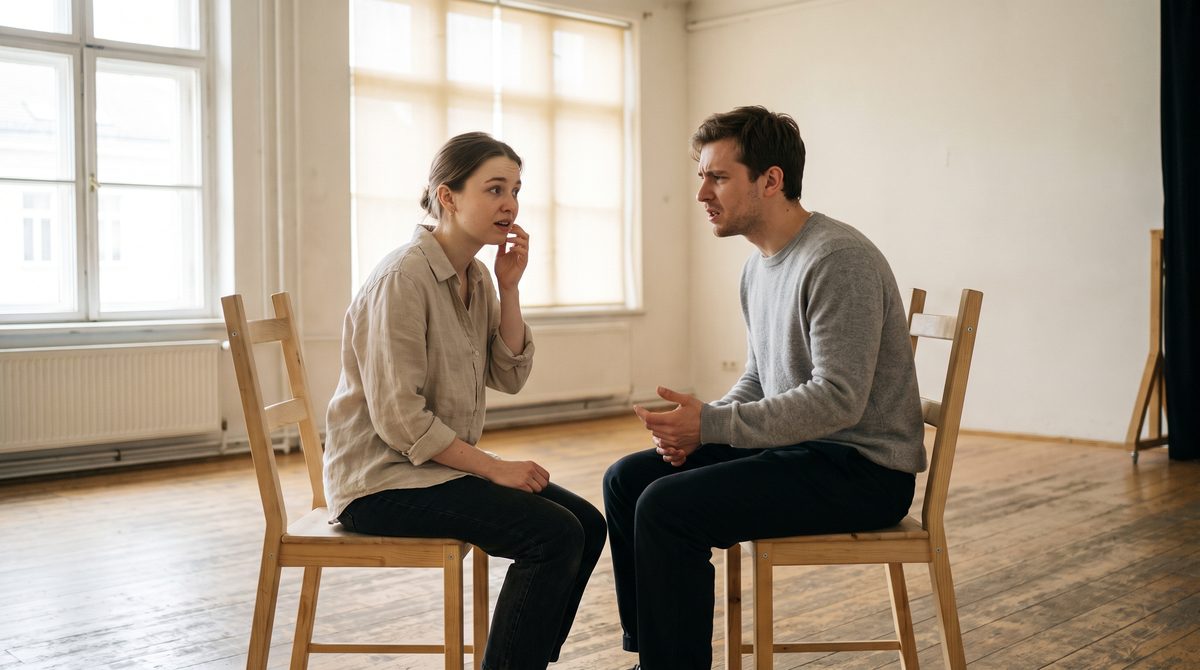
One actor states a plain physical observation. The other repeats it back, identically, and they keep going. No colour, no meaning, no attempt to be interesting. Meisner's own description was that it is mechanical and inhuman, but it is the basis for something.
The observation must be straight and unadulterated. If you decorate it, you have started acting, and the exercise has stopped working.The same words, from your point of view
The grammar flips. “You are smiling” comes back not as “I am smiling” recited, but as your own statement about what you see. Meisner's line to a student was that this is already human conversation. The moment it flips, it becomes contact between two people.
This is the stage that gets reported wrongly almost everywhere, and it is the hinge of the whole exercise.The words change when the behaviour changes
You keep repeating until something your partner does sets up an impulse in you, and then what you say alters because of them rather than because you decided to make it interesting. The change has to be caused, not chosen.
If he thought a student had deviated on purpose to liven it up, he stopped the exercise and made them start again. He had a word for it: readings.Most people find their first repetition session embarrassing. That is roughly what is meant to happen. The exercise strips out clever dialogue, a character to hide behind and any way of knowing what comes next, and leaves you looking at somebody who is looking back.
What it makes visible is how much of ordinary acting is generated rather than received. The discomfort is the sound of a habit being interrupted, and for most people it passes within a few sessions.
Where repetition leads
Repetition is the first exercise, not the technique. The book's own running order shows what it is a foundation for, and the arc is more structured than its reputation for spontaneity suggests.
The three stages above. Attention leaves your own performance and attaches to another person.
His name for the principle underneath everything: the size of your reaction is set by what was done to you, not by what you decided the moment deserved. A small pinch gets a small ouch.
One actor takes on a physical task while the repetition continues. His instruction was to choose something above all difficult, if not almost impossible, with a reason it must be finished.
The point is not stage business. It is that a genuinely urgent task occupies the part of you that would otherwise be monitoring your own acting.
One actor is inside with the activity. The other has a reason to come in. There is a detail here that most summaries leave out: the person knocking has to reach an energy that actually interrupts the activity before the door gets opened. The entrance has to be earned.
His chapter is called “In the Harem of My Head”, and a later one “Quick As Flame”. This is the solo emotional work, and it is the part of the technique most often described backwards. The next section is about it.
His chapter title is “The Magic As If”. This is where a specific personal or imagined equivalent gets attached to something in the text, so that a written line rests on something real to you.
Only now. Scenes from contemporary plays, with everything above still running underneath. The book ends here, fifteen months after it started.
The part everyone gets backwards
Here is the standard contrast: Strasberg goes inward to personal memory, Meisner goes outward to the partner. The interesting objection is that Meisner has private emotional work too, so the contrast must be overstated. That objection is wrong, and we were about to publish it.
Meisner's preparation is a daydream. You imagine something vivid enough to move you, and you arrive at the door already emotionally alive. It is not a recollection of something that happened to you.
The distinction that actually holds
Two kinds of private preparation
Both traditions ask an actor to do something alone before the scene. What they ask for is not the same thing, and the difference is the whole argument between them.
There is a smaller true version of the objection worth keeping. Preparation is private, solo and emotional, so it is fair to say Meisner is not a purely external technique. But the source of the material is the argument, and on that the book is unambiguous.
Where the internet's Meisner comes from
This technique has an unusually good primary source, sitting in print since 1987 and available second hand for a few pounds. Almost nothing written about it draws on that source.
Who actually trained with Meisner
The alumni list circulates widely and it has four names on it that do not belong, one of which appears on a public broadcaster's own page.
You will read that Duvall, Dustin Hoffman, Gene Hackman and James Caan all trained together under Meisner. Duvall and Caan did. Hoffman and Hackman trained at the Pasadena Playhouse, on the other side of the country, and Hoffman later studied with Strasberg after being rejected by the Actors Studio several times.
The real connection is better than the legend. Duvall and Hoffman shared a flat in New York and appeared on stage together. That is where the story comes from, and it has been tidied into a training anecdote it was never about.
Can anybody certify a Meisner teacher?
No. This turned out to be the most practically useful finding on the page, because a great deal of money changes hands on the strength of claims that cannot be checked.
Acting training is largely unregulated. There is no register, no licence and no external body with authority over who may teach this technique or call themselves qualified in it.
The one independent credential we found is that the Neighborhood Playhouse holds accreditation from the American national association for theatre schools, first granted in 1994 and reviewed most recently in 2024. That is real, and it is worth understanding exactly what it covers.
It accredits the institution. It does not evaluate whether the Meisner teaching there is good, and it says nothing whatever about any other school.
Ask how often you will actually be on your feet. Repetition is learned by doing it with a partner, and a class where you work twice a term is selling you a seat, not training. Ask how partners are assigned, and ask what the teacher does when an exercise overwhelms somebody.
Then watch a class before you pay. Watch how the least confident person in the room gets treated, because that is the only reliable information available and it costs nothing.
Does it work?
Nobody has established that, and it is worth being precise about why. The problem is not that the answer is no. It is that the study has never been done.
How intense is it, honestly?
Repetition is confrontational by design, and there is no research telling us what that does to people. Both halves of that sentence matter.
The best account of the exercise's character comes from a research thesis on the technique, which describes two partners observing each other out loud with nothing off limits, and calls it an authenticity boot camp. Its author records being deeply embarrassed, and also humbled and inspired.
That is the intended experience for most people, and the embarrassment usually passes. Some people find it more than embarrassing, and nobody has measured how often or for whom.
There is no published evidence that repetition harms anyone, and we are not going to imply there is. It does not ask for your history, it does not ask for a traumatic memory, and its emotional preparation is explicitly imagined rather than recalled. On the specific question people worry about, this technique asks less of your private life than several others do.
The risk it does carry is a teacher problem, not a technique problem. An exercise built on unguarded observation can be run badly, and honesty can be used as cover for something else.
The self-tape problem
This technique has one structural difficulty in the current industry, and it is worth naming plainly rather than pretending the training solves everything.
The unit of Meisner work is two people. Repetition is not a solo exercise and cannot be made into one. A self-tape frequently removes the second person, or replaces them with somebody reading flatly from a laptop.
Michael Caine put the on-camera version of the principle better than anyone teaching it: you take it off the other actor's face, and that can only come from serious listening. He had no Meisner training at all, which is rather the point.
If the training says everything comes from the other person, then a reader who gives you nothing has removed the thing you trained for. Ask for presence and real cues, not a performance competing with yours.
Close enough to the camera that the relationship is visible in your eyes. The whole value of what you are doing is that a close-up can see you receiving.
Do the imagined preparation before you press record, then drop it. Holding onto it across a take is the failure mode this technique names most clearly.
An objective survives multiple takes in a way that a preserved feeling does not. This is also what makes eight matching takes possible.
If nearly all your auditions are solo tapes, the skill decays without you noticing. It has to be practised with a person who can surprise you.
Framing, sound, continuity and hitting a mark are still required. Listening well on a badly lit tape is still a badly lit tape.
Where the sources disagree
Every page on this course ends here. On this one the primary source is unusually clear, and most of the disagreement is between that source and everybody quoting it.
Is Meisner's preparation a kind of emotional memory?
Commonly saidYes, which shows the contrast with Strasberg is overstated.
What we foundNo. It is an imagined daydream, and his book states that emotional memory plays no role in his system.
What is the second stage of repetition?
Commonly saidA switch into “I feel”, “I think”, “I want”.
What we foundA change of viewpoint on the same observation. The listings site that supplied the popular version cites nothing.
Is the technique a two-year course?
Commonly saidTwo years, as Meisner designed it.
What we foundThe two-year shape is the Neighborhood Playhouse's. The only structure Meisner documented is fifteen months of classes.
Is Meisner safer than the Method?
Commonly saidYes, because the emotional work is bounded.
What we foundNobody has compared them. The argument is reasonable and completely untested, and the risks are different rather than measured.
Who trained with Meisner?
Commonly saidDuvall, Caan, Hoffman, Hackman, Grace Kelly and a long further list.
What we foundDuvall and Caan yes. Hoffman and Hackman were at the Pasadena Playhouse. Grace Kelly and three others do not belong on the list.
Does it suit screen acting particularly well?
Commonly saidYes, and it is the reason to choose it.
What we foundA good argument, made almost entirely by people who teach it. Meisner appears never to have said it.
Can a teacher be certified in it?
Commonly saidLook for a designated or authorised teacher.
What we foundNo external body certifies anyone. At least four organisations each claim to be the only authentic one.
A last word
The strangest thing about this technique is how well documented it is and how little that has helped. The man wrote down what he did, in his own irritable voice, with his students arguing back on the page. It is still in print and it is not expensive.
Nearly everything you will read about it instead comes from people with a class to fill. That is not a conspiracy, it is just what fills a search engine, and the remedy costs less than one session of most of those classes.
Find one person. Notice one true thing about them. Say it, and let them change what you say next.