What the technique actually is
This is the one major system in this section that never asks you to use your own life. It is also the best documented. Chekhov set the whole thing out himself, twice, and both books are still in print. To the Actor came out in 1953 and On the Technique of Acting in 1991. Almost every online guide describes the technique without quoting either of them.
So here are four things in his own words, which is a low bar that most of the field fails to clear.
The practical consequence is simple. Strasberg asks what in your life resembles this. Chekhov asks what image, shape or action would produce it. You do not need to have lost anyone to build a gesture for grief.
That makes him the fourth founder in this section to walk away from emotional memory, and the most thorough. Stanislavski dropped it. Adler thought it too small. Meisner redirected attention to the other actor. Hagen rebuilt substitution into something safer. Chekhov simply built a full toolkit that never needed it.
The Psychological Gesture, from the book
This is the most searched item on the technique and the most badly described. It has a chapter to itself — chapter five of To the Actor — and the fullest account of it did not reach English readers until the 2002 edition, which added a previously unpublished appendix translated by Andrei Malaev-Babel.
Not the want in this scene. The thing the character keeps trying to make happen from beginning to end.
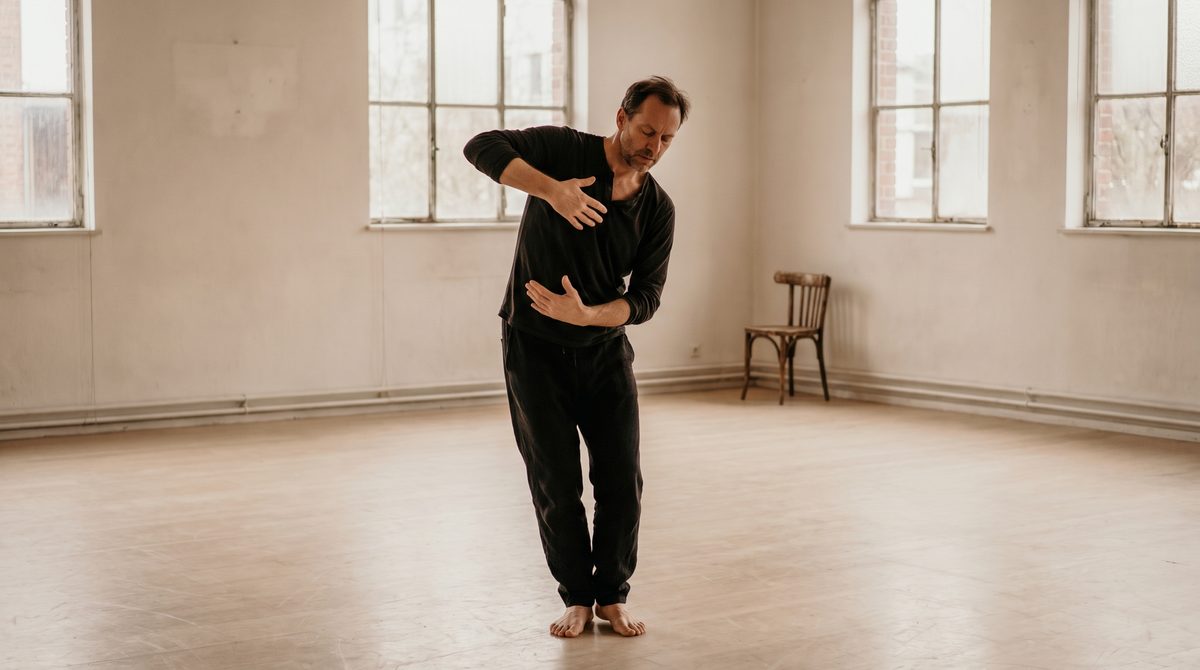
Chekhov taught around eleven basic ones: push, pull, lift, embrace, penetrate, tear, wring, smash, open, close and throw. Almost every human want is a version of one of these. Pick the one that fits and resist the urge to invent something clever.
Full size, whole body, with a clear beginning and a clear end. It should be too big for any stage. That is the point of doing it alone.
Moulding, floating, flying or radiating. The same push means something different depending on which one you use, and the quality is what carries the feeling.
This is the step every summary gets wrong, including the mockup this page replaces. You go back and forth between the gesture and the scene until the gesture has gone inside the acting. It fades by absorption, not by being switched off.
One more thing about the neat five-step lists you will find, this page's included. The list is a teaching device, not Chekhov's own format. He wrote in continuous prose about a practice, and the numbered steps are a later convenience. Useful, but do not go into a class believing he issued a checklist.
The rest of the toolkit, and what gets flattened
Four tools travel alongside the gesture. Each of them loses something in the retelling, and in one case two separate ideas have been merged into one.
Chekhov taught four feelings that are supposed to underlie everything else, sometimes called the Four Brothers: a feeling of ease, a feeling of form, a feeling of beauty and a feeling of the whole. Ease is treated as the most important of them. It is a standing instruction that the work should never look like effort.
It is a core part of the technique and it is missing from most of the popular summaries, including the draft this page replaces. If a teacher mentions the Four Brothers and you have only read the blogs, you will not know what they mean.
Why the language sounds mystical
Because the foundation is genuinely spiritual. Chekhov joined the Russian Anthroposophic Society, probably in 1919, after meeting the Symbolist writer Andrei Bely, whom he called his Teacher. He then built his technique in accordance with Rudolf Steiner's ideas. That is not a rumour and it is not an attack.
It is also why he had to leave. In 1926 actors in his own company denounced him as an idealist and a mystic. By 1928 the Ministry of Education wanted him to stop spreading Steiner's ideas, the Moscow press had called his work alien and reactionary, and he was under serious threat of arrest. He left Russia and never returned.
So the higher ego, the etheric quality of the imaginary body, radiating and receiving — the vocabulary that makes new students uneasy — comes from somewhere specific. You are entitled to know that, and most teaching does not tell you.
The useful conclusion for you is small and practical. You can use every exercise on this page without holding any spiritual belief whatever. The next section explains why they might work anyway.
Who actually studied with him
Every guide to this technique carries a list of famous students, and the list is the clearest evidence that nobody is checking anything. We went through the standard names one at a time.
A handful of other names — Patricia Neal, Jack Palance, Ingrid Bergman, Gary Cooper among them — are repeated widely and are plausible, but we could not find a memoir or interview behind each one. We have left them out rather than pass them on.
He was also a considerable actor himself, which the lists rarely mention. Stanislavski called him the most brilliant actor in all Russia and put him in charge of the Moscow Art Theatre's First Studio. In Hollywood he was nominated for the Best Supporting Actor Oscar for Spellbound in 1945, playing the psychiatrist. He lost to James Dunn.
Grading what is written about him
This is the twenty-ninth research brief we have checked in this course, and this one produced three new examples of a pattern we have now seen eighteen times: a claim that reads as scholarship and turns out to be somebody's coursework.
Does it work?
The brief we were given argued that Chekhov has more evidence behind him than Strasberg, Meisner or Adler. We would like that to be true and it is not.
There is one scholarly article of the relevant kind, published in a theatre journal in 2007, which reads his imaginary-body work through both his own spiritual framework and Buddhist ideas of non-self. It is thoughtful and worth reading. It is also a theory paper, not an experiment. The physiological material in it comes from unrelated mental-imagery research borrowed to support an argument.
If you do not picture things
This is the most imagination-dependent technique on the site, so it needs a caveat the guides never give.
Roughly one person in a hundred forms no voluntary mental images at all, and around three in a hundred form only faint ones. The best current estimate comes from a study of over nine thousand people. If you are one of them, no amount of trying harder will make the imaginary body appear. That is a difference in how minds work, not a failure of commitment, and a teacher who treats it as a failure is wrong.
The good news is that this technique has an unusually clear back door. The gesture, the qualities of movement and the physical centre are all things you do rather than things you see. Choose a posture, put your weight somewhere new, make the action large and let the sensation lead. You will get most of the way there without a single picture.
What to take from it
Almost no one does, and it is the entire advantage available here. One afternoon with To the Actor puts you ahead of most of what you will be told about it.
Push, pull, lift, tear, close. The temptation is to invent something subtle, and subtle gestures do nothing. The crude ones work.
Gesture, scene, gesture, scene. If you do it once and then try to perform, you have skipped the part where it goes inside you.
The one tool that survives a close-up. Where you move from changes the head, the neck and the eyes, and in a self-tape those are all the frame contains.
Thirty seconds of deciding what the room is will change how you take the reader's lines. It costs nothing and it is the cheapest tool on this page.
This technique produces scale, and scale is exactly what a close-up punishes. Build large in the room, then play it at the size of a conversation.
Where we differ from the standard account
Did Meryl Streep study with Michael Chekhov?
Commonly saidYes, along with Robert De Niro and Anthony Hopkins.
What we foundNo. She was six years old when he died, De Niro was twelve, and Hopkins was a teenager in Wales who later read the book.
Do you stop doing the gesture before you act?
Commonly saidBuild it, then drop it completely.
What we foundHe says to alternate between the gesture and the acting until it is absorbed. And in non-realistic work it need not disappear at all.
Is the imaginary centre one idea?
Commonly saidYes — move from somewhere other than your middle.
What we foundTwo. The Ideal Centre in the chest comes first and is about command of your own body. Imaginary Centres come later and carry shape and colour.
Do the four qualities come from Steiner's Eurythmy?
Commonly saidStated as fact.
What we foundProbable but not established. It rests on one author with a stake in the claim, and the main scholarly treatment of these exercises never mentions it.
Has the spiritual foundation been hidden?
Commonly saidQuietly removed by modern teachers.
What we foundAbsent from marketing copy, thoroughly present in the scholarship, and openly discussed in the trade press since at least 2005.
Is there strong evidence this technique works?
Commonly saidMore than for the American methods.
What we foundOne theory paper and no study of Chekhov-trained actors. The evidence is for the mechanism, not the training.
Can you get certified in it?
Commonly saidYes, through a certified teacher-training programme.
What we foundTwo organisations certify their own teachers and no outside body accredits either. Certified means certified by them, which may be fine, but know what you are buying.
Read chapter five. Choose one plain action for what your character wants, do it far too big in a room on your own, then play the scene and do it again. That is the whole technique, and it is older and better attested than almost anything written about it.