Three different things share the name
This is the first thing to sort out, because almost every argument about method acting is really an argument about which of the three someone means.
A sequenced set of exercises, taught at the Actors Studio and the Lee Strasberg Theatre & Film Institute. It has a running order, named exercises and a literature. This is the only one of the three that is a technique.
Used for psychologically detailed American screen acting in general. People say it about actors who trained with Adler or Meisner, or who never trained at all. It is a style label, not a curriculum.
Staying in character off set, refusing your own name, transforming your body, being difficult with colleagues. This is a media phenomenon attached to individual actors. It is not an exercise and it is not in the syllabus.
Someone says the Method is dangerous; they mean the third one. Someone else says it produced the best screen acting of the century; they mean the second one. A teacher says it starts with relaxation; they mean the first one. All three can be right at once, and the conversation still goes nowhere.
For the rest of this page, “the Method” means the first one — Strasberg's taught system. Where we mean one of the others, we will say so.
What is actually taught, in order
The clearest published account of the running order comes from Lola Cohen, who taught at Strasberg's own institute. Her Method Acting Exercises Handbook follows the sequence he used in class.
The order is the part that gets lost. Popular summaries jump to the memory work, which arrives late and rests on everything before it. Read in order, the technique looks far more ordinary than its reputation.
Relaxation
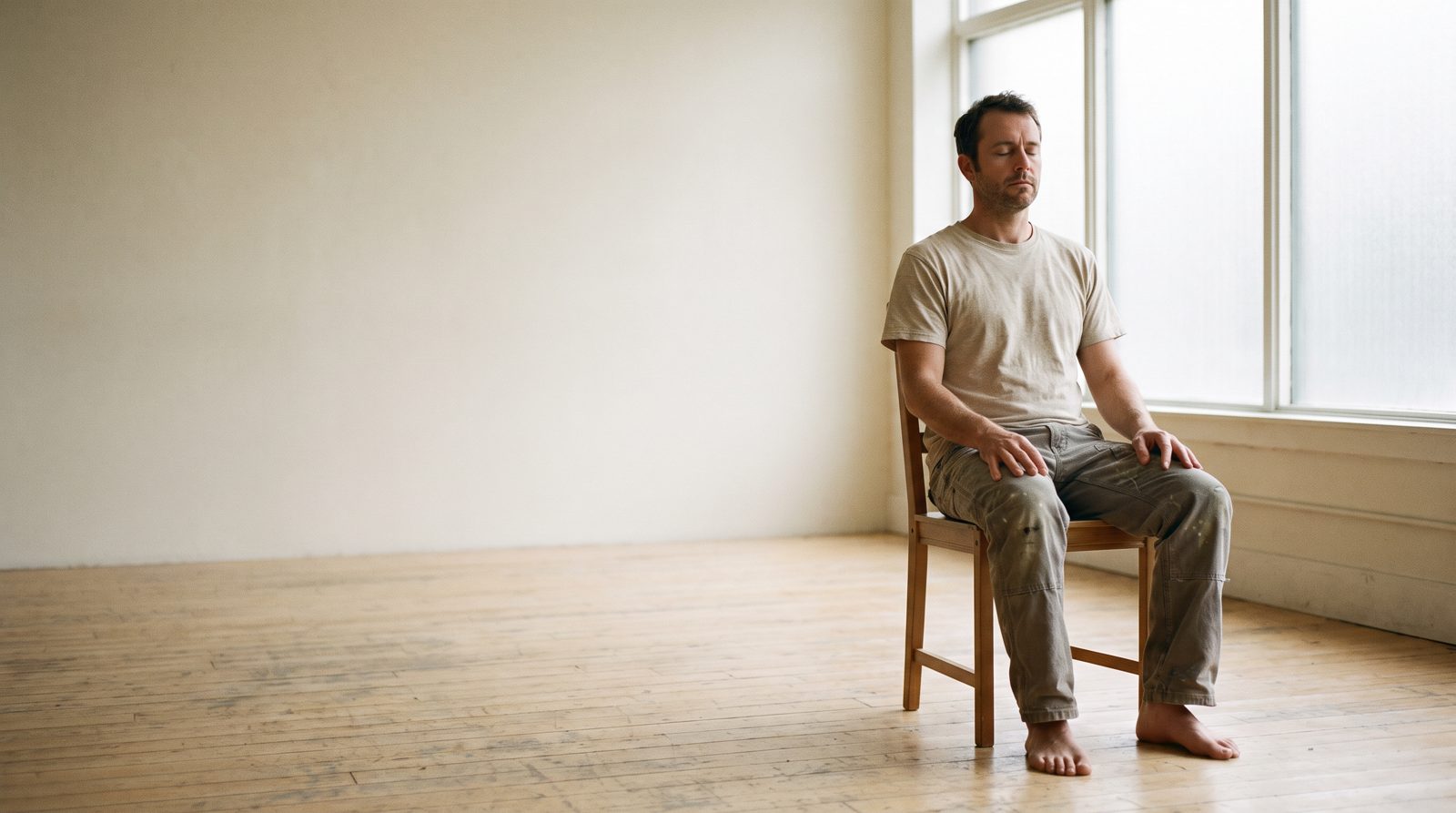
You sit in a straight-backed chair without arms and work through the body, releasing tension you did not know you were holding. Cohen is explicit that this comes before everything, in class and before a performance.
Strasberg called relaxation and concentration the two sides of the acting coin. Concentration is not a separate stage — it is the faculty every later exercise trains.Foundation sense memory
Recreating ordinary sensations without the object present. A breakfast drink. A mirror, and shaving or make-up. A sharp taste, a sharp smell, three pieces of material, sunshine, sound, taking off your shoes. Then overall sensations such as a shower, extreme cold, or strong wind.
This is the bulk of the training, and it involves nothing personal or distressing. It is a cup of tea, done with total attention.Advanced sense memory
Personal Object, then Place, then Private Moment. Each builds on the last, and Place is what Private Moment is built on. Only after these does Emotional Memory appear, followed by exercises combining several at once.
The order here matters more than anything else on this page. The intensity rises gradually, and the exercise everyone worries about sits near the top of a ladder.Character development
The Animal exercise, in which behaviour is found from the outside, plus improvisation and script analysis. This is the part of the Method that works nothing like the caricature of it.
Presence
Song and Dance, an exercise designed to interrupt an actor's habits by making the usual defences useless. It is uncomfortable in a way that has nothing to do with personal history.
Strasberg's own institute lists five components publicly: sensory exercises, relaxation, script analysis, improvisation and affective memory. Two of those five are not emotional at all.Cohen writes that it is vital to stop work immediately when a potential loss of control is observed, and that teachers should supervise these exercises carefully. That instruction comes from inside Strasberg's own tradition, from someone who taught at his institute.
This matters for how you read the safety argument further down. The tradition is not indifferent to the risk. A class that treats distress as the goal is departing from its own source material, not following it.
What his own teacher said about him
The standard story is that Strasberg caught Stanislavski early and never updated. There is a much better version of that argument, and it comes from the man who actually taught him.
Strasberg saw the Moscow Art Theatre on its American tour, which opened in January 1923, and it settled what he was going to do with his life. He then enrolled at the American Laboratory Theatre and studied with Richard Boleslavsky and Maria Ouspenskaya, both former Moscow Art Theatre actors.
The Library of Congress chronology of Strasberg's own papers dates this to 1924. The scholar Sergei Tcherkasski dates it to January 1924. What Boleslavsky taught was the early conception of the system, in which affective memory loomed large.
The better evidence was available the whole time, and it is stronger. Boleslavsky himself thought Strasberg over-emphasised emotion memory at the expense of dramatic action. That is not a later scholar's reconstruction. It is the teacher's verdict on the pupil, formed at the time.
One more detail worth stating plainly. Strasberg never studied with Stanislavski and never met him. Everything reached him second hand, through two teachers, in New York. The argument about what he did with it depends on that gap being real.
Why the inward half arrived first
There is a real transmission problem behind all of this, and it is sharper than the usual version. It is not that Stanislavski was translated late. It is the order in which the two halves reached anybody at all.
- 1924Strasberg begins at the American Laboratory Theatre, learning the early system second hand.
- Early 1930sStanislavski develops the method of physical action, working from the body toward feeling.
- 1935–38Runs the Opera-Dramatic Studio and teaches the system in its final form. Active Analysis belongs to these last years.
- 1938Dies on 7 August, fourteen years after Strasberg's training, with the work still unsettled.
- 1936An Actor Prepares appears in English. The inward half, alone.
- 1938The Russian original of that same half is published — two years after the English. English readers got it first.
- 1949Building a Character, the physical half, finally appears in English. The Method has already set.
- 2008Jean Benedetti reunites both halves as An Actor's Work, the way they were meant to be read.
The other much-repeated story is Stella Adler's. In 1934 she spent five weeks studying privately with Stanislavski in Paris, with Harold Clurman, and came back reporting that he now emphasised action and circumstances over emotion memory.
Strasberg is reported to have responded that he taught the Method, not the System. Two cautions on the popular telling. Clurman was there too, so Adler was not the only Group Theatre member to meet him. And scholarship generally reads Stanislavski as having subordinated emotion memory rather than abandoning it.
How well sourced is what you have read?
This is the section that made the page worth rebuilding. Method acting is the most discussed technique in the field and one of the worst sourced, and our own brief was carrying the problem.
Who actually trained with Strasberg
The famous names attached to the Method are mostly attached wrongly, and the mistake runs through otherwise reputable sources. It is worth going through them one at a time.
“Studied Strasberg” and “studied with Strasberg” are not the same claim. His institute has taught thousands of people since 1969, and he died in 1982. One widely shared list of actors who studied Strasberg includes someone born in 1984.
If a page names a famous actor as proof that the technique works, check which of the two it means, and check the dates. It is a fast test and it catches a great deal.
Daniel Day-Lewis is the most useful name here, because he is now on the record about the label itself. In October 2025 he told the New York Times that he is a little cross to hear people saying someone has gone full method, which he takes to imply that the person is behaving like a lunatic.
He is the actor the press means when it says method acting, and he has no relationship to the technique this page describes. That is the three-definitions problem in one person.
Staying in character, and the stories about it
This is the biggest single misconception, and the anecdotes that sustain it are in worse shape than the technique is. We checked the most-repeated ones.
Look at what that table actually contains. The most famous cautionary tale is denied by the family. The most famous rebuke is disowned by the man it was aimed at. The one genuinely serious case of harm involved no Method exercise at all.
The best statement of the principle comes from Strasberg's institute, from his son, who runs it. The technique is designed to be engaged and then stopped, and you do not continue the reality afterwards. He is an interested party, and it is still the clearest sentence anyone has written on it.
Is it dangerous? The honest answer
This is the question most people arrive with, and it deserves a careful answer rather than a reassuring one or an alarming one. Here is exactly what exists.
An exercise that reliably produces distress is not malfunctioning. That is what it was built to do, and every teacher in the tradition knows it. Whether repeated distress of that kind causes lasting harm is the part nobody has studied.
Both sentences are true at once, and most writing on this subject picks one and pretends the other is settled.
If you are asked to do one
You may say no. You do not owe a class an explanation, a diagnosis or a piece of your history, and declining is not a failure of commitment. A responsible teacher will have another route ready.
Ask what the exercise is for before you do it. Ask whether you can use invented material rather than your own. Ask whether there is a step at the end for coming out of it, because a class that ends the exercise and goes straight to notes has left something out.
Ellen Burstyn, who trained with Strasberg himself, put the frame better than anyone: your children are not in jeopardy, it is a chair and an imagined child. That is the working actor's version of the stop rule in Cohen's handbook.

Does it work better than anything else?
Nobody knows, and the reason is simpler than you would expect. The comparison has never been made.
There is no randomised trial, no quasi-experimental comparison, and no blinded study rating Method-trained actors against actors trained any other way. The absence is total, and it applies to every acting technique, not only this one.
What does exist is a handful of small brain-imaging studies of what happens while somebody acts. One found a pattern consistent with a reduced sense of self during in-character performance, which is interesting and says nothing about training.
What to take from it
The useful part of the Method is the part that never appears in a headline, and you can use it tonight without going near your own history.
Sit in a straight-backed chair and go through the body releasing held effort, particularly the jaw, tongue, neck and shoulders. On camera these are exactly the places a close frame reports on. This is step one of the actual technique and it costs nothing.
A cup of tea. Sunlight on your arm. The texture of a coat sleeve. Recreate it without the object there. The point is training attention to hold a specific thing, and the duller the object the better the training.
An analogous situation you have made up can be as specific as one you lived through, and it comes with no cost attached. Specificity is what does the work, not authenticity of source.
What are you trying to make the other person do? A playable verb will get you further into most scenes than any amount of internal preparation, and it survives multiple takes.
This is Meisner's contribution rather than Strasberg's, and it is the fastest correction available to an actor stuck inside their own head. What you receive should change what you do.
Whatever you use to get in, have something deliberate for coming out: change your clothes, walk, ring somebody, say your own name out loud. The tradition itself says the work is engaged and then stopped.
These exercises were designed for a supervised room with a teacher watching. A self-tape is the opposite: alone, unsupervised, repeated across many takes, and followed by nothing at all. Nobody is there to see you stop.
A tape also needs repeatability. You may need eight takes that match, and a technique built on recreating one intense emotional event is a poor fit for that. Release the tension, make the circumstances specific, choose an action, connect to your reader. That sequence survives eight takes.
Where the sources disagree
Every chapter on this course ends here. On this one, most of the disagreement was between our research brief and the historical record.
When did Strasberg train, and with whom?
Commonly said1923 to 1925, catching an early snapshot of Stanislavski.
What we found1924, at the American Laboratory Theatre with Boleslavsky and Ouspenskaya. No source gives an end date, and he never met Stanislavski.
Did he misunderstand Stanislavski?
Commonly saidHe distorted the system by fixating on emotion memory.
What we foundHis own teacher said he over-weighted it. But he was faithfully developing what he was taught, and half of Stanislavski's book was not in English until 1949.
Is the Method dangerous?
Commonly saidThere is a documented risk profile.
What we foundNo study has measured harm. There is a 38.7 per cent survey signal, a strong precautionary consensus, and one small study pointing the other way.
Does the Method mean staying in character?
Commonly saidYes, and the horror stories prove it.
What we foundIt is not in the syllabus. We could find no statement from Strasberg himself either way, so we are calling that an inference rather than a quotation.
Was Brando the Method's great success?
Commonly saidThe paradigm case, and taught by Strasberg.
What we foundHe trained with Stella Adler and was angry at being claimed. Reputable film references get this wrong.
Does it produce better acting?
Commonly saidLook at the alumni.
What we foundNo comparison of acting techniques has ever been run. A selective school's alumni tell you about its admissions, not its teaching.
Should you train in it?
Commonly saidEither it is the serious choice or it is a liability.
What we foundNeither. Judge the room and the teacher, not the brand, and remember that two of the five components his institute lists are not emotional at all.
A last word
The Method deserves better treatment than it gets from either side. It is not a cult and it is not a shortcut to greatness. It is an old, careful, well-organised training system with one contested exercise near the end of it and a great deal of quiet sensory work before that.
What it does not deserve is the standard of evidence currently applied to it. A technique this widely taught should not have its central claims resting on anonymous uploads and quotation websites.
Sit in the chair. Release the jaw. The rest is optional, and it always was.