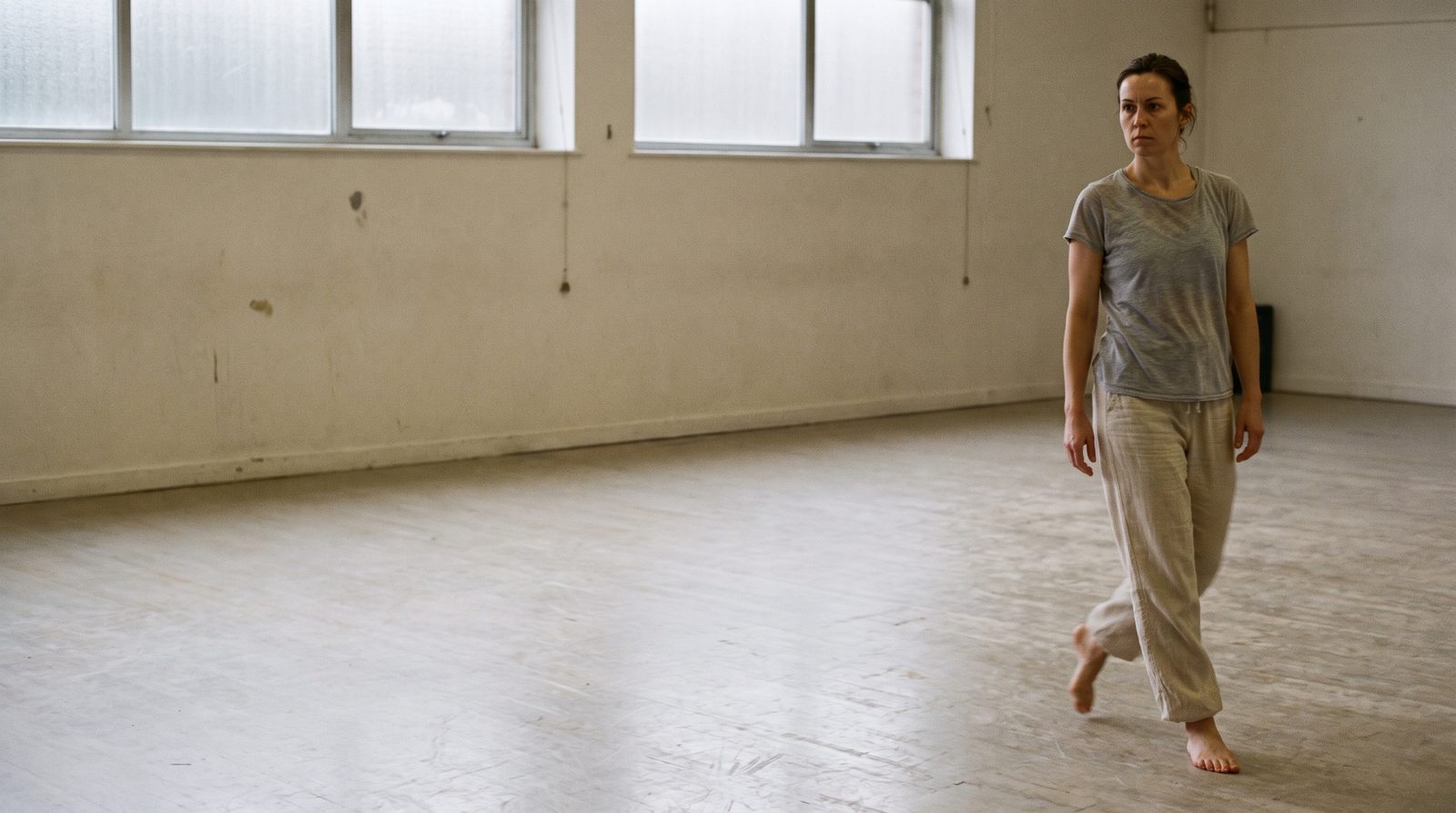
The four dials
This is the useful part and it takes about a minute to learn. Every movement can be described by where it sits on four sliding scales, and Laban called each scale a motion factor.
Space. Does this person go straight at what they want, or circle, scan and arrive at it sideways?
Time. Do they answer immediately, or let a thought stretch out before anything happens?
Weight. Do they press into the world, or barely disturb it as they pass through?
Flow. Is the energy held and checkable at any instant, or allowed to keep travelling once it starts?
Laban's own word for the resisting end of each scale was fighting, and for the yielding end indulging. Strong, direct, quick and bound are the fighting attitudes. Light, flexible, sustained and free are the indulging ones.
The eight named actions, and why they matter less
Combine three of the four factors and you get the eight Basic Effort Actions. Everyone memorizes these, and they are the least useful thing on the page.
They come from Weight, Space and Time only. Two options each, three factors, eight combinations. Laban set them out in Effort, written with the management consultant F. C. Lawrence and published in 1947.
Punch — direct, quick, strongPress — direct, sustained, strongSlash — flexible, quick, strongWring — flexible, sustained, strongDab — direct, quick, lightGlide — direct, sustained, lightFlick — flexible, quick, lightFloat — flexible, sustained, light
Notice what the eight words describe. Punching, pressing, wringing, gliding, dabbing: these are things done to material. The taxonomy came out of watching people work, in factories, which is where Laban and Lawrence developed it.
That is why the dials beat the names. You can make a character more sustained without performing an entire Wring, and one adjusted factor will do more for a scene than a correctly executed named action.
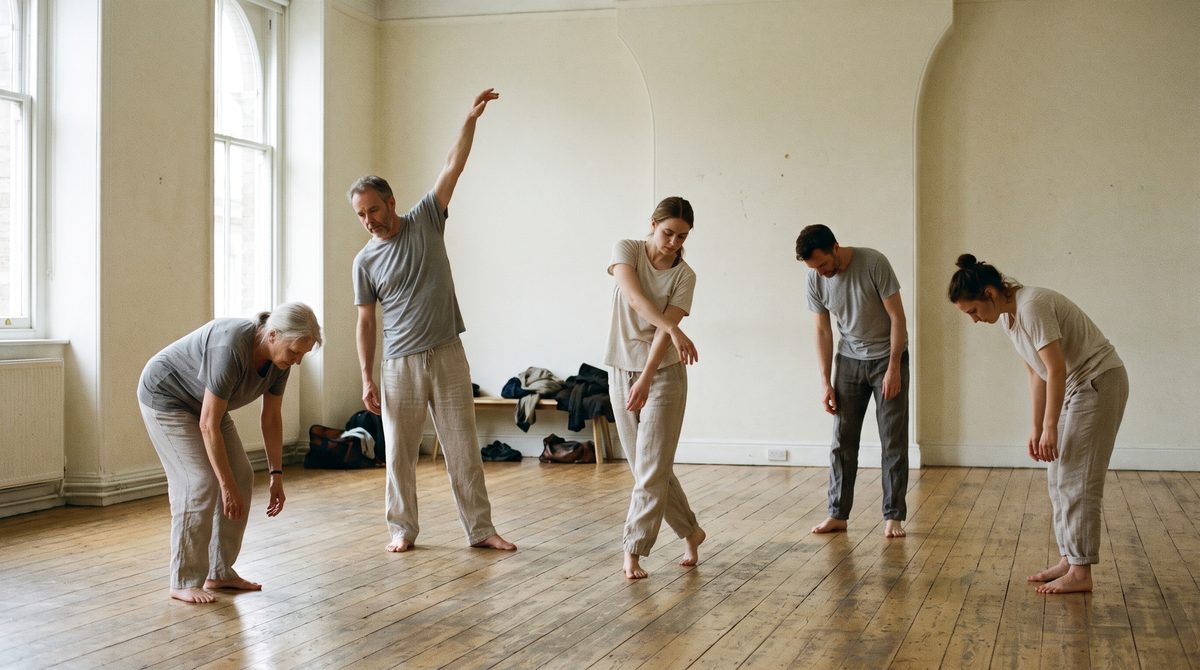
The part actors use is the part nobody agrees on
Here is the finding that changes how you should hold all of this. Laban's system has been measured, in three separate settings, and the same result comes back every time.
In 2019 a study in a psychology journal asked eighteen certified movement analysts to code forty-five video clips. These were qualified specialists, some with twenty-five years of experience, trained by the main institute.
Agreement was calculated for each part of the framework. The geometric parts held up reasonably. The expressive part did not.
The same pattern shows up twice more, from completely different directions. A machine-learning study classifying movement from skeleton data scored almost perfectly on Body and Shape and dropped to 0.62 on Effort. Effort is the hardest thing for a computer too.
And a 2021 study of ordinary viewers found that how legibly an Effort reads varies enormously: Sudden was recognised 82 per cent of the time and Light only 40.6 per cent. The same study found the factors are not independent of one another, which matters for the dial metaphor.
The evidence suggests that turning the Space dial tends to turn the Flow dial with it, and that Weight and Flow are entangled too. Four independent controls is a simplification. It is a good one, because it gets an actor moving differently in about ninety seconds, and that is what it is for.
What none of this argues is that you should stop using Laban. It argues something more precise: the system is strong at generating unfamiliar movement and weak at telling anyone what a movement means. Use it forwards, not backwards.
What has been tested, and what has not
Laban is unusual among acting techniques in having a real research literature, because it is used outside acting altogether. That makes it worth being precise about which questions have answers.
What Laban did between 1933 and 1937
This needs setting out properly, because the organisations that teach his work do not, and because a reader who finds it later will reasonably wonder what else the page left out.
Rudolf Laban was born near Bratislava in 1879 and died in Surrey in 1958. He built his movement system in Germany across the 1920s, running schools in Stuttgart, Hamburg and Würzburg, and directing movement for the Prussian State Theatres from 1930.
He stayed after January 1933, and he kept working. What follows is what the archives and the specialist historians establish.
This is uncontested and it should be said in the same breath as everything below. He was also a foreign national who never took German citizenship, which is part of why he was easy to remove later.
Five years before any law required it. This is the hardest fact in the record and it is documented in the standard archival study of dance under the regime. Our own research brief did not contain it.
The Reich's dance body, under the Propaganda Ministry. In December that year he organised the German Dance Festival, a state showcase.
Roughly 1,250 marks a month. Certification through that body was compulsory for every dancer in Germany, which means he administered the regime's licensing gate for an entire profession.
Writing in a German dance journal, he said that they wished to dedicate their means of expression to the service of the great tasks of the people, and that the Führer pointed the way with unswerving clarity.
He assembled about a thousand amateur dancers from forty-one movement choirs across twenty-seven cities for a piece set to Beethoven's Ninth, with actors reciting Nietzsche. Goebbels watched the dress rehearsal on 20 June 1936 and disliked it, writing in his diary that it came dressed in our clothes and had nothing at all to do with us.
His salary was cut, his contract ended on 31 March 1937, and he was denounced over his past Freemasonry. A foreign passport and no party card left him nothing to hold onto. He left for Paris in August 1937 and reached England in February 1938.
Where the historians disagree, and how sharply
This is a live dispute rather than a settled account, and the two poles are far apart. On one side is the archival study of German dance under National Socialism, which argues that modern dance was not a victim of the regime but an eager beneficiary, and treats Laban as a central exhibit.
On the other is the standard English biography, which argues he was driven by an artistic mission rather than ideology, took a sponsored position because it let him pursue that mission, and belongs among those who simply wanted to survive. That biographer is herself part of the Laban lineage, which readers should know.
They agree on the facts above. They disagree about motive, and no source settles whether he held any private ideological commitment.
The Laban Guild's biography of him says he arrived in England in 1938 as a refugee from Nazi Germany, and says nothing else about the period. The conservatory that carries his name says he fled Nazi Germany in 1938. Both sentences are literally true about 1938 and silent about the four and a half years before it.
We are not telling you to stop using the technique. The dials work, and a tool is not its inventor. But a page that omitted this while criticising other pages for bad sourcing would be doing a politer version of the same thing.
Laban, and the thing people mean by Laban
There are two distinct systems with a shared ancestor, and conflating them is the commonest error in writing about this. If you have heard that a famous actor trained in Laban, this section is probably why.
Two different things
Which one is being talked about?
Both descend from Laban. Only one of them is what movement analysts mean by Laban Movement Analysis, and only one of them was built for actors.
One more attribution worth fixing. Laban's work reached British actors far earlier than most accounts say. Jean Newlove, his first assistant in England, was training Joan Littlewood's Theatre Workshop company in the late 1940s, and Laban's own The Mastery of Movement on the Stage appeared in 1950.
Our brief said actors began using it seriously in the 1980s and 1990s. That is wrong by about forty years, and the sources it came from were a trade magazine and a school drama blog.
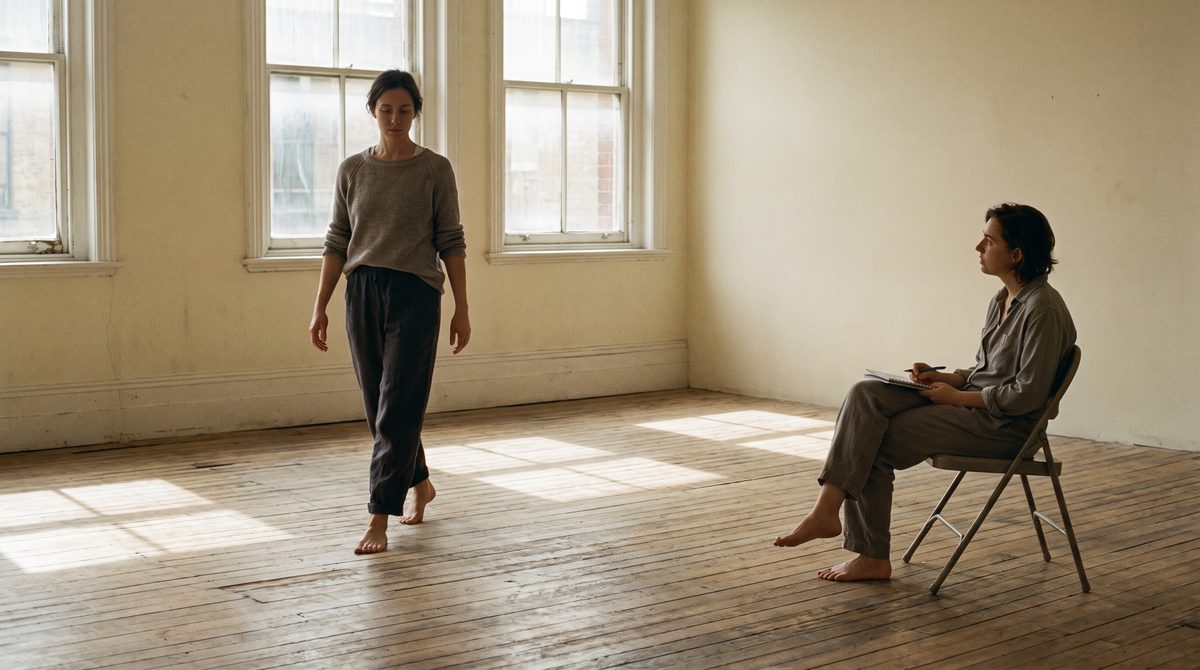
Grading what gets said about Laban
Twenty-two research briefs into this course, the pattern is familiar. Here is where each common claim actually comes from.
How to actually use it
Given all of the above, here is what the technique is good for, stated as narrowly as the evidence allows.
Walk the room, pick something up, sit down. Notice where your own four dials sit. You cannot depart from a habit you have never felt, and most actors have no idea what their own movement signature is.
Usually quick? Become sustained. Usually direct? Let the path wander. One change is enough to stop the body being yours, and two at once tends to produce a demonstration rather than a person.
Ask, persuade, conceal, protect — while keeping the physical adjustment. The movement is not the performance. It is the condition the performance happens in.
Keep the internal organisation and make the visible result much smaller. A close-up will find a change in Time and Flow that a room would not even notice.
This is where the numbers bite. Certified specialists agree about Effort at a level that would fail any reliability standard, so a physical observation is not evidence about anybody's character or intentions.
The scales, the crystal forms and Space Harmony are the dance and notation half of the work. Actor training almost never touches them, and you can have the whole practical benefit without them.
Time survives best, in the pace of thought and breath. Flow reads in the jaw, neck and held breath. Weight partly survives in the voice and hands. Space is the awkward one: it is often described as living in the eyes, and that is our analogy rather than Laban's — Space Effort is about how directly a movement addresses the space around it, not about where you look.
The one piece of evidence pointing this way is that Sudden was the most legible element to ordinary viewers and Light the least. That is consistent with Time surviving the crop. It is a single study, and we are not going to dress it up as more.
Where the sources disagree
Every page on this course ends here. On this one the disagreements run from a Weight term to a historiographical dispute.
What are the eight Efforts made of?
Commonly saidFour factors, including a Flow value for each.
What we foundThree. Weight, Space and Time. Flow is deliberately excluded, and Laban's own 1947 book says so.
Is Weight heavy or strong?
Commonly saidHeavy to light, including on our own movement chapter.
What we foundStrong to light. Heavy means passive weight, a different category that predicts a different emotion in the research.
Is BESS Laban's framework?
Commonly saidLaban's four categories.
What we foundBartenieff's elaboration from the 1960s, with Shape largely Warren Lamb's. Laban never used the term, or the phrase Laban Movement Analysis.
Is Laban objective?
Commonly saidA precise, neutral vocabulary for describing movement.
What we foundPrecise where it is geometric. On Effort, eighteen certified experts agreed at 0.35, which is not a description, it is an impression.
Do the movement qualities carry inherent meaning?
Commonly saidEither obviously yes, or completely untested.
What we foundNeither. Individual components hold up in Western samples. The cross-cultural claim collapsed the one time it was tested at scale.
Did Laban flee the Nazis?
Commonly saidHe arrived in England in 1938 as a refugee.
What we foundTrue about 1938. He held salaried state office in the regime's dance apparatus from 1934 to 1937 and left when he was pushed.
Is the Drama Centre system Laban?
Commonly saidLaban training, and a list of famous alumni.
What we foundMalmgren's synthesis of Laban, Jung and Stanislavski. Two of the most-cited names studied with him privately, not at the school.
A last word
The dials are genuinely good. Ninety seconds of turning one will change an actor's walk more than an hour of thinking about the character, and that is not nothing in a profession where most advice does neither.
What the system cannot do is tell you what movement means. The people best qualified to read it cannot agree with each other, and the man who built it spent four years administering a regime's idea of what bodies were for.
Walk across the room as yourself. Then change one thing, and walk back.