What it actually is
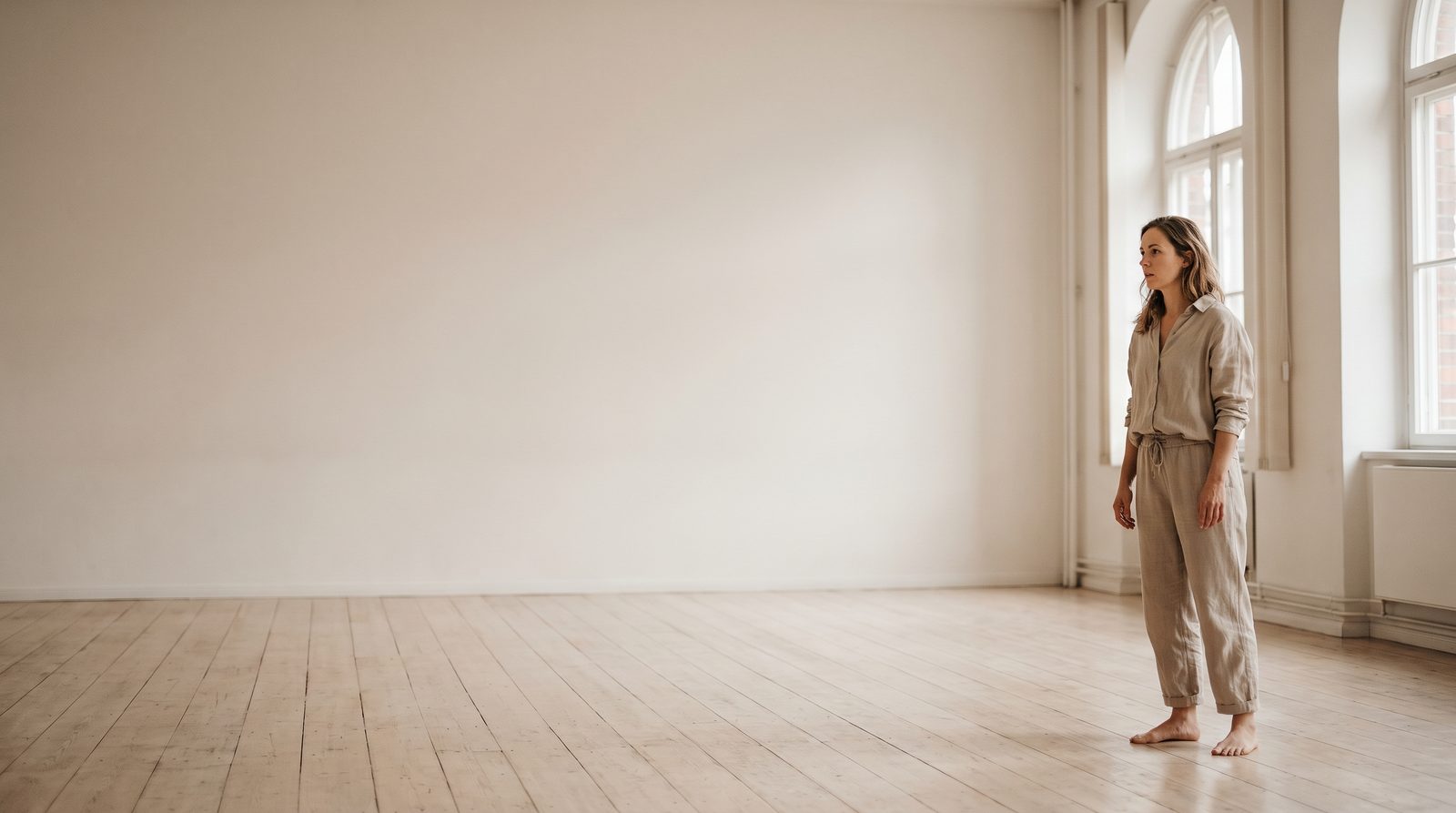
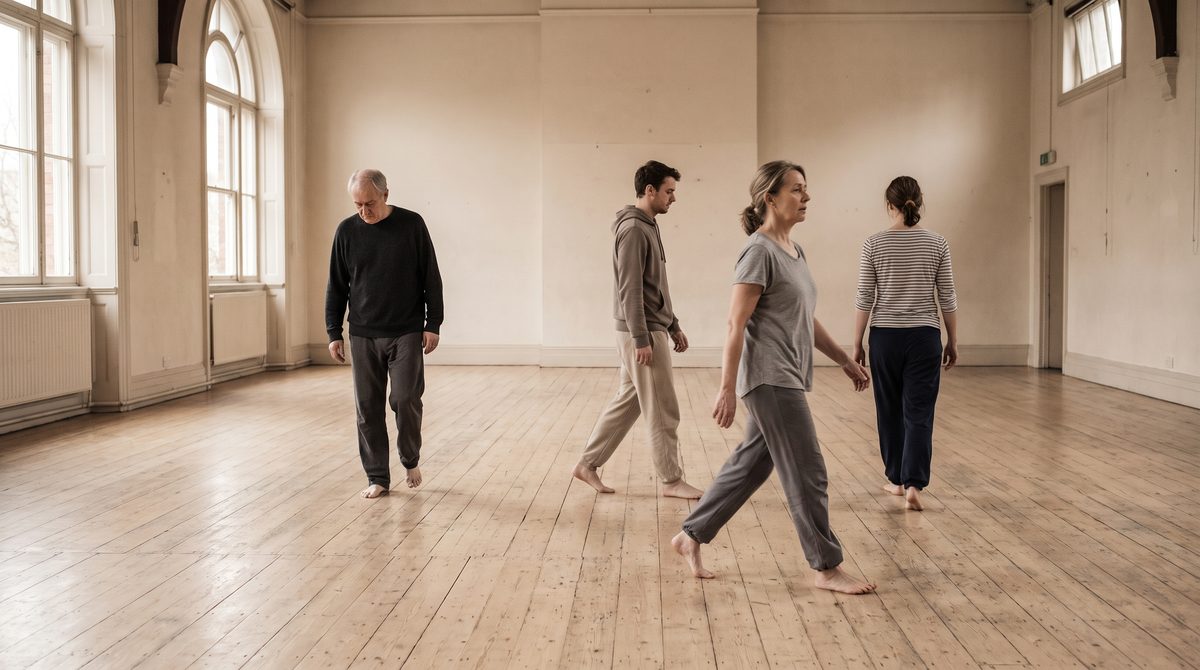
A group of people, an open floor, usually bare feet, and a facilitator who names one thing to notice. Walk the room attending only to tempo. Now only to how far you are from everyone else. Now only to the architecture. Later the lenses get layered until they are all available at once.
The name is literal: they are points of view — separable parts of what a performance is made of, which you can look at one at a time instead of treating as one undivided lump.
That is also what makes it the odd one out in this section. Every other technique here trains an individual, and this one trains a group. Kinesthetic response and spatial relationship do not exist inside one person; they happen between people. It is the least usable alone of anything on this site.
They are opposites and they are prescribed together on purpose. Suzuki trains the individual body: fixed forms, precisely repeated, energy gathered and driven down. Viewpoints trains the group: open, responsive, nothing prescribed at all.
Each one fixes what the other breaks. Suzuki on its own produces soldiers. Viewpoints on its own produces mush. If you only ever remember one sentence about either, make it that one.
The nine physical Viewpoints
These come from The Viewpoints Book by Anne Bogart and Tina Landau, published in 2005, and most guides give you the nine names and stop. The book divides three of them further, and those subdivisions are where the useful detail lives.
The rate of speed at which a movement happens — not fast or slow as an instruction, but speed noticed as something you are choosing.
How long a movement or a sequence goes on before something changes it.
The impulse to move in reaction to something outside you: someone else shifts, a sound lands, and your body answers before you have decided anything. This is the one that cannot be practised alone.
Something recurring, either inside your own body or picked up and echoed from somebody else in the room.
The contour your body makes, which the book divides three ways: lines, curves, or a mix of both; still or moving; and made by the body alone, the body against the architecture, or the body in relation to other bodies.
A movement with a beginning, a middle and an end, split into two kinds. Behavioural gesture belongs to ordinary observed life — scratching, waving, checking a pocket. Expressive gesture is abstract and symbolic, and expresses an inner state, a desire or an idea.
The physical environment, and the book names five parts of it rather than one: solid mass, texture, light, colour and sound. Most summaries reduce this to walls and furniture and lose four fifths of it.
The distance between bodies, and the way that distance keeps changing. The most immediately legible of the nine to an audience.
The pattern your movement draws on the floor — the map, seen from above, of where everybody has been.
They are pitch, how high or low the sound sits; dynamic, its volume and force; acceleration and deceleration, sound speeding up or slowing down; silence, where sound stops and for how long; and timbre, its texture.
Here is why they belong on a self-tape site. The whole-body half of this technique does not survive a chest-up frame, and neither does the floor pattern. All five of these survive a microphone completely intact. That is a small, true and genuinely useful thing, and we have not seen anyone else write it down.
One half of the book gets left out of nearly every summary, and it is the half that makes the technique into theatre. Composition is the making stage. Bogart and Landau describe it as a way of selecting and arranging the separate parts of theatrical language into something coherent for a stage. More plainly, they call it writing on your feet, with other people, in space and time. A group is given a time limit and a list of ingredients that must appear, builds a short piece, shows it, and then everybody looks at what actually happened. Open Viewpoints work is exploration with no product. Composition is the assignment with a deadline. If a class only ever does the first one, you have seen half of it.
Overlie's six, in her own terms
Mary Overlie's original list is Space, Shape, Time, Emotion, Movement and Story, which she later shortened to the initials SSTEMS. She was insistent that they can be listed in any order, because no one of them rules the others. Two of her words mean nothing like what an actor would assume, and this is where almost every account of her work goes wrong.
Who invented it, told fairly
Overlie originated the Six Viewpoints out of the postmodern dance world that followed the Judson experiments. She taught them at New York University's Experimental Theater Wing from its founding in the late nineteen-seventies. Anne Bogart met her there in 1979, on the same faculty. Bogart and Tina Landau built a theatre version over the following decade and published it in 2005.
The version of this story circulating online is that Overlie was robbed and then ignored. We went and checked it, and most of the individual claims do not hold.
One detail says it better than any argument. The Experimental Theater Wing still teaches Viewpoints in its first and second years, and Overlie's name does not appear on the page that says so.
Where you can actually train in it
This is the part guides get out of date fastest, and the most important thing on the page if you are about to spend money.
Grading the sources
This is the thirtieth research brief we have checked, and it produced the two-hundredth reminder that the internet copies itself. Two claims tagged as scholarship turned out to be Wikipedia word for word, which takes our running count of this to twenty.
Does it work?
The same answer as every technique in this section, and we would rather say it than pretend otherwise.
Nobody has run a study on actors trained in Viewpoints. There is no outcome data at all, and very little scholarship of any kind about the practice itself as opposed to the argument over its authorship.
What can be said is narrower and still worth something. Responding to what actually happened, rather than to what you planned, is the single thing every casting director quoted on this site says they are looking for. Viewpoints trains that directly, in a room, with other people. Whether it does so better than anything else is unmeasured.
What you can use on your own
Change no acting choice, and attend only to where the sound stops and how long the gap runs. Then listen back. It is the cheapest experiment on this site.
You have a wall, a floor line, a chair and a depth. Your body is in a relationship with all of it whether you have thought about it or not.
Not how fast you speak, but how fast the thinking moves underneath it. In a close-up that is one of the most legible things there is.
Nerves cut looks and pauses short, so choose one and let it run to its actual end. Most takes get better immediately.
Walk somewhere noticing only tempo, then sit somewhere noticing only the distance between people. It is free, it never runs out, and it is the same instruction every improviser gets: observe.
The lens is there to sharpen listening. If your reader can tell you are running a technique, you have gone too far and the take is about you.
Where we differ from the standard account
Did Overlie publish long after Bogart?
Commonly saidEleven years after, in 2016.
What we foundShe published an account in 1998, seven years before their book. 2016 was her full articulation, not her first word on it.
Did Bogart admit to stealing it?
Commonly saidYes, in her own words.
What we foundThe famous line is a general remark about artistic influence from 1995. She has separately said she took the work and altered it, and credited Overlie by name in print.
Was the credit hidden or grudging?
Commonly saidBuried, if it is there at all.
What we foundIt is on the acknowledgements page and in chapter one, and Bogart published an interview in which Overlie criticised what had happened.
Does Overlie's “Emotion” mean feeling?
Commonly saidTreated as the emotional content of a performance.
What we foundNo. It means being present and available to be looked at. Her own image for it is a dog-sniff-dog world.
Where do you train in it?
Commonly saidSITI Company.
What we foundSITI gave its last performance in December 2022. NYU still teaches it, and Overlie's own organisations teach the six.
Is there evidence it works?
Commonly saidSupported by research on attention.
What we foundNo study of Viewpoints exists. The attention research is about single physical skills and does not transfer cleanly.
Can you learn it on your own?
Commonly saidTry the exercises at home.
What we foundMostly no. It is the most group-dependent technique on this site. The five vocal Viewpoints are the exception and they survive a microphone completely.
Record one take attending only to silence. Change nothing else, manufacture no pauses, and simply notice where the sound stops and what happens in the gap. That is a whole Viewpoint, done alone, in about ninety seconds.