
What it actually is
Catherine Fitzmaurice trained at the Central School of Speech and Drama in London on a three-year scholarship, studying alongside Cicely Berry, and went back there to teach voice in 1965. She moved to Michigan in 1968. The two words that name her method, she says, fell out of her mouth in the early nineteen-seventies.
She wrote the whole thing down in an essay called Breathing is Meaning, first published in 1997. Almost every online guide to her work describes it without quoting a line of it, so here she is.
What the tremor actually is
This is why most people are on this page. Somebody saw a room full of actors shaking and wanted to know what on earth was happening. The plain answer takes three sentences and hardly anyone gives it.
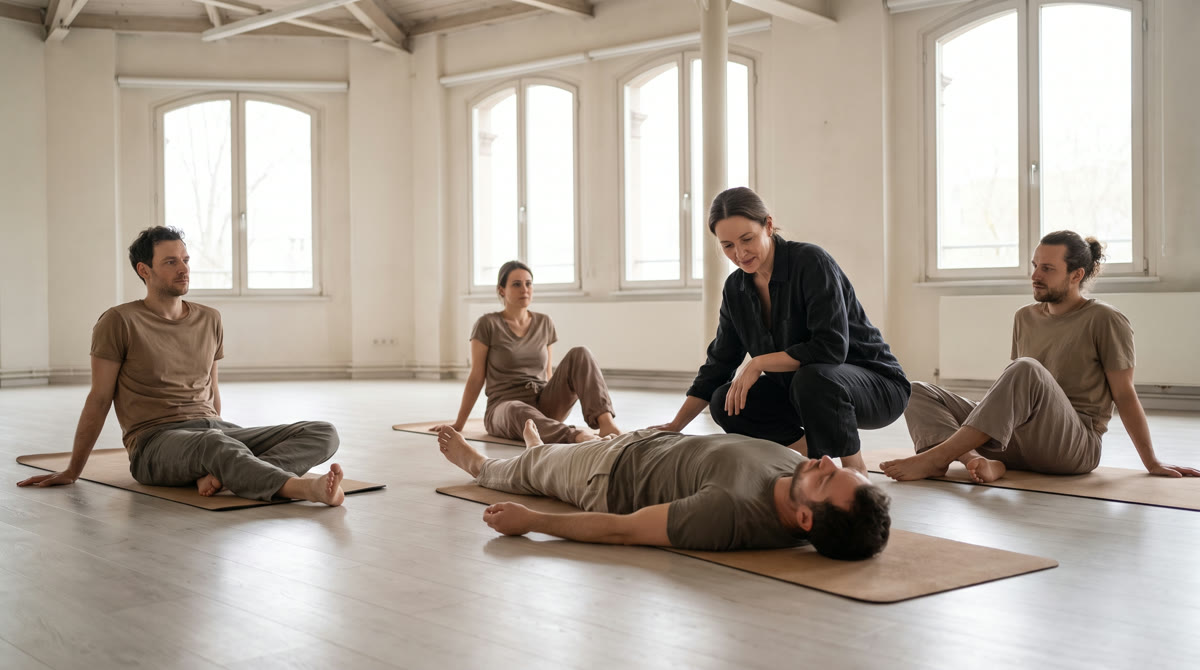
You are put into a position that loads a muscle until it starts to tremble by itself, and then asked to breathe and make sound through it. You cannot manage your breathing while that is happening, and that is the entire point, because managed breathing is what the exercise is dismantling.
Where it comes from, and why that is awkward
Wilhelm Reich was a psychoanalyst whose later work claimed a universal life energy he called orgone, and that boxes built to collect it could treat cancer. Mainstream science rejected it.
The legal end of the story is usually told wrongly, so here it is properly. A US court granted an injunction against the orgone accumulators in March 1954. Reich was never convicted over the science. He was convicted of contempt of court in May 1956, after an associate shipped accumulator parts across a state line in breach of that injunction, and he died in a federal penitentiary in November 1957.
Alexander Lowen, who studied with Reich, built the body-centred practice called bioenergetics. That is the line Fitzmaurice studied in, and the tremor comes down it.
So the question for you is small. You can use every exercise here without holding any belief about Reich whatever, and you are entitled to know the exercise has a history before you are lying on a studio floor doing it.
Restructuring: the half you can practise tonight
This is the concrete, anatomical, immediately usable part of the technique, and it is the part the guides skate over fastest. What follows is her own instruction, in her own words, from a 2005 interview.
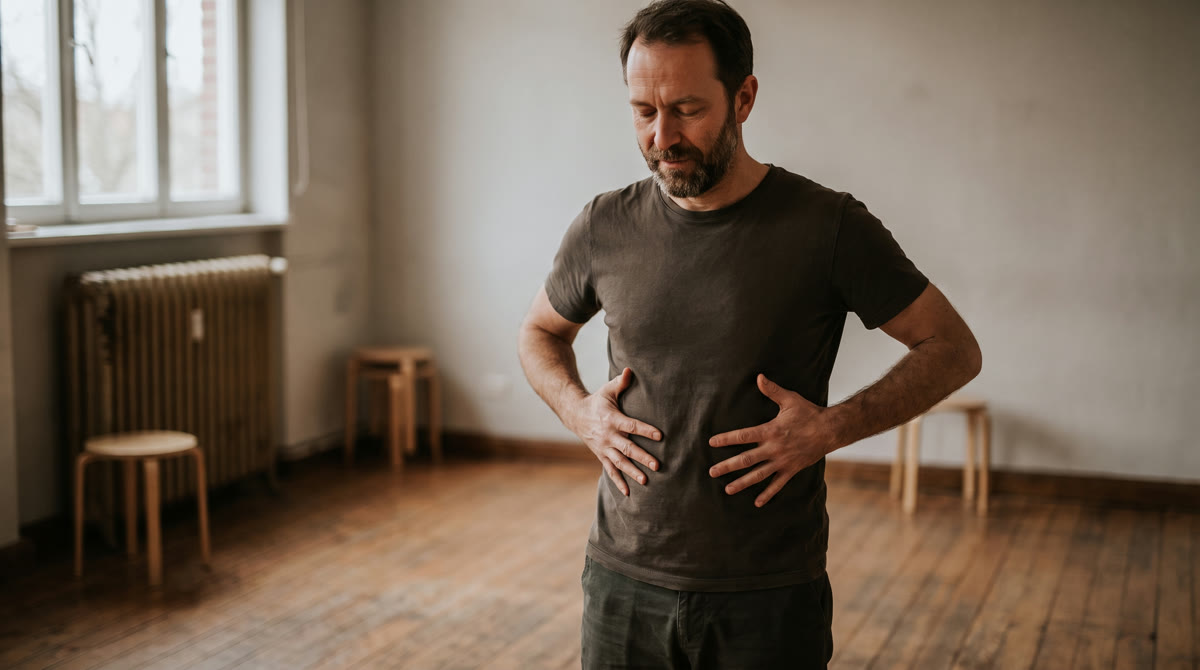
Hands on the sides of the ribcage, low down, roughly level with the bottom of the breastbone. That band is where the work happens, not the upper chest.
Sideways is the instruction, not upward. The belly lets go rather than pulling in. If your shoulders rise you are breathing somewhere else.
The tuck happens while the sound is happening, not before it. This is the bit people get backwards, bracing first and then talking into a locked body.
She is specific: the transversus, the deepest of the stomach muscles. Not the surface abdominals you would use in a sit-up.
Slowly is the whole word. Ribs that collapse take the last few words of your sentence with them, which on camera is exactly where the thought disappears.
She adds that this is roughly what very connected speakers do anyway, without being taught. That is a modest claim and it is probably right.
The focus line runs from the abdomen, down and around the pelvis, up the spine, into the head and out through the brow. The purpose is that your attention sits neither on yourself nor on your vocal tract, but on the point of communication with another person — and she says that involves receiving as much as sending.
The qualifier matters and it is hers, not ours. She calls it a mental image only. It is not a claim about anatomy, and she does not pretend otherwise. More techniques on this site would be improved by that four-word parenthesis.
Is it therapy?
No. It is voice training that borrows a mechanism from somatic therapeutic practice, and a voice teacher is not a clinician. But the question deserves better than a one-word answer.
If you cried after a session, nothing went wrong. You spent an hour deliberately producing a stress-response pattern in your body while breathing and making sound freely, and emotional release is an ordinary consequence of that. It is not evidence that something was healed, and it is not evidence of how committed you are. Be wary of any room where tears are treated as a scoreboard.
So do the sensible things yourself. Tell the teacher about injuries, pregnancy, hypermobility, breathing problems or anything else physical before you start. Ask how consent is handled if there is hands-on work. Coming out of a position is always available and you never need permission. And if you have a history that makes deliberately winding up your nervous system unwise, that is a conversation for a clinician, not a voice class.
Does it work?
Fitzmaurice has had more research attention than almost any other voice technique for actors, which is a genuine point in its favour and a lower bar than it sounds.
There is a real pilot study, published in 2015 in the Journal of Voice, a peer-reviewed clinical journal. There is a second small pilot from 2019 using brain imaging, in a practitioner journal, with ten certified teachers as subjects. Its authors describe it as preliminary and flag the sample size themselves.
We could not read the 2015 study's results. It sits behind a hard paywall with no open copy anywhere, and roughly twenty attempts to reach it failed. So we will not tell you what it found, because we do not know — and a page that describes a study's findings without having seen them is doing the exact thing this course keeps criticising.
What we can tell you is stranger and more useful. When the same lead author published the 2019 follow-up, she cited the 2015 study inside a list of anecdotal reporting and observations by teachers and students. Its own research team, four years on, filed it under anecdote. That is a real signal about how much weight the number of studies can carry.
The honest verdict is the one we give every time. There is a plausible mechanism and no demonstration that it makes better actors. Actors do have a documented problem with doing too much work in the throat, and this technique aims directly at it, but nobody has tested whether it fixes it.
Training, cost and who says you are qualified
Grading the sources
Thirty-one briefs in, and this one is better than most: its own author flagged the gaps honestly and told us to close them. Two sources still needed demoting, which takes our running count of claims that turn out to be somebody's coursework or marketing to twenty-two.
What to take from it
Ribs sideways on the way in, tummy in as you speak, ribs down slowly. Five minutes a day will do more for your tapes than any amount of theory.
Record a take and listen to the ends of sentences. If the thought fades out, your ribs are collapsing early. That is the problem this technique was built for.
The hands-on work, the adaptation and someone watching you are the technique. Shaking on your bedroom floor from a video is not a shortcut to it.
It is free, it is short, and it will tell you more than the teacher probably will about where the work comes from.
What is your certification. How do you adapt positions. How do you handle consent for touch. What happens if someone is overwhelmed. How does this connect back to text.
The chaos is a rehearsal state. Settle first, then press record, or you will get a take full of feeling and no thought.
Where we differ from the standard account
Is Fitzmaurice Voicework just breathing work?
Commonly saidA body-based approach to freeing the breath.
What we foundHalf of it deliberately induces an autonomic stress response. Her own essay says so in those terms.
Is the shaking the same as physiological tremor?
Commonly saidYes, and the term is used to lend it scientific weight.
What we foundNo. Physiological tremor is the tiny invisible oscillation all muscles have. What happens in class is fatigue tremor from a held position.
Was the Reichian origin hidden?
Commonly saidAnother technique with its foundation quietly removed.
What we foundNot by her. She names Reich and Lowen in her own prose. The silence starts with the people summarising her.
Is there strong evidence behind it?
Commonly saidBacked by published research in a clinical journal.
What we foundTwo small pilot studies. The team behind the first later cited it among anecdotal observations. We could not read its results at all.
Is there safety guidance for the tremor work?
Commonly saidAssumed, because it is taught in conservatoires.
What we foundNone published. No contraindications, no screening, no consent language, and no adverse-event data for the related method either.
Does certification mean an outside body approved it?
Commonly saidImplied by the word.
What we foundNo external accreditor exists. The organisation teaches, certifies and sells the credential, and two years of it costs twelve thousand dollars.
Can you learn the whole thing alone?
Commonly saidTry the exercises at home.
What we foundRestructuring, yes, and it is genuinely useful. Destructuring, no. It is hands-on and it opens people up.
Put your hands on the sides of your lower ribs. Breathe in and let them widen sideways while your belly softens. Then speak a line, drawing the deepest layer of your stomach in as the words go out, and let the ribs come down slowly enough that the last word still has air behind it. That is the useful half of this technique, and it costs nothing.