The split every other page skips
Two adults walk into the same class wanting opposite things.
One wants a Tuesday night that is theirs. The other wants a second career. Both are legitimate. They are not the same product, and they should not be sold at the same price.
Most pages written for adults describe the first reader and quietly sell to the second. That is how somebody who wanted a hobby ends up spending three thousand pounds on a showreel nobody will ever watch. It is also how a serious career changer spends two years in a class that never once puts them on camera.
The question underneath the search
Nobody has ever needed permission to start.
The Bureau of Labor Statistics lists the typical entry-level education for actors as some college, no degree, and the required prior work experience as none. There is no register, no licence and no exam. The gate you are picturing does not exist.
But the reassurance you have already read is mostly wrong
Every adult who searches this has met the list of actors who started late. Alan Rickman at 42. Morgan Freeman at 50. It is a comforting genre, and its facts do not hold up.
The pattern repeats every time. The lists confuse started acting with became famous, and those two dates are usually fifteen or twenty years apart.
There is one genuine late starter, and she is worth more than the whole list
“Kathryn Joosten was a psychiatric nurse in Chicago.”
After a divorce in her early forties, she began acting at her community theatre. She moved to Hollywood full time at 56. She won two Emmys. That is a real, documented, genuinely late start — and it took roughly seventeen years from the community theatre to the role people remember her for.
It is never too late to start. That part is true and nothing we found contradicts it.
But people rarely succeed quickly after starting late, and the lists that imply otherwise are wrong about their own examples. Which turns the question into a better one: not am I too old, but what am I starting. A hobby you will enjoy for thirty years, or a second career that will take about ten. Both are fine answers. Only one requires reorganising a life.
The fear underneath the question
You are not really asking about age.
“Am I too old” is almost never the real question. The real one is quieter — will I walk in and be the only person like me? Nobody writes about this, and it is the thing that actually stops people enrolling.
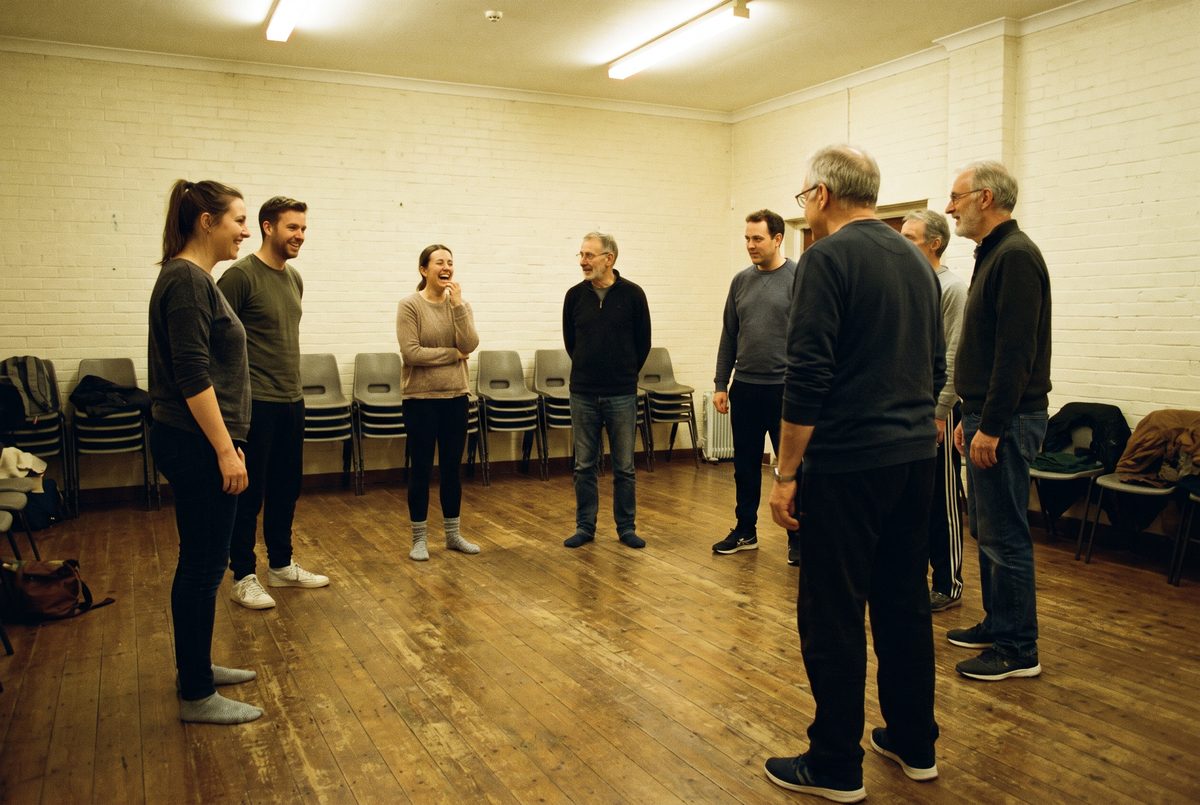
A typical adult evening class. The age spread is usually wider than people expect, and everybody is self-conscious for the first ten minutes.
The honest answer is that the ages are normally mixed. Adult classes routinely include people in their thirties, forties, fifties, sixties and beyond. One adult-classes provider puts it flatly: “There is genuinely no upper age limit.”
What actually happens once it starts
You warm up
Breathing, movement, listening and concentration exercises. It is how everybody arrives in the room, and nobody is being assessed.
Described almost identically by every adult course in our sources, from council classes to drama schools.You play
Theatre games and improvisation. The point is responding, not performing — and it is very hard to feel self-conscious while you are busy.
You work with somebody
A scene, a play reading or a partner exercise. Your attention goes onto another person, which is where acting actually happens.
You get a note, and you go again
The note is not a verdict on your talent. It is one specific thing to change, and trying it is the entire lesson.
This is the reason a class beats reading about acting. You cannot give yourself the note.A class that treats emotional exposure as the point, or that humiliates a struggling student to prove something, is not teaching acting. The full list of red flags is in the beginners chapter, and every one of them applies at any age.
A trade, not a gift
Your life is material. It is not a shortcut.
“Life experience helps” is true and almost useless. The fuller version tells you what to trust and what to work on, which is what you actually came for.
What you already have
The advantages are real
- Lived experience. The circumstances in a script are not imagined for you. Money, grief, marriage, work — you have the reference.
- Better reading. Adults follow behaviour and subtext in a script more accurately than teenagers can.
- Expertise to type into. Twenty years in a hospital is something a 24-year-old drama graduate cannot manufacture.
- A deliberate choice. You are there on purpose, not because it was the class with places left.
What will take work
And the costs are real too
- Self-consciousness. You have more of it, and almost no page mentions that. Looking foolish in front of strangers is a skill.
- Set habits. Physical and vocal patterns built over decades take longer to loosen.
- Time. Rehearsal has to be defended from work and family every single week.
- Runway. If this is a career move you have less of it. That is not fatal. It is a planning fact.
Teachers do report that older students bring an emotional truthfulness younger performers cannot reach yet. The same teachers report the other half of the trade — adults carry more self-consciousness into the room. Training is what turns the first thing into something usable, and the second into something smaller.
The audience nobody writes for
You do not have to want a career for this to be worth doing.
A large share of the adults in these classes have no intention of auditioning for anything. They want to be less frightened of a room. That is a complete reason, and the evidence behind it is decent.
Research on group arts participation is genuinely encouraging. Theatre-based programmes are described as fostering social connection and reducing loneliness. A study of cultural participation in later life found less reported loneliness among participants, and the finding held when controlling for health, social and demographic factors. A pilot randomised trial found that short drama programmes improved self-esteem, confidence and happiness in older adults.
The honest answer
There are parts for your age. There is also a flat market.
This is where pages written for adults tend to cheer, and cheering is not useful. Two things are true at the same time, and you should have both of them.
Most characters on screen are adults, and a large share of them are middle-aged or older. But the training pipeline feeds from school leavers, so the pool of trained actors skews young. The number of parts for a 55-year-old is not small. The number of 55-year-olds competing for them is smaller than the crowd chasing the 25-year-old parts. That is a real structural argument, and it is better than “older actors are in high demand” — a line usually said by somebody selling a course.
The practical point matters more than either argument. Adult beginners get typed into the roles they are already qualified to play — the doctor, the detective, the teacher, the parent, the boss. Your actual working life is casting material. That is specific, useful and genuinely yours.
The question with a checkable answer
Several schools state there is no upper age limit. One of them lets something slip.
If you have wondered whether training is simply closed to you at 45, it is not — and the schools say so in writing.
“Unlike some drama schools.” That is an admission from inside the sector that some schools do apply an upper age limit, formally or in practice. No source we found names which ones. It is worth asking a school directly before you spend anything on an application.
The more useful distinction is not the age policy at all. It is that every course above is part-time, evening or weekend, and open access. For an adult with a job and a mortgage, a three-year full-time conservatoire was never the relevant comparison. The real question is what part-time training exists around work — and the answer is quite a lot of it, some attached to real theatres with Spotlight and Equity routes at the end.
The constraint that decides everything
Choose the schedule you can actually keep.
Adult training is mostly evening, weekend, short-course or live online, sold in term-time weekly blocks. The best class on paper is worthless if Wednesday at seven was never realistic.
The most useful number on this page
Thirty hours a year, against a thousand.
One evening class a week is roughly 30 to 40 hours of training a year. A full-time drama school student does over a thousand. Nobody publishes that comparison, and every adult deserves to see it before they judge their own progress.
That is not a reason to skip the evening class. It is the reason to be realistic about pace. You are not doing a slower version of drama school — you are doing a different thing, and it runs on a different clock.
Expect progress measured in terms, not weeks. Expect to repeat things. And expect the useful growth to come from reps rather than revelation, which is true at every age and simply more visible at yours.
The warning no other adult page gives
Most adult classes are stage classes. Your first audition will be a camera.
Adult provision grew out of theatre and community arts, and that builds genuine foundations — listening, voice, movement, courage. But almost every first-round professional audition now happens as a self-tape.
An actor trained only in a stage tradition makes well-prepared tapes that read as far too big. It is the most common note in the entire system, and it is a scale problem rather than a talent problem. So check before you enrol whether you will ever be filmed and watch yourself back.
Stage training gives you
Presence and range
- Full-body storytelling, and the confidence to use it.
- Vocal freedom and the reach to fill a room.
- Ensemble discipline — timing, listening, generosity.
- Stamina to sustain a performance from start to finish.
Camera training gives you
Scale and precision
- Scale — how little the lens actually needs from you.
- Framing and eyeline, which are technical and learnable.
- Playback, so you finally see what they see.
- Self-tape technique, which is now the audition itself.
And three things about the current system quietly favour an adult with a job. You do not have to live in London or Los Angeles, because the first round is a tape from anywhere. You do not have to take a day off, because taping should take about half an hour. And you can do it at ten at night, which is the only time most working adults have.
Five questions, and the general ones still apply
What to ask before you pay.
- “What is the age range in the class running now?” Not whether adults are welcome. The actual spread.
- “Is this recreational or professional-track?” You are buying one of two quite different products.
- “How often will I be on my feet?” You need reps, not an evening watching a teacher talk.
- “Will we work on camera, and will I see the playback?” If screen work is the goal, this is the question.
- “Can I take one class before I commit?” A taster costs less than a term and answers more than any brochure.
Everything in the beginners chapter still applies at every age. Acting teaching is unlicensed, the audit is free, humiliation is not instruction, and nobody can guarantee you an agent or a job.
The honest state of the evidence
Where the sources disagree.
Did the famous late starters actually start late?
The listsRickman at 42, Freeman at 50, Joosten at 42 or 43 or 60.
The recordRickman graduated RADA at 26. Freeman had a long prior career. Joosten’s dates vary by eighteen years across sources.
Is there an upper age limit at drama school?
NoSeveral schools state plainly that mature students are welcome and there is no upper limit.
SomeThe Bridge: “unlike some drama schools” — an admission that some do. Nobody names which.
Is there work for older actors?
DemandDrama schools: older actors are in high demand in the industry.
FlatBLS: 57,000 jobs, 0% projected growth. No age-distribution data exists at all.
Do acting classes improve wellbeing?
SupportedThe arts-participation literature is real: less loneliness, more life satisfaction and purpose.
CarefulMost strong studies cover drama therapy, care settings or young people — not adult acting classes.
Is life experience an advantage?
YesTeachers report older students bring an emotional truthfulness younger ones cannot reach.
A tradeThe same source notes adults carry more self-consciousness, and their habits are more set.
Hobby class or career class?
BothMost pages imply both at once, and price them the same.
NeitherThey are different products with different outcomes. Being sold the wrong one is the common failure.
Go once. Tell nobody.
You do not have to announce a new life. Book one taster near you, do the warm-up, try the exercise and go home. Then decide about a term, with information instead of imagination.
And whichever of the two adults you turn out to be, learn the camera. It is the room every audition happens in now.
Learn the other half, free