How to Dress for a Doctor, Cop or Period Role
For a doctor, cop or period role, suggest the character — don't costume them. How to hint at the part with simple wardrobe, and what to leave out of the frame.
By Sal Framondi
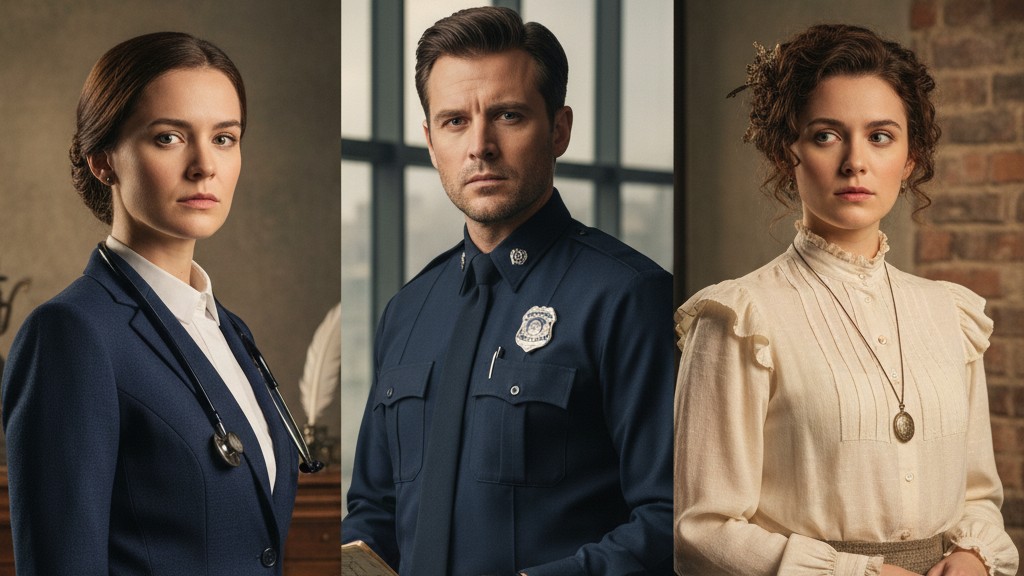
The one rule that covers almost every wardrobe question in a self-tape is this: suggest the character, don't costume them. Casting wants to see you as the doctor, the cop, or the person from another era — they don't want a costume, and they definitely don't want to watch you disappear into one. A single well-chosen shirt does more than a full outfit with props, because it hints at the role while keeping the focus where it belongs, on your face and your acting.
Here's how to apply that to the three types that trip actors up most, and what to keep out of frame entirely.
The idea: a hint, not a disguise
A self-tape is usually framed from the chest up, so casting sees a collar, a neckline, and a color — that's your whole canvas. You're not dressing for continuity or for a photo shoot; you're giving one visual cue that says "this person could be that character," then letting your performance carry the rest. Over-costuming reads as trying too hard, and props pull the eye away from you. Restraint almost always wins.
Doctor and medical roles
You want to suggest competence and cleanliness, not put on a hospital drama. A simple, clean look does it: a crisp collared shirt in a plain color, or a plain, solid top with a neat neckline. Muted, calm colors read as professional.
What to skip: a real stethoscope around your neck, a white lab coat, scrubs head to toe, or anything that turns you into a Halloween version of a doctor. If the story needs it, a plain top in a scrub-like solid color is plenty of a nod. The goal is "this person is a professional," not "I found a costume."
Cop and authority roles
Authority comes from structure and simplicity. A dark, solid top — something with a clean, sturdy line, like a plain button-down or a structured dark shirt — suggests someone official and grounded. Solid navy, black, or charcoal reads as strong without shouting.
What to skip: a fake badge, a toy uniform, anything with a costume-shop feel. A real uniform you don't have the right to wear can also look off, and it's unnecessary. Let a clean, dark, structured top plus your bearing do the work. How you carry yourself will say "cop" more convincingly than any prop.
Period roles
Period is where actors most want to build a full costume, and most need to resist. You can't and shouldn't try to recreate an era from the chest up. Instead, suggest it with silhouette and simplicity: a neckline, a collar, or a fabric that leans toward the period without being a literal reproduction. Simple hair styling that nods to the era can do more than any garment.
What to skip: elaborate costumes, obvious rentals, heavy accessories. A high or simple neckline and a clean, uncluttered look will place you in a different time far more elegantly than a full outfit that reads as a costume party. When in doubt, go simpler and let your voice, manner, and language carry the period.
What to avoid for any role
A few things distract in almost every self-tape, whatever the character:
- Loud patterns and stripes, which can shimmer or vibrate on camera and pull focus.
- Visible logos or graphics, which yank the eye to a brand instead of your face.
- Props, unless the instructions specifically ask for one. Even then, keep it minimal.
- Anything that blends into your backdrop, so you don't lose your shoulders and neckline into the background.
- Bright white or pure black right up at the collar, which can fight your lighting. Softer, solid tones are safer.
A quick way to decide
When you're unsure what to wear, run this: pick a plain top in a color that suits the character's world, check that the neckline and collar read cleanly on camera, remove anything with a logo or a busy pattern, and put down any prop you were tempted to hold. Then ask whether a stranger glancing at the frame would get a general sense of the character without being distracted. If yes, you're done.
When the instructions specify wardrobe
Sometimes casting asks for something specific. If they do, follow their instructions exactly, and if anything is unclear, check the current instructions on the casting platform rather than guessing. Their direction always overrides the general advice here.
Suggest the role with one clean choice, keep props and costumes out of it, and protect the focus on your face and your work. A hint is all casting needs — they're hiring an actor, not a wardrobe.