Before the deposit, the taster or the term
The eight questions, and why they are these eight.
A polished website is not a safeguarding system. These questions are not invented. Each one comes from a standard the child-performance licensing regime already sets for anyone working with young performers. That is what makes them fair to ask, and answerable.
Copy this and send it
Ask all eight. In writing.
- Is every adult who works with young people background checked? In the UK that means an Enhanced DBS check including the children’s barred list. Ask to see the policy.
- What is your child protection policy, and who is the designated safeguarding lead? A serious organisation names a person, not a value.
- What is the adult-to-young-person ratio? The statutory benchmark for chaperones is 1:12, and best practice is 2:12.
- Is any adult ever alone with a young person? And if so, in what circumstances, and who knows about it.
- Do you hold a BOPA, or do you licence individually for performances? This is the sharpest question on the list. See below.
- What is your policy on photography and video, including posting young people online, and where the files are stored.
- How do you handle physical contact in movement and scene work, and do you use intimacy guidance?
- What is the complaints route if my child is unhappy, and does my child know it too?
A BOPA — a Body of Persons Approval — lets an organisation cover all the children in its performances at once, instead of licensing them one at a time. To be granted one, it has to demonstrate “robust and well-embedded safeguarding policies and procedures” and hand over its child protection policy, insurance, and health, safety and fire certificates.
That matters because it is the difference between a local authority having actually inspected their safeguarding and the organisation simply telling you it is fine. Ask the question. The answer, either way, tells you a great deal.
The thing no teen-classes page explains
A weekly class needs nothing. Then one day it does.
There is a whole legal layer around performing minors, and almost none of it applies to a Saturday drama class. But the class is the on-ramp, and the paperwork becomes real the moment the class leads somewhere. Here is roughly where the line sits in the UK.
Two practical notes. The licence application goes to the local authority where the child lives, not where the performance happens. And it is the production’s job to apply, not yours — which is itself a useful test of whether an organisation knows what it is doing. A company that looks blank when you ask is telling you something.
The protection most parents have never heard of
In the United States, the money is legally the child’s.
It is named after Jackie Coogan, a child star who discovered as an adult that his parents had spent his childhood earnings. The law that followed is one of the strongest protections a young performer has, and hardly any parent knows it exists until they need it.
The two places the safety net has a hole
Protection for young performers stops before childhood does.
Both of these are documented, both are consequential, and neither appears anywhere else in the writing about teen acting classes. They are the reason this page exists in this order.
Gap one
Sixteen to eighteen, in the UK
- The licensing regime ends at compulsory school leaving age — in England, the last Friday in June of the school year the child turns 16.
- The young person is still a minor, and under the raised participation age must still be in education or training.
- So a 16-year-old can work with no performance licence, no approved chaperone and no local-authority oversight that applied three months earlier.
- US protections run to 18. A 16-year-old in California is covered. A 16-year-old in England is not.
Gap two
Posting is not performing
- Influencers are not subject to child entertainer labour laws, and are not required to open a blocked trust account in any state.
- Teenagers are told constantly to build a following as a way into the industry.
- That advice moves them from the most regulated corner of the business into the least regulated one.
- No permits, no hour limits, no studio teacher, no chaperone, no mandated reporter — and the content is usually more personal than a production would ever ask for.
The first gap is our reading of the statutory dates, not a finding somebody else has published. Treat it as an observation worth checking with your local authority’s child employment officer. The dates themselves are not in doubt.
The second is not a reason for a teenager never to post. It is a reason to know that the safeguards you would assume follow a young performer do not follow them onto a platform — so the family sets its own. Who approves an upload. What stays private. Whether location is visible. Who handles the money. What happens when they want something taken down.
And a teenager should not have to turn their private life into public content to prove they are serious about acting. That is worth saying to them directly, because a great deal of the advice they will read says the opposite.
Now the part the teenager came for
Start where you can collect hours, not products.
The students who began at six do not have a secret doorway. They have more practice, and practice is available to you this term. Here is what actually exists at your age, and what to check about each one.
If you are the teenager reading this
Awkward for about ten minutes, then much less mysterious.
You will probably warm up, play a focus game, work with a partner, read a short scene and get one practical note. Nobody expects you to know the vocabulary or to arrive fearless.
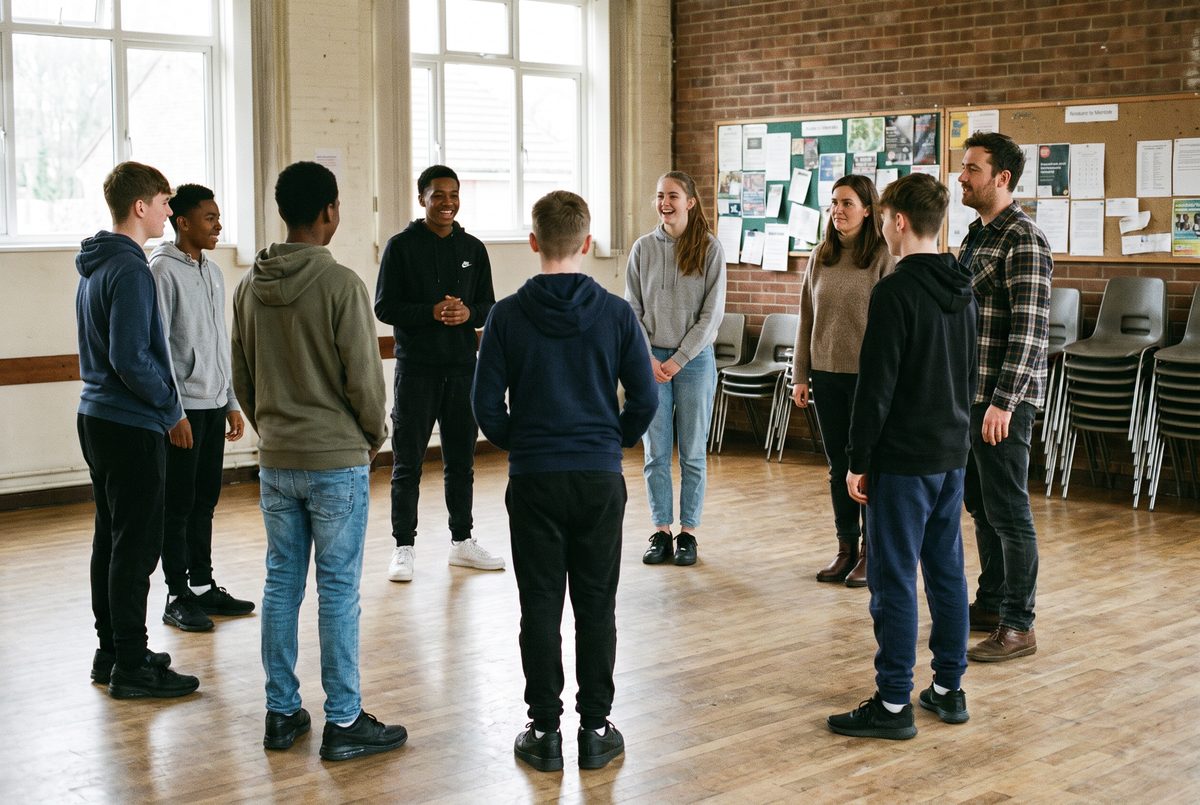
A youth theatre workshop. Note the two adults in the room — the statutory chaperone benchmark is one to twelve, and best practice is two.
Wear clothes you can move in
No costume, no special makeup and no “actor look” is required or wanted.
Put your attention on your partner
Acting gets much easier the moment you stop monitoring yourself, and much harder when you do not.
Try the exercise properly
The point is not to impress anybody in the room. It is to find out what actually happens when you commit.
Take the useful part of the note
A good note gives you something to do. It is not a judgement about who you are, and you should not accept one that is.
If the notes in a class are about the person rather than the work, that is worth telling a parent about.Then they have more hours than you. That is the entire difference, and hours are the one thing you can go and get. You are not behind. You are earlier.
Aimed at parents, because parents have the card
Real opportunity never begins with pressure to pay.
There are three patterns, they all target the adult rather than the young person, and one rule defeats every one of them.
Enforcement is real, and worth knowing about. California’s Krekorian Talent Scam Prevention Act covers creative artists of any age and requires upfront-fee talent services to post a $50,000 bond, keep refund policies and follow rules on success stories and scouts. In February 2017 the Los Angeles City Attorney charged 28 defendants across five casting workshops with pay-to-play violations, and one talent manager was convicted of taking $110,000 in illegal upfront fees from a single family.
The argument that matters most at this age
The drama school door is a self-tape. So is the first audition.
Youth theatre builds the actor, and nothing replaces it. But a teenager who only ever trains on a stage will make well-prepared tapes that read as far too big, and will have no idea why.
This is not a general point. RADA, Central, GSA and Urdang all use self-tape as a first-round filter, with published technical specifications you have to meet. The application to the training is itself a camera audition. So is almost every first professional audition a teenager will ever get.
First, and cheaply
Stage, for the craft
- Voice and movement, built properly and slowly.
- Text — how a script actually works.
- Ensemble, which is most of the job and none of the fantasy.
- Finishing something in front of an audience.
Then, and deliberately
Camera, for the scale
- Conversational volume. Do not project. The microphone is close.
- Eyeline and framing, which are technical and quickly learned.
- Playback, so you can see the size of what you did.
- Following the instructions exactly, which is half of what is being tested.
The good news for a teenager doing exams is that this has made things easier, not harder. A first-round audition is now about half an hour in a bedroom instead of a day out of school travelling to a casting suite.
School, exams and the actual calendar
Classes are rarely the problem. Auditions and jobs are.
Nearly all teen provision is built deliberately around school — term-time weekly sessions, Saturdays, evenings and holiday intensives. The conflict almost never starts with the class.
And keep participation separate from a career in your own head. Enjoying acting is worth doing on its own terms, whether or not the teenager ever auditions for anything professional. Those are two different decisions and they do not have to be made at the same time.
My child is talented but shy
What the evidence supports, and what it does not.
This question deserves a careful answer rather than a reassuring one. The honest version is encouraging in one direction and cautious in the other.
The distinction that answers the question
Participation is evidenced. A career is a separate bet.
One Australian programme evaluation found that 89% of young people in its improvisational theatre programme reported increased self-confidence, and the peer-reviewed literature reports positive wellbeing outcomes for young people involved in drama, with self-efficacy as the mechanism. Group arts participation more broadly is linked to social connection and reduced loneliness. That evidence is about taking part.
It is not evidence about pursuing acting professionally, which involves steady rejection decided overwhelmingly by things outside the performer’s control. A casting director in our research put it as a thousand reasons, and 999 of them have nothing to do with you being a lesser actor. That is true and it is a lot to hand a fifteen-year-old.
A shy fourteen-year-old in youth theatre is doing something evidenced, low-risk and good for them. The pressure question does not really arrive until auditions, agents and money do — and you get to decide when that is.
The honest state of the evidence
Where the sources disagree.
When do the protections end?
UKAt compulsory school leaving age — around 16, while the young person is still a minor.
USAt 18. A 16-year-old in California is covered where a 16-year-old in England is not.
Which US states require a blocked trust account?
SAG-AFTRACalifornia, New York, Illinois, Louisiana and New Mexico.
OthersA financial-services source lists around ten, adding Kansas, Nevada, North Carolina, Pennsylvania and Tennessee. Check the union’s own page.
Is social media a route in?
YesIt is how a lot of young performers now get seen, and the advice is everywhere.
UnprotectedInfluencers are covered by none of the child-performer protections, in any state.
Does a weekly class need a licence?
NoClasses are not performances, and internal sharings usually are not either.
It changesA paying audience, a camera, a broadcast or a school absence, and it does.
Stage school or normal school?
CommittedFull-time training is the serious route, and it is sold that way.
OptionalThe BLS records no required education for actors. Youth theatre plus school gives the hours without the bet.
Should a teen have headshots and an agent?
Marketed hardEspecially to parents, and especially straight after a showcase.
NoNobody legitimate charges to sign a child. Representation follows work, not the reverse.
Send the eight questions first.
Before the taster, the deposit or the term, ask how the organisation protects young people. A good programme will not make you feel awkward for checking — and the way they answer tells you more than any review will.
Then start with the school play. It is free, it is already there, and it is the best training on the list.
Learn to self-tape, free