
Nobody publishes the rulebook
Every page on this subject writes as though a standard exists, so we went looking for it.
The Writers Guild of America West publishes a Screenwriters Handbook for its own members, and it was updated in November 2025. We read it. It contains no formatting rules whatsoever. No page layout, no character cues, and nothing on either mark. It covers credits, residuals, minimums and creative rights, because those are the things a union actually governs.
So screenplay format is convention, and it spreads through software defaults, through studio script departments, and through people copying the scripts they have read. That is not a weakness. But it does mean nobody can overrule you, and the confident tone of most pages on this subject is borrowed.
V.O. against O.S., settled
The distinction is about where the voice comes from, and not about where the body happens to be.
The mark O.S. means off screen. The speaker is standing in the scene's actual location, and the camera simply is not pointed at them. Somebody shouting from inside a closet is off screen, and they are there, in the room, in the world of the scene.
The mark V.O. means voice over, and the speaker is not in that location at all. A narrator, a memory, a letter being read, a voice on a phone from another building.
When we hear a character's own private thoughts while that character is on screen, it is V.O. rather than O.S., because the body is right in front of us and the voice is not.
John August, who writes the most widely used reference on this, calls it counter-intuitive in as many words. It is the single most common error on the subject, because the mark describes the voice and never the body.
Once that lands the rest of the confusion clears: you are not asking where the actor is standing, and you are asking where the sound is coming from.
Then there is O.C., for off camera, which people use as though it were a third option. It is not a screenplay term at all, and it belongs to multi-camera television, the sitcom format shot in front of an audience. Michael Ray Brown puts it plainly: off camera is not used in screenplays, only in three-camera television shows. Some writers also avoid it on principle, because naming the camera inside the story breaks the reader out of it.
The phone call is the fight that never ends, so here is where it lands. Every formatting reference we could reach says a phone voice takes the V.O. mark. Final Draft goes further and suggests stacking a parenthetical underneath, so the cue reads with from the phone on its own line below the name. But produced scripts disagree with each other. Moneyball marks a phone voice as V.O. and Scott Pilgrim marks it as O.S., and neither got anyone fired. The V.O. mark is the convention and the safe choice, and O.S. is not an error worth arguing about.
The extension goes in capitals and the parenthetical underneath goes in lower case. Final Draft states this in its own knowledge base, which makes it the cleanest citable rule on the whole subject.
Fountain, the plain-text screenplay format, is more relaxed and allows either case. Both are correct inside their own world, and that is a fair picture of how much of this actually works.
The same mark, in five different documents
A voice over line does not look the same everywhere, and the differences are the useful part.
One fact underneath all of this reframes animation entirely, and almost nobody tells actors. Western animation records the voices first. The script locks, the cast records, the audio is cut, and only then does an animation supervisor decide which frames get which mouth shape. The performance comes before the picture and determines it. There is nothing to match and nothing to react to, which puts it closer to radio drama than to film.
Anime works the other way round. It animates first and records to a locked picture, an approach codified in the nineteen sixties and kept because it is cheap and flexible. So anime dubbing, ADR and game cinematics are matching work, and Western animation is not. If you have wondered why those two jobs feel so unalike, that is why.
The two-column script, and the trap in it
This is the format most voice over copy actually arrives in, and it is the one nobody explains to actors.
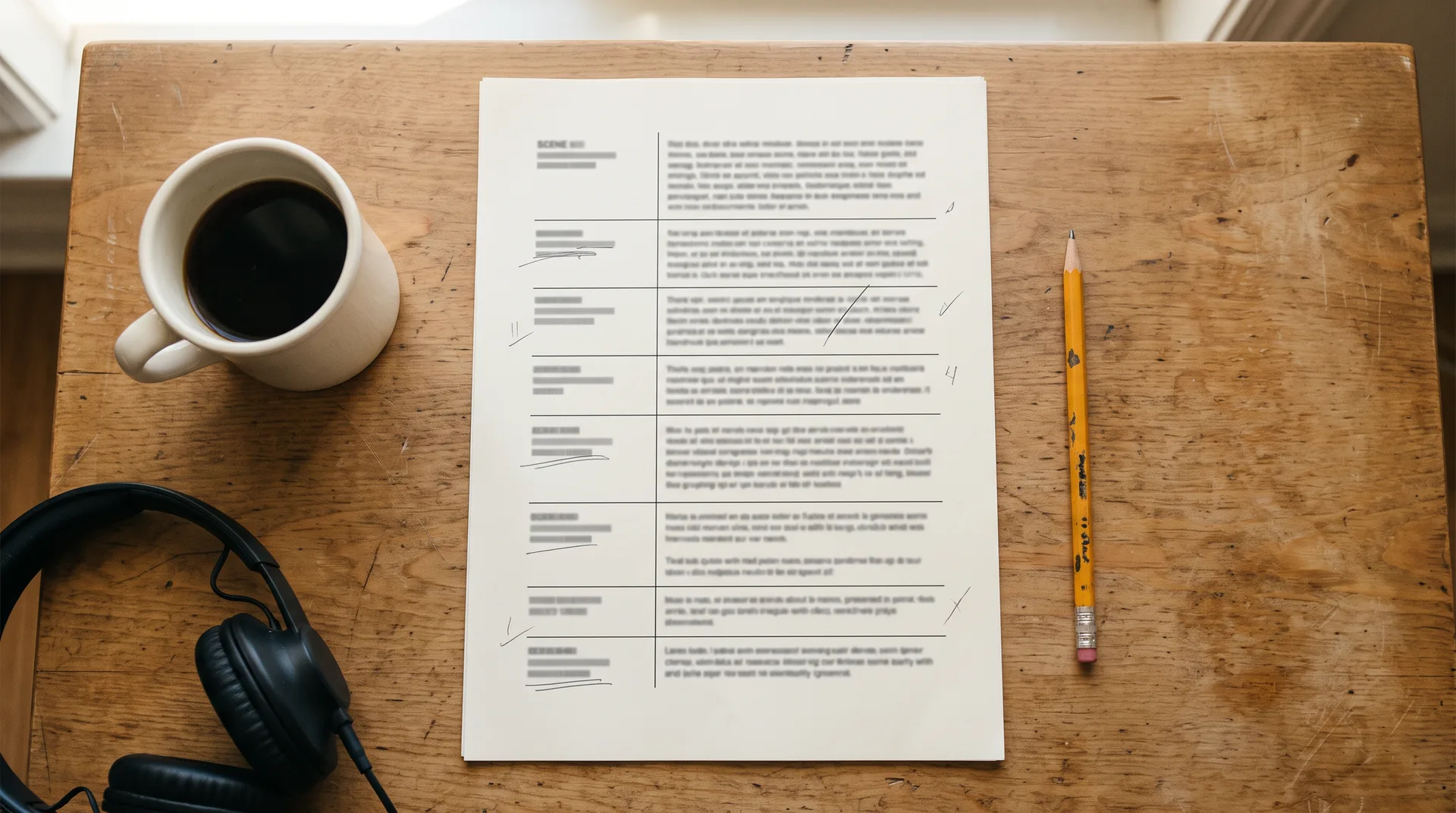
An AV script, meaning audio-visual, is a table rather than a document. It is standard for commercials, corporate video, explainers, public service announcements and broadcast news. The page is a grid, and each horizontal row is one synchronised moment of the finished video. Every audio moment sits beside the picture it belongs to.
Video runs down the left and audio down the right. That is the broadcast and agency convention and it is what you will see almost every time. Some tools invert it, putting audio first so the writer sets pacing before locking pictures. That is a reasonable way to write, and it is not what you will be handed.
In a two-column script, everything not spoken aloud is set in capitals. The whole video column, character labels, music, sound effects, all of it. Spoken copy stays in ordinary upper and lower case so it reads cleanly.
Which means capitals are the instruction to say nothing. That is the exact reverse of the habit you built reading screenplays, where capitals mark a character's first appearance or a moment of emphasis.
An actor who reads their first AV script with screenplay instincts will read the wrong half of the page out loud. It is a five-second thing to learn and an embarrassing thing to learn in a session.
The labels in the audio column are their own small vocabulary. ANNCR or ANNC is the announcer, AVO is announcer voice over, and MVO and FVO are male and female voice over. SFX is sound effects and MUSIC is what it looks like. Named roles appear as themselves, so you will see BOSS or MOM sitting in the same column.
Timing marks often run down the margin in minutes and seconds, and they are checkpoints rather than a rulebook. There is no standardised row-numbering system, whatever a template implies.
A narrow left column carries the cues and a wide right column carries the copy. Sound effects go in the left column, in capitals, underlined. Music cues are underlined too, and they come in three working types: a bridge between scenes, a bed under dialogue, and a sting for sudden emphasis.
Two conventions from radio drama are worth stealing whatever you record. Delivery directions go in capitals inside round brackets, so they can never be read aloud by accident. Technical directions go in square brackets, which tells the engineer what to apply and tells you that you are playing a processed voice.
And dialogue is double spaced for a reason that has nothing to do with paper: the gap is where you write your marks.
Three more formats, and none of them is a screenplay
These are the documents that surprise people who arrive from on-camera work.
The game line list deserves a sentence of its own, because one column on it explains how a session actually runs. The inflection column does two jobs. It tells you the delivery, and it lets the session be sorted by volume so that all the shouting is recorded together. Without that you would ping-pong between a whisper and a scream all afternoon, and your voice would not survive it. The filenames encode structure too, so a line might carry its mission, its area, its character and its number in a single string.
Barks are the other thing worth naming, and they are the short systemic lines that background characters throw out, triggered by what the player does. They are written in large numbers of variations, and recording them is its own kind of stamina.
What to actually do with the markings
Two categories, and confusing them is the most expensive mistake in the audition.
The constraints, which are pass or fail
What they areFile naming, format, length, deadline, the demographic the client asked for.
What happensA file that breaks one is discarded without being listened to. One casting call reported that seventy per cent of submissions came from talent visibly outside the stated age range.
The ruleObey these absolutely, because they are a filter that runs before anybody hears your work.
The adjectives, which are not instructions
What they areWarm, confident, conversational, authentic, and the words in every brief you will ever read.
What they meanThey describe the experience the client wants the listener to have, and they do not describe a sound.
The ruleTranslate each one into something you are doing to somebody. Warm means reassure them, confident means guide them to an answer, and conversational means tell one person something useful.
The failure mode this prevents
What people doThey lower the voice to sound confident, soften it to sound warm, and flatten the energy to sound conversational.
Why it failsEvery one of those is an impression of a quality rather than an action. It reads as performed and it books nothing.
Worth knowingCasting directors say this in almost the same words. One puts it as needing acting chops to interpret copy at all.
Two words people mix up
BreakdownInformation about the job: client, deliverables, usage, rate and deadline.
SpecInformation that guides the performance: tone, feel, character and art direction.
Why it mattersActors read the spec and skim the breakdown, then lose the job on a constraint they never read.
How to mark the page
The methodA slash for a breath or a beat, and an underline on the words carrying the meaning. Phonetic respelling beside any name you could get wrong.
The disciplineRead it aloud first, and mark only what disrupts the natural flow. Over-marking produces a theatrical read rather than a conversational one.
In the roomPencil, never pen, and write down the names of everyone in the session somewhere on the page.
And one habit that will make you look like you have done this before. Find the first appearance of the client's brand name and decide in advance what you are doing with it. It is the one word in the copy that the client is definitely listening for.
If you already act on camera
Most of this you own already, and being honest about which parts is more useful than a pep talk.
You can read sides cold, and you can take an adjustment without losing the thread. You know that a direction is a door rather than a description, and you have already learned not to play a mood. That is the hard part, and it is the part nobody can teach in a weekend. Casting people say it in almost those words: without acting ability behind it, copy is very hard to interpret.
The page works differently, and capitals mean stay silent in a two-column script. The document might be a spreadsheet. The job might be four hundred separate files with names you did not choose.
There is nothing to react to. In Western animation your performance comes first and the picture is built onto it. No scene partner, no eyeline, no room. The technique that replaces it is closer to radio drama than to film.
The delivery is a technical product, and nobody is going to fix your audio. What you send is what airs, and the specification is not negotiable.
None of those three is talent. They are all learnable in an afternoon, which is exactly why they are worth naming. They are the things that make a good actor's first voice over job go badly for reasons that have nothing to do with acting.
One more, because it is physical and people forget. Voice acting is not a seated activity done with the face. The actor who brings the voice to life gets the job, as one casting director working in games and animation puts it. He means the whole body. The booth is small, and you should use it anyway.
Grading the sources
A page whose argument is that other pages overstate their authority owes you its own working.
Where we differ from the standard account
Is there an official screenplay format?
Commonly saidImplied on nearly every page, and rarely stated outright.
What we foundNo, the writers' union publishes none, and the real standard is whatever the software offers in its dropdown.
A character's thoughts, on screen. V.O. or O.S.?
Commonly saidO.S., because the body is present.
What we foundIt is V.O., because the mark describes the voice and never the body, and this is the most common error on the subject.
Is O.C. an option?
Commonly saidListed as a third abbreviation alongside the other two.
What we foundIt is multi-camera television vocabulary, and seeing it tells you what kind of show you are reading.
How is a phone call marked?
Commonly saidV.O., stated as a rule.
What we foundThe V.O. mark is the convention and the safe choice, though produced scripts disagree and we name two that do.
What do capitals mean?
Commonly saidEmphasis, or a character's first appearance.
What we foundTrue in a screenplay and reversed in a commercial script, where capitals mark the words you do not say.
Do animation actors record to picture?
Commonly saidAssumed, because that is how dubbing works.
What we foundWestern animation records first and animates afterwards, while anime does the reverse, which is why the two jobs feel nothing alike.
What does a game script look like?
Commonly saidLeft vague, or described as a script.
What we foundA spreadsheet with a column for context and a column for inflection, and the inflection column is how the session gets ordered.
How closely do I follow the direction in brackets?
Commonly saidFollow the brief.
What we foundObey the constraints absolutely and treat the adjectives as objectives. Warm is not a sound, and it is something you are doing to somebody.
So the next time a V.O. mark appears on a page in front of you, read it as a stage direction about sound rather than a piece of punctuation. Somebody has to be in a room, alone, making that line true. On a good day that person is you, and almost everything you already know about acting comes with you.