What to buy, with the prices re-checked
Two honest tiers, and the gap between them matters less than the marketing wants it to.
Every list of the best microphones for voice acting is written by somebody who gets paid when you click. That is not a conspiracy, it is how those pages earn, and it produces one specific distortion. The article is always about which microphone, and never about whether the microphone is the problem. It usually is not.
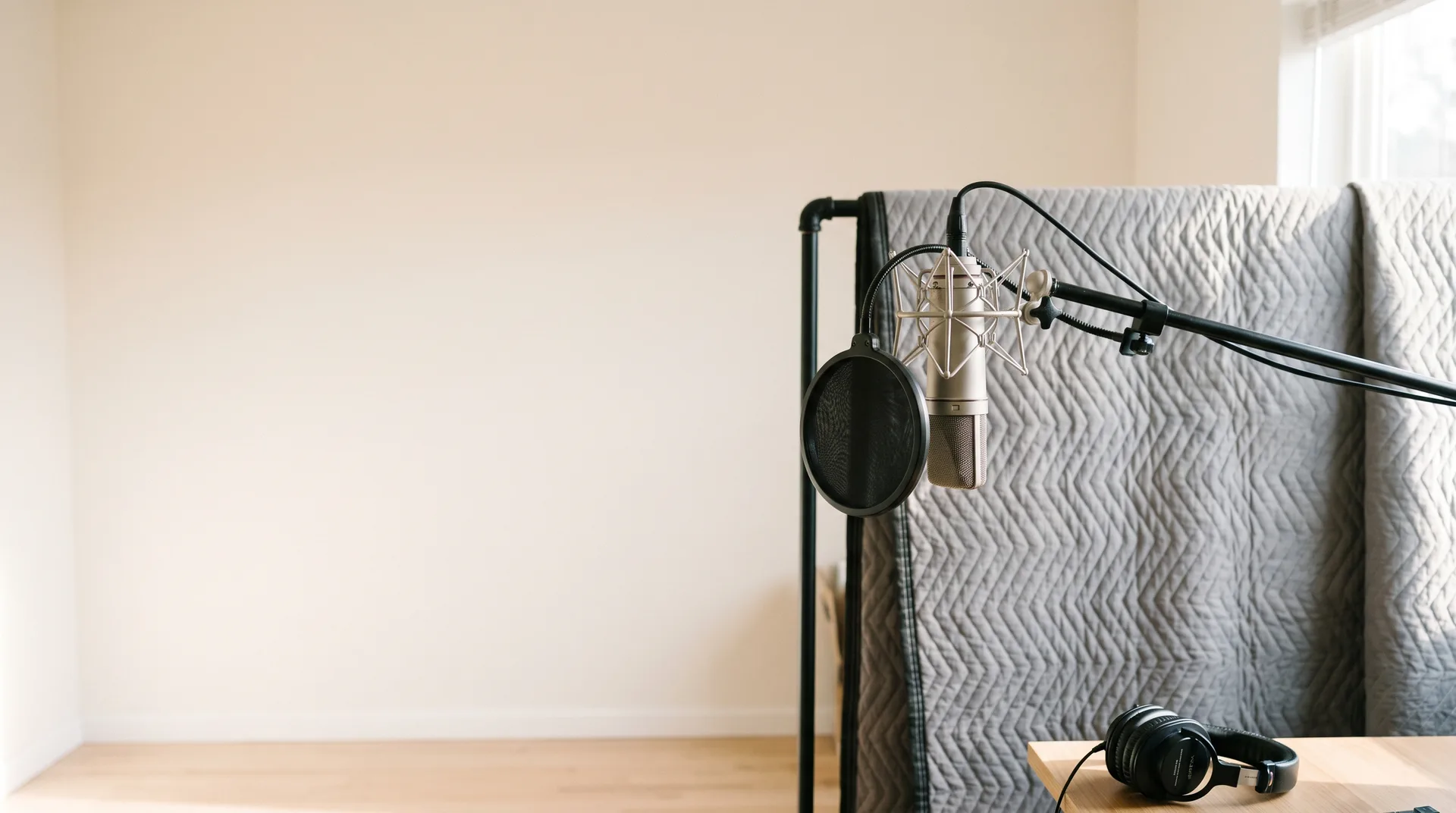
The SM7B and the RE20 are dynamics with very low output. To get a usable level from a budget interface you have to run the preamp near maximum, and a preamp running flat out amplifies its own hiss along with your voice. That is why inline boosters exist: the Cloudlifter CL-1 at $129, or the TritonAudio FetHead at $79.95.
So the classic rig is an SM7B plus a Cloudlifter. That is $439 and $129, which is $568.
Shure now sells the SM7dB, the same microphone with the booster built in, for $549. The integrated version is cheaper than the two-box version it replaced, and it is one less cable and one less thing on the desk. We are not aware of another page that has noticed.
The interface, and what it actually does
Your computer has no XLR socket, and even if you forced the cable in it could not do the three jobs that need doing.
An audio interface is the box that does them. It contains a preamp, which lifts the very weak signal a microphone makes up to a usable level. It contains a converter, which turns that electrical wave into the numbers your software understands. And it supplies phantom power, the small voltage a condenser microphone needs down the cable in order to work at all. If you buy an XLR microphone you need one. It is not an upsell, it is the other half of the microphone.
None of this is a place where spending more buys you a booking. The cheapest one on that list and the dearest one will both deliver a file that passes. Buy for the number of inputs you need and the quality of the metering, and then stop thinking about it.
Buy XLR, and not for the reason we gave you before
The conclusion has not changed. The argument underneath it was wrong, and we would rather replace it than quietly tidy it.
So here is the real reason, which is duller and much more useful.
Source-Connect asks the operating system for an input and an output at the same time, while your recording software is also asking for them. On Windows that is the difficulty. Source Elements say it plainly in their own help pages: Windows does not like to share audio drivers between programs.
Their list of devices known to work is a list of audio interfaces — Focusrite, RME, PreSonus, Audient, SSL, Avid. Those ship proprietary drivers that can serve two programs at once. A USB microphone almost never does.
And the free workaround has a sting. You can wrap a generic device with ASIO4ALL, and Source Elements document that doing so locks Source-Connect to a 44.1 kilohertz sample rate. Broadcast delivery is 48. That is a real problem on a real session.
There is also the mundane half. A USB microphone is an input only, so you still need an output for your headphones, which on a Mac means building an aggregate device and on Windows means the sharing problem above. And most have no zero-latency monitoring, which matters when somebody is talking to you in your ear.
So buy the interface for the driver, not for the connector. Same advice, honest mechanism.
One part of the original argument does survive, and it is worth keeping as what it actually is. The voice coach Lili Wexu makes the case that studios are simply more comfortable working with talent on a conventional rig. That is a claim about professional norms rather than about physics, and it is a fair one. It is just not the same claim as a technical requirement, and we printed it as though it were.
Where the money actually goes
There is one number underneath every cheap acoustic fix, and once you have it the whole subject stops being mysterious.
Five hundred hertz. Above it, everything affordable works. Below it, nothing affordable works. Blankets, duvets, foam, portable booths, the coat rail in your wardrobe: all of them start doing something around there and all of them stop doing anything underneath it.
The reason is thickness. A porous absorber has to be about a tenth of a wavelength deep to work, which the acoustics professor Trevor Cox has put in plain numbers. To absorb at 500 hertz you need roughly seven centimetres of depth. To absorb at 52 hertz you need sixty-five. And it has to cover a large area, not sit in a couple of corners.
Cox measured duvets against acoustic foam of similar depth and found similar performance. So a duvet is a real absorber and not a joke. It is as good as the foam somebody else paid more for.
But a male speaking voice has a fundamental somewhere around eighty-five to a hundred and eighty hertz. Nothing you can hang on a wall touches that. So the duvet genuinely kills the flutter and the sizzle that make a room sound like a bathroom, and does essentially nothing about the boxy low-mid honk that makes a recording sound like a bedroom.
If you have hung soft things up and the recording still sounds like a small room, that is why. You have not done it wrong. You have hit the floor of what the method can do.
The strongest evidence that the room beats the microphone is not from a gear blog. It is peer-reviewed. A 2018 study in the Journal of Voice tested exactly this and concluded that the effect of room acoustics and background noise on voice measurements is stronger than the type of microphone used. That is the sentence to hold on to when a forum tries to sell you a capsule.
The practitioner version has been around longer. The engineer George Whittam, talking to Backstage, put it as a budget rule: if you have a thousand dollars for a microphone and nothing for acoustics, split it in half. That was said in 2011, so read the figure as a ratio rather than a price.
One more thing, because the internet is confidently wrong about it. The clothes-filled wardrobe is not the answer everybody says it is. Acousticians dislike very small booths precisely because room behaviour at low frequencies becomes erratic in tiny spaces, right where the human voice lives. A bigger room with soft things in it usually beats a cupboard.
The portable booth, actually measured
This page used to say reflection filters essentially do nothing. That was too strong, and there is a laboratory test that settles it.
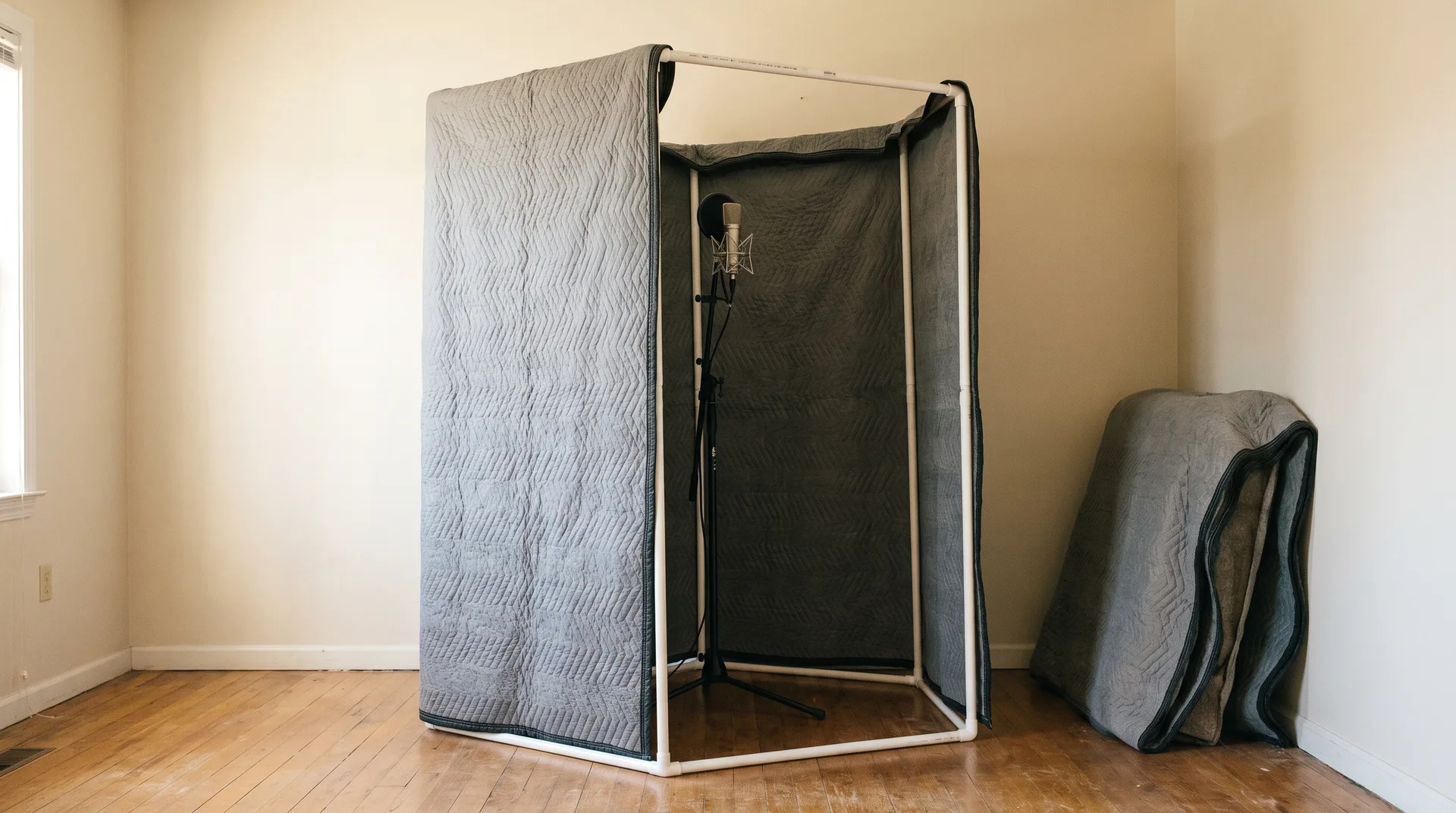
Sound On Sound took ten portable vocal booths to the acoustics laboratory at the University of Salford and measured them in a reverberation chamber. It remains the only controlled comparison we can find, in either direction, and we searched hard for a newer one. It was published in 2014, and we are telling you that rather than hiding it.
The sceptics are wrong that these do nothing. Two and a half to eight decibels of reflection reduction is real. The reasoning usually given for the sceptical case is wrong too: it says a cardioid microphone already rejects what is behind it, but the filter's job is to absorb your voice on the way out, before it can come back off the wall into the front of the microphone.
The manufacturers are wrong as well. One markets its filter as working evenly across the whole spectrum with no coloration at all. Every unit in the test coloured the sound, and none of them worked below 500 hertz.
The honest version. A few decibels above 500 hertz, at the cost of some coloration, and nothing for outside noise. It is a supplement to treatment and not a substitute for it. Size beats price. And if the same $199 could go into broadband absorption behind you and around you instead, put it there.
The numbers a client will actually demand
Start with the term that gets thrown at you first, and then with the three different peak figures that all claim to be the standard.
Your noise floor is the sound of your room when you are not speaking. The fridge two rooms away, the fan, the traffic, the hum of the building, all added together. It is measured in negative decibels and the more negative the number, the quieter the room.
Here is the arithmetic that ruins people. Whatever gain you add later to bring a quiet recording up to the required loudness, you add to the noise floor as well. If you need ten decibels of lift to hit the target, your raw noise floor has to sit ten decibels below the limit to survive it. You cannot mix your way out of this. You can only be quieter to begin with.
It is real, it is everywhere, and it is not a broadcast standard. It is a marketplace rule. One large voice over marketplace states it outright, and gives the reason: so that files survive the conversion from WAV to MP3 on the way in.
The actual broadcast standards say something else. The European recommendation sets true peak at minus one. The American one sets it at minus two. The audiobook platform and the marketplace both say minus three.
And they are not even measuring the same thing. The broadcast figures are true peak. The marketplace figures are sample peak. A file sitting at minus three sample peak can exceed minus three true peak once it is encoded. Meet whichever number your client asks for, and do not let anyone tell you it came from a standards body when it did not.
For broadcast and commercial delivery the shape is different again. Forty-eight kilohertz at twenty-four bits, as a WAV. That is what the UK broadcast delivery specification requires and what the large streamers require for dubbing and description stems. The reason is unglamorous: at 48 kilohertz there is a whole number of samples in every frame of video. Mono is standard, and you deliver dry. No equalisation, no compression, no noise reduction, no gate. The engineer at the other end applies their own chain, and a file that arrives pre-mastered marks you out immediately.
What a take actually gets rejected for
This is the part nobody writes, so here it is in the platform's own words rather than ours.
Its requirements page lists the disqualifiers in one sentence. Files must be free of plosives, microphone pops, mouse clicks, excessive mouth noise, and outtakes. Separately it requires consistency across levels, tone, noise level, spacing and pronunciation. That single pair of sentences covers most of what gets sent back.
Above all of it sits the noise floor, and it is not close.
People fail for cleaning their audio too hard far more often than for not cleaning it enough. A beginner hears noise, panics, and runs noise reduction until the voice sounds like it is underwater.
The platform's own quality guidance says it plainly: the improper use of noise reduction often results in an overly processed and poor sounding audiobook that may be rejected. Its recommended fix is not software. It is better sound deadening in the room, fixing the equipment, and re-recording the affected sections.
On noise gates it is even more direct. Your room tone should not change at all, whether it is under your voice or in the clear, and your audio should never drop to absolute zero. That is the best one-line explanation of why a gate ruins voice over, and it comes from the people doing the rejecting.
If you already self-tape, you own some of this
Being specific about which parts is more useful than telling you it all carries over, because it does not.
What genuinely transfers
The big oneThe habit of vetting a room for noise. You already listen for the boiler, the fridge and the street before you press record. Voice over is that same discipline with a number attached to it.
HardwareYour light stand takes a microphone clip. Your closed-back headphones carry over untouched. Your computer will run any interface on this page.
The soft furnishingsAbsorption does not know what it is absorbing for. Anything you hung up for self-tape sound is already working for you.
The phone or camera microphone
Why notNo route into recording software at forty-eight kilohertz, and no route into a directed session.
The real problemIt is three to six feet away. Voice over wants six to twelve inches. At self-tape distance the balance between your voice and the room is already wrong before anything else goes wrong.
The lavalier
Why notIt is built for a chest, it is usually omnidirectional, and it is voiced with a lift to compensate for sitting under your chin.
The consequenceOmnidirectional means it hears the room equally in every direction, which is the opposite of what an untreated room needs. And it cannot be angled off your mouth to dodge plosives, because it is not in front of your mouth at all.
The ring light
Why notNo audio value whatsoever, and it occupies exactly the space in front of your face where the microphone and pop filter need to be.
WorseIts fan or driver can be a noise source in its own right. There is no shot. Turn it off and move it out of the way.
The USB condenser you already own
The honest answerIt can absolutely make a file that passes audiobook quality control. Plenty of published work was recorded on one.
The ceilingIt struggles with a live directed session, for the driver reasons further up this page. Buy the interface when the sessions arrive, not before.
Grading the sources
A page correcting its own previous claims owes you the working on all of them.
Where we differ from the standard account
Which microphone should I buy?
Commonly saidA ranked list, usually written by somebody paid per click.
What we foundAny competent one at a hundred and nineteen dollars, then spend the rest on the room. The capsule is not what fails.
Why XLR rather than USB?
Commonly saidBecause professional studios and live session software require it.
What we foundThey do not require it. The real reason is that Windows will not share generic audio drivers, and the free workaround locks the session to the wrong sample rate.
Are portable vocal booths worth it?
Commonly saidEither a miracle or a scam, depending on who is talking.
What we foundNeither. A few decibels above five hundred hertz, coloration in every unit tested, and nothing at all for outside noise.
Will a duvet fix my room?
Commonly saidYes, and cheaply.
What we foundPartly. It matches acoustic foam of the same depth, and it does nothing below five hundred hertz, which is where a bedroom sound actually lives.
Should I record in a wardrobe?
Commonly saidThe classic beginner recommendation.
What we foundAcousticians dislike very small booths, because room behaviour turns erratic at exactly the frequencies a voice occupies.
How clean should my file be?
Commonly saidAs clean as you can get it.
What we foundLess clean than you think. Over-processing is a documented rejection reason and your room tone should never drop to zero.
Is minus three decibels a broadcast standard?
Commonly saidQuoted as though it were.
What we foundIt is a marketplace rule about surviving MP3 encoding. Broadcast says minus one in Europe and minus two in America, and measures peaks differently.
Is an SM7B still the smart buy?
Commonly saidYes, with a Cloudlifter.
What we foundThat pairing is five hundred and sixty-eight dollars. The version with the booster built in is five hundred and forty-nine.
So buy the cheap microphone, buy the cheap interface, and then stop. Everything you have left goes into the six feet of air around your head, because that is the part a client can hear and the part no purchase fixes on its own. And if the room still sounds like a bedroom after you have hung everything you own on the walls, you have not failed. You have found the floor, and the floor is at five hundred hertz.