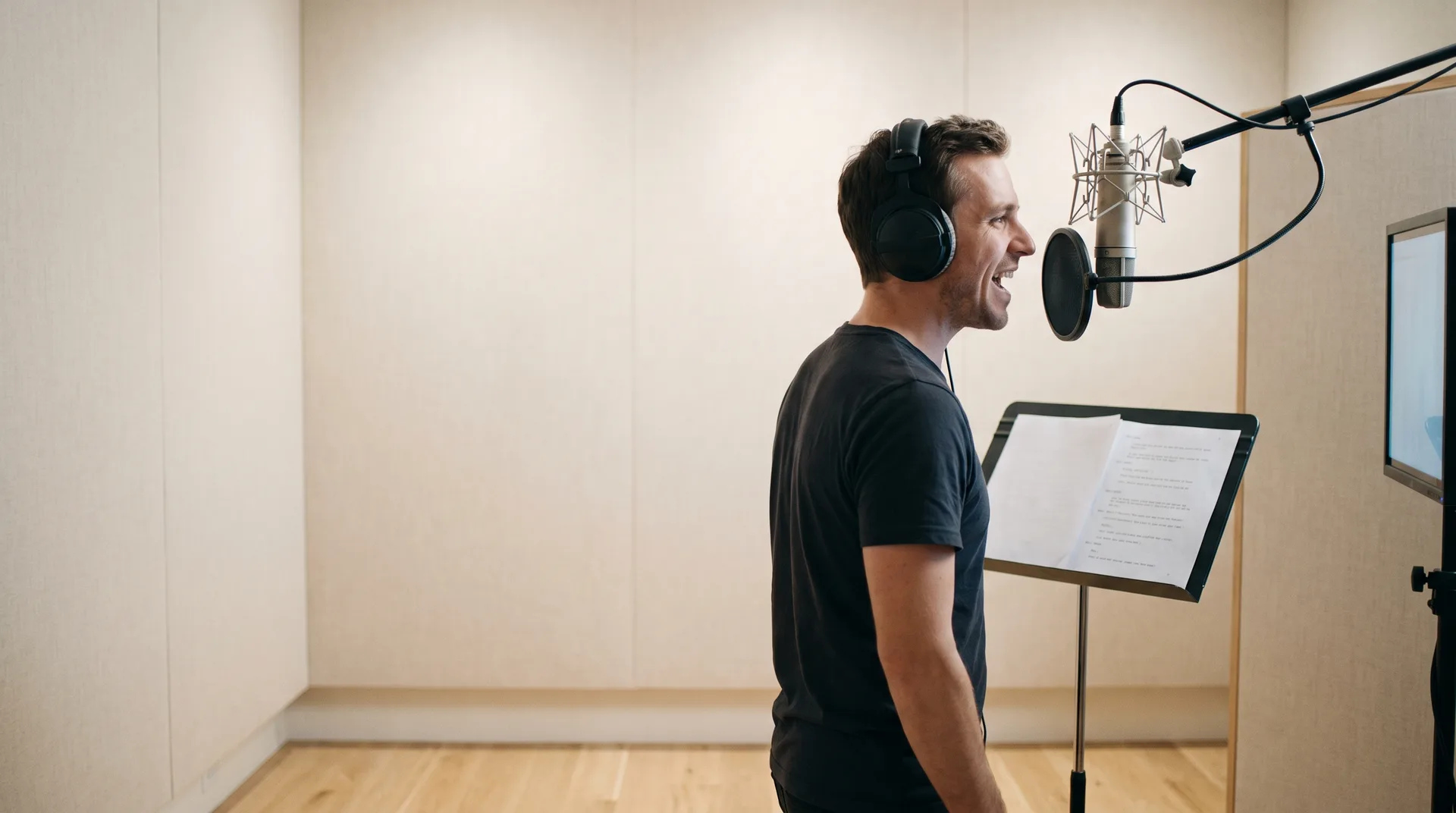
What the dream job actually pays
Start here, because every other page on this subject either avoids the number or prints one that is wrong by a factor of a hundred.
In March 2022 Anime News Network published an investigation into union anime dubs. Its estimate for the English cast of a film that had just opened at number two in America was a hundred and fifty to six hundred dollars each, for the entire job. Not per hour. The total.
Anairis Quiñones, Chris Tergliafera and Tara Jayne Sands have each said they were paid a hundred and fifty dollars for that film. Sands added that she had tried to negotiate a higher rate and failed.
The film took more than thirty million dollars in the United States and more than a hundred and ninety million worldwide.
So this is no longer an estimate. It is an estimate that three named performers then confirmed at the bottom of its range. That is a rarity in this industry and it is the single most useful fact on this page.
Another actor from that cast has said plainly that he could not make a living from anime voice acting without audiobooks and teaching alongside it. That is the honest shape of the work, and it comes from somebody at the top of it.
The union rate, and why most of this work is not on it
There is a contract for exactly this work. It pays several times better, and the biggest employer in English anime does not use it.
SAG-AFTRA maintains a dubbing agreement with a published wage table. The old page here quoted eighty-seven dollars an hour, which was correct in 2021 and has been superseded three times since. Here is the actual ladder.
A union anime film dub, at the minimum call, from July 2026: a hundred and six dollars an hour with a two-hour guarantee is two hundred and twelve dollars. Then a fifty per cent buyout is paid on top for the rights, which takes it to three hundred and eighteen. Pension and health contributions add another twenty-one per cent on top of that.
Roughly three hundred and eighty-five dollars for turning up to the minimum session. Against a hundred and fifty for an entire feature film, non-union.
One correction almost nobody gets right. That dubbing agreement covers feature films. A union anime series for television or streaming is paid per episode under a different agreement entirely, at around twelve hundred and forty-six dollars an episode. Two different contracts, two different shapes of money.
So why is so little of it union? Because the largest buyer of English anime dubs has not signed. In 2022 an actor offered to work on a series non-union, for the same money, in exchange only for a commitment to future talks about a union contract. He was recast. The company's public statement said it would produce the dub at its own Dallas studios and would need to recast some roles. His own clarification was that it was never about the money: they were prepared to pay him union scale or better, they simply did not want it on a union contract.
The recording is concentrated in Texas, which is a right-to-work state. That does not make unions illegal and it does not ban collective bargaining, whatever you may read. What it does is make union security clauses unenforceable, so a union cannot require everyone in a bargaining unit to contribute. The effect is to weaken organising leverage rather than to remove the right, and the distinction is worth getting right.
Nothing. We searched hard for a 2024, 2025 or 2026 organising drive, new agreement or studio signing, and found none.
In February 2023 one of the actors involved predicted the company's plan was to weather the storm and wait for people to get tired of talking about it. Four years on, that appears to have been correct, and we would rather write that than imply progress that has not happened.
For balance, some of this work is union. Films from certain distributors are, and one large streamer's dubbing is done under a standing union agreement whose wage table has been maintained out to 2030. That was reported in 2022 and we could find nothing since that confirms or contradicts it, so treat it as the best available evidence rather than as today's fact.
Who actually hires an English anime dub
Not the streaming service whose logo you associate with the show. The recording studios, and the list has changed.
Look at that geography and say it aloud. Los Angeles, Dallas, Houston, New York. That is the map, and it is the same map as four years ago with one qualification: Vancouver names are appearing on current dub credits often enough to notice. We would call that a trend rather than a fifth centre.
Several guides list licensors instead of studios, which sounds authoritative and helps nobody. A licensor buys the show. A studio books the room. You are trying to reach the second one.
How casting works, and the routes that actually exist
The casting director at the best-known studio has described her own process in public, and it explains why the standard beginner plan fails.
Once a project is greenlit, she lists ten to twenty actors per role from the studio's talent database and requests auditions from them. That is the audition list. So the audition is not the gate. Being in the database is the gate.
She has also said the studio keeps every audition file, tens of thousands of them, accessible at any time. Which reframes a single audition entirely. It is not a lottery ticket that expires. It is an entry in a filing system that gets searched for years.
One of the Houston studios answers the question directly in its public FAQ: at this time it does not hold auditions to cast its English dubs. It goes on to say its actors are trained professionals with backgrounds in theatre, television and film.
That is a company telling you in writing that there is no public door. We would rather point you at it than pretend otherwise.
The thing that changed while nobody updated these pages
Between December 2025 and May 2026 the AI question stopped being hypothetical for anime specifically.
That last row is the one worth sitting with. It does not replace an English actor with a synthetic English actor. It carries the Japanese performer's voice across every language, with their consent and a revenue share. If that model spreads, the English dub role does not get automated. It gets skipped.
California has a statute. It applies to performances fixed from 1 January 2025. It voids contract terms allowing a digital replica without a specific description of the intended uses, and it covers union and non-union performers alike.
Texas has no equivalent. A performer there relies on whatever is in the contract they signed, plus general publicity and misappropriation law.
So a non-union anime dub recorded in Burbank carries statutory digital replica protection. The same job recorded outside Dallas does not. Most English anime dubbing happens in Texas.
The federal bill people point to is not law. It cleared a Senate committee in June 2026 and has gone no further.
The two-hour clause, and the jobs where it does not apply
A veteran's warning about this work has been quoted for years without the context that makes it land.
The line is Steve Blum's, given to Anime News Network in 2022: he saw people damage themselves permanently for some of the lowest pay in the industry. It is usually printed on its own, as a general complaint about rates. It was not. It was said in support of a specific request, from another actor, for hazard pay on shows demanding strenuous and potentially damaging sessions.
That request has an answer, and it is already written into the union contract.
It defines vocally stressful work explicitly. Yelling, shouting, screaming, fighting sounds, death sounds, battle cries, creature sounds, unnatural vocal textures, extensive whispering, high-pitched sounds, and anything else difficult for the performer to deliver.
And then: sessions that predominantly contain vocally stressful work will be no longer than two hours.
There is also a two-hour minimum guarantee, overtime in quarter-hour units, and higher rates at weekends. On a non-union dub, none of it applies. No cap on the screaming and no guaranteed minimum, which is exactly why an actor's 2022 complaint was about thirty-five dollars an hour without session minimums.
The harm is not theoretical. In May 2025 the English voice of one of the most demanding roles in the medium said something startling. He may have lost consciousness between one and three times recording a single finale, and it had happened to him before on the same character years earlier. He put it down to misjudging how long he could sustain shouting while managing his breath between takes.
If you already act on camera
Anime dubbing is closer to your existing skill set than it looks, and further from it in one specific way.
Everyone senior in this business leads with the same thing. The casting director at the best-known studio says the first thing is acting, and that people who think a nice voice qualifies them have misunderstood the job. What she looks for is the acting and the emotion, and whether somebody can own the character honestly.
Anime is recorded after the animation is finished. Western animation records first and draws to the track. Anime does the reverse, an approach fixed in the nineteen sixties because it is cheaper and lets the script stay flexible late.
So an English anime dub is a third-generation performance. Animated to a Japanese track, then re-performed in English against a finished picture, matching timing you did not create, in a language the mouths were never drawn for.
That makes it an ADR discipline rather than a cartoon voices discipline. If you have ever looped your own on-camera work, you already have the mechanic.
What transfers directly
The main thingActing. Taking a note and adjusting without losing the thread. Staying consistent across takes. An ADR stage runs at the rhythm of an on-camera coverage day.
Cold readingSame-day dubs are now normal, and four of one studio's summer titles went out on the day of broadcast. You will read fast and cold.
LoopingIf you have ever done ADR on your own footage, that is the core skill, and most on-camera actors have.
What does not transfer
Your bodyEverything you normally do with a face and a posture has to be routed through breath and voice alone.
Owning the timingYou perform to a fixed picture and a fixed number of mouth flaps. One director describes it as a dance where timing is everything.
The other actorsAnime dubs are recorded one performer at a time. You will rarely play opposite anybody.
One piece of folklore, softened by a director
The beliefThat you must hit the flap perfectly or the take is unusable.
What a director saysOn a modern dub, if a take is spontaneous and right but slightly off, it is the engineer's job to make it fit the animation.
What that meansPlay the moment. Do not sacrifice a true reading to land a syllable.
Set your expectations from somebody who hires. Her advice to newcomers is to be patient and to be ready for the fact that you will not be living professionally from voice acting for at least a few years. That is a casting director telling you to plan for years of not earning from this, and she is not being cruel. She is being useful, which is rarer.
For an actor who already works on camera, that reframes the whole thing usefully. Anime dubbing is a supplementary line of income and a craft to build slowly. It is not a career pivot, and the money section above is why.
Grading the sources
This page rewrites its own previous claims in several places, so here is the working on all of them.
Where we differ from the standard account
What does anime voice acting pay?
Commonly saidAbout a hundred thousand dollars a year, from a salary aggregator.
What we foundThat figure is scraped from job listings that do not exist. Three named actors were paid a hundred and fifty dollars each for a film that took a hundred and ninety-one million.
How do I audition?
Commonly saidSubmit through an online voice marketplace, or to the streaming service.
What we foundEnglish anime dubs are not cast on marketplaces, and the largest employer runs no public audition platform. Two studios take direct submissions and one states it holds no auditions at all.
Is Funimation still hiring?
Commonly saidListed as a current studio, including on a guide republished in 2026.
What we foundIt closed on 2 April 2024. The open auditions that made several careers went with it.
What is the union rate?
Commonly saidNinety-five to a hundred and three dollars an hour, quoted from tables that have since moved.
What we foundA hundred and six dollars an hour from July 2026, plus a fifty per cent buyout on film work, and a different agreement entirely for series.
Is a hundred and twenty-five dollars an hour the going non-union rate?
Commonly saidReported as an average.
What we foundIt is a campaigning organisation's published standard for what actors should be paid, not a description of what they are paid.
Do I need to speak Japanese?
Commonly saidAdvised as a way to access more opportunities.
What we foundNo. Scripts are translated and adapted by writing teams before an actor ever sees them.
Is AI coming for anime dubbing?
Commonly saidTreated as speculation, or not mentioned.
What we foundIt shipped on real anime in December 2025 and was pulled after days. A licensor said it had not approved it.
Am I protected against a digital replica?
Commonly saidRarely raised at all.
What we foundIn California, yes, union or not, for performances from January 2025. In Texas, where most of this work happens, there is no equivalent statute.
So treat this as a craft you build over a decade, in one of four cities, alongside work that pays your rent, and let the fantasy version go. The fantasy version is the one that costs people money. If it is the medium you love, that is a good enough reason and the door is narrow but real. If it is a living you are after, the honest answer is that this is not where it is, and the numbers on this page are why.