Twenty-three briefs, and four of them answer the question
We read the published audition requirements of twenty-three drama schools, universities and competitions, all of it in September 2026. We were hunting for one sentence, and most of them do not contain it.
The two that do are worth quoting whole, and Juilliard permits it. Its Actor Training Program frequently asked questions say you may bring a contemporary monologue “that comes from a screenplay or even that you have written yourself”. A condition follows, because you should also prepare something from a published play.
New York University’s Tisch School of the Arts says the opposite, in a bracket. “All monologues must be from published plays (no musicals; no film/TV scripts; no original material).”
Those are the clearest two sentences in the field. Everything else we read is either silence, or a published play requirement that closes the door without ever mentioning you.
“If possible, for this audition, we request that you do not perform pieces by Gabriel Davis, Don Zolidis, Kellie Powell, or Wade Bradford, and that you avoid any monologue that is not a piece of a larger whole, such as a play, a screenplay, a novel, or a TV script.”
The four writers are the most performed authors of free standalone audition monologues on the internet. The second clause then rules out standalone pieces as a class. It is one sentence and not two rules, so quoting only the first half of it misrepresents them.
Now the part that makes this page necessary. Gabriel Davis is first on that list. He also publishes the most useful free guide to writing a monologue we found anywhere. It is the source of most of the craft in our method section below. One institution’s named exclusion is another reader’s best teacher, and nobody in this field has noticed.
The sentence allowing self-written material sits on the Actor Training Program frequently asked questions page. A newer monologue document on the school’s application site contains no such sentence at all. It has also hardened the old warning about monologue books, and beware has become a flat instruction not to use them.
So the permission is real and published, and it exists in one place while a second official document is silent. If you are going to rely on it, print the page and take it with you.
Eleven of the fourteen pages teaching this cite nobody at all
Before writing a word of method we did what we do on every page here. We read the field and asked each page where it got its ideas, and the answer, almost everywhere, is nowhere.
This matters more than it sounds. Monologue writing is a craft with a real literature behind it. Working playwrights have argued in public about whether the form is any good, and almost none of that reaches the pages people actually read.
Two pages out of fourteen cite a craft authority. One is itself taught by a playwright, and the rest are working from the air. That is why this page names a person for every claim it makes, and says plainly when it cannot.
Arnold Wesker thought a good one was not a monologue at all
A speech that lives inside a play is one object, and a speech built to be performed on its own is another. One page in the entire field says so. The writers who actually make these things have been arguing about it for thirty years.
Wesker made the sharpest move, and in the preface to his one woman plays he refuses the word. “A monologue is one person speaking but not engaged in any action.” It suggests a character thinking out loud and addressing no one else. What you want instead is a play for one actor. That, he writes, suggests “a character responding to a situation, involved in an action, engaged in an exchange of some tension”.
That is a definition rather than a rule, and it is more useful than a rule. Wesker hands the word monologue to the undramatic case. Then he tells you to write the other thing, and every piece of advice below is a way of writing it.
Now the practical consequence, and it is the hard part. A published speech has a play behind it. You have read that play and the panel has not needed to. Your speech has nothing behind it at all, so every circumstance the piece depends on has to arrive inside it, unexplained.
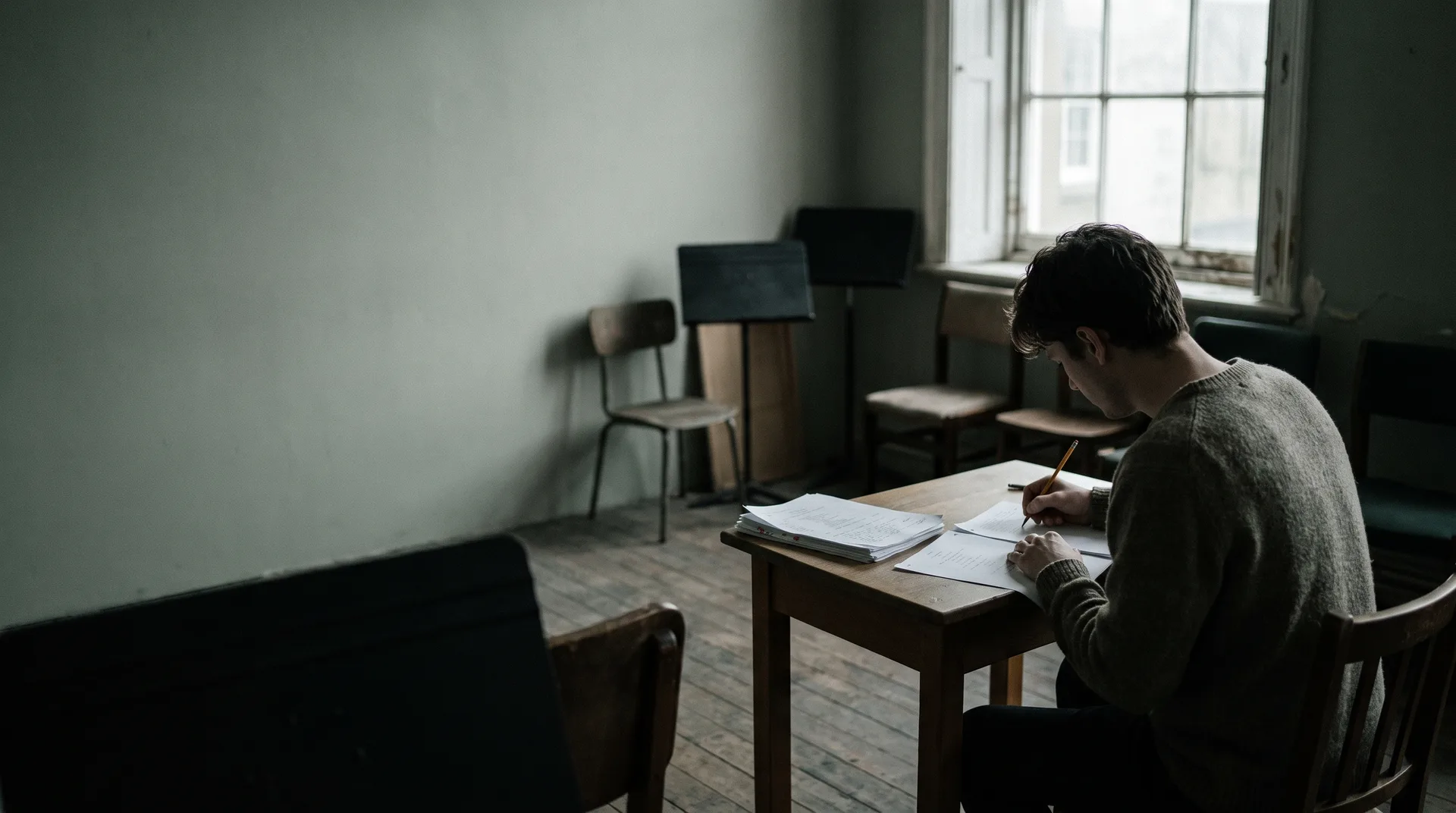
In Creating Your Own Monologue, his chapter on short and audition pieces makes the point physically. “In a bare rehearsal hall, with no lights or costumes to help you, you will only have your words, your body, and your voice to indicate to the viewers when you’ve started performing, when you’ve reached the high point, and when the piece is finished.”
Read that as a writing instruction rather than a performing one. The start, the peak and the end must be legible in the text, because nothing else in the room is going to mark them for you.
Allworth Press published it in 1999 and reprinted it in 2005. It is the only book length treatment of this problem we could find, and none of the fourteen pages above mentions it.
One last framing, and it is the shortest: Will Eno teaches a Princeton workshop on the dramatic monologue. Its stated purpose is to reaffirm “the very simple idea behind all of them: I’m trying to talk to you”. Ask your draft who you is, and if it cannot answer, you have written something else.
The ten elements, and the bus driver
Two sources carry almost all of the teachable craft in this subject. One is a list of ten elements by a playwright who names his own teachers. The other is a studio exercise that produces original material without a blank page.
Gabriel Davis sets out ten elements of an audition monologue, credited to the playwright Milan Stitt and to the director and novelist Kathleen George. He is also careful in a way the copies of his work are not. Some monologues contain several of these, he writes, and others feature only one or two.
Then the mistake, from a writer catching herself making it. Charis Joy Jackson wrote about her own draft in Backstage. She used too much exposition at the start. She spent less time on the immediateness of what was happening right then. Her diagnosis is one sentence long: “I’d forgotten to give the character an objective for the scene.”
That is worth more than a rule, because it is the rule discovered by breaking it. And it points at the advantage you have as an actor. You already know what is unplayable, because you have stood in a room and tried to play it.
Glenn English of Act Now Studio in New York published it in June 2021. It is the only method in this field that starts outside your own imagination. Interview a real person, or work from a published collection of interviews. Do a full character analysis from what the interview gives you, and fill the gaps from the givens or from your own invention.
Then adapt, because his adaptation rule is also a writing rule. “You want to cut anything that isn’t active in speech or observation. Nothing in the passive voice and try to keep it in the present tense whenever possible.”
He allows the exception in the same breath, because it is fine to slip into the past for background, as long as you keep it active.
Jackson offers a second route for people who freeze at a keyboard. “If you’re stuck on what to write, or just intimidated by the blank page, rely on your improv skills.”
Improvise it aloud into your phone, then transcribe what survives.
The worked example is the best thing in the whole subject, so here it is in full. A student built a piece from an interview with a bus driver. He used a chair and a phone playing the audio of a bus ride. From that he recreated the specific details of driving, of traffic and of riders. Then, in English’s words, “he just leaned over and started talking to one of his riders, the way some bus drivers naturally do.”
A specific world, established through physical activity, that then finds somebody to talk to. The doing comes first. The address arrives out of it, and that is the reverse of how almost everyone writes a first draft.
English’s own summary of why it worked: “It was a very specific setup that got the viewer involved, that organically evolved into the monologue.”
The account is one studio’s and it is not independently corroborated, so take the shape rather than the outcome.
The rule everybody repeats, and nobody we can find said first
You will be told that the character must change during the speech. We went looking for the person who said it, and we came back without one.
Here is what actually exists. Michael Shurtleff’s sixth guidepost is Discoveries. It is about scene work with a partner rather than about monologues, asking what is new and what your partner is saying or not saying. It has since been pointed at solo speeches, and the people who moved it do not say they have.
Davis comes closest to the rule and stops short of it. His ninth element is discovery in the moment, not transformation across the piece. He writes that we are often seeing a character come to a realisation. Often is not must, and he also says a monologue may feature only one or two of his ten.
Juilliard uses the word transformation once, and it is about something else entirely. The school asks that the different characters you choose reveal your capacity for transformation. That is a note about the set of pieces, and it says nothing about the inside of any one of them.
Karen Kohlhaas’s The Monologue Audition is the standard book length authority here, and we could not read the text. The rule may well be in there, properly argued. If it is, we will quote it and correct this section.
We also nearly published something false ourselves. Our working notes said Davis argues that a button matters because there is no lighting cue in an audition room. It is a good argument and a memorable one. It is not in Davis, and it is not in the one other article on buttons we could find. We could not source it to anybody, so we have taken it out and told you, instead of quietly dropping it.
Treat it as a trade convention of the commercial audition monologue, not a law of dramaturgy. Panels do respond to a piece that arrives somewhere, and coaches are not making that up. But nobody has derived it, and you are allowed to know that.
The version we would build on is Davis’s, because it is weaker and truer. The speaker should not know at the start exactly what they are going to say. That produces the same effect and it is far easier to write than a transformation.
An artificial intelligence tool is selling audition monologues to drama school applicants
Not one editorial page in this subject mentions generated material. The tools have no such reticence, and one of them names the exact use that two institutions above forbid.
HyperWrite markets a monologue writer with a single line of purpose. It offers to “generate unique and engaging monologues for acting auditions or drama school applications”. Read that against the Tisch bracket, and against the Thespys rule, and the collision is complete.
The Thespys wording is the sharpest of the three, and it is not about authorship at all. The title of the play the monologue came from must appear on an approved materials list. No other approval method is allowed, and a generated speech has no play. It cannot pass that gate, whatever anybody thinks of it.
A generated monologue fails on three grounds at once. It is barred wherever original material is barred. It has no larger whole to belong to, and it removes the one advantage of writing your own.
That advantage is worth naming, because everything else you perform belongs to somebody. It can be recognised, compared and heard fifty times in a week. A piece you wrote is yours to post, film, reuse and develop, and no panel has heard it before. A generated piece gives you the disadvantages of original material with none of that.
We are not being sniffy about the technology. Using it to find a subject, or to argue with a draft, is one thing, and submitting its output is another. The line is who wrote the words you stand up and say.
Length, layout, and the three readers
Three practical questions close the subject, and two of them have answers everybody agrees on. The third is not addressed anywhere in the field at all.
Length first, and English gives the working arithmetic as thirty, sixty and ninety seconds. A minute and a half, he says, is plenty in the professional world. That matches the numbers in our own chapter on cutting, and it matches what most briefs ask for.
The bus driver piece broke it. “Now did it break the 90 second rule? Yeah, kind of, but when something is really unique and really well done, they’ll let you get away with that.”
Set that against Gwyn Gilliss. She says that after two minutes a panel changes its mind, and it goes the other way. Both are true, and the honest instruction sits between them. Write to the limit. A piece that earns fifteen extra seconds will be obvious to everybody in the room. That includes you, and you cannot decide in advance that yours is one.
We could not find a single page that tells you how to lay an original monologue out on paper. Not the how-to pages, and not the script formatting guides. So this is our house answer rather than a citation. We have marked it as ours.
Put the character name and one line of situation at the top, above the speech. A published extract would carry an act and scene there. That is context for a reader, not something you perform.
Write no stage directions inside the speech. If the move matters, the words should make it necessary. Directions in an audition piece read as instructions to a panel, and they will be ignored.
Write no cue lines. A cue line means the other person is real and absent. That is exactly the problem the standalone form exists to avoid. Let the speaker absorb the reply.
Last, the thing nobody wants to do. Backstage’s advice on writing your own material for an agency audition is six words long. Get a lot of second opinions. With an original you are judging the writing and the performance at once. You made both. Your judgement is the least reliable instrument in the room.
Grading the sources
This page counts other people’s pages and quotes institutions directly. It corrects one of our own notes. And it publishes a house rule with no citation behind it. So it owes you the method on each.
Where we differ from the standard account
Am I allowed to perform something I wrote?
Commonly saidNobody says anything. Not one page teaching monologue writing tells you to check whether the room will accept the result.
What we foundJuilliard permits it by name and Tisch forbids it by name. Nineteen of twenty-three briefs never mention it at all.
Do the drama schools ban original work?
Commonly saidAssumed, wherever the question comes up at all, usually as a warning without a source.
What we foundEight British schools are silent on it. What stops you is a published play requirement, which is not the same thing.
Is a monologue just a long speech?
Commonly saidTreated as one everywhere, with a play extract and a standalone piece taught as the same object.
What we foundWesker distinguishes them and refuses the word for the good version. One page in the field notices the distinction.
Must the character change during it?
Commonly saidStated as a rule on page after page, and in coaching copy on the biggest actor sites.
What we foundNo named authority for it. The nearest thing is Shurtleff on scene work, moved across without a note.
How do I lay it out on the page?
Commonly saidNot addressed by the how-to pages or by the script formatting guides. The question simply is not asked.
What we foundNothing at all. So we have published our own answer, and labelled it as ours rather than dressing it up.
Can I use a generated monologue?
Commonly saidSilence from every editorial page, while at least one tool advertises the drama school application by name.
What we foundIt fails three separate tests at once. And it throws away the only real advantage of writing your own.
Where does the material come from?
Commonly saidSit down and write about something that matters to you. That is where most people stop and stay stopped.
What we foundOne studio publishes an actual method. Interview a real person, analyse, fill the gaps, then cut everything inactive.
Can I judge my own piece?
Commonly saidImplied throughout, since the pages teaching you to write one never mention showing it to anybody.
What we foundYou are grading the writing and the acting, and you made both. Three readers and one week beat any amount of rereading.
So write the thing Wesker would not call a monologue. Decide who is in the room before you write the first line. Go and get the specific detail from somewhere real. Let the address arrive out of the doing rather than opening with it. Then read the brief for the words published play. That sentence, and not the word original, decides whether you can take it into the room.