
Before the list, three things you are allowed to know
You are not required to have a reader.
Most actors arrive at this page carrying a low-grade embarrassment about asking people for favours. So here is the permission first, with the sources attached.
The UK Code of Best Practice: a reader is often beneficial to a good self-tape, but should not be an absolute requirement.
The same Code, in plain words: “Actors are not expected to pay for readers for their self-tapes.”
Casting director Krista Husar: as long as you have somebody you can connect with, “it’s okay if they sound stiff or are not a pro.”
The Code goes further than most actors realise. It says that if you are struggling to find a reader you should tell your agent and the casting director, and that all endeavours will be made to assist. That is a door most people never try. It is agreed by the Casting Directors’ Guild, the Casting Prep and Media Association, Equity and the Personal Managers’ Association, and it is mandatory for CDG members.
Actor Michael Gaston has made the argument directly, objecting to the assumption that actors can simply impose on their friends: “that should never be the unpaid potential employee’s responsibility.” We are not printing that as a grievance. We are printing it as permission — because an actor who knows a reader is not required will make a better decision at nine at night than one who quietly withdraws from the audition.
The tape is due tomorrow and nobody picked up
Six options, in order, with honest trade-offs.
The first three are unambiguously better than the last three. The last three are what this page is really about — and the published sources disagree about all of them, so we are showing you the disagreement rather than inventing a consensus.
A live reader in the room
Best quality, hardest to arrange. They do not need to be an actor — Krista Husar, Heidi Miami Marshall and the UK Code all say so explicitly.
A live reader remotely
Zoom, FaceTime or a phone call, with their voice on a speaker beside the camera. Coach Heidi Miami Marshall describes the fiddly part honestly: you have to position their window so your eyeline lands just off the lens and you can still see their face.The trade-off nobody mentions: a voice coming through a laptop speaker gets picked up by your microphone, so it will sound worse than a person in the room. Put the laptop behind or beside the camera and turn it down.
A paid reader
This buys you option one or two with money. Around £12 to £28 for a virtual reader — genuinely less than most actors assume. Prices further down.
An AI scene-partner app
The 2026 option, and the one with the most marketing noise around it. Read the next section before you decide — including the part about our own interest in the answer.The honest answer →
Pre-recording the other lines yourself
Free, popular, and specifically prohibited by at least one casting office. Weeble Mountain Casting instructs actors: “Do not pre-record your cue lines, or leave silence between your lines.”And yet Puro Casting takes the opposite view — they have received tapes where the actor recorded the other part and played opposite themselves, and say it works pretty well with timing caveats. Two casting offices, opposite instructions.
Leaving gaps
Last resort, and the sources split hardest here. Puro Casting says if there is genuinely nobody, simply leave gaps. The CDG guide says avoid this at all costs — do not read your own lines with imagined pauses between them, because anyone reading in with you is better.
Options one to three are agreed on by everybody. Options four, five and six are contested by named casting offices, sometimes in flat contradiction. A page that gives you a clean ranking here is inventing agreement that does not exist — and you would find out eventually.
Which changes every decision below
The reader is there so casting can watch you listen.
Most pages treat the reader as a logistics problem. Casting treats them as an instrument, and that reframe explains everything else on this page.
So here is the sentence that governs the rest
The reader is not there so you have something to talk over. They are there so casting can watch you listen.
That explains why fixed pre-recorded audio is a problem, why a monotone reader is worse than an amateur one, and why where they stand matters as much as how they read.
The most commercially polluted question in self-taping
Are AI reader apps accepted?
Our own interest, stated first
We sell one of these. Read that before you read the rest.
GotAuditions makes a scene partner reader. So we have a commercial interest in your answer to this question, and you should weigh what follows accordingly.
We are telling you that up front because every other source on this topic has the same problem and does not say so. Here is the actual state of the public record.
What the app companies say
Several AI scene-partner apps state that casting directors generally accept AI line readers — a live human is preferred, but virtual readers are fine, and casting is focused on your performance. One compares it to a ring light or a microphone: just a tool. Another says it was built in collaboration with casting directors.
What a company selling human readers says
A human-reader marketplace argues the reverse. Casting directors can tell the difference. AI timing is robotic. There are no emotional cues to react to. It carries a testimonial from an actor who used an AI voice app for months and wondered why they were not booking.
Both claims about what casting directors think come from companies selling opposite products. Neither one cites a casting director.
The actual state of the public recordWhat the casting side has actually said
We looked hard for a named casting director on the record about AI readers and could not find one. What exists is this:
The technical distinction that cuts through both marketing positions
The CDG guide’s objection dates from an earlier generation of tools, and it is an objection to fixed playback. You record the other lines, press play, and your timing is now locked to a recording that will not wait for you. That objection is sound, and it still applies to recording the lines yourself.
The current apps do something mechanically different. They listen for your cue and respond, so the timing is yours rather than the recording’s. Several also let you record a real human voice for the other part instead of using synthesis at all.
Use an AI reader for rehearsal, where being able to run a scene forty times at midnight without social cost is the entire point. For the take you send, a live human is still preferred by everyone who has said anything on the record, and no casting director has publicly endorsed the alternative. If you do use one for a take, use one that responds to your cue rather than playing on a timer — and if it lets you record a real voice, do that.
The question underneath the question
Does a bad reader actually hurt you?
The sources split. Weeble Mountain Casting says good auditions can be ruined by the lack of a reader, and that you should line one up the moment the notice arrives. Krista Husar says stiff and non-professional is fine.
Backstage’s script-analysis guidance offers the bridge: prepare properly and you will have your stimulus and responses ready even if the reader is cold and gives you nothing. And the sharpest version of the counter-argument is that a misused reader is usually the bigger issue than a weak one — if your delivery sounds preloaded, no reader will rescue it.
So the diagnostic question is not “was my reader good?” It is: could I hear them well enough to react to them? If yes, use the take. Casting is not grading your friend.
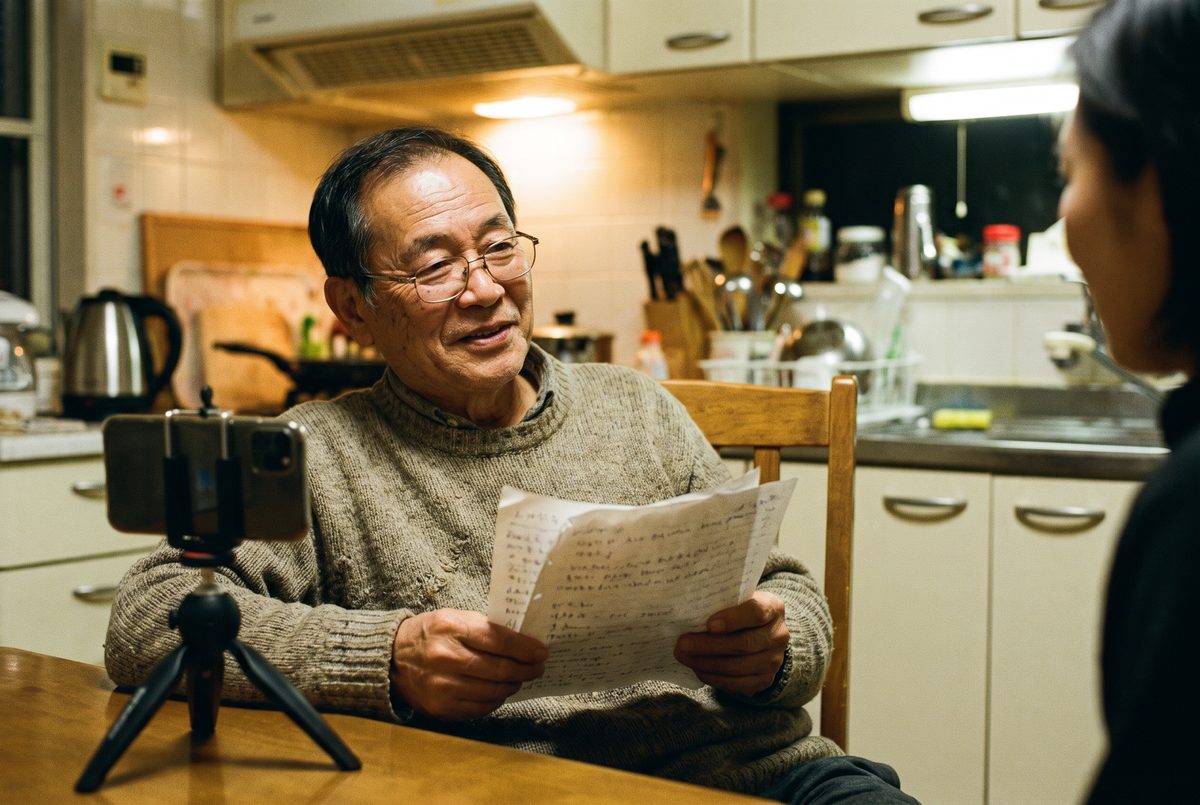
If you do not know other actors
Where to actually find one.
In rough order of how likely each is to work tonight.
The most useful thing on this page
What to tell your reader, before the first take.
Say all of this out loud in ninety seconds. It turns a willing non-actor into a genuinely useful reader, and we could not find another page that has it in one place.
“Stand here.”
Beside the lens, about one step from it, at my eye level. Mark it on the floor with tape. Casting director Marci Liroff puts the ideal position as almost straddling the tripod — a few inches too far away and the full impact of your eyes is lost. If the scene has more than one other character, they cannot all stand in the same spot — that is what the triangle method is for.
“Quieter than me, but clear.”
You are closer to the microphone than I am, so you will sound louder than you think. Do not whisper, though — if they have to strain to hear half the scene, that is its own problem.
“Do not act it. Do not be flat either. Just mean it.”
The folk theory that a monotone read keeps attention on the actor is wrong. Via Backstage, Pearlman is clear that it creates an imbalanced scene and a weaker tape.
“One voice for all the characters.”
Doing different voices is, in Pearlman’s phrase, “the verbal equivalent of slipping on a banana peel” — and it guarantees attention moves off you.
“Do not read the stage directions.”
Straight from the CDG guide. Dialogue only.
“Here is the pace, the tone, and the two places the scene turns.”
Thirty seconds of this is worth more than an hour of anything else you could do to the tape.
“If I fumble, keep going.”
Do not stop unless I stop.
“Three takes, not fifteen. Twenty minutes.”
Bounding the ask is the single most useful thing you can do for both of you. It makes the favour easy to say yes to — and it quietly fixes the over-taping problem at the same time.
You ask someone to read. After four or five takes they start wrapping up — that one was great, just send it. They mean well. But the session ends before you have found your best take, because when somebody is giving up their time you stop experimenting.
Telling them the length in advance is what prevents that. It is the whole reason point eight is on the list.
The actual price of the problem
What it costs, if you pay for it.
Lower than most actors assume — and worth setting against the fact that in the UK you are not supposed to be paying at all.
Published prices, Los Angeles studios
Roughly what a reader costs.
These were published when we checked them and studio pricing moves. Treat them as a range rather than a quote, and check the current figure before you book.
The fix that stops this happening again
The reader problem is not an emergency. It only looks like one.
It becomes visible at nine at night, which is why actors treat it as a crisis. It is actually a standing problem, and the fix is structural and slightly unglamorous.
Build a pool of three or four people before you need one
Reciprocal, so nobody accrues a debt. Casting director Nicole Arbusto gives the only structural answer we found from the casting side: be a reader for your friends, and start a group where you all sign up to read for each other.
Read for other people first, and often
It is the cheapest professional generosity available, and it makes asking frictionless. It is very hard to feel like a burden when you read for three people last month.
Identify one paid fallback in advance
A studio, a marketplace profile, a coach. Then the nine-o’clock decision is a booking rather than a search.
Install and test an app before the night you need it
For eleven at night when there is no fallback left. Testing it under deadline is how you discover it does not work the way you assumed.
Always bound the ask
Twenty minutes, three takes. Say it when you ask. The social cost of asking drops enormously when the request has edges.
Before you take anybody’s advice, including ours
Where the professionals disagree.
On this topic more than any other, almost everything you will read is written by somebody selling either an app or an hour of a human’s time. Here is the honest state of the record.
Is a reader required?
Essentially yesWeeble Mountain Casting: good auditions can be ruined by the lack of a reader, so line one up as soon as the notice arrives.
NoThe CDG Code: beneficial, but should not be an absolute requirement.
Who pays?
You doThe market, which charges roughly $15 to $35 for a virtual reader.
NobodyThe CDG Code: actors are not expected to pay for readers for their self-tapes.
Can you pre-record the other lines?
NoWeeble Mountain Casting: do not pre-record your cue lines. The CDG guide: apps like that never sound good.
YesPuro Casting: recording the other part yourself works pretty well. And the CDG Code — same organisation as the guide — lists a pre-recorded app as an acceptable form of reader.
Can you leave gaps?
YesPuro Casting: if there is genuinely nobody, simply leave gaps.
NeverThe CDG guide: avoid at all costs. Anyone reading in with you is better.
Does the reader need to act?
PreferablyThe CDG guide: preferably another actor, ideally of the right sex for the part.
Not at allKrista Husar: fine if they are stiff or not a pro. Heidi Miami Marshall: a non-actor friend cannot harm you.
Do casting directors accept AI readers?
YesThe AI app companies, all of which sell AI readers.
NoA human-reader marketplace, which sells human readers.
Neither side cites a casting director. We could not find one on the record either way, and we sell a reader too. That is the whole answer to this row.
Whose fault is a dead take?
The reader’sFlat, rushing, giving you no cues to play off.
YoursIf your delivery sounds preloaded, no reader will save it — and actors sometimes blame the reader when the real problem is that they were not listening.
Before you press record
The reader check.
- They are beside the lens, one step away, at my eye level — and the spot is marked.
- They are quieter than me but clearly audible, not whispering.
- They are using one voice, and not reading the stage directions.
- They know the pace, the tone and where the scene turns.
- They know it is twenty minutes and three takes.
- I can hear them well enough to react — which is the only test that matters.

Nobody picked up. You can still tape.
A reader is not required. You are not expected to pay for one. A stiff non-actor is fine, and a casting office will help if you say you are stuck. None of that is widely known, which is the only reason this page needed writing.
Then go and read for somebody else this week, so that next time you ask, it is easy.
Rehearse with a scene partner