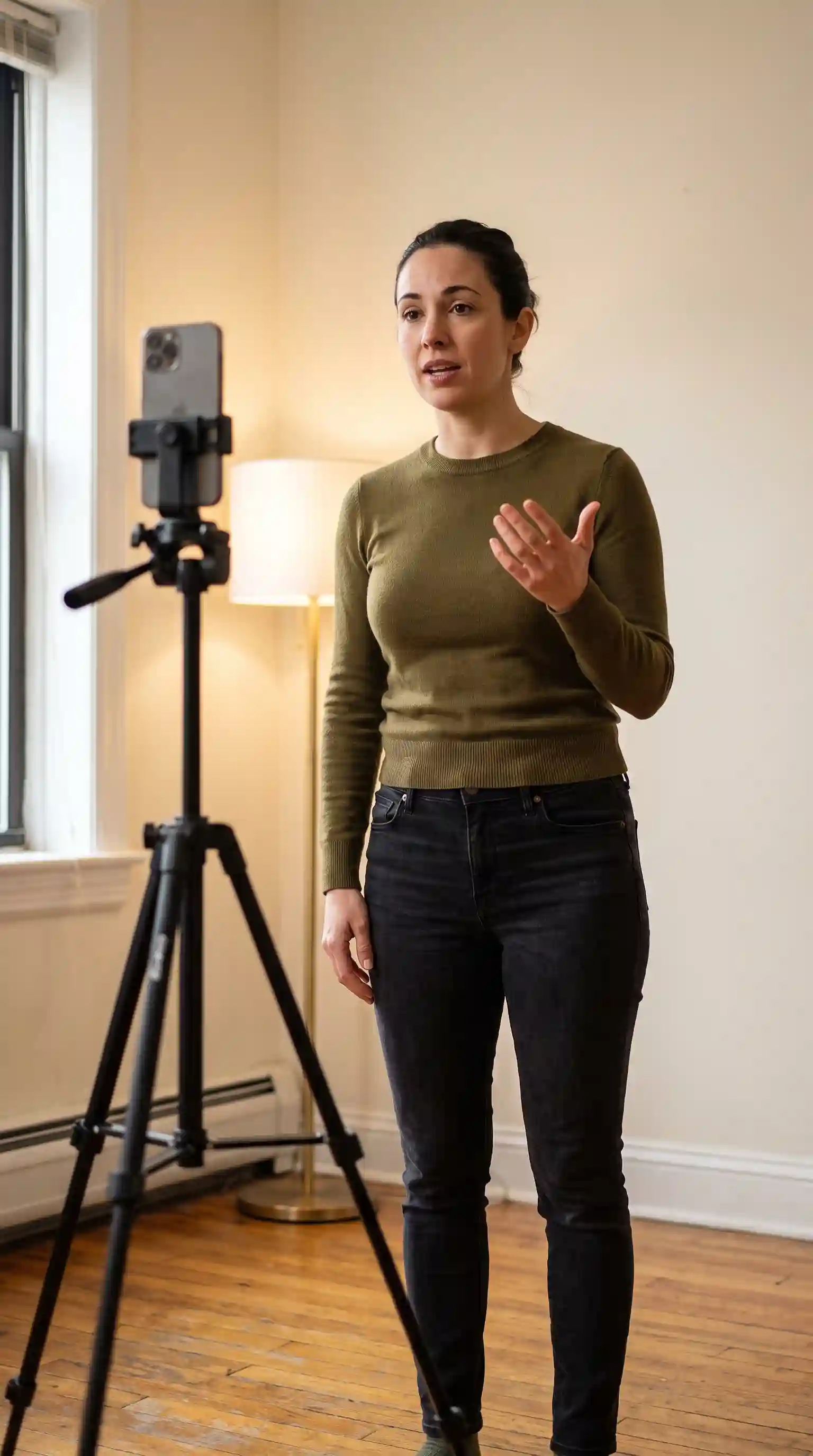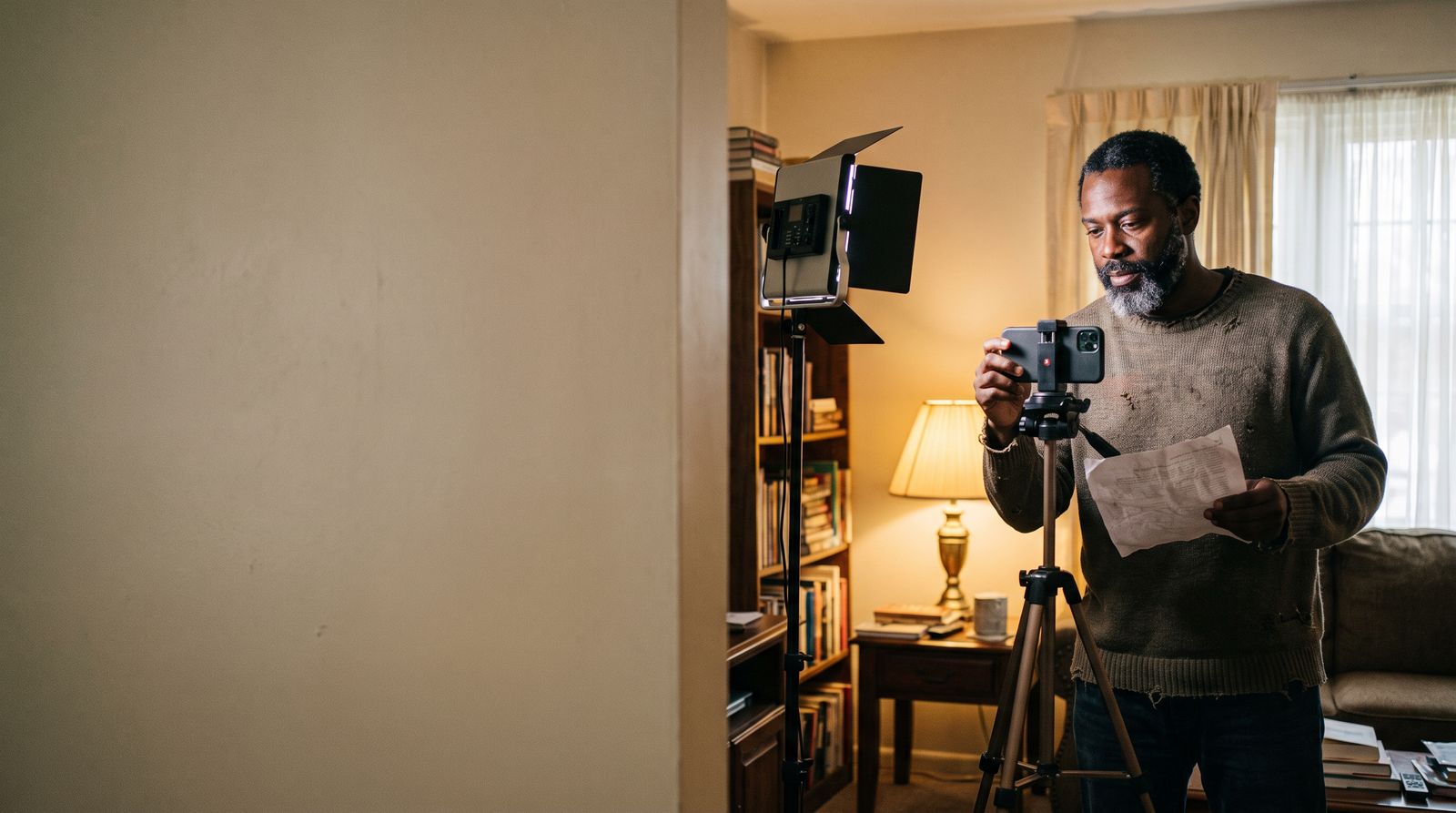
Make your first ten seconds count.
Casting directors have said on the record that they decide in four to ten seconds. That is not a reason to panic, and it is not a reason to buy equipment — because most of what fills those seconds is not your acting. It is the frame, the light, the sound, the orientation, and the first words of your slate. This chapter is about getting those right, so the performance you worked on actually gets watched.
Ready for your next step?
Learn at your own pace, find an opportunity, or use a tool when you need a little help.
Find your next audition
Browse opportunities by city and project type.
Browse casting calls →Practice without a reader
Run the other character’s lines on screen so you never tape against silence.
Open the teleprompter →Reach actors for free
Post a role and connect with performers looking for work.
Post a casting call →The familiar advice
“Good light, good sound, neutral background, be natural.”
- No evidence for any of it — no named casting director, no numbers, no sourcing
- Rules stated as universal that are contradicted by the union agreement and by other casting directors
- Nothing about what you're owed — turnaround, page limits, whether you must memorize
- And "always landscape", which for union work is no longer what the contract says
What you will get here
Clear answers, reliable sources, and honest guidance when professionals disagree.
- What actually happens when your file is opened, from casting directors on the record
- The two failure modes — rejected, and never attributed. The second is far more common
- What the SAG-AFTRA contract and the UK Code guarantee you, quoted
- And the questions the profession has not settled, named rather than smoothed over
Need something to audition for?
Put this advice into practice. Browse current casting calls for film, television, theatre, student films, commercials, voice-over work, and more.
Start here, because everything else in seventeen chapters follows from it
What actually happens when your file is opened
In January 2025, on a filmed installment of the Act Up podcast shared to Instagram, Atlanta casting director Tiffany Roshae — whose credits include the BET limited series Zatima — said she gives some audition tapes about four seconds. Asked whether she meant it: "I'm dead serious." She framed it as pattern recognition: does it take eight seconds to work out whether this is a man or a woman, ten seconds to work out whether this is an Amazon driver or a surgeon.
Some casting directors watch the first ten seconds and then decide yes or no. It isn't personal.
A casting associate, quoted in a casting-panel write-up — reported second-hand, so treat as corroboration rather than proof
The reaction was fierce, and it deserved to be. Risa Bramon Garcia — casting credits including The Affair, Masters of Sex, JFK and Fatal Attraction — posted a video response calling the original conversation "insensitive." Actors quoted in the trade coverage in February 2025 called it insulting, and a slap in the face given the effort involved and the unpaid readers.
But read what the rebuttal did and did not do
Bramon Garcia did not defend the four seconds. She also did not dispute the number. What she did was reframe it as an invitation — to start a scene with more presence and more generosity, to be there in real time, alive in the story, from the first frame. Actor Matthew Cornwell echoed it: actors must reflect raw humanity from the start to earn more than four seconds.
Nobody on either side of that argument said the window was long. That is the useful part, and it is why this chapter exists.
Which produces the argument this chapter is built on, and it is not the one you were expecting
At this viewing speed the technical layer is not a hurdle standing between you and the assessment. It is a large fraction of the assessment.
Think about what fills those seconds. The filename. The framing. Landscape or portrait. Whether the slate opens the file. All of it lands inside the window where the decision is being made.
So these are not boxes to tick before the real work starts. They are where the watching starts, which makes them where the craft starts too.
The first technique, and it happens before the camera is on
Two minutes with the request, before you record anything
You have the sides. The deadline is close. The request mentions a slate, a filename and an upload portal you may never have used. You do not have to hold all of that in your head, and you should not try. Pull out five things, write them down, and put them beside the camera.
- The deadline — and the time zone. Then set an earlier personal one, for a reason that is not the one you think. See the box below.
- Exactly what is to be recorded. Scenes, slate, full-body shot, profiles, improvisation, anything else named.
- The framing, in their words. Landscape or portrait. Chest-up, medium or full body. Copy their language rather than translating it.
- The filename format, copied not remembered. Per the next section, there is no universal convention — theirs is the only one that matters.
- How it must be delivered. Upload portal, email attachment, private link, separate files or one continuous file.
And the reason for an early personal deadline is better than "in case the upload fails"
Casting director Caroline Liem has twenty years in film, studio features and series. She makes a point almost nobody passes on: some offices watch tapes as they arrive.
So if there is time left, and your read is strong — or just slightly off — the office may come back with redirects. Notes. A steer towards what they actually want.
She describes it as getting a redirect without stepping into the room. Which turns the buffer from risk management into opportunity: submit early and you may get a second attempt with notes. Submit at the deadline and you get one shot by definition.
One widely-repeated version of this that we are labelling rather than repeating
You will often hear a harder version of this: that a role arriving Sunday and due Friday may "already be cast" by the time you send on Thursday.
Be careful with it. The person who says it is an actor and educator, not a casting director. It also sits awkwardly against two things — offices set deadlines they intend to honour, and the UK Code guarantees minimum turnarounds.
Treat it as "some offices work this way," not as a rule. Liem's point stands perfectly well on its own.
The most important thing is to read the instructions very carefully.
[And if you need more information about the requirements] reach out and ask. It can make you stand out as a candidate.
Nicole Arbusto, casting director (Somebody Somewhere)
Notice what she is arguing against. Better technology makes actors feel they need to do more — buy more, build more, light more. Her top priority costs nothing.
And the second half of that quote is worth reading twice. Almost every self-tape guide implies that asking a question marks you out as an amateur. A working casting director says the opposite, on the record.
The failure mode nobody writes about, because it is duller than rejection and far more common
Rejected and never attributed are not the same thing
The story actors tell themselves is that a casting director watched the tape, disapproved of the sloppiness, and passed. That happens. Casting director Marci Liroff — E.T., Footloose, Mean Girls, The Vampire Diaries — states plainly that some offices will refuse to view an audition if the actor failed to follow instructions, and adds the line everyone quotes:
If you can't follow the instructions in an audition — how can they trust you on set?
Marci Liroff, casting director, writing in Backstage
But there is a second failure that is quieter, much more common, and almost never described. The tape is not judged and found wanting. It is unroutable.
This is a better story than the one about being judged, and it is kinder as well as truer
Your tape was probably not watched and disliked. It was probably a file called something like Untitled_final_2.mp4 sitting in a folder of three hundred, belonging to nobody.
Which reframes the whole subject. Following the naming instruction is not obedience. It is being findable — and at 200 to 300 files a day, findable is the only version of you that reaches the director.
And here is why "just use a standard filename" is bad advice
Three orderings. Four sources. No agreement. That is not a gap in our research — it is the actual state of the industry.
Which is why any guide handing you one "correct" filename is wrong before it starts. Here is the rule that survives all four: if they gave you a format, copy it exactly. If they didn't, use the project, the role and your own name — in any order, with nothing exotic in it.
And the boring technical rejections, which do more damage than any of the interesting ones
- A wrong or upper-case file extension, or special characters and extra full stops in the filename.
- iPhone High Efficiency (HEVC) encoding errors — a documented, recurring failure on casting platforms.
- The file exceeds the platform's cap, which differs per platform and sometimes per request.
- Unstable Wi-Fi mid-upload. Actors Access's own advice is Ethernet, or move closer to the router.
- Browser cache serving you a stale version of the page, so the upload button behaves oddly.
- An edit within the scene. Two offices are explicit that cutting the best bits of different takes together is a red flag and the tape will most likely not be shown to the director. Trimming the top and tail is fine. Cutting inside the take is not.
One rejection cause with almost no coverage anywhere, and it catches well-meaning people
Per the joint PMA, Spotlight and Casting Directors' Guild good-practice guidelines, casting or self-tape information should not be shared with anyone — and sharing details anywhere, including chat rooms, forums or social media, may lead to your tape being rejected.
Which means "so excited to be taping for [show] today!" is a rejection risk, and nobody tells actors this. It is not about secrecy for its own sake; breakdowns are confidential documents and the production's release schedule is not yours to move.
The half of this subject that gets left out, and it is the half that is on your side
There are two rulebooks, and they constrain the casting office too
Almost every self-tape guide treats the instructions as unlimited. Whatever the office asks, you do.
That stopped being true in the United States in November 2023, and in the United Kingdom in 2021. Two documents now set floors — and hardly anyone they protect has read either.
Read the SAG-AFTRA framing line again, because it contradicts what you have been told
"The shot may frame either head-and-shoulders or full body in a vertical portrait format."
Vertical is contractually permitted on US union work. Which puts a hole in the near-universal "always landscape" advice.
But the boundary matters more than the rule. This binds union work only. Non-union, commercial, student and international projects are not covered.
So an actor who reads "vertical is allowed" and shoots vertical for a non-union indie is following a rule that doesn't apply to them.
There is also a practical argument on the other side. Spotlight says filming in portrait causes problems for casting directors uploading your file into the system they use to process tapes. That is a much better reason than "it looks like TikTok" — and it holds whatever the contract permits.
And the honest other half, which most pages about "following directions" leave out entirely
The instructions are also a document the industry has been arguing about for five years, because badly written ones transfer unpaid labour and unreasonable deadlines onto the actor.
In 2023 a group of UK actors spent six months consulting around two hundred peers. Their conclusion: the existing framework was no longer fit for purpose. They asked for anonymity, because they feared being blacklisted.
One organiser, on the difference between jobbing actors and established names: "we're being treated with absolute disdain."
They proposed eight things. Independent regulation. Being told that your tape was viewed, and who it went to. Tapes deleted afterwards. Disclosure of how many tapes were requested — and whether the part is already out on offer. Full scripts as standard. A four-day turnaround excluding weekends. No expectation to be off-book first time. And a yes or no within a reasonable time.
So: follow the instructions, and also know what a reasonable request looks like. A chapter that only preaches compliance is less useful than one that also tells you when to have your agent push back — and the Code explicitly says casting directors will use best endeavours to arrange an extension if the agent or performer asks for one.
Why you keep getting told opposite things by people who all know what they are doing
Questions the profession has not settled
If you have felt stupid for being confused about slates, orientation or how many takes to send — you were confused because the answers genuinely conflict. Here is the disagreement, named.
| The question | Position A | Position B |
|---|---|---|
| Slate first or last? | Slate at the top, so they know who they're watching. | Some casting directors edit the slate out entirely — because they don't use slates, or it breaks the mood. Send it as a separate file and let them choose. |
| Landscape or vertical? | Landscape, always, universally. | The SAG-AFTRA contract permits vertical portrait on union work. Spotlight says portrait breaks their upload process. |
| Do you need to memorize? | Off-book or you look unprepared. | "Memorization is not required" on union work, per the 2023 agreement. |
| How many takes? | Send your best one. | If they asked for two, send two. Named sources contradict each other on what "two takes" means. |
| Do you need a reader? | Never tape without one. | The UK Code: beneficial, "but should not be an absolute requirement" — and you are not expected to pay for one. |
| Is the slate a formality? | Housekeeping. Get it over with. | One casting director uses slates as extra audition material when a director needs to see more personality and there's no time for a recall. |
| Should you ask questions? | It marks you as an amateur. | A working CD says asking "can make you stand out as a candidate." |
| What if the email and the platform disagree? | Nobody says. | The specific request beats the general guide. See below. |
Which leaves one rule that resolves all of them, and it is the only universal rule on this page
When the casting office gives you an instruction, that instruction wins. A general self-tape guide — including this one — can give you a safe default. Only the office casting this role can tell you what it wants for this role.
The order runs like this. First, the specific request for this audition. Then the platform's own requirements. Then general best practice. Then whatever you read somewhere.
And if the email and the platform genuinely contradict each other, and you can't tell which is current? Ask. Per the section above, that is a documented positive rather than a risk.
The section people actually arrive here needing, usually at speed
You already sent it and something is wrong

What you can do depends entirely on the platform, and the answer is genuinely different on each one. This is the least-published useful information in the whole subject.
- If the platform lets you replace the file — correct it once, check it plays the whole way through, and resend. Once.
- If the submission is locked and the tape is unusable or unidentifiable — send one short, calm note through the contact method you were given. Not three.
- If the error is minor, let it go. Put the lesson into the next submission rather than carrying it around all day.
And the thing worth saying plainly, since this page has spent two thousand words on why the details matter
Professional does not mean perfect. It means prepared, clear and easy to work with. The evidence on this page is about which failures are systematic — the unroutable file, the tape that will not open, the four seconds you spend in silhouette. It is not evidence that one typo ends a career, and nobody quoted here says that.
One finding that is true, sourced, and published almost nowhere an actor will find it
The view counter is measuring the wrong thing
You send a link. Days pass. The counter says zero, or one, and you conclude that nobody watched it and it was all for nothing.
The majority of tapes will be downloaded and viewed either offline or via another platform — and when a tape is downloaded and watched offline, some file-sharing sites do not register that the tape has been viewed as a result.
[Vimeo is named specifically.]
The UK Code of Best Practice for Self-Tape & Zoom Auditions, agreed by the Casting Directors' Guild, the CPMA, Equity and the PMA
That is not reassurance. It is a description of the workflow, written down by the industry body whose members do the watching. Casting offices pull files down and watch them offline, in sessions, often alongside a director. The counter on the sharing site never learns about it.
And a second thing, because half-truths are worse than the whole one
Some tapes genuinely are never seen by anyone. A role gets cast off an offer. A budget collapses. A project goes on hold. This is not paranoia — the UK actors' reform proposals specifically ask casting to disclose whether a part is already out on offer, which tells you it is a recognised phenomenon rather than an actor's imagination.
So the honest version is: a zero on the counter tells you nothing about whether you were watched, and there is a real, separate category of tapes that were never going to be watched by anyone. Neither of those is a verdict on your work, and neither is something you can fix by taping it again.
Where this chapter hands off
The rest of the technique, in order
Everything above happens before you press record. The chapters that follow are the making of the tape itself — and they are ordered by how much difference each one makes to those first ten seconds.
In rough order of leverage
- Light, because a face in silhouette is the fastest way to lose the four seconds. Free to fix.
- Sound, because the room is louder than you think and clipped audio ends a viewing at second twelve.
- A reader, because a responsive scene partner is the single highest-leverage variable in the performance — and per the Code, you are not expected to pay for one.
- The slate, because it is the first thing in the file and, per one casting director, is sometimes reused as audition material in its own right.
- Framing and background, because they are decided in the first frame and cannot be fixed afterwards.
- Wardrobe, because it is read before the dialogue is.
- The edit, because trimming top and tail is expected and cutting inside the take is a red flag.
Keep going
The How to Self-Tape guide
Ch 2 · Preparation
Sides into playable choices
Ch 4 · The reader
And why you shouldn't pay for one
Ch 5 · How many takes
Two, and why fewer is better
Ch 9 · Framing
Decided in the first frame
Ch 10 · Lighting
The free fix that does the most
Ch 11 · Audio
If they can't hear you
Ch 16 · The slate
The first thing in the file
Ch 17 · Glossary
Every term in a casting request
Two minutes with the request buys you the ten seconds
Before you record, pull five things out of the request. The deadline and its time zone. Exactly what is to be recorded. The framing, in their words. The filename format, copied exactly. And how it must be delivered.
Write them down and put them beside the camera. Then send it early — some offices watch as tapes arrive, and may come back with notes. A second attempt, without ever stepping into a room.
When a casting office gives you an instruction, that instruction wins over anything you have read, including this page.
And know what you are owed. On US union work: 48 hours' notice, eight pages, no compulsory memorization, and vertical framing permitted. In the UK: four days, six pages, weekend protection, and no expectation that you pay for a reader.
None of this is bureaucracy. At four to ten seconds of viewing, it is where the watching starts.
Sources, scope, and important context
The four-second figure is one named casting director's stated practice, not an industry standard, and the ten-second figure reached us second-hand — neither is a measurement, and we have not presented either as one. The SAG-AFTRA provisions bind US union work only; non-union, commercial, student and international projects are unaffected. The UK Code is mandatory for Casting Directors' Guild members and carries no statutory penalty. Platform behaviour can change without announcement — these notes summarise published guidance reviewed on 31 August 2026, and the instructions on your current invitation always take priority. We could not source actor-community verbatim on instruction failures; the actor reaction quoted here comes from trade-press comment rather than the forums where it actually lives. Nothing here is legal or contractual advice.