
The distinction that makes twenty contradictory casting directors agree
Three different things get called bold. Only one of them is wanted.
Almost every argument on this topic dissolves once you separate them, and nobody in the published record separates them.
A specific point of view. Who this person is to you, what you want, what is in the way, what changes. Invisible in a still frame. Audible in one line.
Volume. Louder, bigger, faster, more. This is what actors hear when they are told to be bold, and no source in our research asks for it.
A bid for attention from outside the scene. Music, edits, costume, unrequested props. Occasionally brilliant, usually a distraction.
The sentence this whole chapter rests on
Specificity is what is being asked for. Volume is what gets mistaken for it. A gimmick is what happens when you try to solve the problem outside the performance.
A quiet, still take can be extremely bold. A shouted one is usually just loud. The two have nothing to do with each other.
And here is why the distinction matters practically. A specific choice that turns out to be wrong is adjustable. Casting director Jill Anthony Thomas puts it plainly: make a strong choice with the scene, and if it is wrong, they will adjust you. A generic read gives them nothing to adjust. Volume gives them something to switch off.
The most contested topic in the whole Academy
Where casting actually stands, name by name.
On file naming or lighting, disagreements run two or three sources deep. Here, more than twenty named professionals have spoken publicly and they land in three separate camps.
Camp one: go bold, because safe is the mistake
Camp two: grounded, not big
Camp three, which is not a middle position
This group is not splitting the difference. They are rejecting the question. If you arrived here asking “should I be bolder?”, several credible people are telling you the question itself is the problem.
Casting director Kim Williams says going slightly bigger than necessary is fine, because they can pull you back. Note the context: she is talking about a cold read, in a room, with a casting director present who can redirect you in real time. Jill Anthony Thomas’s “we will adjust you” carries the same assumption. On a self-tape nobody adjusts anything. The tape you send is the entire conversation, so advice written from an in-room reflex does not transfer cleanly.
The most repeated phrase in casting advice, and the least defined
What “make a strong choice” concretely means.
A choice is strong when it answers a question the script leaves open — and answers it one way rather than hedging. Five questions do almost all of the work.
Nothing in the right-hand column is loud. Every item in it changes how the scene behaves — the pace, the pauses, where you look, what you do with your hands. That is the whole mechanism. Specificity produces behaviour, and behaviour is what casting is watching for. Volume produces noise.
Casting director Heather Basten supplies the sixth question, and it is a good final check: never leave the scene the way you entered it. If you are the same person on the last line as the first, you have not actually made a choice yet.
Backstage’s script-analysis guidance draws the clearest line anyone has: you may choose whatever you like, as long as it does not contradict the writer’s intent — and not so far into left field that the casting director is caught off guard by something suggesting you did not understand the story. Your choice fills what the script leaves open. It does not overwrite what the script already decided.
The reframe that makes the pile of 300 less frightening
Standing out is not the same as being different.
Casting director Howard Meltzer sets the real bar, and notice that it has nothing to do with novelty: the self-tape has to be “good, if not better, than the actors we are seeing in the room.” Not stranger. Better.
And most of the pile you are frightened of has already removed itself. Unwatchable framing, inaudible sound, ignored instructions, files nobody can attribute — the technical gate eliminates a large share of any submission stack before anyone judges a performance. Clearing that gate and being specific already puts you in a much smaller pile than the raw number suggests, and it costs you no risk at all.
Justin Radley’s prescription for the room where everyone looks alike is not “do something different.” It is: prepare thoroughly, build a backstory, dress the part, present professionally. That is unglamorous and it is the actual answer.
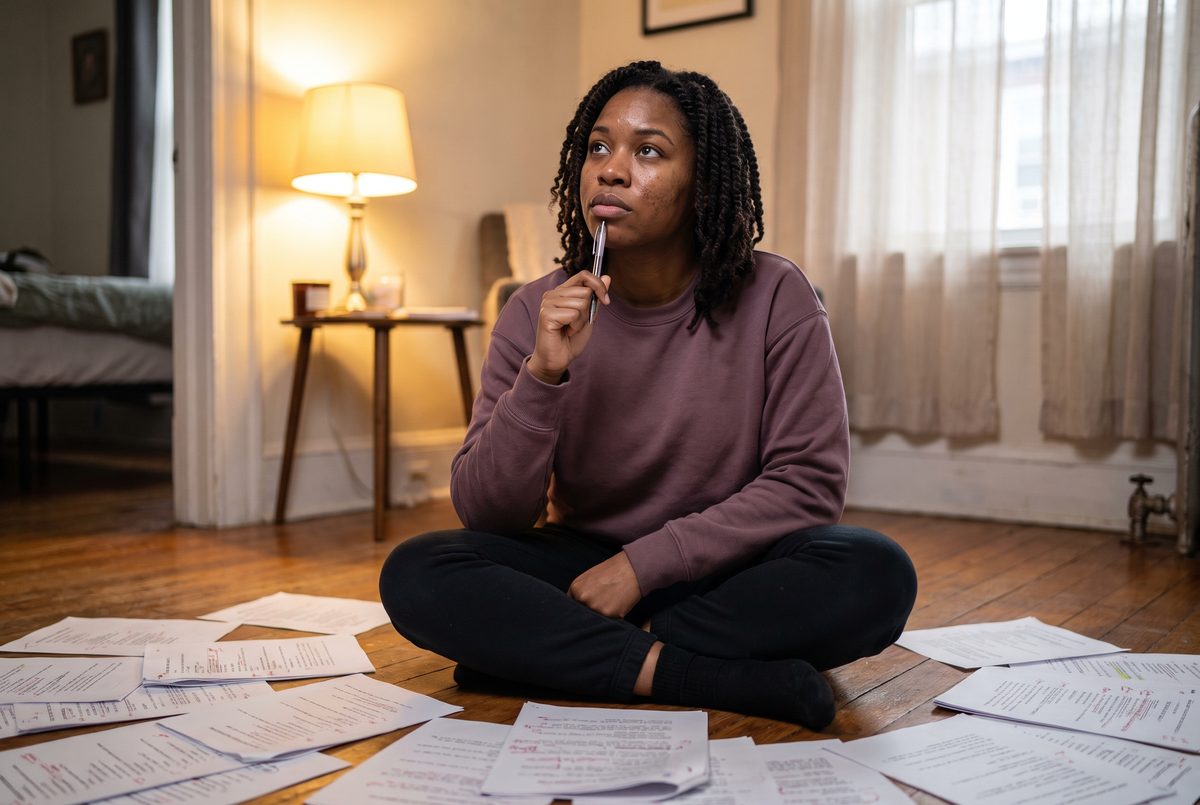
Props, music, edits, costume
The gimmick line, and the one named exception.
Almost every source warns against decoration. One respected casting director liked exactly the thing everyone else warns about, and the reason why is the whole rule.
And then the exception, from a casting director who had just finished warning you off props
Luci Lenox liked a tape of someone being shot, with sound effects added.
Immediately after saying you do not need many props or much costuming, she describes a self-tape she enjoyed for exactly that reason. Her verdict: it was surprising, and it was fun.
It is tempting to read that as permission. It is not, and the difference is precise. The sound effect solved a staging problem the sides created. The scene required something that cannot happen in a living room, and the actor found a way to let it happen anyway.
It was not attention-seeking. It was problem-solving. That is the entire line between a bold element and a gimmick, and it is why one tape with sound effects delights a casting director while another one irritates her.
Why the exception is an exceptionSo the test is not “will they notice this?” It is: does this exist because the scene needed solving, or because I needed noticing? You already know the honest answer to that before you press record.
Three questions, adapted from Casting Networks’ own framework
Before you keep any bold element.
- Does it directly enhance the character and the performance?
- Is what it adds worth the risk of distraction?
- Does the tape still look clean and professional with it in?
If a bold element cannot survive all three, it is a gimmick, whatever it felt like at eleven at night. A coffee mug can settle a whole scene. A full costume usually swallows one.
The example that comes up in every acting class
Barry Keoghan broke every rule and booked. Sort of.
The story is real, it is worth knowing, and almost everybody tells it wrong.
Keoghan sent an unsolicited tape for the Riddler in The Batman. Ten dollars of costume from a shop, storyboarded, no dialogue, music over the whole thing, shot cinematically. He has said he wanted the swag of it to come across. It is a genuinely brilliant piece of work.
The fear underneath the whole page
If I make a choice and they hate it, have I burned the office?
Nobody does this calculation out loud, so we will.
Take those three seriously and the arithmetic changes. If most outcomes are decided by things outside your performance, the downside of a specific choice is small and the upside is being remembered. A generic tape that does not book produces nothing at all. A specific tape that does not book produces, at worst, a note in somebody’s file. That asymmetry is a far better argument for boldness than “casting directors like bold choices” — and it survives the disagreement above, because it does not depend on which camp is right.
The four-second problem, and what it does to “bold”
In January 2025, Deadline reported an Atlanta casting director describing giving some tapes around four seconds. Casting director Risa Bramon Garcia publicly called the conversation insensitive. She notably did not defend the four seconds — she reframed it as an invitation to begin a scene with more presence.
It does not make boldness pointless. It relocates it. A choice that pays off beautifully at forty-five seconds may never be reached. Your choice has to be legible in the first line — not explained, not announced, but already operating. That is the version of “be bold” that survives the conditions actors are actually taping into.
The practical resolution, and it has a name attached
Should you send a safe take and a risky one?
There is a specific, sourced structure for this, and it is better than anything you will improvise at midnight.
Take one
Just the words on the page
- Play the scene as written, with the central choice fully committed.
- No additions, no button, no invention.
- This is the take that proves you can serve the material.
Take two
Where the instinct shows
- Add the thing you actually want to do — a button at the end, a reaction, a moment of improv.
- Change the tactic or the relationship, not the volume.
- This is the take that shows casting how you think.
That structure is Debby Romano’s, from casting Shrinking: make one take just the words on the page and one where improv is added, so casting can see the actor’s instinct. Rose Rosen wants two or three takes and specifically as separate clips. A casting director via Spotlight says that if a single take has not been requested, two or three different interpretations show range.
The rule that comes out of all of it
Where the instructions allow more than one take, Romano’s structure is the best-sourced way to be bold without gambling. One as written. One with the risk.
Where they allow only one — or the platform only accepts one file — send the specific one, not the safe one. A safe take in a pile of three hundred safe takes has nothing to do.
The question nothing online answers
How do you stand out in a co-star with four lines?
You mostly do not, and understanding why is more useful than trying harder.
A four-line role has almost no room for interpretation, so the “make a bold choice” advice does not apply in the form it is usually given. What is being assessed is narrower and completely learnable: can you deliver information cleanly, can you listen, and are you a real person in the world of this show.
Which leaves exactly one place for specificity, and it is the right one. Decide who this person is when nobody is watching them. The nurse at the end of a fourteen-hour shift. The barista who is late for something that matters. The neighbour who knows more than they are saying. None of that gets announced, none of it needs a prop, and all of it is visible.
Do not load a small part with five elaborate decisions. One clear relationship and one playable need is the whole job. A co-star scene that is over-decided reads as an actor auditioning for a bigger role than the one on offer, and casting notices that immediately.
The most common form “bold” takes
Can you improvise or change the words?
The published answers look contradictory until you notice they split by medium rather than by taste.
Same question, two different industries
Where improv is welcome and where it is not.
Nobody frames it this way, which is why the advice appears to conflict.
The assumption the whole chapter rests on
Does being memorable actually pay off?
Six named casting professionals say yes. One working actor says no.
If casting does not remember you, “stand out” has no payoff beyond this one role.
So this is the load-bearing question, and we are going to give you both sides rather than the comfortable half.
The casting side, repeatedly
Jackie Davies and Robert J. Ulrich (The Boys) describe taking careful notes while watching tapes together — noting what they liked and what someone might be right for, even when the actor is wrong for this one. Kate Leonard: casting watches everything that comes in and makes a note of everyone. Mary Clay Boland: not booking does not mean you were not seen, or not put on a list for something else. Chelsea Ellis Bloch: distinct choices keep you in mind for future projects.
And Marisol Roncali gives the concrete example rather than the assurance: Zazie Beetz auditioned for Star Wars, they loved her from it, and that is how they knew to bring her in for Deadpool.
The actor side
In the comments on Deadline’s 2023 self-tape coverage, a working union actor of fifteen years describes “sending endless tapes out into the void and never hearing anything” — and says that given the sheer volume of tapes requested, the chance of a casting director watching all the way through and making a note saying not right for this, but I liked what she did is nil. That is a commenter rather than a bylined source, and we are attributing it as one.
Both are probably true, at different scales. An office taking notes together on a limited request list behaves nothing like an office processing eight hundred submissions for a co-star.
How to hold the contradictionSo the memory payoff is real but not uniform. It is a reason to be specific. It is not a guarantee, and any page that quotes only the casting side is selling you something.
The whole field, side by side
The disagreements, laid out.
Bold or safe?
BoldNancy Nayor: going vanilla is the mistake. Rosen, Imoru, Avetyan, Thomas, Han agree.
GroundedCasting Networks’ own guidance: it is not about bold choices to stand out. Greenstein: do not overdo it. Snow: grounded, not over the top.
Should you try to stand out at all?
YesThe premise of almost every article written on this subject.
Wrong questionHibbs, Koonce, Bergman, Radley: stop guessing and stop competing. Be specific and be yourself.
Props and effects?
RarelyStageMilk: never as a gimmick. Spotlight and the CDG: limit them. Husar: costume does not help.
SometimesLuci Lenox liked a tape with added sound effects. Surprising, and fun.
Improvise?
BarelyCollin Daniel: limited, especially first round. Chris Gehrt: do what is written first.
YesKirkland Moody: improv is really important. Radley: auditions often allow more of it than the shoot.
How many takes?
One or twoMike Page: three max, over-taping kills it. CDG: one, at most two. Puro Casting: just one.
Two or threeRose Rosen: two or three as separate clips. Debby Romano: one as written, one with improv.
Does a bold miss cost you?
NoJill Anthony Thomas: if it is wrong, we will adjust you. Jue, Simkin, Bishop: most outcomes are not about you.
UnknownOn a self-tape there is no adjustment, and no casting director is on record either way.
Do they remember you?
YesUlrich, Davies, Roncali, Bloch, Leonard, Boland: we take notes and we remember.
NoA working actor via Deadline: given the volume, the chance is nil.
How much do they watch?
Four secondsAn Atlanta casting director, via Deadline, January 2025.
All of itCasting directors elsewhere: we watch the tapes we request.
Before you press record
The bold-choice check.
- I know exactly who the other person is to me — not their job title, the history.
- I can say what I want and what stops me in one sentence each.
- I know the moment before, and I know where the scene turns.
- My choice fills an open space without contradicting anything the script decided.
- The choice is legible in the first line, not at forty-five seconds.
- Nothing I added is louder than the scene — no prop, accent, costume or camera idea.
- I am different at the end from how I was at the start.
- If I get two takes: one as written, one with the risk. If I get one: the specific one.
Be specific. That is the whole instruction.
Twenty casting directors argue about boldness and almost all of them are describing the same thing from different angles: they want to see a person who decided something. Not louder. Not stranger. Decided.
A generic tape that does not book leaves nothing behind. A specific one occasionally leaves a note in a file — and every so often, four months later, somebody makes a phone call.
Build the choice from your sides