Lighting darker skin, part one: the history, told accurately
You cannot understand why so many photographers are bad at this without knowing where the default came from — and the history is real, documented and academically citable, so we are going to get it right rather than dramatic.
Kodak’s “Shirley cards” were the reference cards photo labs used to calibrate colour and exposure. The reference skin was a white woman’s. The media scholar Lorna Roth, in the Canadian Journal of Communication (2009), documents that a light-skin bias was embedded in colour film emulsions and in early digital camera design, and that the rendering of non-white skin was, in her word, deficient.
Here is what that meant on the floor of a lab, from a technician who worked with the cards:
“If Shirley looked good, everything else was OK. If Shirley didn’t look so hot that day, we had to tweak something — something was wrong.”Jersson Garcia, Richard Photo Lab — NPR, 13 November 2014
Be careful how you tell this story, because the easy version is wrong. Kodak did not sit down and design a racist film stock. The scholarship does not say that and neither will we. The writer Syreeta McFadden put the correct framing to NPR:
“I don’t mean to say that it was a deliberate and exclusionary practice, but [it was] much more of a wilful obliviousness.”Syreeta McFadden — NPR Code Switch, 16 April 2014
Norm-setting by default. The reference was a white woman because the assumed customer was a white woman. And the sting is in what fixed it: the widely reported account, sourced to Roth and to the artists Broomberg and Chanarin, is that Kodak improved its rendering of dark tones after complaints from chocolate and furniture advertisers — not from Black photographers. As McFadden points out, Black customers largely didn’t complain, because they blamed themselves. They assumed they were bad at taking pictures.
Lighting darker skin, part two: what is actually true in 2026
Now the honest part, because there is a lazy version of this section that ends with “cameras are still racist” and it is not what the people who do this for a living say.
The film-era bias is history. The sensor is not the problem. Ava Berkofsky, the cinematographer who shot HBO’s Insecure, dates the turnaround precisely:
“I’d say it turned around in 2010. When the [Arri] Alexa came out, it really changed how people were shooting digital and what kind of results we could get.”Ava Berkofsky, cinematographer (Insecure) — Mic, 6 September 2017
What is still broken is everything automatic. Auto-exposure. Face detection. Auto white balance. Auto-retouch. The training data behind all of them. Google conceded this publicly when it launched Real Tone with the Pixel 6, admitting that a lack of testing across skin tones had produced errors like over-brightening and unnaturally desaturating skin.
And the second thing that is still broken is much simpler. Photographers were never taught. Berkofsky again: “When I was in film school, no one ever talked about lighting nonwhite people.”
If you are shooting your own headshot on a phone and you have darker skin, turn off the automatic processing and shoot RAW. The bias in 2026 does not live in the sensor. It lives in the software that decides, on your behalf, what a correctly exposed face looks like. That single toggle is the highest-leverage thing in this entire section, and it is free.
Lighting darker skin, part three: the technique, from people on the record
This is not vibes. These are working cinematographers describing what they physically do.
Reflect, do not blast. This is the core of it, and it is Berkofsky’s central technique:
“Rather than pound someone’s face with light, [I] have the light reflect off them. I always use a white or [canvas-like] muslin, so instead of adding more light, the skin can reflect it.”Ava Berkofsky — Mic, 6 September 2017
Keep the light off the walls. “The trick is keeping [light] off the walls. If you keep it off the walls, you can expose for the faces and it still has a cinematic look.” Read that as a headshot instruction: light the person, not the room. A background that is soaking up spill is a background that is dragging your exposure down.
Bring a polariser. Both Berkofsky and the DP Dave Insley name it independently. It shapes the reflected light on skin the same way it shapes reflections off glass and cars — which, given that the whole technique is about reflection rather than blasting, is exactly the tool you want.
Do not matte the skin to death. This directly contradicts standard headshot-day makeup advice, and it comes from Ernest Dickerson, who shot She’s Gotta Have It: “I always made sure that the makeup artists I worked with put a moisturiser on black skin so that we [got] some reflections in there.” Insley puts it more bluntly: “Don’t let makeup completely matte down to ‘perfection’ — that’s awful.” The reflectivity is the point. Powdering it flat throws away the entire technique.
And now the background, where almost everybody gets the rule backwards. You will be told never to shoot dark skin on a dark background. That is not what the DPs say. Jim Sofranko names the actual hazard: “dark skin tones against bright or burnt-out backgrounds… Keep the contrast under control.”
A hot, blown-out background is the trap — it drags the exposure down and turns your face into a silhouette. A white cyc. A bright sky behind you. A dark background with good separation light is fine, and frequently beautiful. The DPs on separation are unanimous, and one of them says you can “often not have enough of it.”
One thing we will not tell you. The cinematographer Bradford Young says of dark brown skin: “When you underexpose [it], they pop and resonate and shine in a particular way.” He is right, and he is talking about narrative film — an authorial choice, on a calibrated screen, in a dark room. A headshot is not a movie. It has to survive being shrunk to a 200-pixel thumbnail and scrolled past on an uncalibrated laptop by a casting assistant in a hurry. Do not ask for an underexposed headshot. Expose properly for the face, let the background fall where it falls, and shape with reflection and rim light rather than raw power.
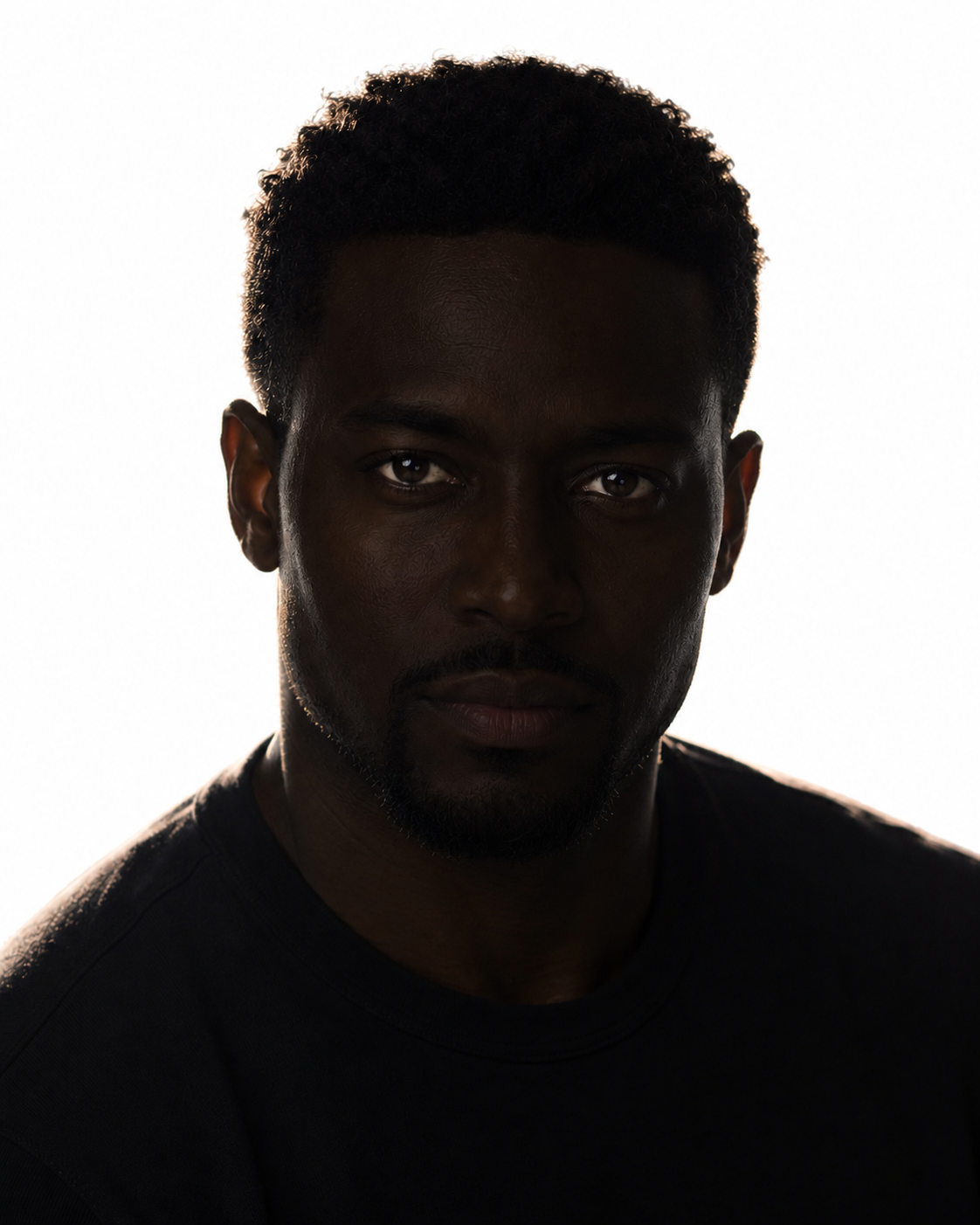
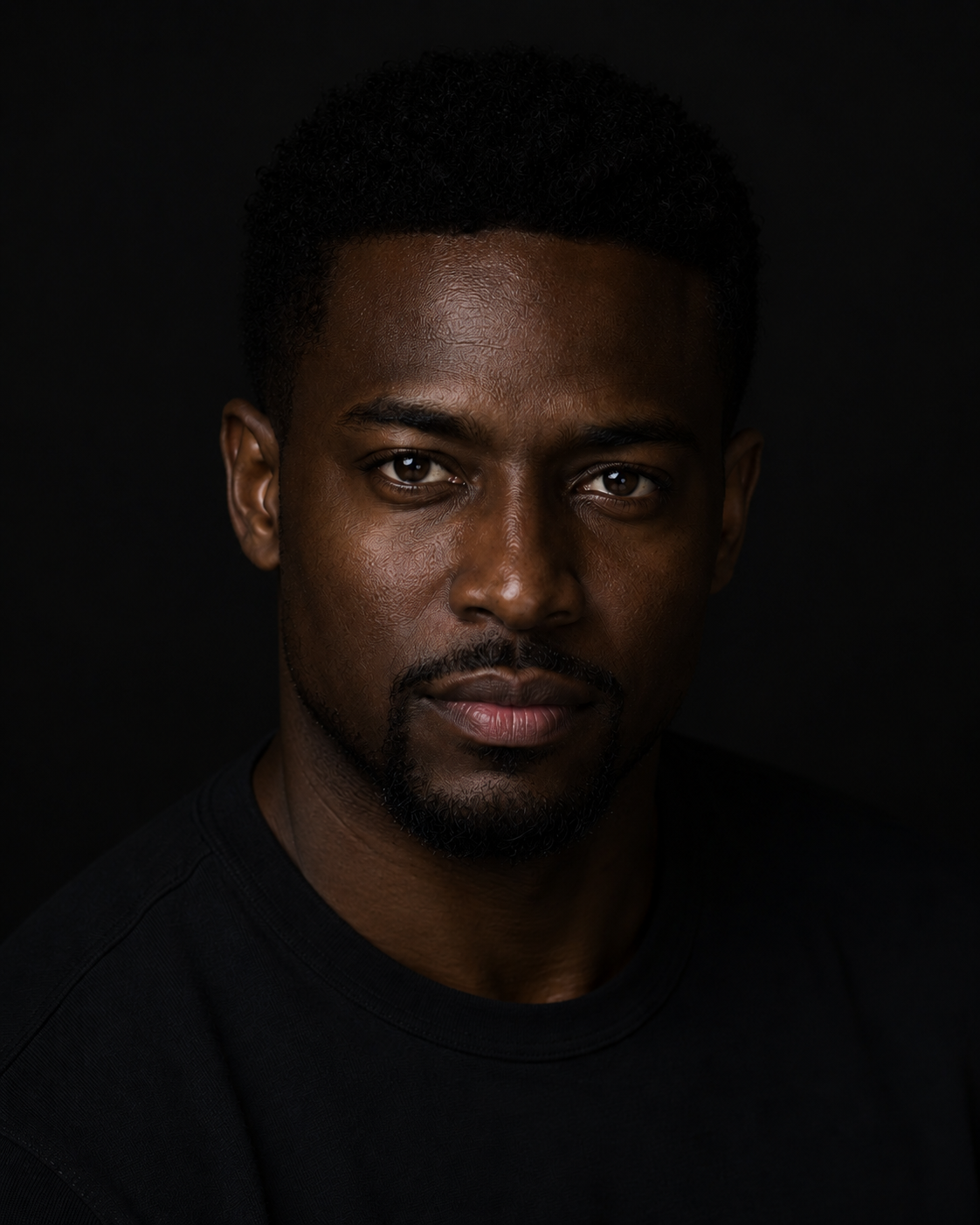
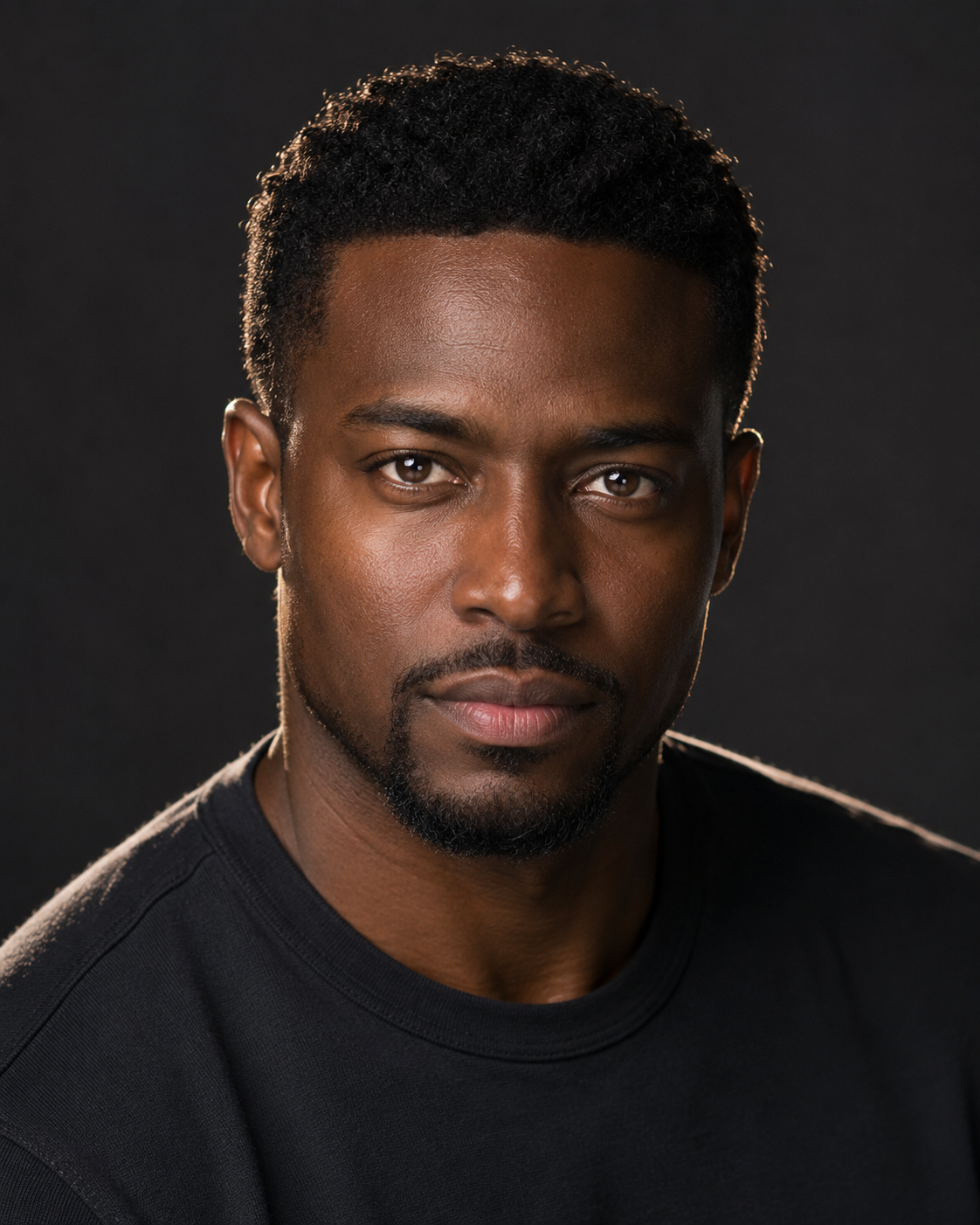
The 60-second test before you book anybody: scroll their portfolio and count. If there are no dark-skinned faces in it, that is your answer. If there are, but they look ashy, grey, or lit exactly like everybody else, that is also your answer. Then ask five things: Will you expose for my face or the background? Do you use a polariser? What is your plan for separation? Will your makeup artist matte me completely flat? (The correct answer to the last one is no.) And: can I see your raw, unretouched frames of a dark-skinned subject?
Plus-size actors: the problem is not that they rejected you
Everything you have been told about plus-size headshots is a slimming instruction. All of it is optimising for the wrong outcome, and here is the evidence.
In 2017, Refinery29 got three named casting directors on record about body size. It is the only real piece of journalism we could find on this, it is dated, and the mechanism it describes has not moved.
“When a writer puts in ‘attractive,’ I do think there’s an automatic assumption that that means ‘thin.’ If you put that in the breakdown, you’re not going to get a lot of submissions of plus-sized people. Because the agents aren’t thinking that either.”Venus Kanani, casting director (Heathers) — Refinery29, November 2017
“A lot of times you hear this vague, ‘This isn’t how I saw the role.’ They don’t want to say, ‘This person isn’t [thin].’ It’s usually all locked into what’s right for the part, and they’ll try to say some other reason.”Tiffany Little Canfield, casting director, Telsey + Co (This Is Us) — same source
Now the number that changes the strategy completely. Canfield estimates she saw around fifty actresses for the part of Kate on This Is Us. A major network pilot role routinely generates thousands of submissions. Venus Kanani saw forty for Heather Chandler.
The pool is tiny. Partly because many agents don’t sign larger actors, and partly — this is the part that hurts — because of self-elimination by actors who never submitted.
The casting director’s problem is that they cannot FIND you. Not that they found you and rejected you.
Which means submitting is the strategy, and a headshot engineered to hide your body is actively self-defeating. You are not clearing a bar by looking thinner. You are volunteering for a room where you will be compared to people who are actually thin — and where the casting director will feel misled.
Angles, lenses and the flattering lie
So here is the technique, stated mechanically, with no moralising in either direction.
Camera at, or very slightly above, eye level is the neutral, honest position. That is where a headshot belongs.
The high angle — camera looking down at you — is the classic slimming cheat, and it does something else that nobody mentions. It makes you look smaller. More deferential. Younger. Slightly childlike. That is a casting choice, and it is being made for you, silently, by a photographer trying to be kind. If you are marketing yourself as an authority figure — a boss, a judge, a detective, a surgeon — the flattering angle is actively working against your bookings. Nobody says this, and it is true.
A low angle enlarges the jaw and the neck. Know that before somebody does it to you.
And the lens is not a slimming tool. It is a truth tool. Perspective distortion is caused by distance, not focal length — a short lens simply forces the photographer closer, and being closer exaggerates whatever is nearest the camera. An 85 to 135mm equivalent, shot from six to ten feet, renders you as a person sees you from conversational distance. That is the whole science and it applies to everyone equally.
The trap, stated plainly: every flattering angle is a small lie, and lies compound. The casting director’s screen shows a face. The room shows a body. The gap between the two is the entire risk.
“Wear black, it’s slimming.” Four reasons it’s wrong.
We went looking for a named industry professional on record attacking this advice. We did not find one, so we are not going to manufacture a citation. What follows is our reasoning, built entirely on sources elsewhere in this section. Judge it on the argument.
One: fit beats colour, every time. Too-tight clothing pulls and bunches. Too-loose clothing adds bulk — loose reads as bigger, not smaller. A well-fitted mid-tone top will do more than a shapeless black one ever will.
Two: black on a dark background kills separation. That is the same lighting problem from the top of this chapter. If the point of a headshot is a face and a neck, dressing to disappear is a strange plan.
Three: slimming optimises for the wrong outcome — see the callout above. The breakdown already assumes thin. You will not win that comparison by shaving fifteen pounds off a photograph.
Four: colour is a casting signal. It tells the reader where you work, and it makes them click. Spending it on a doomed slimming manoeuvre wastes the most valuable thing you are wearing.
The posing that actually works is mechanical, and it applies to every single body in this chapter. Angle the body slightly off-axis to the lens. Shoulders down and back — not hunched forward, which reads as apologetic and collapses the neck. A small forward lean from the hips brings the face toward the lens and lengthens the neck without any chin-jutting. Keep the arms slightly away from the torso so they don’t press flat against it. None of that is a plus-size instruction. It is just posing, and it is the same for everyone.
Natural hair, braids, locs and protective styles
Shoot your hair the way you actually wear it. The reasoning is structural, not sentimental: the one non-negotiable rule across every casting director in this entire section is that the headshot must match the person who walks in. A protective style is not a costume. It is how you will arrive.
The real problem — and it is a genuine, mechanical one — is when your hair changes. Locs one month, a twist-out the next, braids after that. Your headshot is a promise, and Backstage is blunt about it: “if you dramatically change your look, you need new headshots.”
The resolution is the one the UK casting directors arrive at independently: shoot the range in one session. It costs nothing extra on the day. Then keep the submitted shot current. That is exactly what Spotlight’s casting directors ask for when they say they want beard/no beard, glasses/no glasses, hair up/hair down — “simple variety,” and facts about your face rather than characters.
And one question to ask the photographer, which is not a diva request: has your hair and makeup person worked with my hair texture? If they haven’t, bring your own or arrive camera-ready. It is the difference between a session that produces usable frames and one that doesn’t.
On the CROWN Act, get the facts right. As of 2026 it has been enacted in 27 US states. There is no federal law — versions passed the House in 2020 and 2022 and died in the Senate both times, and it was reintroduced in 2025. It clarifies that “race” includes traits historically associated with race, specifically hair texture and protective hairstyles. Pennsylvania’s version, signed in November 2025, notably covers head coverings as well, under both race and religious creed.
And now the honest part. These are employment statutes, and they contain a narrowly drawn occupational-qualification exemption. We could find no case law and no published guidance applying the CROWN Act to a casting decision. The entire body of commentary is about workplaces and schools. So:
The CROWN Act protects you at your day job. Whether it protects you in a casting decision has, as far as we can find, never been litigated. Do not plan your career around it. We would rather hand you an unresolved question than a false reassurance.
We also went looking for a named Black casting director on record about hair changes and headshots. There isn’t one. Not that we could find. That is a gap in the entire internet, and we are not going to fill it by inventing a quote.
Glasses, head coverings, and the places nobody has written anything
Glasses: shoot both. If you wear them every day they belong in the shot, because the shot has to match the room — but agents commonly want a glasses-free option on file, and Thom Hammond explicitly names “one with and without glasses” as part of the variety UK casting wants. If you do not wear glasses in life, do not add them as a “look.” The risk is entirely one-sided: fake glasses can only mislead.
The reflection fixes are mundane, physical and free. Raise the key light above eye level and angle it down, so reflections travel away from the lens. Tilt the chin down a few degrees, or tilt the arms of the glasses down slightly so the lens plane angles away from the source. Use large soft sources, never a direct on-axis flash. Anti-reflective coating genuinely helps.
And the one nobody warns you about: never wear photochromic or transition lenses to a headshot session. They will darken under studio light and hide your eyes — which, per Spotlight, are the entire point: “Your eyes are your most important feature, so make sure they are as visible as possible.” This is the single most under-warned mistake in this chapter.
Hijab. Shoot it the way you wear it. If you sometimes wear it and sometimes don’t, shoot both — the headshot’s only job is to accurately predict the room. Ask specifically about fabric colour against the backdrop, because a dark scarf on a dark background is precisely the separation problem from the top of this chapter, and it is solved by a rim light. And keep hold of the obvious thing that the industry keeps forgetting: Muslim women are not a monolith. Some wear hijab. Some don’t. A woman is more than what is on her head.
Kippah, turban, dastaar — and here we stop, because we have nothing to sell you.
We searched for headshot guidance for actors who wear a kippah or a Sikh turban. There is none. No casting director statement. No photographer guidance. No industry advice of any kind. The search results are Bollywood listicles and Pinterest boards.
So we are not going to invent any. What we can do is apply the general principle and tell you plainly that it is reasoning by analogy and not sourced guidance: if you wear it every day, it is in the shot, because the shot must match the room. Ask about separation, because a dark turban against a dark background has the same physics as everything else on this page. That is all we have, and pretending otherwise would be worse than saying so.
Visible disability: the dilemma is real, and we are not going to resolve it for you
Use the current numbers, not the famous one. You will constantly see “95% of characters with disabilities are played by able-bodied actors.” That figure is from a Ruderman Family Foundation white paper published in July 2016, studying the 2015–16 television season. It is a decade old and it is quoted everywhere as if it were current.
The current figure is from the USC Annenberg Inclusion Initiative, and it is worse than it sounds. Just 2.4% of all speaking characters in the most popular films of 2024 had a disability — the same level as 2015. Of those characters, 61% were male and 70.8% white. Annenberg’s own conclusion: “despite all of the activism and press attention… no meaningful change has been realised.” One genuinely good data point in the same study: 20% of top-grossing 2024 films had a lead or co-lead with a disability — a new high.
So: should it be in the headshot?
The argument for: those numbers tell you that disabled roles get taken by non-disabled actors, and authentic casting requires that casting directors can find you. A photograph that conceals a wheelchair, a cane, a prosthesis or a facial difference makes you harder to cast authentically — and it re-creates the mismatch problem the moment you enter the room.
The argument against, which is also completely real: many disabled actors want to be cast in roles where disability is incidental, and fear the photograph will collapse them into the equipment. Backstage names it exactly: “The biggest industry challenge is people diminishing wheelchair users into just a wheelchair.”
And here is the reframe that gives you the decision back: a headshot is a HEAD shot. For a great many disabilities, the question simply does not arise — a wheelchair does not appear in a chest-up frame. The disclosure decision therefore lives in your stats and profile fields and in your body shots, not necessarily in the headshot at all. The actor Shannon DeVido’s practical route is to add “PWD” — performer with disability — to the stats section of a profile, if you choose to disclose. Backstage’s framing is worth keeping: you can include it, but by no means do you need to.
Where the disability is facially visible — a facial difference, visible scarring, ptosis, Down syndrome, a hearing aid, a prosthetic eye — the match-the-room rule applies at full strength, and retouching it out is both dishonest and strategically stupid, for all the reasons in the last chapter.
And the honest note: we found no casting director on record saying “put your disability in your headshot” — and none saying don’t. Not one, either way. The industry has simply never given this guidance. We are not going to fabricate a casting director in order to sound authoritative. You get the framework, the numbers, and the fact that the guidance does not exist — which is itself the most useful thing anybody has told you about it.
Tattoos, and the production fact nobody tells actors
Location is destiny. Hands, forearms, neck and face are exposed in essentially every role, and those are the genuinely restrictive placements. Torso and upper arms are a non-issue for most casting. If a tattoo will be visible in the wardrobe of the roles you actually want, it should be visible in your marketing — decision-makers should know before they get invested.
And the thing almost no actor knows: a visible tattoo on camera can require a release from the tattoo artist. There is copyright in the design. Productions may not have the budget, the time or the makeup hours to cover it. That is a real, concrete, unglamorous reason casting is cautious about ink — and it is a far better thing to know than the vague sense that somebody disapproves of you.
There is no consensus on hiding versus showing, and we are not going to pretend there is. Hiding them widens your theoretical range and narrows your actual bookings. Showing them does the reverse. Pick deliberately. Don’t drift.
Trans and non-binary actors
Start with what the platforms actually do, because it is a strategic decision most actors make by accident.
Backstage offers 27 gender identity options, the ability to add one that isn’t listed, and — critically — separate control over which character genders you want to be found for. Spotlight offers Female, Male, Transgender–Female, Transgender–Male, Non-Binary and Custom, developed with the trans-led organisation Gendered Intelligence. And Spotlight’s mechanic matters enormously: non-binary performers appear in unfiltered searches and in non-binary-filtered searches, but do NOT appear in male- or female-filtered searches unless they explicitly opt in.
Actors Access now has five gender options, and we could not verify what they are, because the profile editor sits behind a login. We are not going to guess. Same for Casting Networks’ current fields. If a site states them confidently, ask yourself how they know.
On disclosure, the UK position is sourced and it is worth knowing precisely. Per Spotlight and Gendered Intelligence: “You don’t have to disclose your trans identity in an audition — that’s entirely up to you.” You are protected from discrimination and harassment under the Equality Act 2010. And under the Gender Recognition Act 2004, if someone acting in a professional capacity outs a trans person who has legally changed their gender, that can be a criminal offence. Deadnaming is outing: “A trans person can refer to their past names and pronouns at will, but it’s not appropriate for anyone else to do so.” That has a direct practical consequence for credits and CVs — work under a previous name is yours to disclose, or not.
Now the headshot question, and the honest answer: no casting director anywhere is on record giving headshot guidance to trans or non-binary actors. Not one. We looked. So what follows is our reasoning, clearly labelled as ours.
The platforms are built for range. Backstage lets you select multiple genders and separately select which character genders to be found for. Spotlight makes the male/female searches an opt-in. Which means: if you have ticked “find me for male and female roles” and you have one image, you are asking a casting director to do imaginative work that they will not do. Your images should support the range you have actually opted into.
But this must never become a demand that trans actors present multiply in order to be employable. The correct framing, and the only one we will offer: if you want range, shoot for it. If you want to be seen exactly as you are, one honest shot is correct and complete. Both are legitimate, and the choice is a career decision with a real cost either way — as the actor Mel Cort puts it, on roles: “As much as I want to see a role tailored to someone like me, I would prefer no role over one that plays off of stereotyping or outdated perceptions of nonbinary people.”
And notice, finally, that the one iron rule of this entire section — it has to look like you — is the rule that protects you here more than anyone. It means nobody can demand you present as something you are not. The headshot’s only job is to predict you.
- Lighting for darker skin — working DPs, on the record.
- Plus-size casting — three named CDs, 2017.
- Glasses — UK casting director, named.
- Tattoos — production release requirement, sourced.
- Trans/non-binary platform mechanics — Backstage, Spotlight.
- Headshot guidance for kippah or turban wearers. none
- A casting director on whether a visible disability belongs in a headshot. none
- A named Black casting director on hair changes and headshots. none
- Headshot guidance for trans or non-binary actors from any casting director. none
- A named professional dissenting from “wear black, it's slimming.” none
The retouching trap, and it is the point of this whole chapter
Everything above can be undone in twenty minutes by a well-meaning retoucher with a preset built for one kind of face.
Retouching away a scar, a facial difference, vitiligo, a birthmark, a gap tooth, a crooked nose, textured skin, or the texture of textured hair is not cleaning up. It removes the one thing that made you findable in a grid of ninety-six thumbnails.
The photographer Natalie Young was asked, by a client, to remove her freckles. She declined. The agent Carrie Johnson warns that a character actor with interesting lines whose headshot has been polished into a mannequin will be caught out the second the door opens. The photographer David Green, on the crooked teeth and the big nose and the jug ears: “Great! A casting director needs exactly that look.”
The flaw is very often the casting. And there is no rule protecting you here — no union, guild or platform has any retouching standard at all. There is no rule. There is only a market. Nobody will disqualify you. They will just stop calling, and never tell you why.
“Do not remove this. It is not a flaw. It is my casting.”
Say it at the consultation. Say it again at the shoot. Put it in the email with the retouch selects. The default preset does not know the difference between a spot and the reason you get hired — and it will erase both with the same slider.
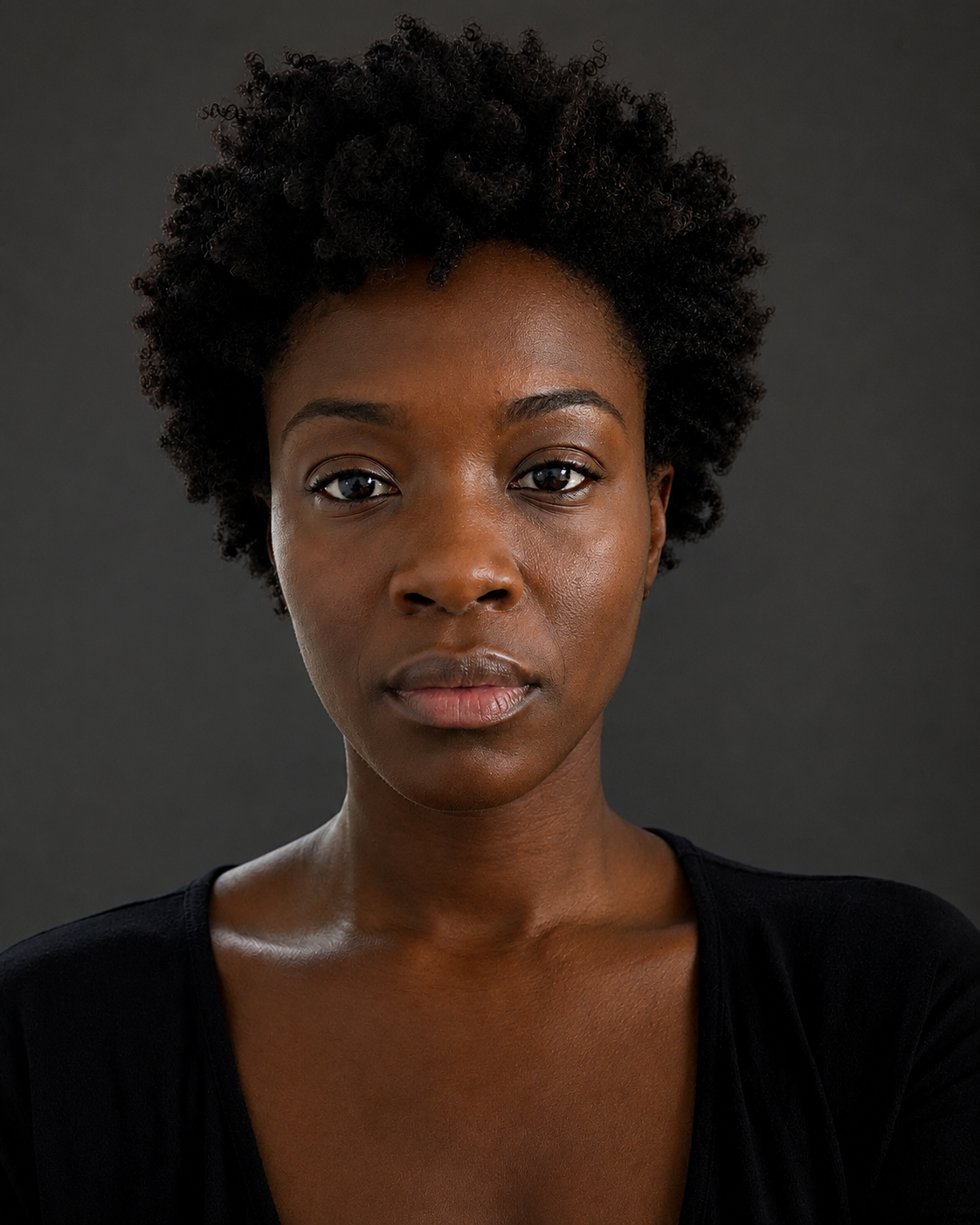
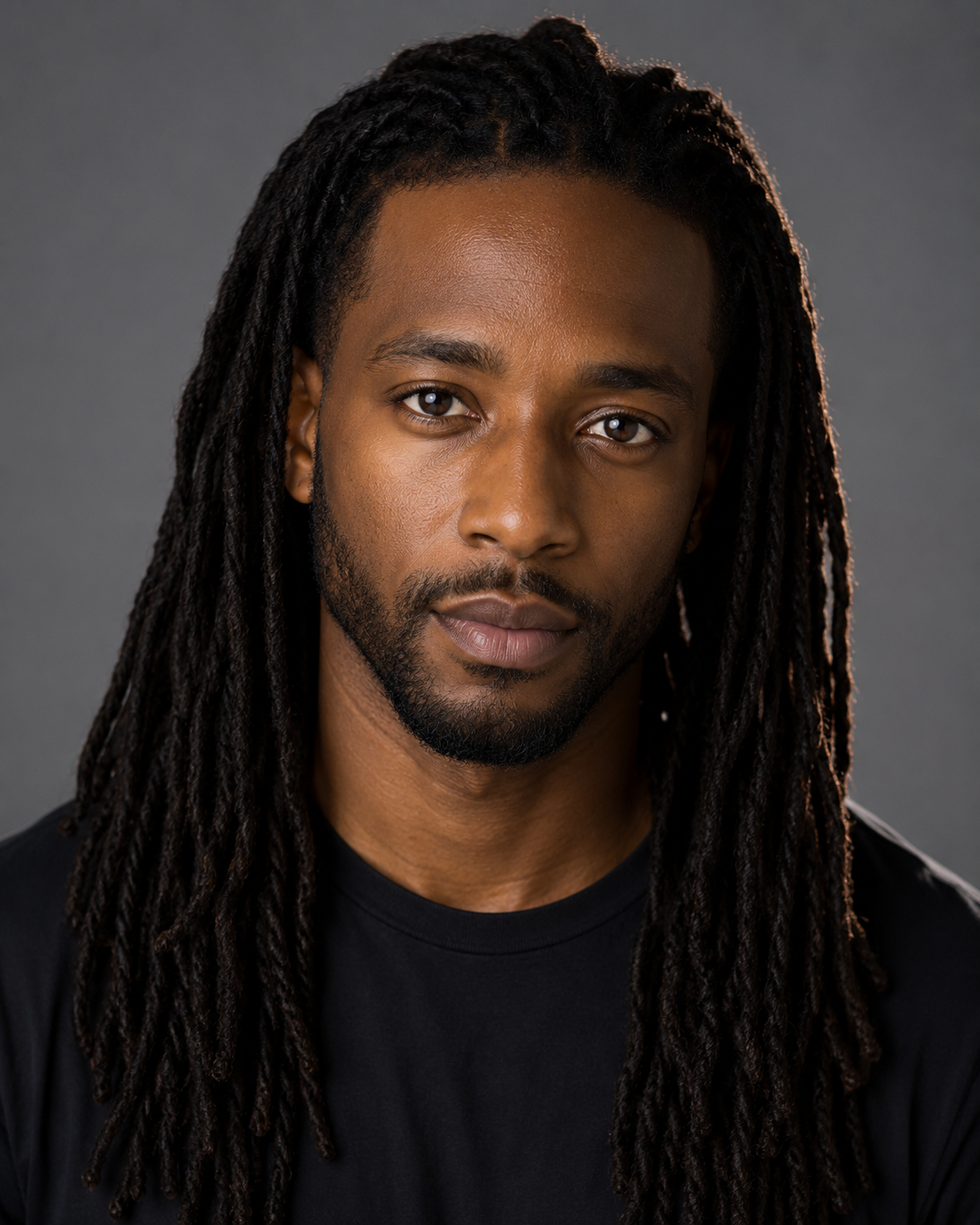

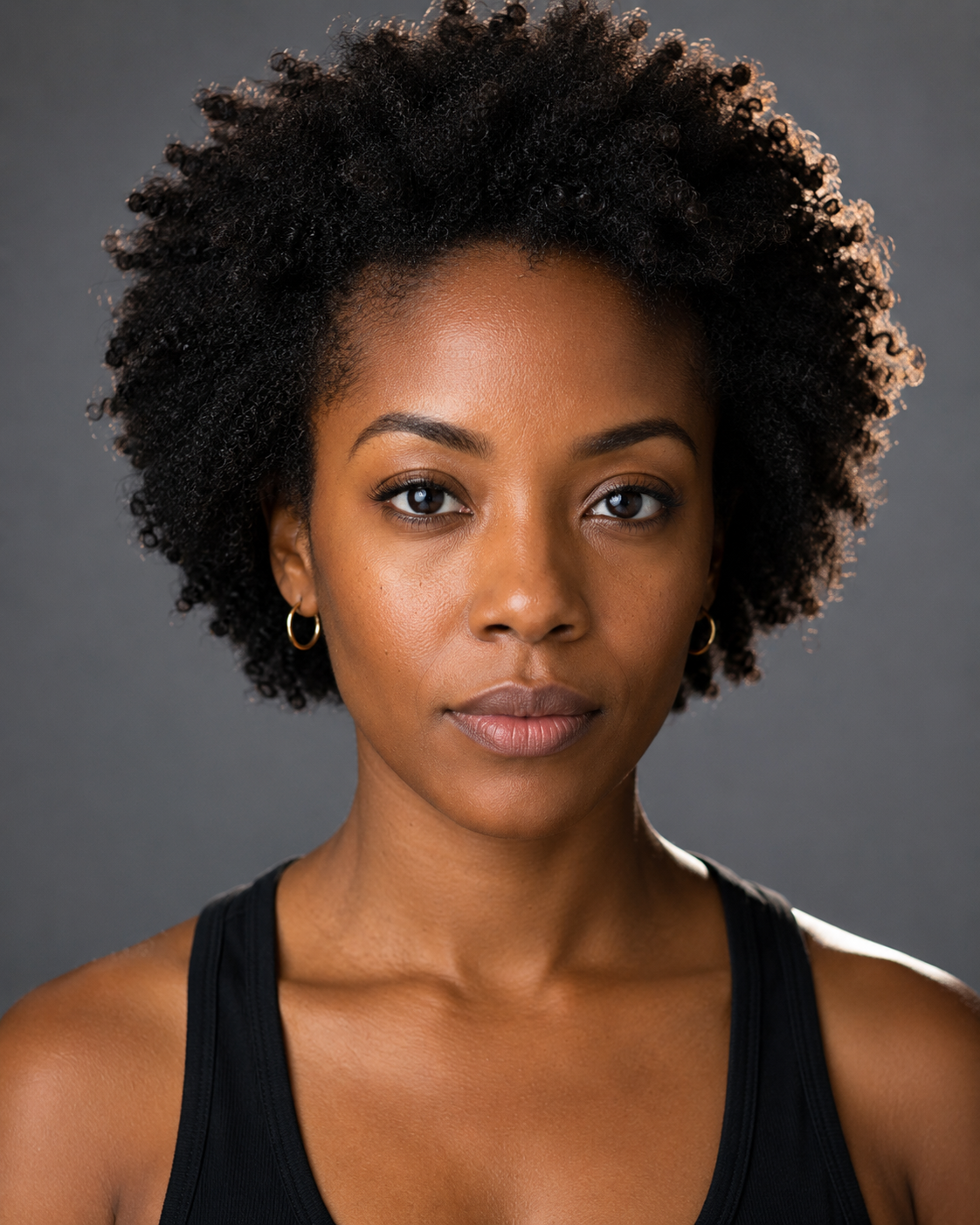
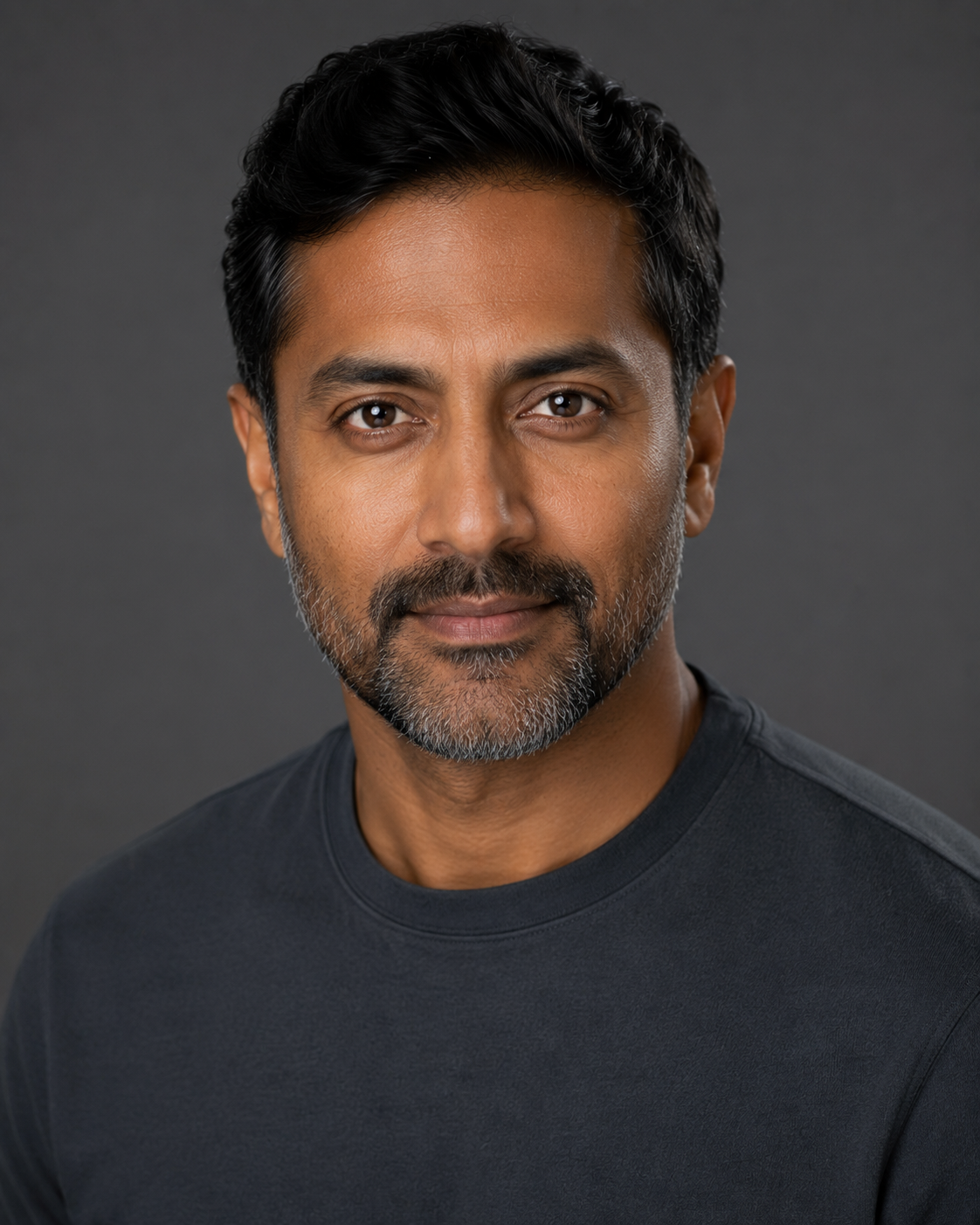
That is the chapter. No affirmations, no encouragement to be yourself, no one telling you that what makes you different makes you special. Just the light, the angle, the fabric, the lens, and one strong instruction: make them a photograph of the person who is going to walk through that door — and then go and submit, because the only thing worse than being rejected is not being findable.