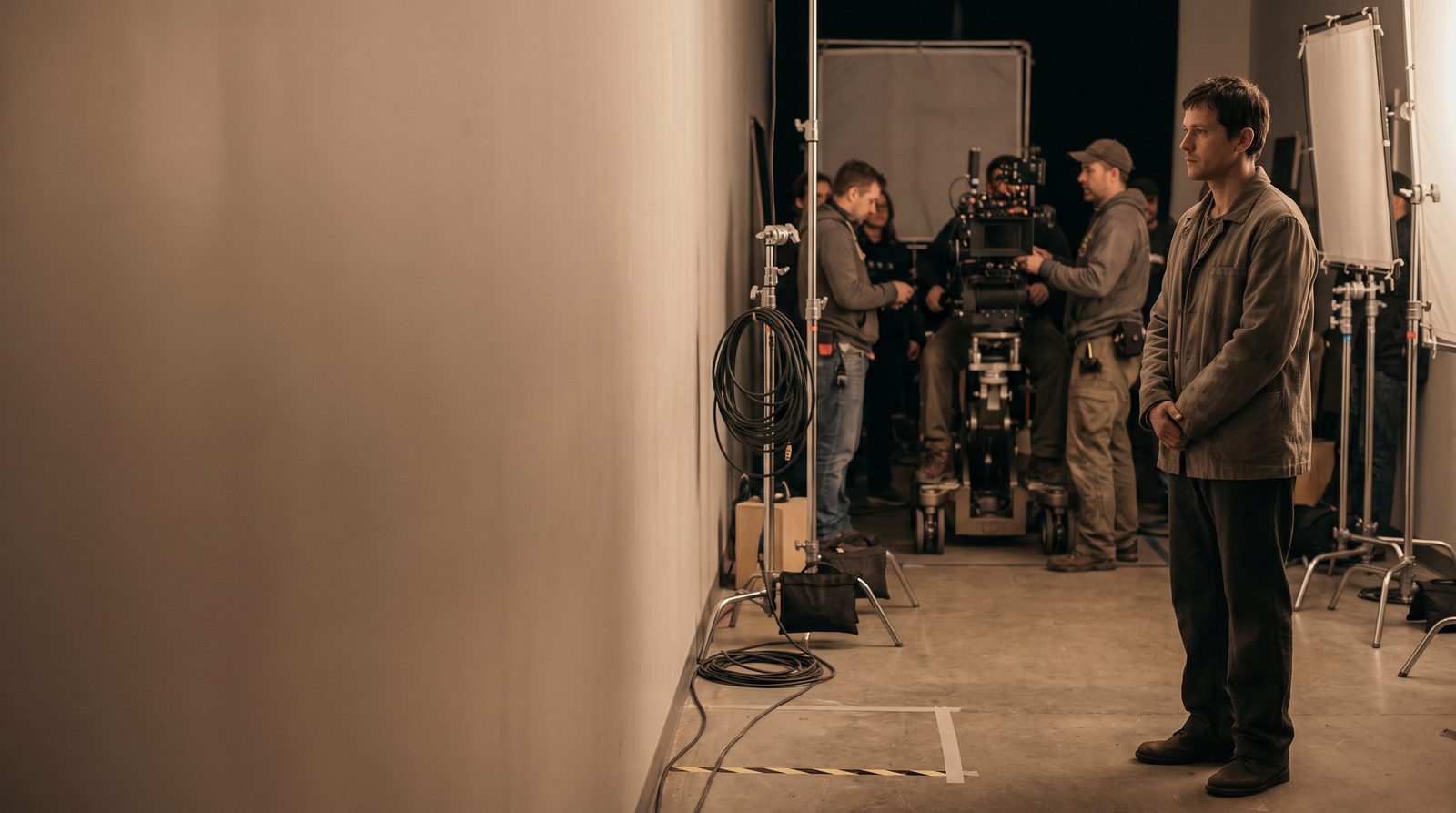
Nobody is talking to you, and the usual explanation is wrong
Every guide for nervous actors offers the same comfort: the crew have been ordered not to look at you. It is a lovely thing to be told on your first day. We went looking for it and it does not stand up.
What is genuinely true, and documented properly, is about the eyeline rather than eye contact. Sidney Lumet describes it in his book Making Movies. Just before a take, a well-trained assistant director calls out: “Clear the eyeline, please.” His reason is practical. If one actor is playing a love scene with another, he does not want to be looking past her at a teamster drinking coffee.
That is a real, standard practice on real sets. It is about not being a visible distraction in the space an actor is looking into, and it is why the area behind whoever you are playing with quietly empties before a take.
The rest of the quiet has a simpler explanation. A working set is a live recording environment, and most of the people near you are concentrating on something narrow and technical. Silence is not a verdict on you. It is the sound of fifteen people trying to make the day.
Etiquette here is not manners. It is a system for protecting time.
This is the idea that makes every other rule on this page memorable, and it is the reason a set feels stricter than any other workplace you have been in.
A shooting day is scheduled to the minute and the whole enterprise is aimed at making the day — finishing the shots that were planned for it. That phrase is real industry vocabulary, not something a writer invented, and it is the thing every department is measured against.
Once you see that, the rules organise themselves. Quiet protects the sound take. Chain of command stops fifteen people solving the same problem twice. Back to one protects continuity. Last looks protects the frame. None of it is ceremony.
Before you do the thing you are wondering about, ask: does this cost time, or could it ruin a take?
If the answer to either is yes, do not do it, or ask first. If the answer to both is no, you are almost certainly fine.
You will never memorize every rule, and you do not have to. One principle covers most of them, and it is the principle everyone around you is already working from.
There is an old industry line about punctuality that gets repeated on every set: if you are early you are on time, if you are on time you are late. It is a genuine piece of oral culture rather than a written rule, and it is not unique to film. It is still the standard you will be judged by, so treat your call time as the moment you must already be there and ready.
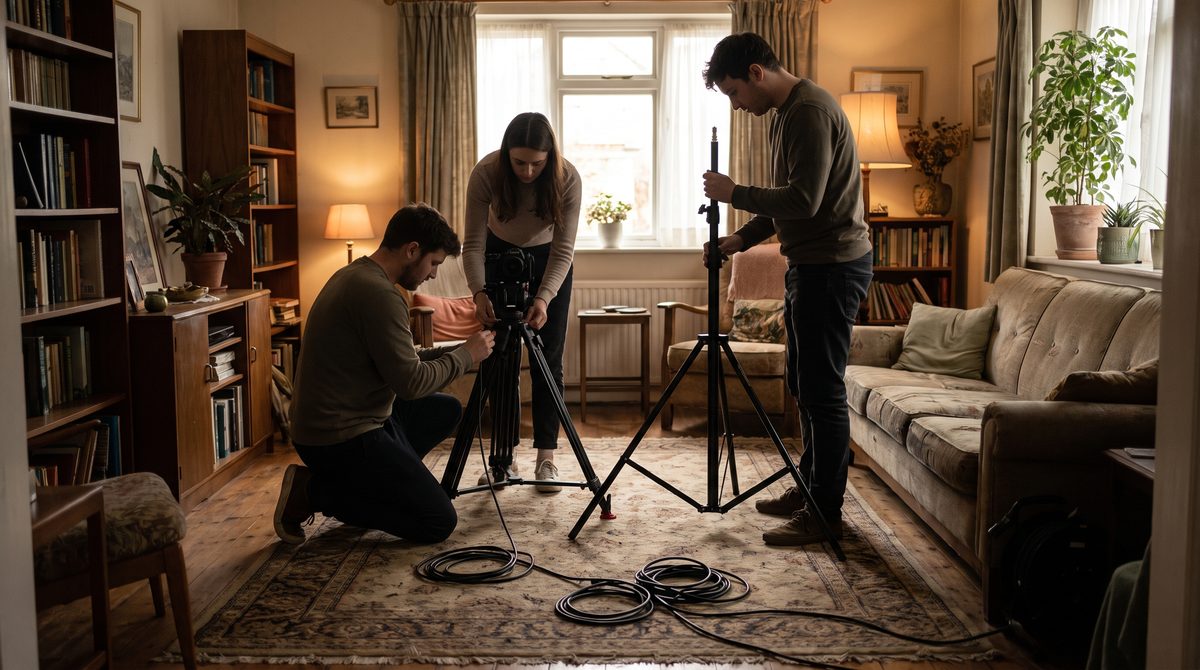
The shape of a shooting day
Most of the fear about a first day is not knowing what happens next. Here is the order, and the acting occupies a much smaller part of it than you expect.
Your longest reliable block of the day, and the best time for lines and quiet. Your call time is when you are there and ready, not when you set off.
The director works the scene with the actors, then shows it to the crew. This is the one moment in the day when your input on the scene is genuinely wanted.
Stand-ins occupy your positions so the crew can build the light and work out the technical problems. You are usually released, often for a long time.
The lighting is done and they are ready. That is you. Be findable — the assistant director needs to be able to produce you quickly.
Hair, make-up and props do a final check on you and the set. Stand still and let them work. It takes seconds and it protects continuity.
Sound, camera, marker, action. When they go again, return to exactly where you started, doing exactly what you were doing.
Then the setup finishes, they move on to a new angle or a new scene, and the whole cycle starts again. Most of a shooting day is waiting, and being good at waiting is a genuine professional skill rather than a failure of glamour.
Who everyone is, and who is allowed to direct you
One piece of hierarchy matters more to an actor than all the rest, and it protects you as much as it constrains you.
The convention on a film set is that only the director gives actors direction. Notes about your performance come from one person. If they start coming from somewhere else, something unusual is happening, and you are not obliged to act on suggestions from people whose job that is not.
The only source of performance direction on a feature. On television, see the note above.
Runs the floor and controls the clock. Calls last looks and calls you to set. Does not call cut.
Usually your actual point of contact. Call times, base camp, where to be and when. Tell them if you leave the set.
Your marks and your frame. Collaborators rather than wardens, and they respect a smart technical question.
Continuity. They are the person who will tell you which hand you used, and they are always right.
Your microphone, and the reason they wince at a rustling costume or a jangling prop.
The words, and one that has quietly gone
The glossary is the thing most people want from a page like this. It is also where we found our clearest error.
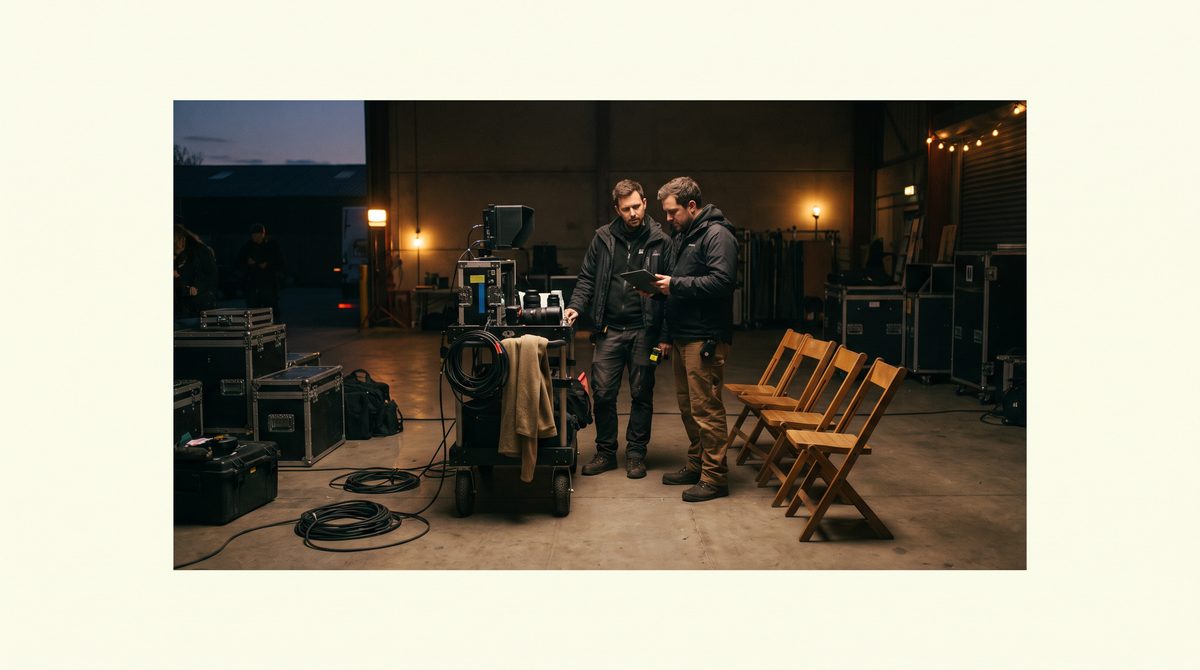
The unwritten rules you are most likely to break
There is a line in one crew guide that sums the whole thing up: on a film set, there are more ways to be wrong than right. That is why the principle matters more than the list.
Questions, ideas and mistakes
The advice not to speak up is usually given too broadly. There is a clean distinction, and it is worth learning because it works in both directions.
If you do not understand a word somebody has used, ask. Once, quietly, of the right person — usually the second AD or whoever is nearest and not mid-task. Standing there with a blank expression is worse than asking, because a misunderstood instruction costs a take and a question costs four seconds.

Saying no, and what you are actually entitled to
Most etiquette pages stop at being agreeable. That is incomplete, and this is the section where being approximate would be worst, so we researched it properly and we are going to be precise about what is a right and what is only good practice.
Deference is the culture on a set. It is not unlimited, and it is not the same thing as having no standing. The structures below are real, and knowing which is which is the difference between asking for something and being told no.
On stunts and physical risk the position is more straightforward. Responsibility for safety sits with the production company as the employer, not with you, and every stunt should have a risk assessment and a coordinator behind it. In the United States, performers have a contractual route to question the stunt coordinator, and background performers who were not warned in advance of hazardous work can decline it and still be paid. “I am not comfortable doing that” is a complete sentence, and the alternative is a double.
On the floor, the practical route is your second AD, then the first AD or production. That is custom rather than a rule, and it is the right first move for most problems.
For anything that route will not fix, there are formal channels. SAG-AFTRA runs a 24-hour on-set safety line on 844 723 3773, and a separate line for sexual harassment on 855 724 2387.
In the United Kingdom, the Film and TV Charity runs a free, confidential support line on 0800 054 000, open to anyone working in film and television. It is an advice service rather than a formal reporting route, and it will help you work out what the formal route is.
And outside all of it, your agent. Part of what they are for is being the person who makes the difficult call so that you do not have to make it on the day.
How to get asked back
This is the real question underneath the whole page, and the honest answer is duller and easier than most people fear.
You were on time every day. You knew your lines and hit your marks, so nothing was wasted on you. You took direction without arguing, which is what casting was assessing in the first place. You were the same person at hour eleven as at hour one. And you were decent to the crew.
That is the whole list, and none of it requires talent you do not already have. The professional standard is boringly high and boringly simple, which is genuinely good news if you are frightened of your first day.
Grading the sources
This was the most thinly sourced research we have worked from. Almost every claim came from a film school's marketing blog, a crew blog or a software company's content page. Some of it is true anyway, and two things were not.
Two things we deliberately did not print. We found a helpline number for a British performers’ union that we could not confirm against the union’s own published page, so it is not on this page — a wrong number in an emergency is worse than no number. And we have not given exact hours, turnaround or rate figures for British supporting-artist work, because those sit in agreements we could not verify at source and they change. Ask your union for the current agreement rather than trusting a figure on a website, including this one.
Where we differ from the standard account
Why is nobody talking to you?
Commonly saidCrew are under orders not to make eye contact with actors.
What we foundThey are trained to stay out of your eyeline, which is real and documented. The no-eye-contact rule mostly is not.
What is set etiquette actually about?
Commonly saidRespect, hierarchy and knowing your place.
What we foundTime. Every rule protects a take or protects the schedule, and that one idea explains nearly all of them.
Who is allowed to direct you?
Commonly saidOnly the director, always.
What we foundTrue on a feature. On television much of the authority sits with the showrunner, and ADs direct background.
Is checking the gate part of the day?
Commonly saidYes, after every completed setup.
What we foundDigital cameras have no gate. The phrase survives, the ritual mostly does not.
Are you entitled to an intimacy coordinator?
Commonly saidYes, on any intimate scene.
What we foundYou are entitled to ask and to be considered in good faith. The contract requires best efforts, not a guarantee.
Can you refuse unsafe work?
Commonly saidOf course. It is the law.
What we foundIn the UK the statutory protection does not cover the genuinely self-employed. Check how you were engaged.
How do you get asked back?
Commonly saidBe memorable and make an impression.
What we foundBe on time, know it, hit the marks, take the note, and be the same person at hour eleven.
Before your first day, do one thing. Find out who your second AD is and how to reach them, because that is the person who answers nearly every practical question you will have and the person to tell if you need to step away. Everything else on this page you can learn on the day. That one is easier to have in advance.