
The note is not “be flexible”. It is “be specific”.
Our own draft of this page said we could not find casting directors on the record about character choices. That was wrong: they say it constantly, and they say it under their own names.
Casting Networks published a round-up of audition advice on 30 December 2025. It carries seven casting directors, each named, each with credits you can check. Every one of them asks for a choice, and the word most of them reach for is “bold”.
The clearest of them is Jill Anthony Thomas, who cast Gilmore Girls. “Make a strong choice with the scene. If it’s wrong, we’ll adjust you.” Read the second sentence as carefully as the first. She is not promising that your choice will be right. She is telling you that being wrong is cheap, and being blank is not.
The others say versions of the same thing. Ani Avetyan asks actors to “make bold choices”, and not to “go with the same clichéd choices that every other actor is going to make”. Nancy Nayor says bold choices produce “the auditions that are the most memorable”. Sunday Boling puts it in four words: “Stay with your own choices.” And Bella Hibbs aims at the fear underneath it. “Stop trying to guess… show us what you have to offer.”
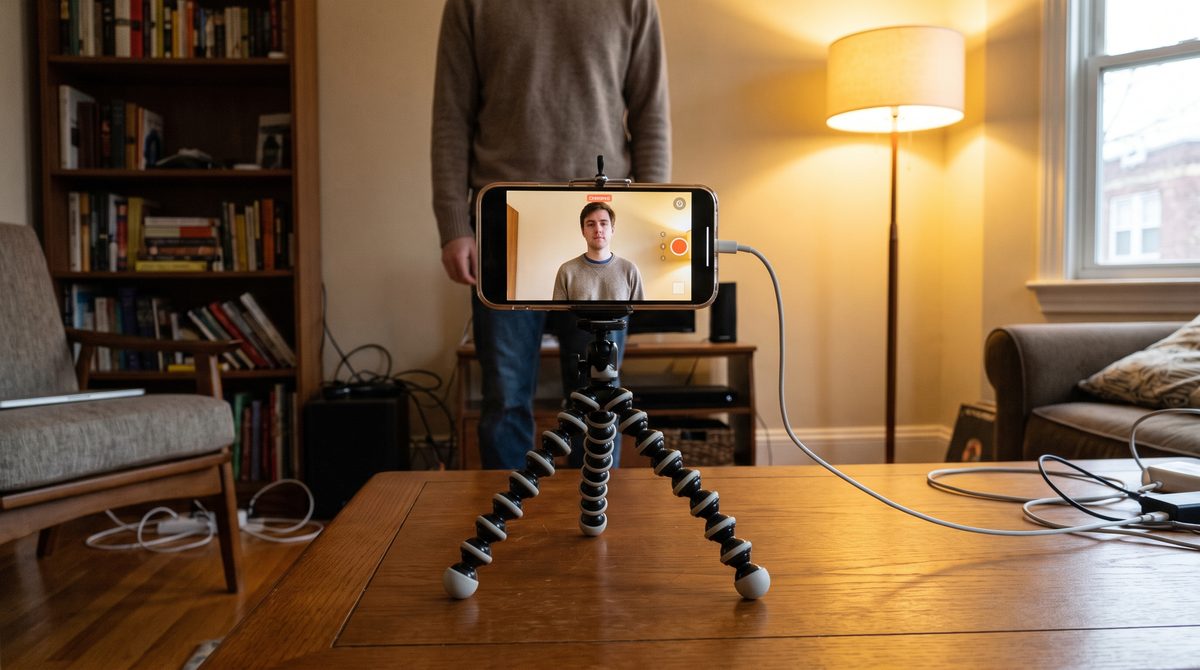
What a tight frame actually removes
This page began from the idea that a self-tape is shot chest-up, so most physical character work is wasted. The idea is roughly right and the word “standard” is wrong, which changes what you should do about it.
The convention is well attested. Writing in Backstage, in a guide last updated on 31 July 2024, Cori Hundt recommends “a tight frame that goes from your chest to just over the top of your head”. She calls it a medium close-up. That is the shape most actors have seen and most readers will recognise.
But it is a convention, not a rule, and casting people disagree about it in public. The casting director Daryl Eisenberg, in Backstage on 1 November 2021, asks for the opposite. “Adjust your framing to be from the waist or chest up to give us an idea of your proportions and size.” Her reason is worth having in full. “When the frame is tight, all I have is your face. But I want to know what you look like and how you live in your body.”
The underlying point survives the correction, because most tapes are tight in practice. In a chest-up shot the camera cannot see your walk, most of your stance, the lower half of your costume, or how you occupy a room. None of those tools is useless. They are simply the wrong first investment for a frame that will not contain them.
So start with what still reaches the viewer. How quickly you think, and where your attention goes. The rhythm of the voice, your status with the other person, and what you need from them right now. Those all survive the crop.
Small is not the same as less
There is a hundred-year-old reason the camera rewards small behaviour, and knowing it stops you confusing small with empty.
Screen acting did not become quiet because quiet is truer, but because the lens changed what could be read. In her 1992 study of Griffith’s early films, the film scholar Roberta Pearson describes two competing styles around 1910. The histrionic code worked from a limited vocabulary of standard gestures, held long enough to read from the back of a theatre. The verisimilar code worked from minute gestures, transitory attitudes and small ordinary objects. The second displaced the first between roughly 1908 and 1913. The reason was mechanical: a medium that can show a face six feet tall rewards small behaviour and punishes semaphore.
Change one thing, and where that idea really comes from
Our draft credited this to “Stanislavski anecdotes and Laban-based work”. Half of that is right, half is loose, and the best source was left out.
The Stanislavski passage is real and it is better than the paraphrase. It is in Building a Character, the Elizabeth Reynolds Hapgood translation, published by Theatre Arts Books in 1949, in the first chapter. The teacher Tortsov dries his upper gums with a handkerchief, so his lip sticks and rides up over his teeth. One mechanical trick, nothing else.
His pronunciation changed, and his voice with it. So did his carriage, his walk, his hands and his legs. He had not decided any of those separately. They arrived on their own, and the book says his inner faculties responded to the external image he had made.
That is the whole idea, written down in 1949. Change one thing on purpose and let the rest follow. Do not decide forty things and then assemble them.
Two honest limits: he is describing stage characterisation, not a camera parameter, and he never uses anything like the word “dial”. That framing is ours, and it is a fair reading of the passage, but it is still a reading.
The closer ancestor is somebody our draft never mentioned, because Michael Chekhov built an entire technique on exactly this move. His book To the Actor was published by Harper in 1953. In it, the psychological gesture and the qualities of movement — moulding, flowing, radiating — are single adjustable parameters that reshape a whole characterisation. That is not an anecdote we are stretching. It is a documented method, and it is the honest source for what this page teaches.
Laban needs a correction rather than a credit, because his four Effort factors are Space, Weight, Time and Flow. Their poles are direct and indirect, strong and light, sudden and sustained, bound and free. Weight is strong and light — never “heavy”, and we have corrected that word elsewhere on this site.
The things a tight lens can still read
Five qualities survive the crop. Choose one to change deliberately, and let two or three others sit where they naturally fall.
Do they answer at once, or let the idea arrive first? This is the easiest one to change and the easiest one to see, so start here.
What do they look at, what do they avoid, and how fast do they look back? On camera, character is mostly a description of how somebody pays attention.
Do they hold themselves tight, or sit easily in a silence? Breath is visible from the chest up when almost nothing else is.
Do they expect to be heard, ask permission, or quietly take control? Status lives in the face and the timing, so it survives a crop that removes the body.
Where does the voice sit, and does the thought shape the sentence or follow it? Move it a little, but do not turn it into an effect.
None of this has been measured. We looked for peer-reviewed work linking tempo or eye behaviour to perceived character on screen, and found none. These are teaching tools, not findings.
Keep only the history that changes what you do
Backstory earns its place when it alters your behaviour in this scene. It becomes a hobby when it only makes the character feel more complete in your notebook.
Write down one piece of backstory. Now remove it, and run the scene in your head without it.
Did your action change — your relationship, your urgency, or what you do when they say the hard line?
If yes, keep it, because it is feeding the scene. If no, let it go. It may be genuinely interesting, but it is not helping this tape.
“Be yourself” does not mean bring less
Actors hear this note as an instruction to neutralise, but three named casting directors, asked directly, are asking for the opposite.
So bring your imagination and your sense of humour. Bring your real capacity to listen and be changed, your particular rhythm and warmth, and your willingness to make a specific offer. Leave behind the protective character voice, the blank read designed to offend nobody, and the idea that casting wants a puppet.
Commit completely. Hold the choice lightly.
A strong first choice shows casting your point of view, and flexibility lets the room explore. You need both, and casting directors describe wanting both.
Juliette Ménager describes what she does with an actor’s own idea. “I usually let them do one pass because sometimes they have a creative idea and I want to let them have that.” The first take is yours. That is the offer.
Cami Patton describes the other half: “Come in having already made choices… but also listen and be open because that might get thrown out the window.” Both halves are load-bearing. Most actors are missing one of them.
So treat a redirect as information rather than a verdict, because a note is not always a correction. Sometimes the director simply wants to know what else is available. Answer that question fully instead of defending the first take.
Play the scene with your first clear interpretation and record it.
Change the status relationship completely and play it again — not louder, just a different footing.
Change the action — what you are doing to them — and record a third. Not the mood, but the action itself.
If all three are watchable you are flexible, and if only one is, you have a habit rather than a choice.
Three pages, twenty minutes
Say the breakdown gives you one line: “Maya, thirties, guarded.” You are not supposed to know the arc. Treat the description as a clue about behaviour, not a request to invent a lifetime.
Finish the sentence “I am trying to…” — reassure, expose, win back, calm, challenge, escape. One verb, aimed at the other person.
What do they expect from this person, and who has the higher status when the scene opens? Status can move during the scene, so decide where it starts.
Fast or slow — do they think before speaking, or find the thought while speaking? This is your one dial, and the camera sees it clearly.
What might they find funny, irritating, touching or beneath them? One surprise stops a character being a description of a mood.
What happened sixty seconds ago, then ten, then one second before the first line. Then stop adding, and put it on camera.
The eleven-minute check
Two takes and three questions. None of them is whether it felt like a real person, and that exclusion is deliberate.
Take a short scene you already know, and record it once with no character layer at all.
Now choose one visible dial, and tempo of thought is the best one to start with. Change only that, and record it again.
Watch both takes chest-up, once with the sound on and once with it off. The silent pass is the honest one, because it removes the thing you have been rehearsing.
Then ask three questions about the second take. Could somebody who has not read the scene describe this person? Does the choice actually appear inside the frame, or only in your head? Could you drop it tomorrow and play the scene a different way?
If the answer to all three is yes, the work is specific, visible and flexible. That is enough for an audition. It is not a finished performance and it is not supposed to be. You are being asked whether there is a person here and whether you can be directed. Both of those are answerable in three pages.
Grading the sources
This page rests on one trade round-up, two books from 1949 and 1953, one film-history monograph and one study. Three of the claims we are grading are our own, and all three failed.
One thing we could not find, and it is a hole in the evidence rather than in our reading. Nobody appears to have run the experiment this page implies. Film the same actor doing the same scene twice, changing one quality and nothing else. Then ask viewers who have not read the script to describe the person in each take. Until somebody does that, “change one dial” is a teaching tool with a good pedigree and no measurement behind it. We would rather say that than dress it up.
Where we differ from the standard account
How much character do you need?
Commonly saidBuild the whole person — history, walk, voice, inner life — before you record.
What we foundKeep only what changes what you do in this scene. Everything else is work that will not reach the frame.
Does casting want you to commit or stay open?
Commonly saidDo not over-commit, and give them something they can shape.
What we foundSeven named casting directors asked for a strong, specific choice. They said they will adjust you if it is wrong.
Is a self-tape chest-up?
Commonly saidYes, that is the standard framing.
What we foundNo union or platform publishes that rule, and SAG-AFTRA asks only for landscape and a full-body slate. One casting director asks for waist-up so she can see how you live in your body.
Where does “change one thing” come from?
Commonly saidStanislavski, and Laban.
What we foundThe Stanislavski passage is real, but it is stage characterisation from 1949. Michael Chekhov, in 1953, built the actual method.
What is Laban’s Weight?
Commonly saidHeavy and light, and each Effort carries its own emotion.
What we foundStrong and light, and the readable states are combinations of Effort factors, never a single one.
Does “be yourself” mean bring less?
Commonly saidNeutralise the choices and be easy to direct.
What we foundThree named casting directors asking for the opposite. The version that tells you to flatten comes from studio marketing copy.
Is the tempo exercise proven?
Commonly saidPresented as a method, and often as science.
What we foundNo peer-reviewed work links tempo of thought or eye behaviour to perceived character on screen. It is a teaching exercise and we label it as one.
Take your sides tonight. Record the scene once with no character layer, then change one thing only — how fast the thought arrives — and record it again. Watch both chest-up with the sound off. If you cannot see the difference, the camera cannot either.