
The method, in six propositions
Each of these came out of the research rather than out of a preference, and each is testable by you, this week, with a phone. That last part matters more than any of them being right.
Everything follows from this. Indicating, overacting, self-monitoring, pushing, performing to somebody who is not there, and going flat are all one error wearing different clothes: attention on yourself.
Emotion is an output, not an instruction. You cannot reliably play sad. You can persuade, hide, confront, protect, or get somebody to stay, and the feeling arrives as a consequence or it does not.
The delete test is the most portable tool we have. Remove the fact. If the scene plays the same, it was trivia and you can stop carrying it.
A wrong specific choice can be redirected. A careful, safe, general one gives nobody anything to work with, which is worse than being wrong.
A simple map — facts, want, obstacle, action — lets you stop inventing and become available to the other person. Preparation is not the enemy of aliveness. Unstructured preparation is.
Casting directors on this site say they can tell when a tape has been done twenty times, because the humanity has been ironed out of it. Stop before that.
If you take one sentence from this page, take that one in the strip above. And if you only want to know what is different about it: almost every other approach you will be sold is a method for generating feeling. This one is a method for putting your attention somewhere and leaving it there.
Does it apply beyond self-tapes? Yes, to all of it. But the self-tape is where all six are hardest to obey, because you are alone, unwatched, unlimited and unredirected. That is why this site exists.

Showing the working, including where it went wrong
Every acting site asserts a philosophy. Very few show why it holds, and none that we have found shows where its own evidence has since weakened. Here is ours, graded honestly.
Proposition one — attention outward — is the load-bearing one, and it arrived from four separate places that were mostly not talking to each other. That convergence is the reason we believe it. But the four legs are not equally strong, and one of them has largely given way.
One more correction while we are here. We used to describe these fields as entirely unaware of one another. That is not quite true — the 2019 fMRI paper cites the Noice memory work directly. Diderot obviously predates everyone, and the motor-learning literature mentions none of them. The convergence is real. Total isolation is a better story than it is a fact.
The hundred-year drift away from emotional memory
This is the most interesting thing the research turned up, and we need to start by giving credit we originally failed to give.
Seven major teachers each moved away from emotional memory — the practice of generating feeling by recalling your own past — and they did it independently, over roughly a century, for different reasons. We believed nobody had laid them side by side. We were wrong about that. Isaac Butler's The Method, published in 2022, traces this arc across Stanislavski, Strasberg, Adler, Meisner and Robert Lewis, and academic work has covered the same ground. What we have not found anyone doing is carrying the comparison forward past the mid-century generation to Chekhov's alternative system and the two most influential modern handbooks. That narrower claim we will stand behind.
Lee Strasberg went the other way. He was arguably the most influential acting teacher of the twentieth century, he made affective memory more central than Stanislavski ever did, and he defended it until he died in 1982. He believed he was completing Stanislavski's project rather than departing from it. Any claim of a directional consensus has to explain why it excludes the era's dominant teacher, and simply leaving him out looks like choosing the seven who fit.
There is a second objection worth knowing. These seven were not one movement. Adler and Meisner broke from Strasberg inside one organisation in the 1930s — a factional split, not seven researchers converging. Stanislavski's shift had its own causes. Chekhov's predate the American argument entirely. And a peer-reviewed article by Sergei Tcherkasski in Stanislavski Studies argues the opposite thesis outright: that affective memory was never abandoned, only refined.
We still think the pattern is real and worth publishing. But it is a pattern assembled afterwards from teachers solving different problems, not a march in one direction, and you should hear the objection from us rather than from somebody else.
What survives all of that is still the strongest single claim we can make. The version of the Method most beginners are sold — mine your own past for feeling — is the version several of its own most important figures moved away from, in some cases including the man who invented it. That is worth knowing before you pay somebody to teach it to you.
What is actually proven
This is the section that we think earns the rest of the page, and it is the one nobody selling acting training will ever publish.
Across sixty pieces of research covering every major acting technique, we could find controlled, peer-reviewed evidence for four of them. Not evidence that they make better actors — evidence that they do anything measurable at all. Here is the whole list, with what is wrong with each.
And that is the list. There is no controlled evidence at all that Strasberg, Meisner, Adler, Hagen, Suzuki, Viewpoints, Laban, Practical Aesthetics or Chubbuck produce better actors than each other, or than nothing. We looked. If it exists we could not find it.
Two things that does not license us to say. It does not mean the techniques do not work — absence of evidence in a field almost nobody has studied is not evidence of absence, and generations of good actors came out of all of them. And the famous alumni lists prove nothing either way, because those schools also selected extraordinary people and would have produced impressive graduates by admitting them and doing nothing.
What it does license is a warning. Confident claims in this sector should be read as marketing until shown otherwise, because the sector is unregulated, price does not track quality, and almost everyone making a confident claim is selling the thing they are confident about. Including, you should notice, us.
What this is not
Worth stating plainly, because it is what makes the page usable rather than one more thing competing for your loyalty.
It does not replace Meisner, Hagen, Chekhov or anything else. It is a set of tests to apply to whatever you already do, and the six propositions are compatible with every technique in this Academy.
Most working professionals blend, and Meisner listening with Hagen realism is a documented combination. Nobody is asking you to convert.
Across sixty dossiers of casting-side material, not one casting director expressed a preference for any technique. Not one. That is a striking silence and it should change how you shop.
The only filter we found that reliably works is auditing the room and asking one question: how often will I be worked on, by name?
The propositions are testable. Try it their way, try it this way, film both, and look. If the footage contradicts this page, trust the footage.
Acting quality is one input among many. Fit, ensemble, schedule, approvals, chemistry and a dozen invisible decisions are outside your control and always were.
What to actually do
The order matters more than completing all of it, and it is derived from the whole body of research rather than from taste.
If you are a beginner, do steps one, three and eight and skip the rest until those are habits. If you have trained for years, start at two and nine, because the delete test and the take cap are where experienced actors lose most and where the training itself gives you no protection.
And to know whether you are improving, six questions — none of which is whether you felt good about it. Did you do something to someone? Were you changed by what they did? Were you alive when you were not speaking? Was the choice specific? Did you avoid pushing? Could it have gone differently next time?
Where we disagree with the standard advice
Five positions the research supports and the industry's usual advice does not. Every one is testable with a phone, which is the point.
Are we selling something?
Yes, and you should assume that colours everything above. Here is the position, once, plainly.
This project kept finding the same pattern across the whole industry. The most confident advice comes from the people selling the solution. Reel studios set the length rules. Acting studios set the technique rules. Workshop companies set the access rules. In every case the person with the strongest opinion had the largest financial interest in you accepting it.
We run a site with tools for actors and we would like you to use them. What we can honestly say is that most of the method on this page costs nothing. The nine steps need a script, a phone and preferably another person. The delete test is free. The take cap is free and saves you time. If you did nothing on this site except read the sequence above and stop at three takes, we would consider that a success and you would owe us nothing.
What we will not do is tell you that a technique is proven when it is not, that a purchase is necessary when it is not, or that we know something we do not. The whole argument of this page is that carefulness is the product, and it stops being worth anything the moment we sell you something on the strength of it.
What we do not know
Nobody asks this. We think answering it unprompted is the most useful thing on the page, and several of these are real holes rather than modesty.
See the section above. Four techniques have controlled evidence and none of it is about acting quality. Everything else is tradition and claim.
Inadequately covered across this whole project. We found no injury data and no adaptation guidance anywhere for the physical techniques, which is a significant failure and not only ours.
Named in our research and not engaged with on their own terms. We have written about Suzuki. We have not written from inside it, and the difference matters.
The most significant unaddressed need in the voice research we did, and we are not currently qualified to close it.
Thin across career, formats and reels. Most of what is published about this industry is American, and we have flagged it page by page rather than quietly generalising.
Needs practitioner review before we go further with it. It came up in the sense memory, Chubbuck and Fitzmaurice research and it is not something to improvise.
Grading our own working
We grade sources at the foot of every chapter on this site. It would be strange not to do it to ourselves, and this page turned out to need it more than most.
Five claims, one of which held completely, two which needed narrowing and two which were wrong. That is roughly the hit rate we would expect from anybody working at this scale, and it is the reason the corrections are on the page rather than quietly edited out of it. Our running count of industry claims tracing to a blog, a forum or marketing copy now stands at forty-one. Our count of our own claims that needed correcting stands at four.
Where we differ from the standard account
Is there a best acting technique?
Commonly saidFind the one that suits you and commit to it.
What we foundNot one casting director in sixty dossiers expressed a preference for any technique. You choose a teacher, not a system.
Is acting training evidence-based?
Commonly saidGenerations of great actors prove it works.
What we foundFour techniques have controlled studies and none is about acting quality. Alumni lists prove nothing, because those schools also selected extraordinary people.
Should you mine your own past for emotion?
Commonly saidIt is the heart of the Method.
What we foundSeveral of the Method's most important figures moved away from it, including Stanislavski. The version most beginners are sold is the one its inventors left behind.
Does science support acting technique?
Commonly saidNeuroscience confirms what actors have always known.
What we foundOne fMRI study of fifteen amateurs, asking for replication. And a motor-learning result we relied on was largely overturned in 2024.
Is more preparation better?
Commonly saidDo the work; there is no substitute.
What we foundThere is a ceiling and it arrives early. Casting can tell when a tape has been done twenty times, because the humanity has been ironed out.
Should a method page sound certain?
Commonly saidAuthority is what makes advice worth following.
What we foundIn an unregulated sector where everyone confident is selling something, the admissions are the only part you can check.
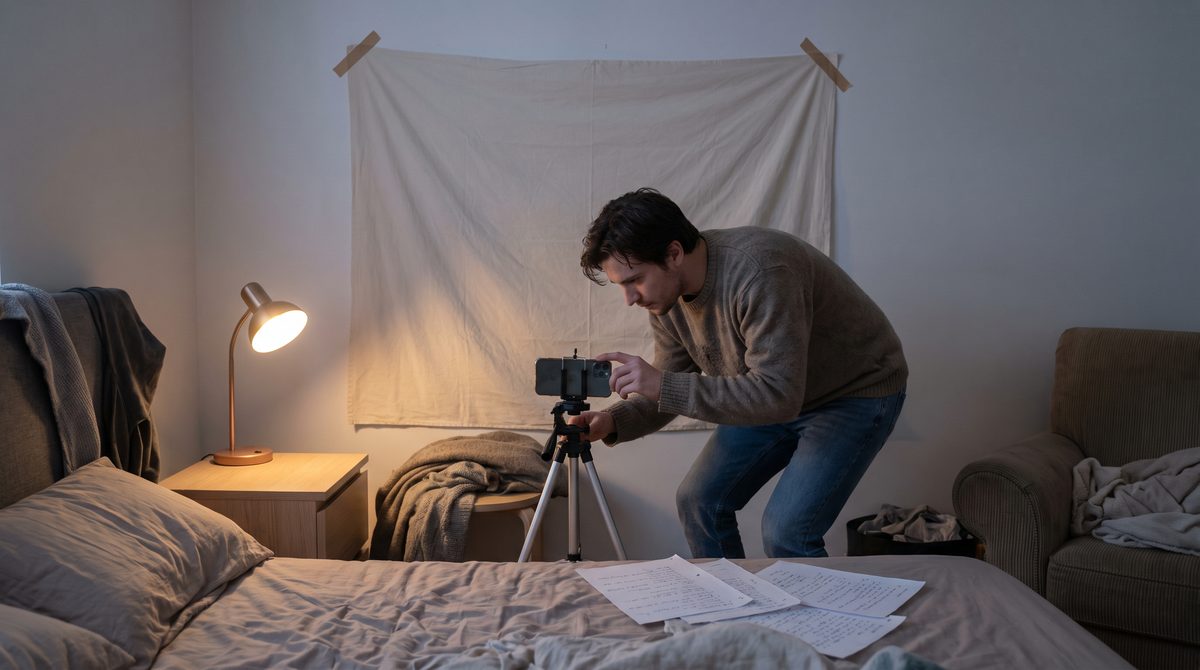
Take a scene you know, record it twice — once watching how you look, once with one clear thing you want from the other person — and watch both back with the sound off. That eleven-minute experiment is the entire method, and if the footage disagrees with this page, believe the footage.