
You are not too much. Your attention is in the wrong place.
There is a diagnostic for this, and it comes from someone who has spent thirty years fixing it on sets. It names the cause rather than the symptom, which is why it works.
Mel Churcher is a British screen and voice coach with a serious record behind her. She was Head of Voice at Rose Bruford College, spent twelve years in the voice department of the Royal Shakespeare Company, and has coached Daniel Craig, Benedict Cumberbatch, Angelina Jolie, Keira Knightley and Michelle Yeoh. She also wrote two of the standard books on the subject. In 2015 she published a short checklist for new screen directors who can tell something is wrong but cannot name it.
Her entry for the actor who is doing too much is the whole of this page in three lines.
That last point is worth pausing on, because four unrelated fields arrive at it independently. Diderot noticed it in the eighteenth century, and motor-learning research has measured it for twenty-five years. Neuroscience has since watched it happen inside the brain. And every casting director quoted anywhere on this site says the same thing in plainer words. Self-monitoring makes performance worse, and a target makes it better. Volume has almost nothing to do with it.
So the honest first move is not to shrink. It is to notice who you think is watching, and to put your attention back on the person you are actually talking to.
Why you look like you are mugging
Nearly everyone arriving here has had the same experience. You watched yourself back, and the person on the screen was doing far more than you thought you were doing.
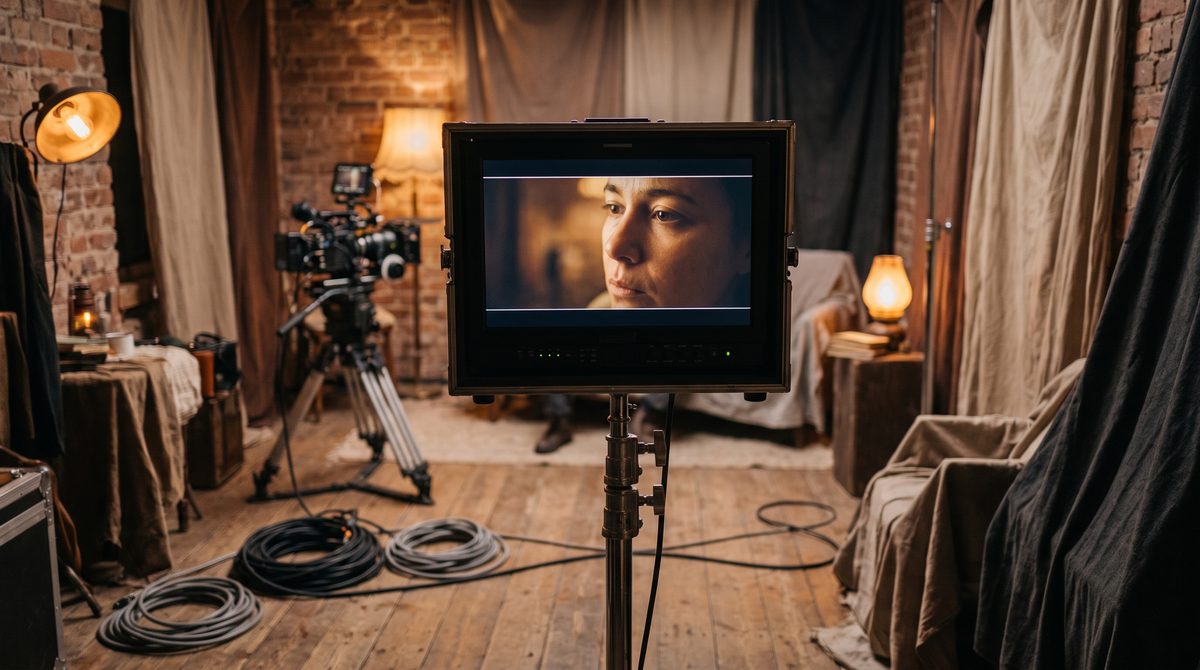
Andrew Tsao teaches screen acting to third-year students in the professional actor training programme at the University of Washington. In 2007 he described the moment his stage-trained students meet the camera. They play something at full theatrical size, and then he sits them in front of a monitor where their face fills the frame. “Good grief,” you're likely to say, “I look like I'm shouting and mugging.” He has watched that reaction for years, and it is the standard one.
His explanation of why is the clearest in the research. “The landmark difference between acting for the screen and acting for the stage is the power of the close-up.” And then the line worth keeping: the camera is a device he likes to say is “designed to look behind someone's eyes.”
A man asks a woman: “Do you love me?” She answers: “Of course I do.” The camera moves in on her face, and we know she is lying.
Nothing was added to make that happen, and she did not do anything to signal it. The proximity did the work, which is exactly what makes an amount of expression that is completely normal in a room read as performance on a screen.
This also answers the question about mirrors. You look fine in a mirror because a mirror shows you life-size from two feet away. A close-up is your face at six feet tall, in front of strangers, held for as long as the editor wants it. That magnification is the whole structural difference between the two crafts.
And it is why stage training makes the first weeks harder rather than easier. Stage technique is built to reach the back of a large room, and everything in it pushes outward. The camera wants the opposite, and almost no theatre training teaches you to act through a lens eighteen inches from your face. This is not a talent problem and it is certainly not stupidity. It is a well-trained instrument being used in the wrong room.
Tsao's own summary of the alternative is worth carrying around. “Screen acting demands a kind of inner precision that ultimately on the surface looks very small, almost imperceptible.” Note the order of that sentence: the precision is inside, and the smallness is only what it looks like from outside.
Most on-camera overacting happens while you listen
This is the part almost nobody publishes, and it is where a chest-up frame actually catches people. The problem is rarely in your lines. It is in what your face does during theirs.
Todd Thaler cast The Professional, Cop Land, Little Children and Pollock, and has taught at Tisch, Brooklyn College and the Atlantic. In a piece he wrote for Backstage in 2013 he names the behaviour precisely. “Many actors listen too animatedly by smirking, nodding, blinking, and raising and furrowing eyebrows.”
If you have an expressive face, none of this means you have a problem. An expressive face is an asset and nobody sensible wants you to flatten it. What causes trouble is an editorialising face, and the two are easy to confuse. The eyebrows and the smirk are your commentary on the material. The camera reads commentary as performance, and it reads it instantly.
Thaler's fix for an actor who is being too broad is a genuinely strange instruction that works. He tells you to hide your opinion and simply report your words, the way a news anchor delivers a story they may feel strongly about but must present without opinion — flatly, matter-of-factly, dispassionately. “The feelings become subtext.”
What the frame actually asks of you
Here is where the widely repeated numbers come from, and why we are not printing them. Then here is the version you can genuinely use.
The claim circulating everywhere is that Michael Caine gives an arithmetic for this. Halve the energy for a medium shot, take away three-quarters for a close-up, and for an extreme close-up simply think it. It sounds authoritative, it is enormously quotable, and actors treat it as a rule.
We went looking for it. It is not in Acting in Film, it is not in the 1987 BBC masterclass the book came out of, and it does not appear in any interview or transcript we could reach. Searching the exact phrases returns a single source: an essay on a screen-acting newsletter. Everything else is a copy of that. The one line resembling it that we did find turned out to be a reader's paraphrase in a blog comment section, not Caine at all.
He teaches close-up technique in concrete physical terms. Pick one eye of your scene partner, stay with it, and do not blink. “As you get near the camera, slow down.” And the image everyone remembers: be like a duck, calm on the surface and paddling like the dickens underneath.
His actual point about close-ups is about thought rather than percentage. In the tightest frames the work is internal, and the camera collects it. That is the same idea the fake ratios are gesturing at. It just never came with numbers attached, because numbers were never the useful part.
What is genuinely true is that shot size changes what carries the scene. That is not a formula, it is a fact about frames, and you can find out which frame you are in by asking. It is a completely normal question on any set.
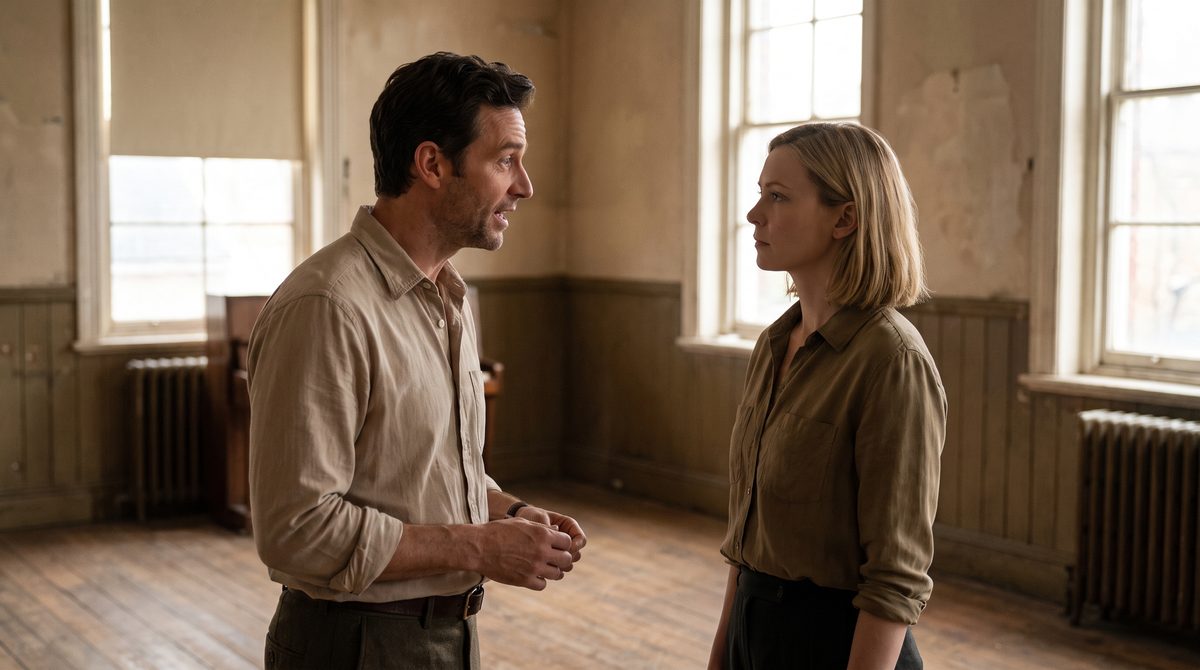
One correction while we are here, because it matters for judging your own tape. A close-up is not chest-up or waist-up, though several guides say so. Chest-up is a medium close-up and waist-up is a medium shot. If you frame yourself chest-up and then perform as though you are in a medium, you will read as considerably bigger than you intended.
“Less is more” is being misapplied, and it is doing damage
This is where we part company with almost every article on the subject. The advice is not wrong exactly. It is being given without the second half, and the second half is the part that keeps you employable.
Mel Churcher, whose diagnostic opened this page, once listed twenty-two reasons that actors get caught mumbling on screen. Some are practical. The lines arrived under the hotel door at three in the morning. It is a night shoot after a day shoot. Nobody rehearsed. Then the list turns, and the final three items are an argument.
Number twenty is that they have adopted an awful style that makes them feel real from the inside. Number twenty-one is that they are not really communicating any needs to anyone. And number twenty-two, the last and the angriest, is that people keep telling them less is more. “HOW CAN IT BE LESS THAN LIFE?”
She also makes the technical distinction that the advice is missing. “In screen there is no audience — so — you don't need levels to reach beyond the participants of the scene.” Read the second half of that carefully. You do not need to reach beyond the people in the scene. You absolutely do still need to reach them.
There is a piece of Hollywood history that settles the argument, and Churcher points at it directly. “George Cukor's famous advice to Jack Lemmon was about doing less acting.” It was not about voice levels, and it was not about becoming small.
He was shooting It Should Happen to You in 1954, his first film. Cukor kept asking him for less, take after take, the same note. Lemmon eventually protested that if this continued he would not be acting at all.
Cukor's reply, in the version Lemmon's son has told on stage: “Exactly!” Other retellings have him saying that Lemmon was beginning to get it. The wording moves around, and we would rather say so than pick one and pretend it is a transcript. What every version agrees on is the substance. Cukor wanted less acting, and he never asked for less life.
How to tell which problem you actually have
Both notes exist. Some actors are told to bring it down and some are told they are giving nothing, and a few unlucky people get both in the same week. Here is a test that takes ten minutes.
Do not try to be restrained for this. You need honest material to look at, not a corrected version of yourself.
All of it. You are looking at behaviour, and the voice will keep persuading you that things are fine.
Skip your lines entirely on this pass, because this is where the answer usually is.
Nods, eyebrow lifts, smiles, blinks, head tilts — count them. You are collecting information, not issuing a verdict on your talent.
Now the reverse question. Does anything they say seem to land on you, or does your voice simply continue on its own track?
Remove only the most repeated signal, and give yourself a listening task in its place. Then check whether the second take got more specific or merely flatter.
The signs you are too big are the ones above. Your face moves while the other person is speaking. You can tell what you think of every line. You look down when you are not talking, which is hiding from the camera. Your shoulders are up and your breath is high.
The signs you are too small are quieter and easier to miss. Their lines do not land on you, so nothing changes in your face at all. You cannot say in one sentence what you want from them. With the sound off, nothing is happening. And you are under-supported rather than genuinely quiet, which is audible even when you cannot hear it yourself.
Now the honest part, and it is the reason this page has one diagnosis rather than two. Both lists come from the same cause. You are not doing anything to the other person. Too big and too small are the same failure at different volumes, which is precisely why turning the volume knob has never fixed either of them.
Where the rule genuinely does not apply
Every article about overacting is quietly written about naturalistic single-camera drama. Comedy is a different instrument, and the difference is not a matter of taste.
The multi-camera sitcom is filmed in front of a live studio audience, which means it is the one screen format with an audience in it. The scale there is fuller by design, and it is not a mistake. Mark Cendrowski, who directed The Big Bang Theory, describes the room this way: “Jim Parsons can get laughs from a studio audience simply by raising an eyebrow. It's like coaching a basketball game.”
Notice that even in the format with the biggest scale, the example he reaches for is an eyebrow. The audience amplifies, so it does not take much. What is different is the timing rather than the size.
Single-camera comedy runs on the opposite settings. Alec Berg, who ran Silicon Valley, put the trade-off plainly. “We can't play tonality on our show with multi-cam, but on the flip side, it's awesome to be in front of an audience.” The tonal range that single-camera buys you is exactly the range that gets flattened by a laughing room.
So the practical instruction is to find out what you are in before deciding how to play it. Format, tone, genre and the director's taste all outrank any general rule about smallness. “Less is more” is a note about naturalism that has been mistaken for a law of physics.
The fix, in the order to do it
None of these is “be smaller”. That is deliberate, and it is the whole argument of the page.
Jaw, shoulders, breath, hands: this is the half you genuinely should remove, and it is usually the half that is causing the visible pushing.
An action verb aimed at them. To warn, to shame, to disarm, to find out. If you cannot say it, that is the problem, not your face.
Not for a reaction to your performance, but for evidence about the thing you are trying to do. That single change reorganises everything visible.
Keep the other person just beside the lens and spatially real. A reader in the wrong place quietly turns you into somebody talking to nobody.
The pushing actor is very often frightened. The answer is not calming down, it is a target — because trying to be smaller while frightened produces somebody frightened and small.
It is a symptom-level note and it might mean six different things. Ask whether they want less physical expression, a more conversational voice, or a different relationship.
The order matters more than it looks. Releasing effort without a target just makes you a relaxed person with nothing to do, and naming a target without releasing effort leaves the tension that was producing the pushing in the first place. Both halves, in that sequence, and the visible behaviour organises itself.
Scale in a self-tape
This is where the problem is most likely to happen and least likely to get corrected, for four reasons that are all structural rather than personal.
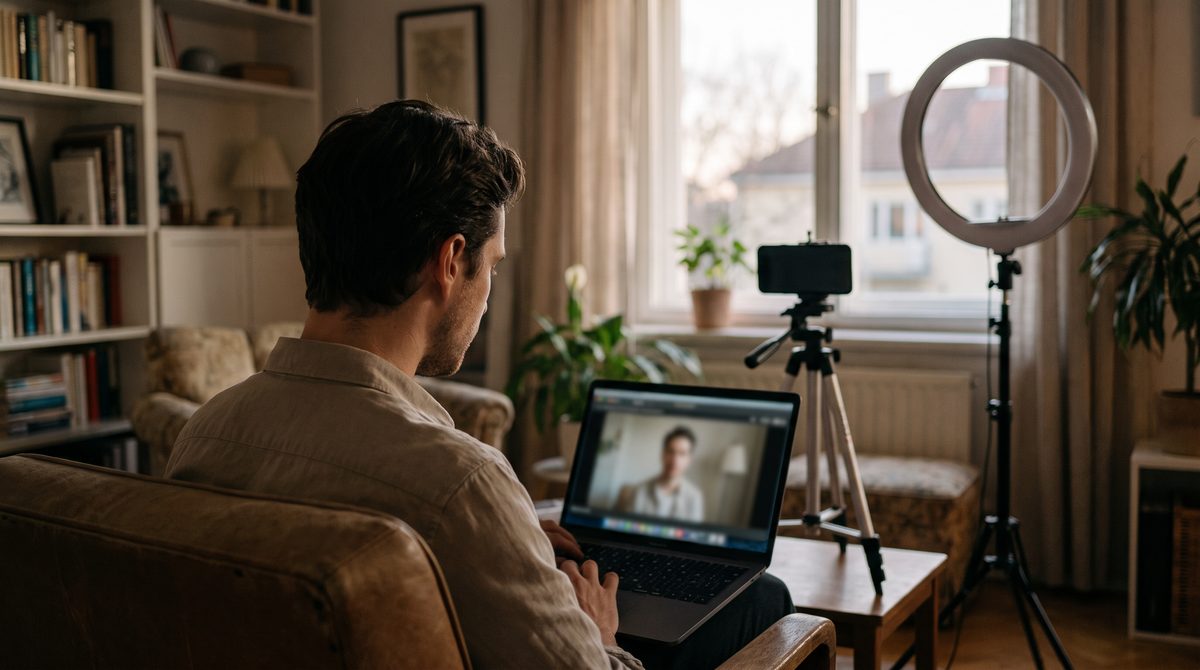
You choose the frame, and almost everybody chooses something close. Nobody is standing beside you to say take it down a bit. The reader is often flat, so there is less arriving for you to respond to, which pushes you toward generating expression yourself. And you can do twenty takes, which is its own trap: casting directors on this site have said they can tell, because the humanity has been ironed out.
Chest-up is a medium close-up and it is already intimate. Judge your performance against that frame, not against the one you imagined.
Phone lenses are wide, so standing close to one distorts your features and exaggerates any movement toward the camera. Move the phone back and zoom.
A responsive human beside the lens changes more than any adjustment you can make to your own face. It is the highest-value fix available to you.
Once you are framed, stop watching yourself. Self-monitoring is the fastest route straight back into the problem, and it is happening in real time.
Rachel Mossey's casting office puts it directly: you usually do not need to project or enunciate for on-camera work, and even an upset character rarely needs to shout.
If a second version is genuinely different, change the tactic or the relationship. More and less are not alternate takes. They are the same take at two settings.
The same casting office is blunt about the stakes, and it is worth reading twice. “Over-acting will make the director quickly pass. Under-acting will make them wonder if you can do more.” Those are not equivalent outcomes. One closes the door and one leaves it open, which is a reasonable argument for erring slightly toward the quieter version when you genuinely cannot tell.
Grading the sources
This page corrects a very widely repeated claim, so we owe you our working. Two of the most-quoted lines on this subject could not be stood up at all. This takes our running count of claims tracing to a blog, a forum or marketing copy to thirty-two.
One more thing worth saying plainly. There is essentially no empirical research on performance scale. Nobody has measured what makes a screen performance read as too big. The nearest work is on attentional focus in motor skills, which is what the first section of this page leans on, and one recent study on the difficulties actors face moving from stage to camera. Everything else here is practitioner consensus, which is worth a great deal and is not the same as evidence.
Where we differ from the standard account
Should you halve it for a medium and take three-quarters off for a close-up?
Commonly saidMichael Caine's rule, quoted everywhere.
What we foundHe does not appear to have said it. One newsletter essay, then copies. What he actually teaches is one eye, no blinking, and slowing down.
Is overacting a size problem?
Commonly saidYes, and the fix is to do less.
What we foundIt is an audience problem. You are performing to somebody who is not there, and the remedy is to remove them rather than shrink.
Where does overacting show up?
Commonly saidIn the big moments and the emotional lines.
What we foundIn how you listen. Nodding, smirking, blinking and eyebrow work, all of it while somebody else is talking.
Is less more?
Commonly saidThe universal note, given to everybody.
What we foundLess amplitude, volume, commentary and demonstration. Never less want, stakes, attention or thought. “How can it be less than life?”
Is stillness the answer?
Commonly saidStillness reads as presence on camera.
What we foundOnly with something alive behind it. There is no neutral on camera, and stillness with nothing in it reads as absence.
Does “do less” apply everywhere?
Commonly saidIt is the rule for all screen work.
What we foundIt is a note about naturalism. Multi-camera comedy is played fuller on purpose, and the format decides before the rule does.
Is being too small the safer mistake?
Commonly saidBetter to underplay than to overplay.
What we foundMarginally, and for a specific reason. Over-acting makes a director pass; under-acting makes them wonder whether you have more.
Record one take of anything tonight and watch it with the sound off, looking only at the sections where the other person is speaking. Count the nods. That is the whole diagnosis, and it takes ten minutes.