The mistake has a name, and the name is useful
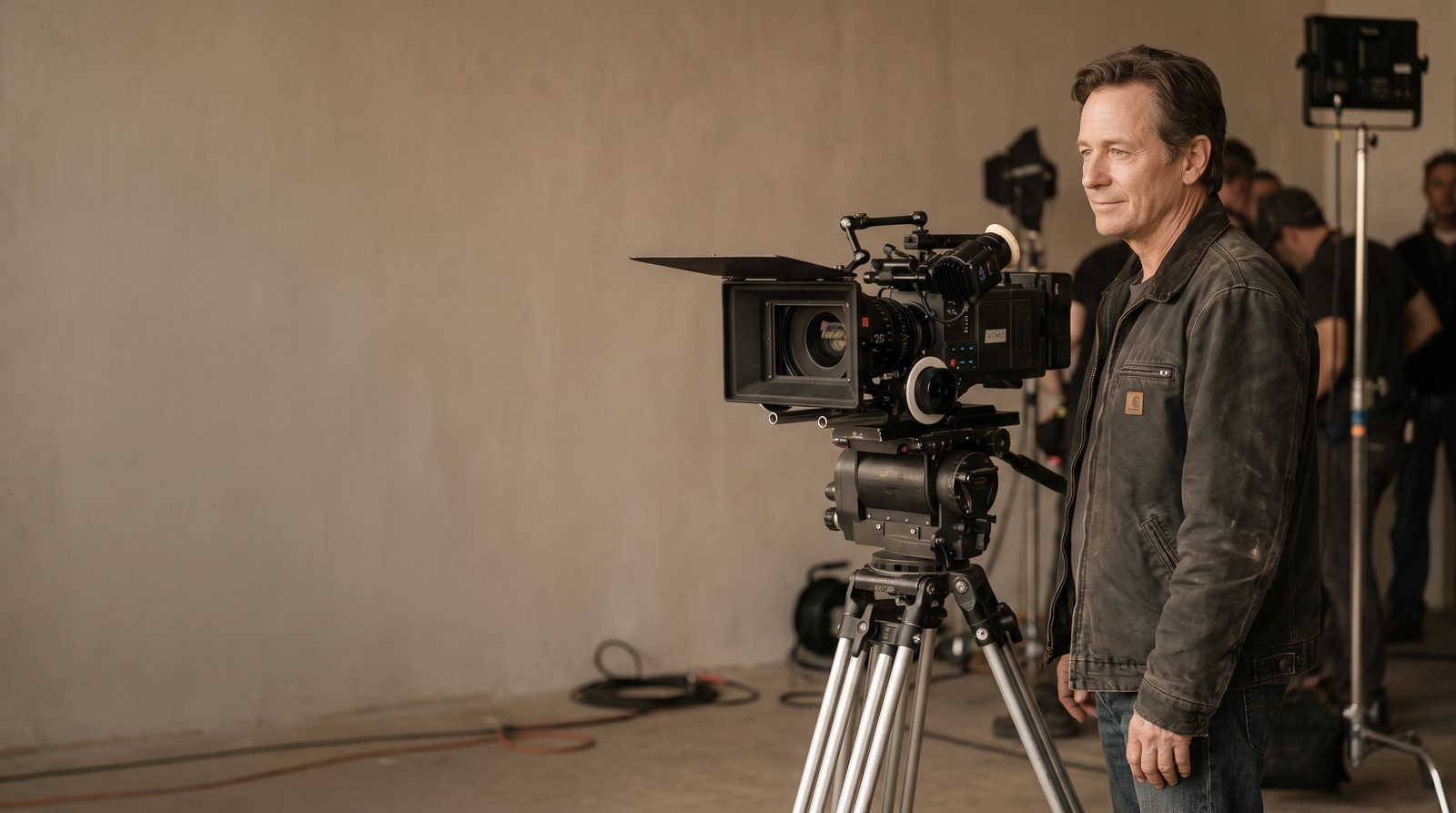
Actors who are perfectly happy in front of nine hundred people go strange in front of one lens. The coach Heidi Miami Marshall gave that behaviour a name, and it is the most precise diagnosis we found anywhere in this research.
She calls it hiding out. The actor looks somewhere far away, drops the head, shuffles backwards, turns a shoulder in. They hide their face from the one thing in the room that came to see it.
Her correction is a single sentence and it is worth having exactly as she wrote it. “The camera loves your face! It especially loves your eyes.” The camera is not an examiner. It is closer to an audience of one that has moved right up to you and is waiting.
What she offers instead is a habit of attention. Know where the camera is, and let your movement toward it or away from it be a choice rather than a flinch. Done well, she says, the actor and the camera end up moving “quite powerfully in sync”.
Hiding out is not vanity, which is why telling somebody to stop doing it rarely works. Being magnified is genuinely uncomfortable, and retreating from the thing magnifying you is a sensible instinct. It is simply fatal here, because the face is the entire medium.
“Forget the camera” is the wrong half of a true sentence
The standard note is not stupid, and we want to give it its strongest form before disagreeing with it. Its strongest form turns out to contain the answer.
Here is the best version of the opposing case we could find from somebody real. The casting director Marci Liroff, writing in Backstage, puts it like this. “You’ve got to know where the camera is, what your blocking is, and which is a wide or close-up shot, then forget it. Forget it and lose yourself in your character.”
Read the order of that sentence. Three technical facts come first, and the forgetting comes last. She is not telling you to be ignorant of the camera. She is telling you to finish the technical work early enough that it stops occupying you.
The Michael Caine rule that Michael Caine never wrote
There is a scaling formula taught in classes and repeated across the internet, always with his name on it. We went to the book. It is not there.
The formula goes: play it at half for a medium shot, three-quarters for a close-up, and for an extreme close-up simply think it. It sounds exactly like the sort of thing he would say. It is specific, it is quotable, and it is easy to teach.
We had the text of Acting in Film: An Actor’s Take on Movie Making checked against two independent transcriptions. The two sections where he discusses shot sizes and scaling contain no percentages and no fractions at all. The formula traces to a single Substack post and to nowhere else.
This matters beyond one quote. An invented rule that sounds precise will travel further than a real principle that needs thinking about, and once it has been repeated enough times it becomes something people teach. The same Substack is the only source for an unsourceable Helen Mirren quote, which is a pattern rather than an accident.
Where to look, and why somebody shouts about it
This is the most-asked practical question on the subject, and the answer is more interesting than a rule about not looking down the lens.
Eyelines carry meaning. Where a character looks tells the audience what that character is thinking about, and the eyelines across a scene have to agree with each other or the cut falls apart. That is why it is treated as a real job on set rather than an actor's private business.
Sidney Lumet recorded the moment it becomes audible. Just before a take, a well-trained assistant director calls out: “Clear the eyeline, please.” His reason is funny and exact. If one actor is playing a love scene with another, he does not want to be looking past her at somebody drinking coffee.
In practice the solution is geometric. The camera is placed so that you look just to the side of the lens, which keeps the illusion that you are engaging with a person rather than an audience. In an over-the-shoulder shot you simply look at the actual other actor, which is why those are the easy ones.
And when the geometry goes wrong, it is somebody's job to fix it. Peter Rosenfeld, a camera operator whose credits include The Social Network, Gone Girl and American Sniper, handles the handheld version of this problem by putting a piece of tape where your eyeline needs to land, then standing so the off-camera actor is hidden behind him. You look at the tape. The shot works.
An awkward eyeline is a known technical problem with known technical solutions, and solving it belongs to the camera department.
It is not a sign that you are bad at this, and it is not something to quietly endure. If you cannot find a natural place to look, say so.
One honest caveat on our own sourcing: the tape description above is the reporter's account of Rosenfeld's method rather than a sentence in quotation marks from him. The technique is his. The wording is the journalist's.
Marks, light and frame
The technical section, and the one that repays learning fastest. A mark is not a cage. It is the reason your wide shot and your close-up can be cut together at all.
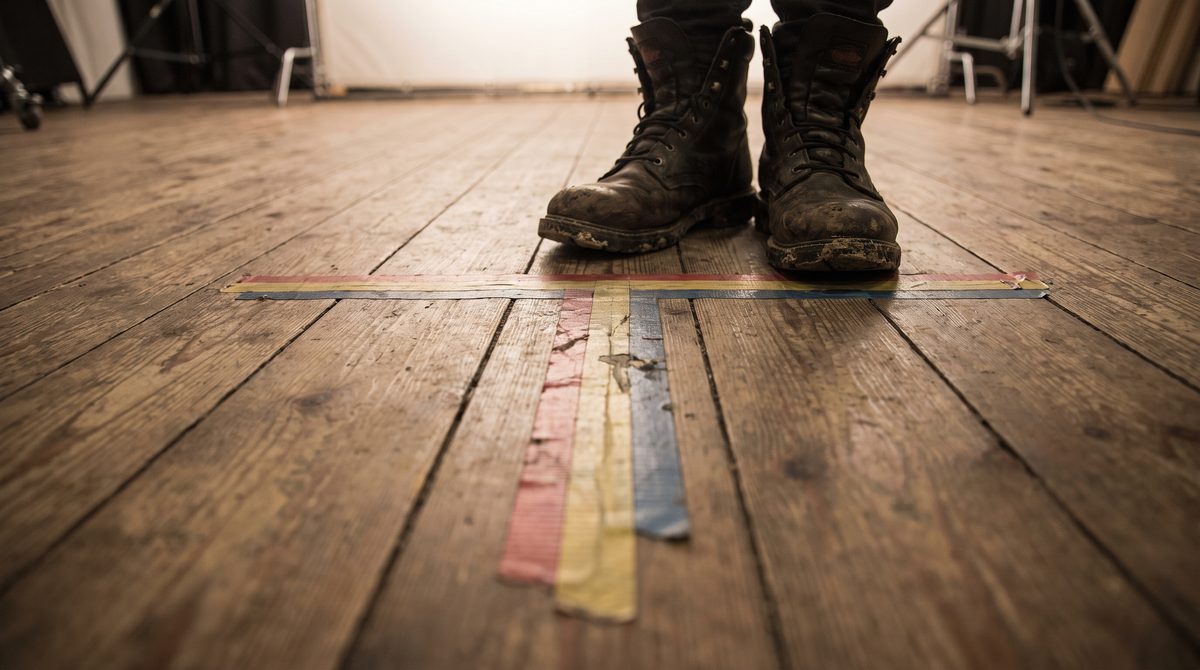
A mark is a small piece of tape on the floor, usually a T or an X, telling you where your feet stop at a given moment. On location it might be chalk, a sandbag, a pebble or a scuff somebody made with a heel. The material changes and the job does not.
Here is the part nobody explains, and it reframes the whole thing. Marks are placed after the shot has been designed, because the camera has already been told where to look. The tape is not a restriction imposed on your performance. It is a note telling you where the frame and the focus already are.
“Obviously an actor can’t look down to see if he has hit his mark, so the way to ensure accuracy is to stand on the mark, then say your line at performance pace while walking backward to an earlier position.”
“When you go forward from that earlier position, saying the same line, you wind up on the mark. If you practice the rhythm of this a few times, you won’t go wrong.”
That is genuinely his, it is in Acting in Film, and it is more specific than the version usually passed around. The trick is that you are timing the line, not measuring the floor.
On glancing down, the honest note is a craft point rather than a prohibition. If you must look, do it early and make it the character's idea. Somebody who looks thoughtfully at the ground three steps before they stop is acting. Somebody who checks their feet the instant they halt is an actor looking for tape, and it reads.
Light works on the same principle as the mark. The lighting was designed for a position rather than for you, so six inches in the wrong direction can take your face out of the key. If the warmth on your cheek changes, you have drifted. That is a fair thing to raise in rehearsal rather than discover in the edit.
Doing it nine times, and doing nothing
Two questions that trouble people new to sets, and both have practical answers rather than mystical ones.
The part people underestimate is what happens when they are not speaking. On camera that is not a gap between your lines. It is very often the shot. Reaction is what an edit is assembled from, which is why the other actor's coverage can end up being about your face.
The crew are not the enemy either
The friendliest sentence written on this subject is also the one we can stand up least well, so here is both halves of that.
The sentence is: “The camera operator and the first AD are your collaborators, not your wardens.” It is a good sentence. It says something true about how sets actually run, and it gives a nervous actor permission that nobody else bothers to give.
The underlying point survives its sourcing, because a cinematographer makes a version of it independently. Understanding how a set runs makes you a more reliable collaborator, and that reliability is what buys you the freedom to act. Being easy to work with is one of the few things in this business that compounds.
The freeze, and what actually helps
Two pieces of research get quoted constantly in this area. Both are real, and both are about something slightly different from acting, so here is what they do and do not support.
The first is about nerves. A 2014 study by Alison Wood Brooks found that people who reappraised their anxiety as excitement outperformed people who tried to calm down. Saying “I am excited” beat saying “I am calm”. The mechanism she describes is a shift from treating the moment as a threat to treating it as an opportunity.
The second is about attention. Gabriele Wulf's review of fifteen years of motor-learning research found that an external focus beats an internal one. Attending to the effect of a movement works better than attending to your own body performing it.
The practical version is simple enough. Release the jaw, the shoulders and the breath, because physical tension genuinely costs you. Keep the adrenaline, because it is fuel and trying to eliminate it makes things worse. And put your attention on something outside yourself, which on camera means the other person, the thing you want, or the tape you are looking at.
A self-tape is a set that you are running alone
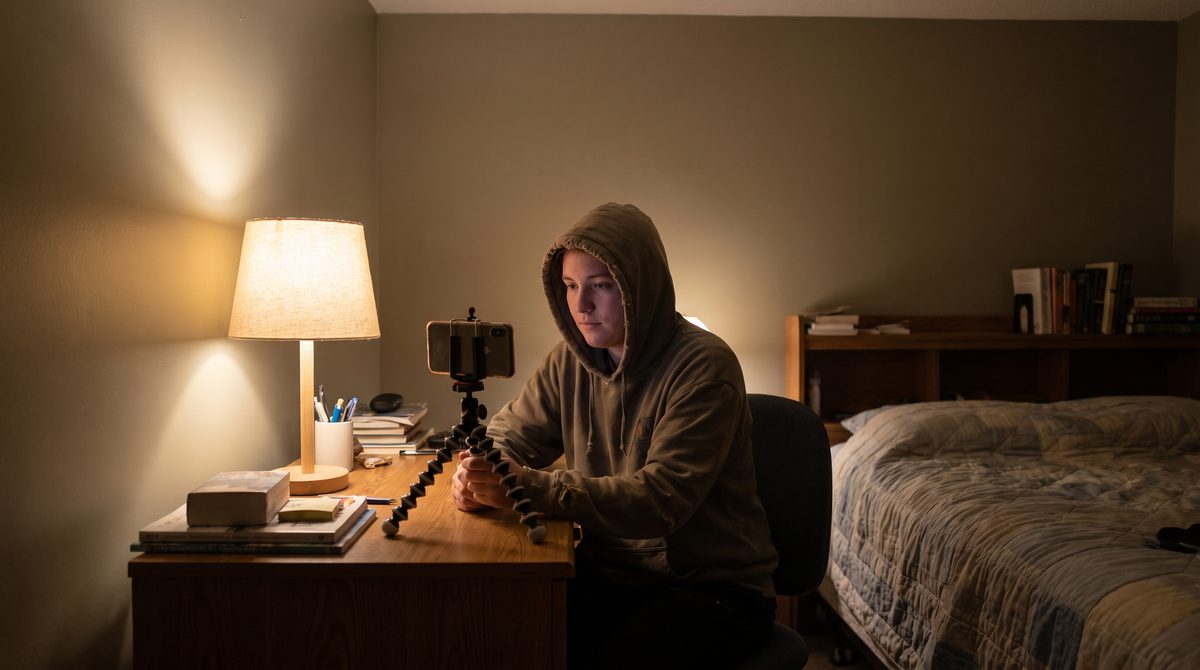
Everything above describes fifteen people managing a frame. In your bedroom, you are all fifteen of them, which is the honest reason any of this matters to you.
On a tape, you choose the shot size — and that choice sets how much of what you do will read at all.
On a tape, you place the reader, just off the lens, at roughly your own eye height.
On a tape, you are the gaffer. Light the face, and check that you have not drifted out of it.
Tape on your own floor still works, and it is still worth doing if you move at all.
On a tape, nothing stops you but you. Cap it deliberately, because repetition without a variable is decay.
A real person doing something to you. Find a partner before you find a class — it is the highest-leverage thing in a tape.
Watching yourself back is the other half of learning this alone, and there is a right way to do it. Watch with one specific question rather than for a general impression. Was I in my light. Did anything happen when I was not speaking. Did I hide. A verdict on yourself is the least useful thing footage can give you and the most common thing people take from it.
Grading the sources
This page rests on one book, two peer-reviewed papers, one trade publication and a set of self-published pages. One widely taught claim turned out to be invented, and two celebrity quotes we found along the way appear to be as well.
One gap we could not close honestly. We wanted a strong, developed argument for the opposite view — a serious case that actors should genuinely ignore the camera. The best real version we found is a single sentence from a working casting director, and even that one puts the technical knowledge first. That is a thin opponent, and we would rather tell you the opposition is thin than build a straw one and knock it over.
Where we differ from the standard account
Should you forget the camera?
Commonly saidYes. Pretend it is not there and just be truthful.
What we foundEven the people who say it list three technical questions first. The forgetting comes after the knowing.
How much smaller should you play a close-up?
Commonly saidHalf for a medium, three-quarters for a close-up, think it for an extreme.
What we foundCaine never wrote that. He wrote that you reduce physically and not mentally, which is a different instruction.
Why do actors freeze on camera?
Commonly saidNerves, and you should try to relax.
What we foundA named coach calls it hiding out. And the research says reframing nerves beats trying to remove them.
Is the technical side your job?
Commonly saidNo, that belongs to the crew.
What we foundPartly yours, and cheaply learned. Marks, light and eyeline all change what survives the edit.
Can you look down for your mark?
Commonly saidNever.
What we foundDo it early and make it the character’s idea. It is the timing that gives you away, not the glance.
Is asking the crew questions unprofessional?
Commonly saidKeep your head down and do not slow anything up.
What we foundFour questions save more time than they cost. The clock is the enemy, and you removing an unknown helps it.
Can you learn this on your own?
Commonly saidYou need a class and a room full of people.
What we foundMore than most acting, because the camera gives you an objective record. But you still need one other person.
Do one thing tonight. Put a piece of tape on the floor, film thirty seconds twice — once retreating from the lens and once sharing your face with it — and watch both with the sound off. The difference between those two takes is the whole subject of this page.