
Answering the search, then complicating it
The colour, and why it is the least important variable.
Blue is the most-recommended colour in the published record. Grey is the most-recommended fallback. Black, white and green each have at least one credible casting voice arguing against them — which is why any page that ranks colours confidently has not read its own sources.
Spotlight, Weeble Mountain, Puro Casting, Backstage and the CDG guide. No source argues against it.
Schuster, Liem, the CDG, Backstage. Most recommended in the whole corpus, and least explained by anybody.
White, black and green all have a named casting professional on each side. The disagreement is real, not noise.
What casting has actually said
Before colour, brightness
You need three different brightness values in frame.
Your background, your clothing and your face. If any two sit at the same brightness, one of them disappears — and the camera decides which.
The casting-side sources circle this without ever naming it. Actors Access says avoid a backdrop that blends with your skin tone or your hair. Arlene Schuster says a backdrop should not be stark white because you either blend into it or, with a darker skin tone, get blown out against it. Both are describing the same failure: two of the three values collapsing into one.
The floating head, explained properly
Caroline Liem’s warning about black backdrops is usually repeated as an aesthetic preference. It is not. Dark hair against a dark backdrop merges — and once the hair merges into the wall, the face detaches from it and appears to hover.
It affects anyone with dark hair regardless of skin tone, and it is the strongest single argument against black in a home setup. The professional fix is a backlight separating hair from wall, and almost nobody taping in a bedroom has one.
Distance, part one
The shadow of your head, and the free fix.
This has a precise, sourced answer that appears in no self-tape guide we could find, and it is the same fix behind the halo you keep seeing behind your head.
If you have the room
Five to six feet
- Portrait practice states it flatly: get five to six feet from the wall and your shadow stops reaching it.
- There is nothing to fix, because there is nothing there.
- It also fixes colour spill, at the same time and for free.
If you do not
Raise the light
- “No space? Raise the lights.” Lifting your key drops the head-and-body shadow down the wall.
- It falls out of the bottom of the frame entirely.
- Costs nothing, takes ten seconds. The single most useful free tip in this chapter.
Distance, part two — the mechanism nobody publishes
Colour spill, and the folklore it explains.
Your backdrop is the largest single-coloured surface in the frame, which means it reflects a significant amount of coloured light back onto you. Photographers call it colour spill, and it happens whether you notice it or not.
It shows most on skin, because skin is translucent — light penetrates slightly below the surface before bouncing back out. And it comes with two numbers that change how you should think about your room.
The two numbers
At two to three feet from the wall — normal in a small room — colour spill is significant. At six to eight feet it becomes negligible.
Which is why the green-screen industry, which deals with spill in its most extreme form, places talent six to ten feet from the screen as standard practice. Same physics, louder colour.
Here is why this section matters more than the colour list above it. One mechanism explains three separate pieces of casting folklore that the published record states without ever explaining.
Three received rules, one cause
What is actually happening.
Publish the mechanism instead of the three rules and a reader can judge the wall they have actually got.
Skin across every tone sits in the orange-red-brown region of the colour wheel. Blue is opposite it, so a blue backdrop maximises hue separation from any face without needing brightness to do all the work. Blue spill cools the shadow side much as a fill light would. And a mid-blue sits near the centre of the camera’s range, so it exposes cleanly. All three of those are our inference. No source states them. We would rather publish a reasoned hypothesis, labelled, than repeat “blue makes everyone pop” for the fortieth time.
The third mechanism
Your wall is arguing with your face.
A phone’s auto-exposure meters across the whole frame, and your background is the biggest thing in it. So the wall behind you is not a neutral backdrop. It is actively setting the brightness of your face.
Bright white pulls the exposure down and takes your face with it — the mechanism behind Schuster’s warning, and she notes it specifically disadvantages darker skin. Actors Access supplies the worst case: never a stark white wall or a bright light directly behind your head, which backlights you and throws your face into shadow. Black pulls the exposure up, lifting noise out of the shadows and giving the camera nothing to separate you from.
A mid-grey or muted blue sits in the middle, so the camera settles on your face because nothing else is shouting. That is the real reason the two uncontested colours are the two uncontested colours.
Two seconds, and it ends the argument
Lock your exposure on your face.
If you cannot change your wall, this is the single highest-value instruction on the page.
On an iPhone, press and hold on your face in the camera app until AE/AF LOCK appears at the top of the screen. Most Android camera apps have an equivalent. That takes the wall out of the decision completely — the camera stops re-metering, and your face stays where you set it for the whole take.
The finding that unifies this whole guide
Nobody has added up how much room you need.
Three chapters of this Academy each give you a distance. They are given on three different pages, by different sources, and nobody has ever put them next to each other.
What the three chapters each ask for
Roughly eleven to thirteen feet of room.
The microphone wants to be six to eight inches from your mouth, which the phone cannot do from five feet away. That is the third constraint, and it is the one you can remove.
So for most actors, taping in a bedroom or a flat, the advice does not fit in the room. Which means the useful thing is not the ideal. It is the order in which to give the ideal up.
Shoot on the diagonal — free
The longest line in any rectangular room runs corner to corner. Turning your setup forty-five degrees buys two to three feet for nothing.Almost nobody says this and almost everybody could do it. It is the cheapest two feet in self-taping.
Solve the microphone separately — cheapest purchase
A lavalier removes one of the three constraints entirely. The mic goes on you, so it stops competing for floor space.The audio chapter covers why this is the one purchase in self-taping that genuinely earns its money.
Give up wall distance before camera distance — free
This is the key judgement on the page. A shadow on the wall is fixable by raising a light. Perspective distortion from a close camera is not fixable at all — it is baked into the image.When something has to give, it is always the wall.
Raise the light — free
Now that you are closer to the wall, lift the key so the remaining shadow drops out of the bottom of frame.
Then choose a low-spill backdrop
You are now close to the wall, so spill is significant at this range. Pick a muted mid-tone, not a saturated one.Note where the colour question finally arrives on this list. Fifth.
The purchase question
What to actually put behind you.
Second-most-common reason people arrive here, and the honest ranking is not the expensive one.
One purchase, two chapters solved
The curtain you hang for the picture is also fixing your sound.
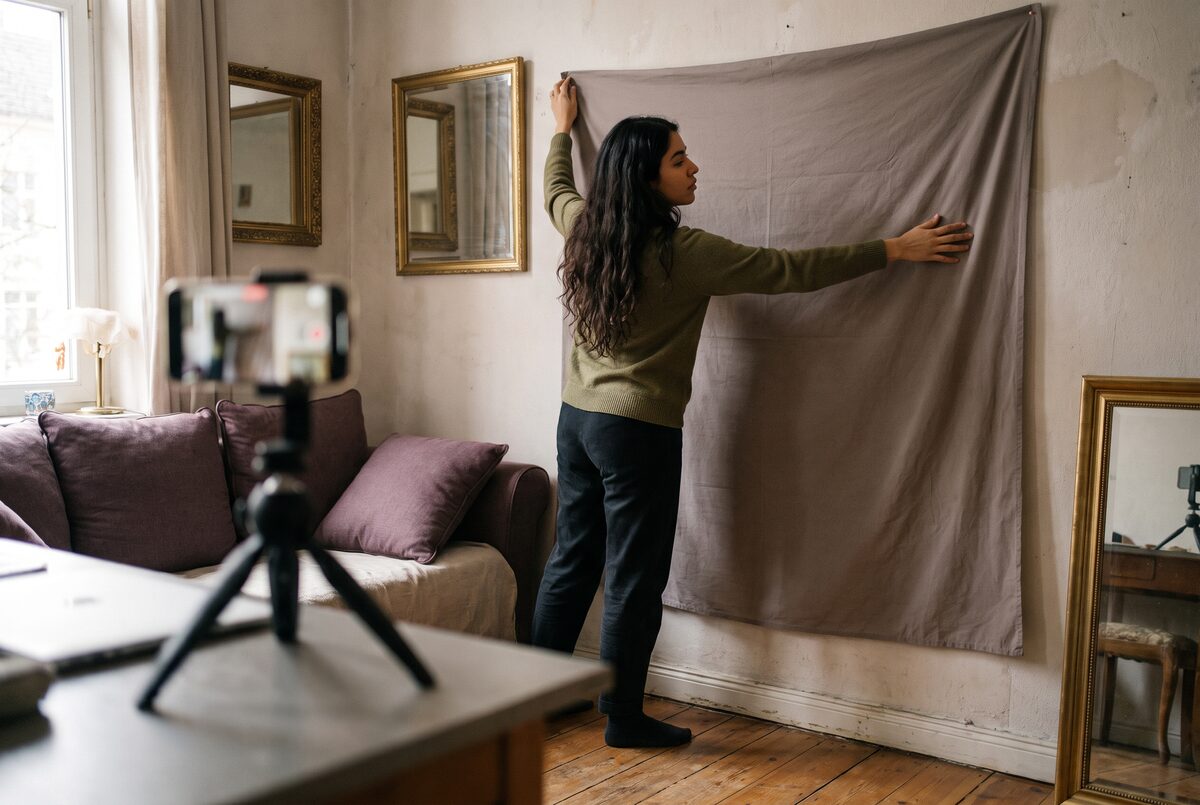
Actors Access recommends a curtain because the fabric gives visual depth. Nobody connects it to the other thing a heavy fabric hung on a wall does.
It absorbs the sound reflecting off that wall. The wall directly behind you is one of the surfaces the audio chapter identifies as the source of the boxy reverb in most home tapes — and it is the strongest reflection reaching your microphone.
A curtain is a backdrop and acoustic treatment in the same object, bought once. Per pound, it is the best thing on this page.
The connection nobody drawsAnd hang it with an air gap. A few inches off the wall rather than flat against it improves the absorption and buys you a little extra separation from the shadow surface at the same time.
Where two things share one name
Green screens and virtual backgrounds.
The sources look like they contradict each other on green. All of them are correct, because they are describing two different things.
A colour choice
A muted or dark green backdrop
- Goldwasser and Schuster both name green as an acceptable neutral.
- It behaves like any other mid-tone — fine at distance, spilly up close.
- Verdict: acceptable, on the same terms as any other colour.
A technical tool
A saturated chroma-key green screen
- Chroma key needs three to ten feet of separation, even lighting across the whole screen, and controlled spill.
- An actor in a small room meets none of those conditions, so the green lands on skin and hair.
- Verdict: the wrong tool for a bedroom — and exactly what Weeble Mountain is describing.
The question underneath the question
Is “plain” actually a rule, or advice that hardened into one?
A working actor and self-tape coach has challenged the premise in public
“But is that actually a rule? Or is it simply advice that has become accepted as fact?”
Their reasoning: when self-taping became the norm, casting were receiving auditions filmed in front of overflowing bookshelves, family photographs and piles of laundry. So the advice became use a plain backdrop — which they still consider excellent advice for beginners.
Their position is that the goal is not merely to avoid distracting. It is to enhance: a subtle colour wash, a carefully lit background, a touch of depth, a more cinematic feel, with the focus still squarely on the performance.
Which would be one coach against twelve casting sources — except for this.
Casting Society board member Zora DeHorter told the Los Angeles Times she had been particularly impressed by performers repurposing their home environments as makeshift sets — shooting a forest scene in a nearby park, a hitchhiking sequence on a road with a real car.
Zora DeHorter, CSA board · Los Angeles Times, September 2020How we would resolve it. The plain backdrop is a default, not a law. It exists because the alternative — an unconsidered home background — is worse than plain. A considered background can beat plain, and a named CSA board member has said so on the record. But considered means lit, deliberate and in service of the scene, not simply “not plain.”
The specifics
What is actually not allowed behind you.
The test underneath all of them
Anything behind your head. Anything moving. Anything recognisably domestic. Anything brighter than your face.
Those four cover every case the published lists cover, plus the ones they do not: the door frame, the radiator, the washing on the airer, the reflection in a mirror, and the flatmate crossing the doorway behind you. The four-part test is ours. The rules above it are on the record.
The honest state of the evidence
Where the sources openly disagree.
Black?
AcceptableThe CDG guide lists black among its four acceptable wall colours.
Resist itCaroline Liem: you get a floating head. And in a home setup you have no backlight to fix it.
White?
FineBackstage: a solid neutral such as white or grey. Liem: white is fine.
Not stark whiteSchuster: you blend in, or with darker skin you get blown out. Actors Access: never directly behind your head.
Green?
A fine neutralGoldwasser and Schuster both name green as acceptable.
DistractingWeeble Mountain: green screens distract and affect skin tone. Resolvable — backdrop versus chroma key.
Plain, or considered?
PlainTwelve casting-side sources: blank, neutral, no distractions, no props.
ConsideredZora DeHorter, CSA board: impressed by actors repurposing home environments. A coach: the plain rule is advice that became fact.
Wall, or fabric?
FabricActors Access: a solid curtain is ideal, because the waves give depth.
WallMost guidance simply defaults to a blank wall and never compares the two.
Which colour is best?
BlueSchuster, Liem, the CDG, Backstage.
GreySpotlight, Weeble Mountain, Puro. These are the only two nobody objects to.
How far from the wall?
UnaddressedNot one casting-side source in this corpus mentions distance from the backdrop at all.
Five to six feetPortrait and green-screen practice: 5–6 ft for shadow, 6–8 ft for spill. The gap in the record is the finding.
Before you press record
The background check.
- The wall is a mid-grey or a muted blue — or at least not stark white, not black, not saturated.
- My wall, my top and my face are three different brightnesses.
- I am as far off the wall as the room allows, and I turned onto the diagonal to get more.
- There is no shadow of my head in frame — I raised the light until it dropped out.
- Nothing is growing out of my head, moving, domestic, or brighter than my face.
- I locked the exposure on my face before the take.
- If I hung fabric: it is matte, gapped off the wall, and lit softly enough that the creases vanish.
- I am not shooting towards a window.
Nobody has ever been cast because of a wall colour.
What a backdrop can do is get in the way — throw a shadow, tint your skin, argue with your exposure, or quietly tell a casting director something about your flat. Clear those four and the wall has done its whole job.
Then stop thinking about it and go and act.
Get your setup checked