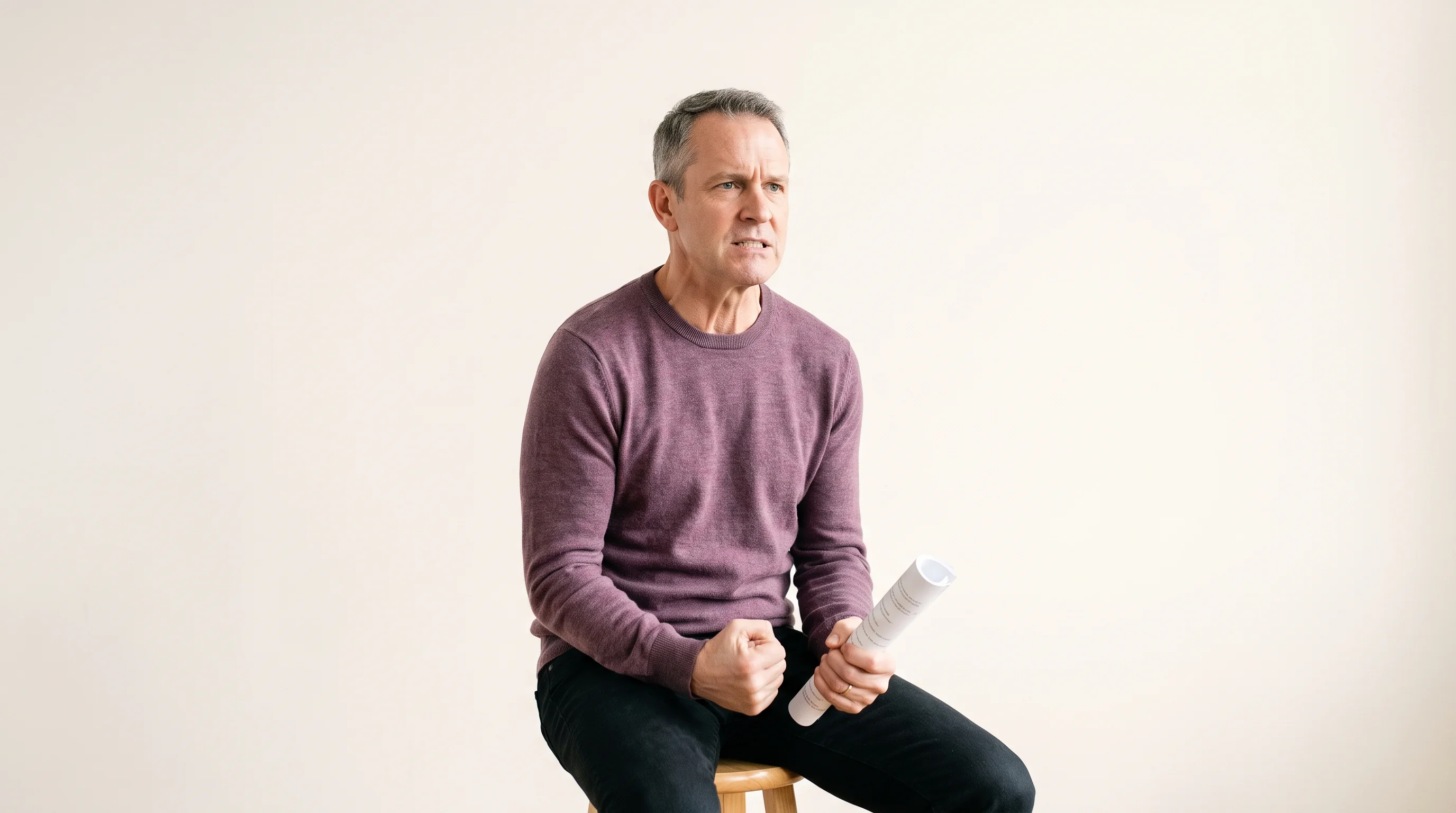
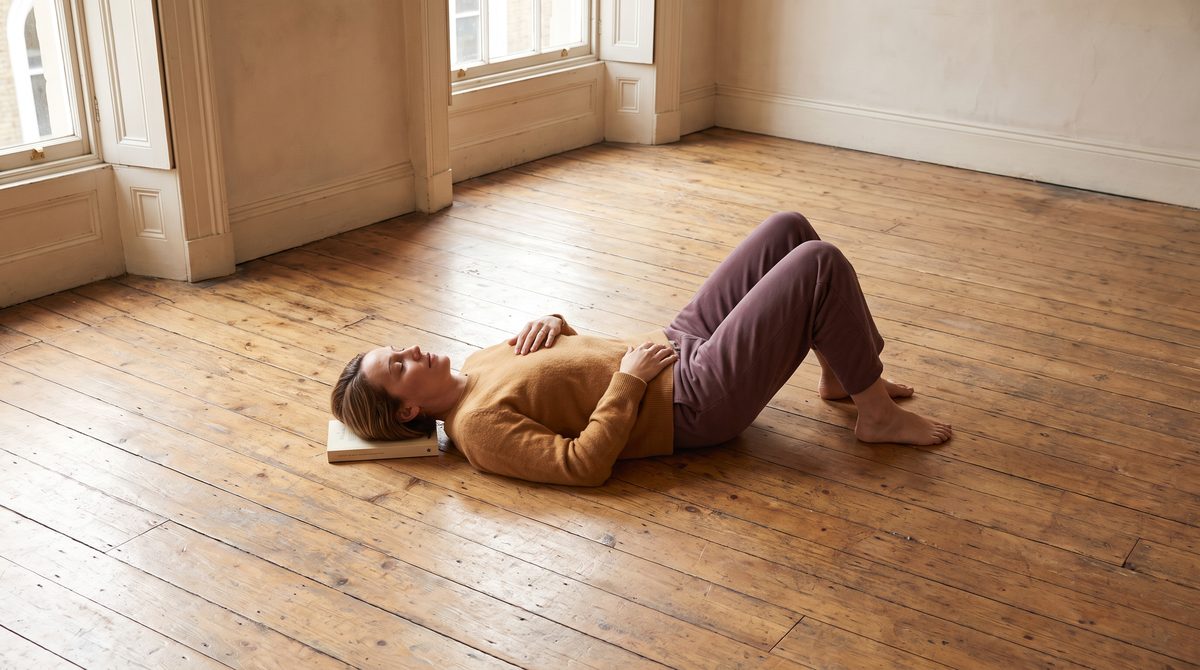
The word is doing two jobs
Almost every page written about this topic treats relaxation as one thing, tells you to get rid of it, and leaves you worse off. There are two things, they need opposite handling, and confusing them is why the advice never quite works.
One is muscular, and it is effort you are applying that the job does not require, living in a few specific places. The other is your autonomic nervous system doing exactly what it evolved to do when something matters. Only one of those is a mistake.
Two different problems
Tension is not the same as nerves
They feel similar from the inside, which is why the advice gets muddled. They are not similar, and the correct response to each is close to the opposite of the correct response to the other.
What it is
Held muscular effort you are not aware of applying.
Adrenaline. Heart rate, breath rate, alertness.
Where it shows
Jaw, tongue, neck, shoulders, throat, the corners of the eyes.
Shaking hands, dry mouth, racing thoughts, a high breath.
What it costs
Your voice, your movement, and the close-up.
Working memory and confidence — but it also supplies the energy.
Can you change it?
Yes, directly and quickly.
Not in ten minutes. Not by deciding to.
So do this
Release it.
Leave it alone and point your attention somewhere useful.
This split is ours. The sources below support each half separately, but no researcher or teacher states it as a single formulation. We think it is the useful way to hold it. Label it as our editorial framing rather than a finding.
Where the tension actually lives
“You look tense” is a useless note because it does not say where. The research is more specific than the notes usually are.
Stanislavski called muscular tension the occupational disease of the actor, and he was describing something measurable. The clearest numbers come from a voice clinic that examined a cohort of drama students.
2013 · Journal of VoiceLerner, Paskhover, Acton & Young — voice disorders in actors
Who
A retrospective review of 30 first-year graduate drama students examined by stroboscopy.
Laryngeal hyperfunction
59%. Overworking the muscles around the larynx — pushing the voice with the throat rather than the breath.
Also found
Incomplete glottal closure 62%, reduced mucosal wave 55%, reflux findings in 48%.
Read it carefully
These are trainees, not established actors, and these are examination findings rather than diagnosed disorders. One clinic, 30 people, looking back at records.
Even with those caveats, the direction is worth knowing. More than half of a class of young actors were already working their throats too hard, in their first year, before any professional demand had been placed on them.
The through-line that unifies four chapters of this course.The voice chapter says the fault is pushing with the throat. The movement chapter says it is pushing with the shoulders. The acting chapters say it is pushing with visible effort, which is what indicating is.
Three departments and one error: effort applied in the wrong place.
Relaxation, correctly understood, is the correction to all three — and it is a redistribution of effort, not an absence of it.
On camera the geography matters more than it does on stage. A chest-up frame contains your jaw, your neck, your shoulders and the corners of your eyes, at a size no theatre audience ever gets. Held effort in any of them reads as discomfort. The viewer will not know why they are uneasy watching you, and they will not care to work it out.
One thing not to push through. Ongoing hoarseness, pain, or a loss of range is not something to solve with a relaxation exercise. It is a reason to see a doctor or a speech therapist. In laryngeal hyperfunction the instinct to push harder is precisely what maintains it, so effort is not a treatment.
Why “just calm down” fails
This is the standard advice, it is what almost everybody reaches for, and there is a good reason it does not work. It asks you to change the one thing that will not move.
Start with how common the instinct is. In a survey of 300 adults run as groundwork for a well-known study, people were asked what advice they would give someone facing an anxiety-provoking speech.
Given three options90.97% chose “try to relax and calm down”. 7.74% chose “try to be excited instead of anxious”, and 1.29% chose cancelling the speech.
Asked in their own words84.94% recommended calming down, with about a fifth mentioning excitement somewhere in their answer.
So the honest figureBetween roughly 85% and 91%, depending on how you ask. Not a single clean number, and the forced-choice version offered only two alternatives, one of which was giving up.
Now the part that matters more, because it is meta-analytic rather than a single study. Reappraising stress has been tested many times, and the results split cleanly depending on what you measure.
2019 · PLOS ONELiu, Ein, Gervasio & Vickers — a meta-analysis of arousal reappraisal
Scope
14 articles covering 36 independent samples of people taught to reinterpret their stress arousal.
How it felt
A real improvement in subjective experience. SMD 0.429, p = .020.
What the body did
Nothing measurable. SMD −0.084, p = .531. In the authors' words, reappraisal groups did not outperform controls on physiological measures of stress.
What you cannot changeThe heart rate itself.
What you can changeWhat the heart rate means to you.
This is the most useful single fact on the page. Talking to yourself does not slow your pulse — and it does change how the whole experience lands. So the ten minutes you spend trying to be calm are spent on the only part that will not move. Spend them on the jaw and on your attention instead.
That also settles a fear held by a lot of good actors. If relaxing means lowering your arousal, then yes, it will cost you something, and your instinct to resist it is correct. If it means letting your shoulders down, it costs you nothing at all.
The “I am excited” study, honestly
Our research brief told us to lead the chapter with this finding, because it contradicts what most people believe. We checked it properly, and it is a good deal shakier than its fame suggests.
The study is real and it is very well known indeed. Alison Wood Brooks, writing alone in the Journal of Experimental Psychology: General in 2014, tested a very cheap intervention: say “I am excited” out loud, or simply be told to get excited, instead of trying to calm down.
Compared with those who attempt to calm down, individuals who reappraise their anxious arousal as excitement feel more excited and perform better. … These findings suggest the importance of arousal congruency during the emotional reappraisal process.
Brooks, “Get excited: reappraising pre-performance anxiety as excitement”, Journal of Experimental Psychology: General 143(3), 2014, pp. 1144–1158Her reasoning is genuinely elegant. Anxiety and excitement are both high-arousal states with similar physiology, so relabelling one as the other is a short trip. Going from high arousal down to calm is a long one, which is why the popular strategy is also the hard one.
What she actually ranFour studies and a pilot, not three
Karaoke
113 people, scored by the voice-recognition software in a Nintendo Wii karaoke game. 80.5% accuracy after “I am excited”, against 69.3% with no statement.
Public speaking
140 people, rated blind for persuasiveness and confidence by three raters. A solid effect on both.
Maths
188 people, timed arithmetic under a small financial penalty. This is the weakest result in the paper — p = .042, a small effect.
A fourth study
218 people, testing the mechanism only. No performance task at all. It is usually left out of summaries.
The catch in the numbers
The totals look healthy, but the karaoke study split 113 people across six conditions — about 19 people per group. And the largest reported effect, often quoted as if it measured quality, is actually how long people talked for.
The thing almost nobody mentions: it has never been replicated. We searched for direct replications, registered reports, and large multi-laboratory projects. In more than a decade, and with the paper cited thousands of times, no direct replication has been published — and it does not appear in the big coordinated replication efforts either. That is not a failed replication. It is worse in one specific way: nobody has checked.
And where the wider evidence has been pooled, the effect shrinks a long way. A 2024 meta-analysis in Scientific Reports by Bosshard and Gomez gathered 35 studies of arousal reappraisal and stress mindset interventions. The pooled effect on performance was d = 0.22. Correcting for the tendency of small studies to report large effects brought it down to d = 0.14, and a p-curve analysis did not find evidential value. Brooks's own headline effects were around d = 0.68 to 0.77 — three to five times larger than the corrected field-wide estimate.
One well-designed null result, in a setting close to performance. Behnke, Lakens and colleagues ran a registered report in 2024 with 300 participants in a cash-prize esports tournament, using an intervention that included arousal reappraisal. It found nothing: no improvement in performance, no change in the cardiovascular response, no difference in how people felt.
So what should you actually do with it? Something, but not everything. The same 2024 meta-analysis found the effect was larger for public performance tasks than for written cognitive ones, which is mildly encouraging for an audition. And the intervention costs you four seconds and no money.
How we would put it. Saying “I am excited” is a reasonable thing to try, it is free, and there is a real if small body of evidence pointing that way. It is not a technique that has been shown to work reliably, and anyone selling it to you as settled science has not read past the abstract. Treat it as a cheap experiment on yourself rather than a method.
Two smaller corrections to what circulates about this paper. The phrase “primes an opportunity mindset” is widely quoted as Brooks's. She wrote “adopt an opportunity mind-set”, which claims less. And the figure usually given as “over 90% believe you should calm down” is the higher of two numbers in her own pilot, from a question with only three options.
And the transfer to acting is ours. Karaoke, a speech to strangers, and timed arithmetic are reasonable stand-ins for an audition. They are not auditions. No study has tested this on actors.
Breathing, and what has actually been tested
Breathwork is the one short practice in this area with a randomised trial behind it. The trial is genuinely useful and it has three problems you should know about.
2023 · Cell Reports MedicineYilmaz Balban and colleagues — brief structured respiration practices
Design
A remote randomised controlled trial. Five minutes a day for 28 days, four groups: cyclic sighing, box breathing, cyclic hyperventilation, and mindfulness meditation as the comparison.
Numbers
108 randomised (30 / 21 / 33 / 24), and roughly 100 analysed (27 / 19 / 32 / 22).
Result
All four groups improved. Cyclic sighing — the exhale-focused one — beat meditation on both mood and breathing rate, each at p < 0.05.
What it did not show
No change in heart rate variability or resting heart rate, in any group. Both were stated primary endpoints, so two of the three physiological outcomes came back null.
Who was in it
Most participants were recruited from an undergraduate psychology class at Stanford. Nineteen people in the smallest arm.
A declared interest
The senior author became an advisor to WHOOP in June 2022 — and a WHOOP wrist strap was the device that collected all the physiological data.
None of that makes it a bad study. It is a randomised controlled trial of a free, five-minute, equipment-free practice with a positive result on how people felt, which is more than almost anything else here can claim. It is just not the settled science it gets presented as.
What cyclic sighing actually is, since this is usually described wrongly. You will read that it is a “1:2 inhale to exhale ratio”. That ratio is not in the paper. What participants were told to do was inhale slowly, then take a second smaller inhale on top to fill the lungs completely, then let a long, slow, full exhale out. A double inhale and one long release. The fixed-duration description belongs to box breathing, which is a different arm of the same trial.
The wider picture is consistent. A 2023 meta-analysis in Scientific Reports pooled 12 randomised trials covering 785 adults and found breathwork reduced self-reported stress, at a moderate effect size. Its authors are careful about it, and so should we be.
However, we urge caution and advocate for nuanced research approaches with low risk-of-bias study designs to avoid a miscalibration between hype and evidence.
Fincham, Strauss, Montero-Marin & Cavanagh, Scientific Reports 13:432, 2023 — whose review found most included studies at moderate risk of biasA contradiction worth naming, because a careful reader will spot it. Breathwork lowers arousal, and this page has just told you not to try to lower your arousal. Both are right, and the resolution is timescale. The trial tested a daily habit over four weeks, not a rescue in a corridor. Use breathing as training, to bring your baseline down over time. In the ten minutes before, do not try to sedate yourself.
The techniques, ranked by what is behind them
This is the ranking the field does not publish, because most of what gets taught has nothing behind it at all. Two entries changed grade when we checked them.
Relaxation methods for actorsWhat the evidence actually supports
Alexander TechniqueHands-on, needs a teacher
Strongest
One large, well-conducted trial: 579 people across 64 GP practices, where 24 lessons produced a substantial and lasting reduction in back pain and disability. But that is for pain and function, not for performing, and no trial has tested it on acting.
Exhale-focused breathworkFree, five minutes, daily
Moderate
One randomised trial of about 100 people, plus a 12-trial meta-analysis of 785 adults. Real, modest, and caveated above. Best available short practice.
Giving attention a targetAn objective, and a person
Moderate
Rests on the convergence set out in What Acting Really Is, including brain-imaging work showing acting involves turning down self-processing. Indirect, but it addresses the actual mechanism of feeling watched.
“I am excited”Reappraisal
Weak
One famous unreplicated study; a pooled effect of d = 0.14 to 0.22 once corrected; one good null result. Free to try, wrong to rely on.
Progressive muscle relaxationTense and release, by group
Weak
A 2024 systematic review covering 46 publications and over 3,400 adults supports it for stress and anxiety generally. No pooled effect size, and nothing on performers.
None found
Taught in studios everywhere. We found no study of it whatsoever. That absence is worth stating plainly, given how confidently it is passed on.
Trying to calm downThe default
Avoid
The strategy 85 to 91% of people pick, aimed at the one thing that does not move. Not harmful — just the worst use of your last ten minutes.
A note on grading. “Strongest” here means strongest in this list, which is not a high bar. Only one entry has a large trial behind it and that trial was not about acting. Anyone presenting relaxation training for actors as evidence-based is overstating what exists.
A lineage everybody repeats that we could not source. It is commonly said that Strasberg's relaxation exercise descends from Edmund Jacobson's progressive muscle relaxation, and our own brief suggested it. We looked, and found nothing connecting them. The documented line runs entirely through Russia:
Stanislavski, then Boleslavsky and Ouspenskaya teaching at the American Laboratory Theatre in New York, then Strasberg. Jacobson's work is roughly contemporary and looks similar, which is probably why the story took hold.
Resemblance is not descent, and we are not going to assert it.
Two claims about the Alexander Technique that we had to downgrade. It is often said that NICE recommends it for back pain. It does not — the relevant guideline does not mention it. NICE does mention it for Parkinson's, and the wording is worth quoting exactly: “Consider the Alexander Technique for people with Parkinson's disease who are experiencing balance or motor function problems.” “Consider” is the weakest recommendation NICE issues. We also found the technique described as endorsed by the performers' health charity BAPAM; what actually exists is teachers listed in its practitioner directory, which is a different thing.
The ten minutes before
Assembled from everything above. It is short on purpose, and the order matters more than the content does.
1
Release, do not sedateJaw, tongue, shoulders, back of the neck. Let your teeth come apart. Shake your hands out. This is the half you genuinely should remove, and it takes under a minute.
2
Two or three long exhalesNot a breathing session. A few slow full out-breaths to stop the breath sitting high in your chest, which is where nerves put it.
3
Relabel it, out loud if you can“I'm excited.” Costs nothing, might help a little. Do not be surprised if your heart does not slow down, because it is not supposed to.
4
Give the attention a jobWhat do you want from the other person in this scene? Self-consciousness is attention pointed at yourself, and it cannot occupy attention that is already busy elsewhere.
And during the take? Almost nothing, deliberately. The only thing that works while you are actually playing is the exhale, because an out-breath fits inside a line and nobody watching can see you do it. Everything else is attention, and attention belongs on the other person.
The thirty-second version. One long exhale, and one sentence about what you want in the scene. That is the whole thing, and it beats a longer routine done badly while you are being called in.
Do not do a full relaxation between takes. The
over-taping research on this course quotes a casting director who can tell when someone has done twenty takes, because they have ironed out all of the humanity. A long calming routine between takes cools exactly the arousal you want to keep. Release the jaw, breathe out once, go again.
When it is not a tension problem at all
“Why am I fine at home and terrible in the room?” is the most common question on this subject, and relaxation is the wrong department for it.
Being watched pulls your attention inward. That is the actual mechanism at work, and it is not a muscular one. The chapter on what acting actually is sets out the convergence in detail, including brain-imaging work finding that acting involves turning down self-processing while attention goes up. No amount of loosening your shoulders addresses attention.
So the fix is not calm but a target: something you want, something in the way, and a person to do it to. That is also why the improvisation research belongs here, since improv training appears to work by increasing your tolerance of uncertainty rather than by lowering your arousal.
On shaking and a dry mouth. Both of those are adrenaline, and both of them are completely normal. Drink water beforehand, breathe out slowly, and take some comfort from the physics: a slight tremor is essentially invisible at conversational framing, and a close mic does not hear it.
When it is more than ordinary nerves
Everything above concerns the normal arousal of doing something that matters. Some readers are describing something else, and this section is for them.
If it is persistent, out of proportion, or present when nothing is happening, that is not a relaxation problem and a breathing exercise is not the answer. It is also common in this profession rather than being any kind of personal failing.
2015 · The Australian Actors' Wellbeing StudyMaxwell, Seton & Szabó — a preliminary report, 782 respondents
Performance anxiety
26% — 204 respondents — reported experiencing debilitating performance anxiety. Roughly a quarter of men and rather more of the women surveyed.
Winding down after a hard role
Alcohol was named by 42.8%. It ranked third, behind reading or television at 48.6% and talking to friends or family at 43.7%.
How to read it
A self-selected online survey, self-reported, and described by its own authors as preliminary. The alcohol figure in particular is often quoted alone, which makes it look worse than the data show.
What we will and will not say. Debilitating performance anxiety is treatable, and a GP or a therapist is the right route. On beta blockers: they are prescription medication and that is a conversation with a doctor, not something a webpage should advise on. Nothing on this page is medical advice, and no acting teacher should be treating it as therapy.
Where the sources disagree
Every chapter on this course ends here. These are live disagreements, and on this topic several of them are unresolved.
Should you calm down before performing?
Commonly saidBetween 85% and 91% of people think so, depending how you ask.
What we foundIt aims at the one part that does not move. Reappraisal changes how stress feels but not what the body does.
Does “I am excited” work?
Commonly saidA famous study says yes, with large effects.
What we foundNever directly replicated in twelve years. Corrected pooled effect around d = 0.14 to 0.22, and one good null result.
Is arousal the enemy?
Commonly saidAnxiety drains working memory and hurts performance.
What we foundTrue, and it is also the fuel. The adjustable part is your relationship to it, not the level.
Does breathwork reduce arousal?
Commonly saidYes — cyclic sighing beat meditation on mood and breathing rate.
What we foundWhich is why it is a daily practice, not a corridor rescue. And it moved neither heart rate nor its variability.
Is tension the same as nerves?
Commonly saidBoth get filed under “relaxation”.
What we foundOne is muscular and should go. The other is autonomic and should stay.
Will relaxing make me flat?
Commonly saidA real fear among good actors, usually dismissed.
What we foundHalf right, and worth taking seriously. Lowering arousal costs you something; releasing your jaw does not.
Is the inverted-U curve the frame for all this?
Commonly saidThe Yerkes–Dodson law: performance peaks at moderate arousal.
What we foundYerkes and Dodson measured neither arousal nor performance in the modern sense, and the curve was read into their 1908 figure decades later. We have not used it.