
Start here, before anything else
Nobody can do the thing that beginners spend their first year trying to do.
You have been asked to be sad, or you have asked it of yourself. So you go looking inside for sadness, and either it does not come or you produce a shape that looks like it. Both feel like failure. Neither is. You have been given an instruction that cannot be followed.
“Emotional mapping doesn’t work and it is not playable.”Ernest Goodman Studio, on result directing — a summary of what most well-known acting and directing teachers now hold
The reasoning behind that is precise, and it is worth understanding rather than just accepting. You cannot plan a response. A response is by definition the thing that happens to you when something else happens first. So if a director demands an emotion — or if you demand one of yourself — your attention goes to producing it, and the moment your attention is on producing it, the performance stops being believable. The alternative is not vaguer. It is more concrete: objectives, action verbs, images, given circumstances. Create the conditions, and let the feeling come or not come.
The same source gives the practical version of a note, and it is the single most useful thing a director can know. If you want a more intense performance, change the objective or the action verb. Do not ask the actor to be louder. Louder is the result you want; the verb is the thing that produces it.
This is the most-asked question in acting and the honest answer is: you do not, directly. You give yourself something to want, a specific person to want it from, and something real in the way. Then you let the reaction happen, or not happen.
A performance that is trying to produce tears is visibly a performance trying to produce tears — which is the exact definition of indicating, the error everybody warns you about and nobody defines. The tears are not the job. The attempt is the job.
Here is what an action verb actually looks like. Every one of these is something you can do to another person, and every one can fail.
to accuseto warnto shameto pleadto dismissto charmto testto forgiveto protectto exposeto comfortto win back
The literal arrival
You have a scene. Here are the eight questions, in order.
Do these in writing the first few times. They take about twenty minutes and they replace the vague dread of “how do I make this good” with eight things that have answers.
Read it once for story.
Not for your part. What happens, to whom, and what is different at the end? You cannot make a choice about a scene you have not understood.
Where are you, and when?
The given circumstances. The place, the time of day, the weather if it matters, and above all what just happened.
Who is this person to you?
Not “my boss”. “The person who passed me over and is now asking me for a favour.” If the script does not tell you, invent it. A specific relationship is the single cheapest improvement available to a beginner.
What do you want from them?
One thing, in this scene, phrased as something they could actually give you, refuse you, say or do. Not “respect”. “I want her to say she remembers my name.”
What is in the way?
No obstacle, no scene. If you can get what you want by asking politely, you have not found the scene yet.
What are you doing to get it?
The action verb. And it changes — line by line, whenever the last one stops working. That changing is most of what a good performance is made of.
What is the moment before?
You did not begin existing on line one. Walk in carrying the thing that just happened, and the first line stops sounding like a first line.
Where does it turn?
Find the point where new information or behaviour forces you to adjust — and then actually let it land, rather than playing the ending from the beginning.
For longer work — a play, a recurring role — there is a bigger version of the same thing. Write a profile and fill in the blanks the writer left: where this person is from, their family, what they like and dislike, the memories they hold on to, the moments that changed them. Then write down exactly what they want and how they pursue it in every scene, including how far they would go. It is slow, and it is the difference between playing a person and playing a mood.
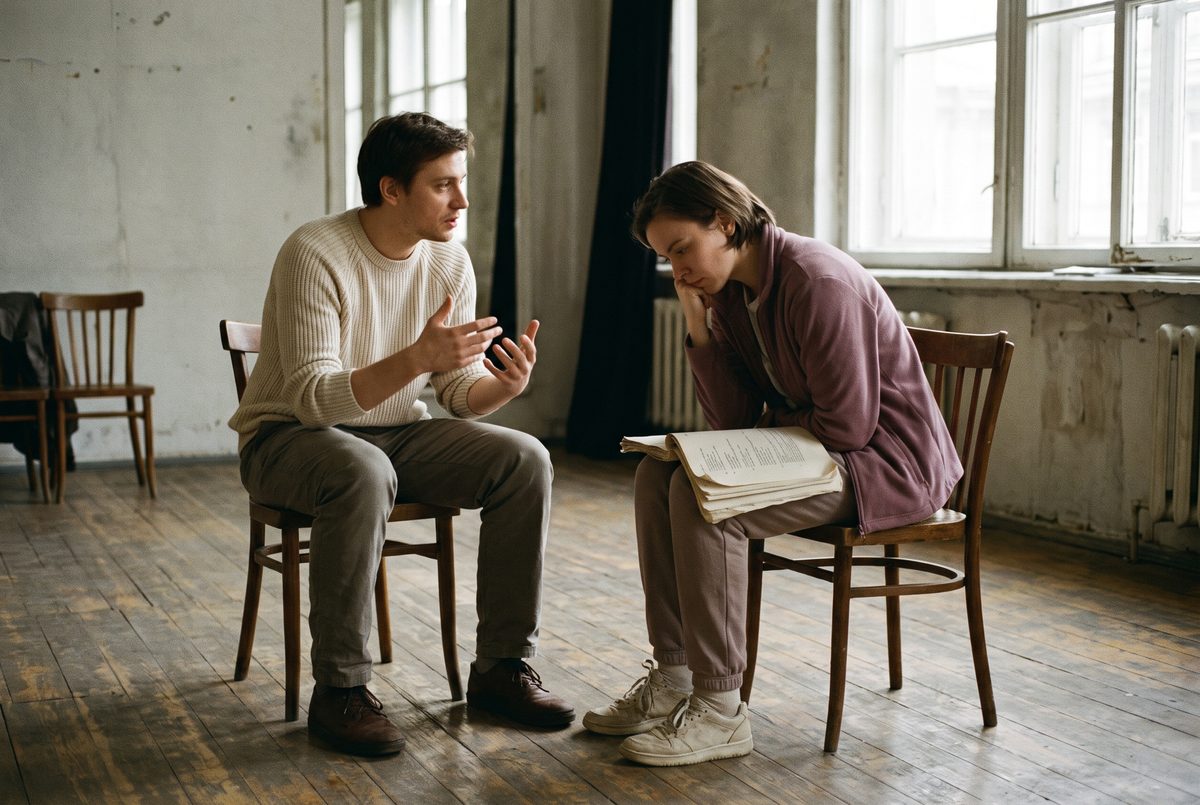
The whole skill in one picture: not waiting for your line — receiving theirs.
The one skill that is both trainable and visible
Listening is not waiting politely for your turn.
If you take one practical skill out of this page, take this one. It is the thing casting directors say they are watching, it is what people mean when they say two actors have chemistry, and it is the only headline skill on the list that you can measurably get better at.
Beginners tend not to listen — and not only to the words. To how the words are being said. The pause before them. Whether the other person looked away. Whether the tactic you just tried actually worked, which you can only know by watching what it did to them.
Stanislavski had a word for it: communion, the live contact between two actors. And here is the observation that makes this section worth more than the usual advice to “really listen”.
Once an actor has built a character and is performing it, they concentrate on themselves and lose contact with the partner.Ernest Goodman Studio — an uncomfortable thing for a craft built on character work to notice
Character work — the profiles, the backstory, the accent, the walk — can actively damage your listening, because it turns the attention inward at exactly the moment it needs to be outward. That is not an argument against preparation. It is an argument for a specific order: prepare thoroughly, then put it down and look at the other person.
It is also, from a completely different direction, a defence of Meisner’s entire approach — and it lines up exactly with what chapter one found: acting is attention pointed outward.
Which gives a beginner something much better than “be natural”. Your headline skill is not being emotional, and it is not being relaxed. It is actually receiving what the other person does, and letting it change you. That is checkable. You can watch a tape and see whether it happened.
It is also why a reader matters more than a ring light. A reader is not there to supply the missing words. They are there to give your attention a person to reach toward.
Practitioner consensus, not research
Eight named beginner errors, and six of them are the same mistake.
These come up again and again across teachers and studios who have never met each other, which is why we trust them. Read the left two columns as reported. The right-hand column is ours.
It also answers the question about copying actors you admire, which everybody asks and everybody gets a snooty answer to. Imitation does not fail because it is unoriginal. It fails because you are copying an output. The actor you admire arrived at that sound by attempting something specific on somebody specific, under pressure. You can reproduce the sound. You cannot reproduce the attempt, and the attempt is the part that made it good.
The most common private worry
“Why does my acting feel fake to me?”
Almost always, this is a description of self-observation rather than a description of the work. You are the only person in the room who can hear your own commentary — and you are listening to it instead of to the scene.
Diderot named the mechanism in 1773: an actor has to watch and regulate their own playing, and that critical work is not compatible with sincere feeling. When a person is genuinely stricken, they do not keep watch on themselves doing it. Two and a half centuries later a 2019 fMRI study found that acting is characterised by deactivating self-processing while increasing attention — the same shape, arriving from neuroscience.
The answer is: give the attention somewhere else to go. A person. A thing you want from them. Something in the way. Attention is not optional — it will sit somewhere — and if you do not give it a job it will sit on you.
Self-consciousness is not a character flaw you have to overcome before you are allowed to act. It is attention pointed at the one place it cannot usefully sit.
And on freezing when somebody watches you: it is close to universal, and it is not a verdict on whether you should be doing this. A cognitive behavioural hypnotherapist writing for Spotlight makes a point worth carrying around — trying to prevent the anxiety usually makes it worse, and reframing it from “something is wrong with me” to “this matters to me” changes how your brain treats the whole event.
The evidence, and its limits
Years do not make you good. Being corrected does.
This is the one question on the page with an actual research literature behind it, so it is worth doing properly — including the part where the research is contested.
The foundational work is Ericsson, Krampe and Tesch-Römer (1993) in Psychological Review, built on studies of thirty violinists at a Berlin music academy and a comparison of expert and amateur pianists. Three findings from that line of work matter to somebody starting out.
With that said, here is what it actually gives a beginner, and it is more than it first looks.
Completely unserved — nobody gives beginners a syllabus
Four weeks, one short scene, about twenty minutes a day.
Everything above is a principle. This is the part where you do something with it. Use one short scene for all four weeks — changing material every week is a way of avoiding the difficulty.
Take one short scene. Work through the eight questions on paper — on paper, because writing catches vagueness that thinking does not. Then say the scene aloud once.
Do not try to be good. This week is comprehension, not performance.
Same scene. Write an action verb beside each line — to warn, to charm, to dismiss. Run it three times, changing one verb each time.
Notice that changing the verb changes the feeling without you trying to feel anything. That is the whole first principle, experienced rather than read.
They do not need to be an actor and they cannot harm you by being bad. Run the scene and give yourself exactly one job: respond to how they said it, not to what you planned at home.
Ask them to read it differently the second time without telling you how.
Your phone is fine. Watch with one specific question, not a general verdict: am I doing something to them, or performing at them?
Watch it once, write one note, and stop. A second and third viewing is not analysis; it is self-criticism with a screen.
Where to get scenes and monologues, free and legal:
Tens of thousands of public-domain works with a browsable plays subject index. Free, permanent, no account.
Every play, free and properly edited — the standard modern text, not a scan.
A paid academic library that many public libraries subscribe to. Free with a library card, and most people have no idea.
Real broadcast scripts, released as PDFs. Contemporary, and written to be spoken.
You are almost certainly measuring the wrong thing
What “good” looks like when you have been doing this for six weeks.
A beginner cannot assess their own work, and the usual questions make it worse. These six can actually be checked — by you, from inside, immediately after a take.
Did it look real. Did I feel something. Was it moving. Those are outputs, judged by other people, and you cannot assess them from inside your own head — which is precisely why trying to produces the spiral rather than the improvement.
The six above are all things you can actually check. That makes them a usable definition of progress instead of a verdict on your talent.
The honest state of the evidence
Where the field genuinely disagrees.
How do you produce emotion?
DirectlyThe intuitive answer, and what nearly every beginner attempts first.
IndirectlyEmotional mapping is not playable. Use objectives, action verbs, images and circumstances, and let the feeling follow.
Does character work help?
It is the coreOf most training everywhere — the profile, the backstory, the physical life.
With a costOnce performing a built character, actors concentrate on themselves and lose contact with the partner.
Does experience make you good?
AssumedLength of experience and reputation are how expertise is traditionally judged.
WeaklyOnly a weak relationship with actual, observed performance.
Is deliberate practice the answer?
Best modelIt is the best-supported account of skill acquisition we have.
OverstatedIt does not explain every difference or guarantee expertise, and researchers disagree on how much it explains.
Can you teach yourself?
YesThe material is free, the exercises are public, and nobody is stopping you.
Not entirelyDeliberate practice requires immediate feedback, and you cannot give yourself feedback.
Should you study several techniques?
BreadthA toolkit is better than a single tool, and professionals blend constantly.
SoupBouncing between them every few weeks produces work that looks forced instead of specific.
Is talent real?
Universally assumedBy the industry, by audiences, and by every beginner worrying about it.
UnsettledThe 1993 work challenged talent and years as sufficient explanations — without settling the question either way.
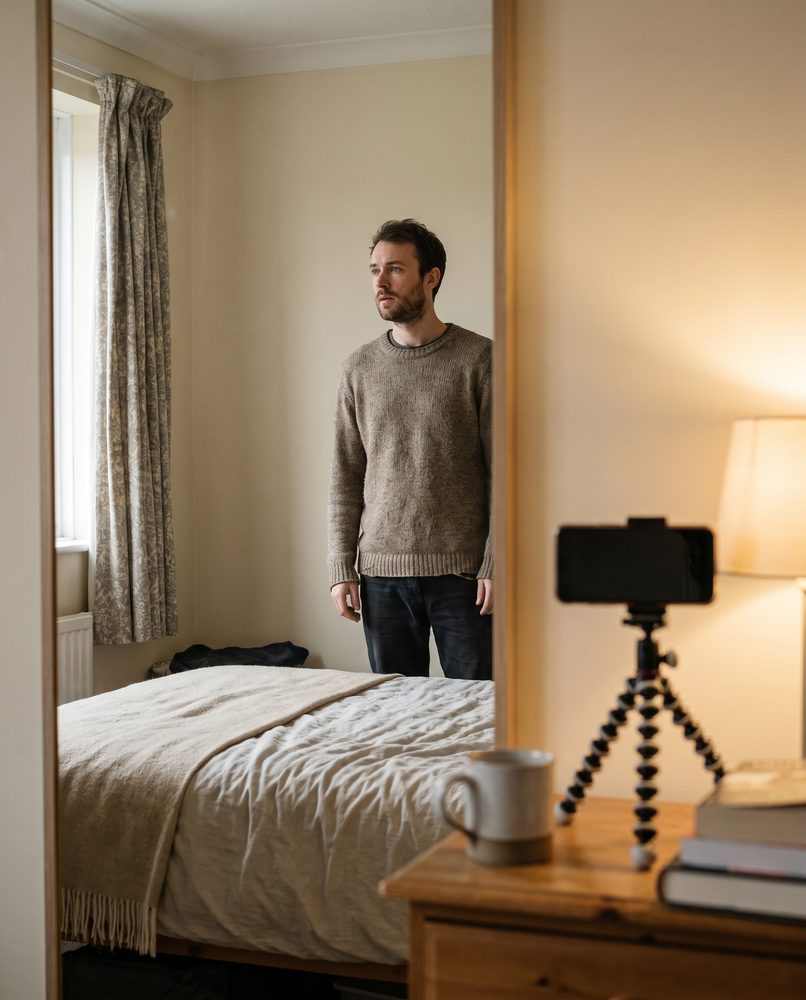
One line. Six verbs. Ten minutes.
To warn. To charm. To dismiss. To beg. To test. To forgive. No emotional instruction at all. Film it on your phone if you want, but you do not have to.
You will hear the feeling change six times without ever having tried to feel anything — which is the whole of this chapter, learned in the only way it can be.
Chapter two: the techniques