Concentration is not a muscle
Almost every page on this subject promises exercises that build your focus, the way press-ups build your chest. We went looking for the evidence that this works, and there is none.
That is not a small point, because it changes what you should do tonight. If focus were a capacity you could enlarge, the sensible move would be daily drills. If it is a direction, drills are beside the point and the whole question becomes what you aim at.
Everything in this course has landed in the same place. The failure is almost never insufficient effort. It is misdirection, and effort applied in the wrong direction usually makes things worse rather than better.
Two kinds of inward, and only one is fatal
This is the distinction that makes the rest of the chapter usable, and it survives everything we are about to demolish, because it does not depend on any of it.
Two completely different operations get described as focusing inward. The first is narrowing your attention until the room disappears. The second is turning your attention onto yourself and assessing how you are doing. They feel similar from the inside and they are opposites.
The distinction
Narrowing is not watching
The first shrinks the field of attention while leaving an object inside it. The second replaces the object with you.
Diderot got there first, in 1773, and he put it as a paradox: you cannot both feel something and stand outside yourself observing that you feel it. The neuroscience arrived two and a half centuries later and pointed the same way. Brown, Cockett and Yuan scanned actors in 2019 and found that acting deactivates self-processing while attention goes up.
What Stanislavski actually wrote — and who wrote the rest
Here is the correction we did not expect to be making. If you have been taught “Stanislavski's three circles of attention” at drama school, a good deal of what you were taught belongs to somebody else.
Stanislavski's circles are in chapter five of An Actor's Work, and they are spatial. A circle of attention is a defined area with objects inside it, and you can make it small, medium, large or larger still. He also distinguishes fixed circles from moving ones. It is a technique for deciding how much of the physical world your attention encloses.
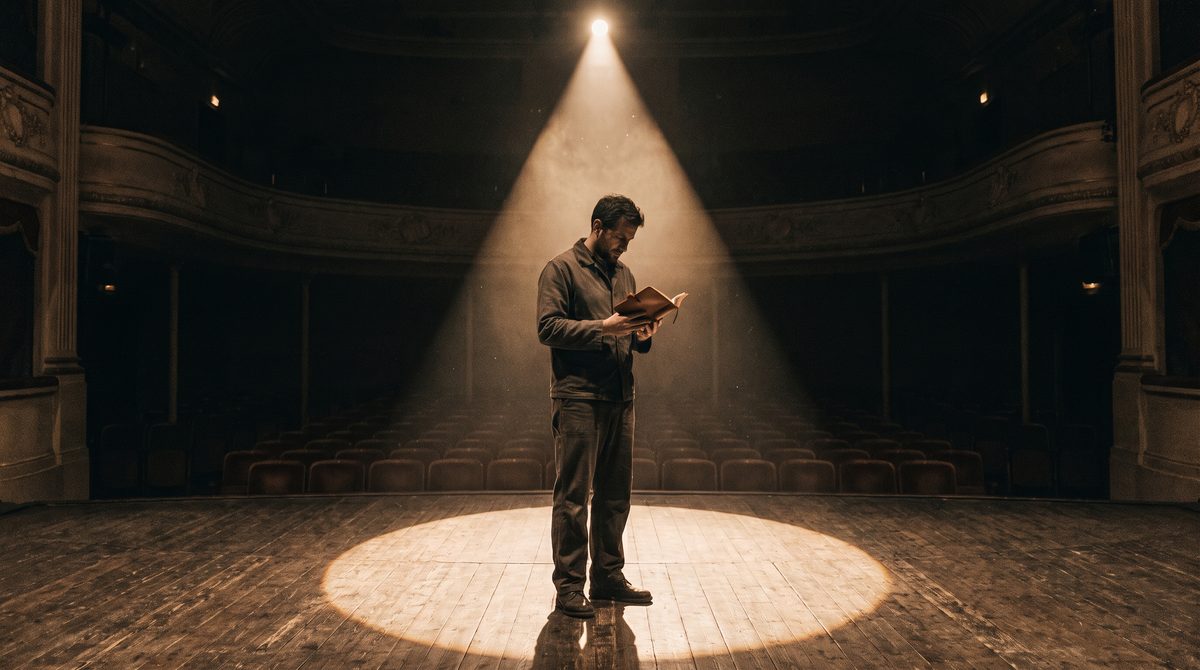
The most famous image is real. In a lit circle on a dark stage, cut off from everything outside it, you get what he calls solitude in public.
During a performance, before an audience of thousands, you can always enclose yourself in this circle, like a snail in its shell. You carry it with you wherever you go.Stanislavski, An Actor Prepares, trans. Elizabeth Reynolds Hapgood — the same image appears in Benedetti's An Actor's Work, ch. 5
Now the part that gets attributed to him and is not his. You will be taught that the first circle is yourself, the second is the person you are talking to, and the third is the whole room. That is a real and useful system. It is Patsy Rodenburg's, from her book The Second Circle, published around seventy years after Stanislavski wrote his.
Two different systems
Circles of attention, circles of energy
Both are genuinely useful. They are not the same thing, they were written seventy years apart, and almost every drama-school handout merges them.
What sport science claimed
The most exciting thing in our research brief was a body of motor-learning work that seemed to prove the whole argument from the outside. It deserves setting out properly before we tell you what happened to it.
In 2001 Gabriele Wulf and colleagues proposed what they called the constrained action hypothesis. The claim is elegant and it maps onto acting immediately.
When performers utilize an internal focus of attention (focus on their movements) they may actually constrain or interfere with automatic control processes that would normally regulate the movement, whereas an external focus of attention (focus on the movement effect) allows the motor system to more naturally self-organize.Wulf, McNevin & Shea, “The automaticity of complex motor skill learning as a function of attentional focus”, Quarterly Journal of Experimental Psychology A 54(4), 2001
In plain terms: think about how your arm is moving and you interfere with a system that runs better on its own. Think about the effect you are producing and you leave it alone. Over twenty-five years the idea was tested across basketball, golf, balance, jumping, walking and music, and it became one of the most widely taught findings in coaching.
You can see why it looked like the missing piece. Diderot said it in 1773 from a theatre seat. Stanislavski built a technique around it. A brain scanner pointed the same way in 2019. And here was a laboratory measuring it in bodies.
What happened when somebody checked
In 2024 an independent group at McMaster University took the field's own data and re-analysed it with methods designed to detect publication bias. This is what came out.
The starting point was a large meta-analysis published in 2021 by Wulf's own group, pooling results across dozens of studies. The re-analysis used exactly the same dataset. All that changed was correcting for the tendency of the literature to publish results that worked and quietly shelve results that did not.
The muscle-activity row is the one that should stop you. That was the finding connecting focus to physical tension, and the one we most wanted to use, because it would have joined this chapter to the relaxation chapter with a measurement. It went from a large effect to essentially nothing.
Our findings impugn the evidential basis for the superiority of an external focus of attention.McKay and colleagues, Psychological Bulletin, 2024
Why the advice survives anyway
Here is the honest position. The sport science turned out not to be load-bearing, because the practical advice never actually rested on it.
What the motor-learning research offered was corroboration from an unexpected direction, and corroboration is nice to have rather than necessary. The instruction to attend outward was already supported by four separate things, none of which depend on Wulf at all: a philosophical argument from 1773, a technique that has been taught continuously since about 1910, a brain-imaging study, and the unanimous testimony of everyone who casts for a living.
So the table below stands. It just stands on different legs than we planned.
Every entry in the right-hand column is a question with an answer outside your own head. That is the only property they share, and it is the property that matters.
Getting it back mid‑take
Everyone loses it. The useful question is what you do in the second after you notice, and there are two instincts here that both make it worse.
The first bad instinct is to concentrate harder, which means applying effort to the act of attending, which is attention on yourself. The second is to try to relax, which the previous chapter covers and which aims at the one thing that will not move in the time available.
If your attention span is short
A lot of people arrive at this page assuming they are constitutionally unsuited to acting because they cannot hold a thought for long. The answer is kinder than they expect.
Sustained vigilance is not what acting asks of you. A scene is not one long act of concentration, it is a series of short specific tasks, and Stanislavski's own solution was to break a role into small pieces precisely so attention only has to hold for a moment at a time.
The memorizing chapter covers the neurodivergence research in more detail. The relevant point here is that this is one of the places where a differently wired reader may be well served by the technique rather than defeated by it.
Concentration in a self-tape
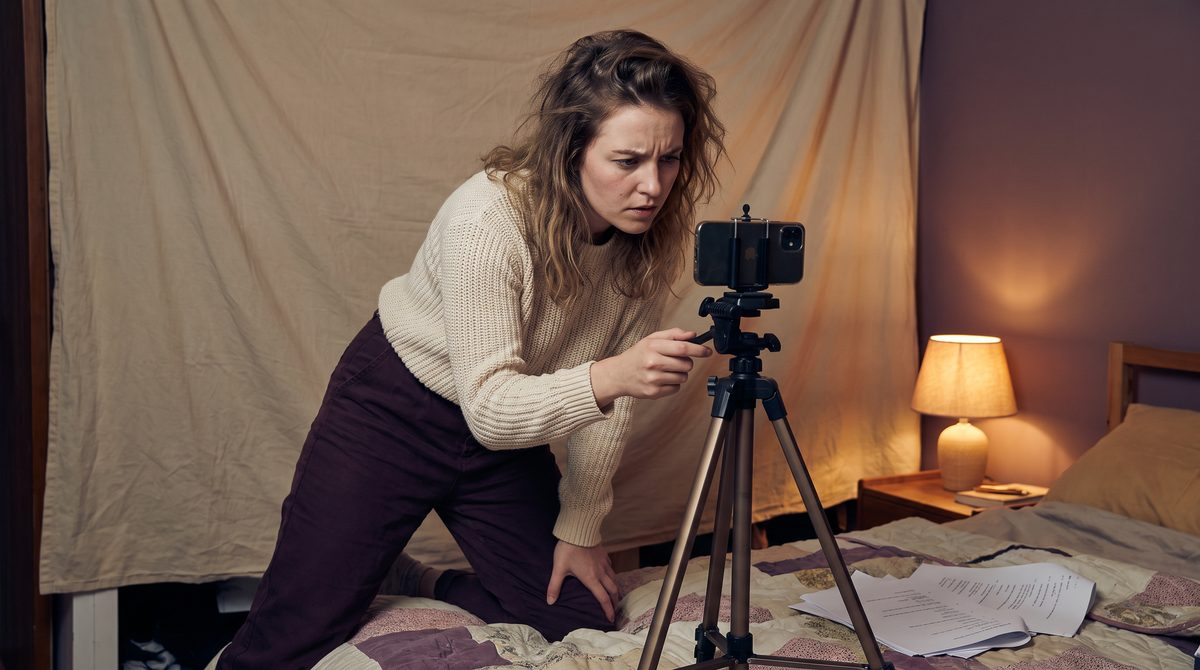
A self-tape is an unusually hostile place to concentrate, and nobody says so out loud.
Consider what you are being asked to do. The circle is tiny and almost empty: one reader, one lens, a bedsheet. You are also the crew, monitoring framing and sound and whether the phone is still recording, which is technical, self-directed attention of exactly the kind that hurts. Your reader may be flat, giving you very little to attend to. And nothing arrives from outside to pull you out of yourself, because there is no director.
- Set up completely, then stop being the crew. Check everything, then commit and leave it alone.
- Make the reader the circle. Casting is watching you receive, so that is where the attention belongs anyway.
- If your eyeline is empty, put something there. A taped cross beats trying to imagine harder, because an external focus needs an external object.
- Do fewer takes. Every take you do as your own director is a take spent looking at yourself.
Where the sources disagree
Every chapter on this course ends here. On this topic almost everything is contested, including things you will have been taught as settled.
Can you train concentration?
Commonly saidThe premise of every concentration-exercise page.
What we foundNo evidence that generic focus drills build a transferable capacity. The useful variable is direction, not capacity.
Should attention go inward?
Commonly saidStanislavski's smallest circle asks you to narrow right down to yourself.
What we foundNarrowing the field and inspecting the performer are opposite operations. The small circle still has an object in it.
Whose three circles are they?
Commonly saidStanislavski's, taught as first, second and third circle.
What we foundThat numbering and those definitions are Patsy Rodenburg's, from about seventy years later. Stanislavski's are spatial and there are more than three.
Does external focus improve performance?
Commonly saidTwenty-five years of sport science, taught in coaching worldwide.
What we foundPooled effects fall to roughly zero once publication bias is modelled, and not one study in the literature was preregistered.
Is focusing on yourself physically tenser?
Commonly saidSeveral studies found higher muscle activity under internal focus.
What we foundAll from one laboratory. An independent test found no difference, and the pooled effect drops from 0.83 to 0.06 after correction.
Does it hold for beginners?
Commonly saidThe advice is given to everyone equally.
What we foundA 2025 review found no evidence novices benefit at all, and two studies found beginners did better with the opposite instruction.
Has anyone tested this on actors?
Commonly saidThe transfer from sport is treated as obvious.
What we foundNo study has. It has been tried in dancers, singers and instrumentalists, where a 2024 review found no consistent advantage either way.