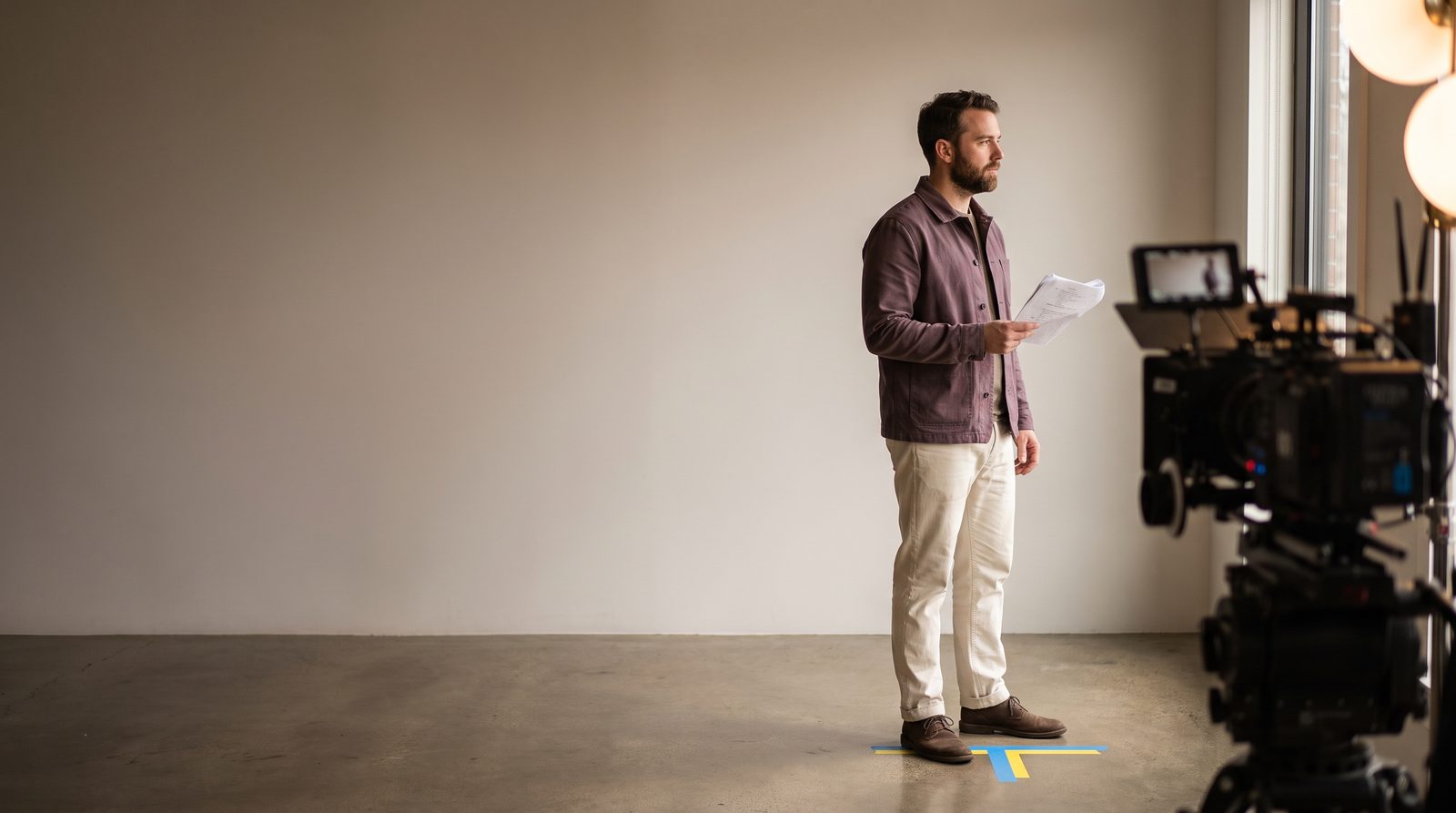
The framing the rest of the chapter depends on
It is not magnitude. It is structure.
Almost every article on this subject says stage is big and screen is small. That is true, and as an instruction it is close to useless. It tells you to subtract without telling you what to add.
Start by conceding the point properly, because the best source in the field makes it plainly.
You've got to make yourself disappear. In theater, it's just the opposite. You really make the acting work for you. In movies, you dump the acting and become.Michael Caine, interviewed by Dave Davies on Fresh Air, NPR, 2 November 2010
So scale is real. But scale is the visible difference, and it is the only one anybody teaches. The differences that actually strand a stage actor on their first film are invisible, and there are four of them.
The four differences
What changes when the camera arrives
Not one of these is about how loud you are. Every technical demand later in this chapter comes out of the fourth one.
The row nobody teaches
An editor builds the performance. You supply the material.
This sounds like a technicality and it is not. It is the fact everything else in screen acting is downstream of.
Thelma Schoonmaker has cut Martin Scorsese's films for fifty years. Asked what editing actually consists of, she does not describe pace or rhythm.
The more interesting editing is not so visible. It's the decisions that go into building a character, a performance, for example.Thelma Schoonmaker, interviewed by Nick Pinkerton, Film Comment, March–April 2014
Read it as a job description rather than a boast. Building a character. Building a performance. She is describing something she does after you have gone home, using pieces you handed over without knowing which ones she would keep.
Marks, matching, eyelines, coverage and continuity are not bureaucracy, and they are not somebody else's department. They are the conditions under which your work survives to be seen.
A moment you are proud of, filmed while you were three feet off your mark, is not in the film. It is not a debate. It is out of focus.
And the actor who fights hardest against this proves the point.
Andy Serkis has spent a career insisting that performance capture is acting rather than a special effect. His formulation is that a performer working this way is authoring the role. That is a strong claim, and he makes it in the one medium where authorship is easiest to deny.
The inversion, from an actor going the other way.
Adrien Brody won an Academy Award before he ever stood on a Broadway stage. Describing his first theatre job, he reached for a word that ought to belong to the cutting room.
The joy and pain of doing theater is your own physical, emotional, intellectual being has to carry the responsibility of remaining present and editing; being aware of timing, humor, depth, relationships with the other characters, pacing of the play.Adrien Brody on his Broadway debut, interviewed by Jamie Kravitz, Broadway.com, 30 April 2026
That is the thesis stated by the other side, unprompted. On screen an editor does it and you never see them work. On stage you do it yourself, live, while also acting. Brody's other line names the trade honestly. Films are not easy, he says, but you have a great deal at your disposal to help when a moment does not flow. On stage there is no apparatus to catch you.
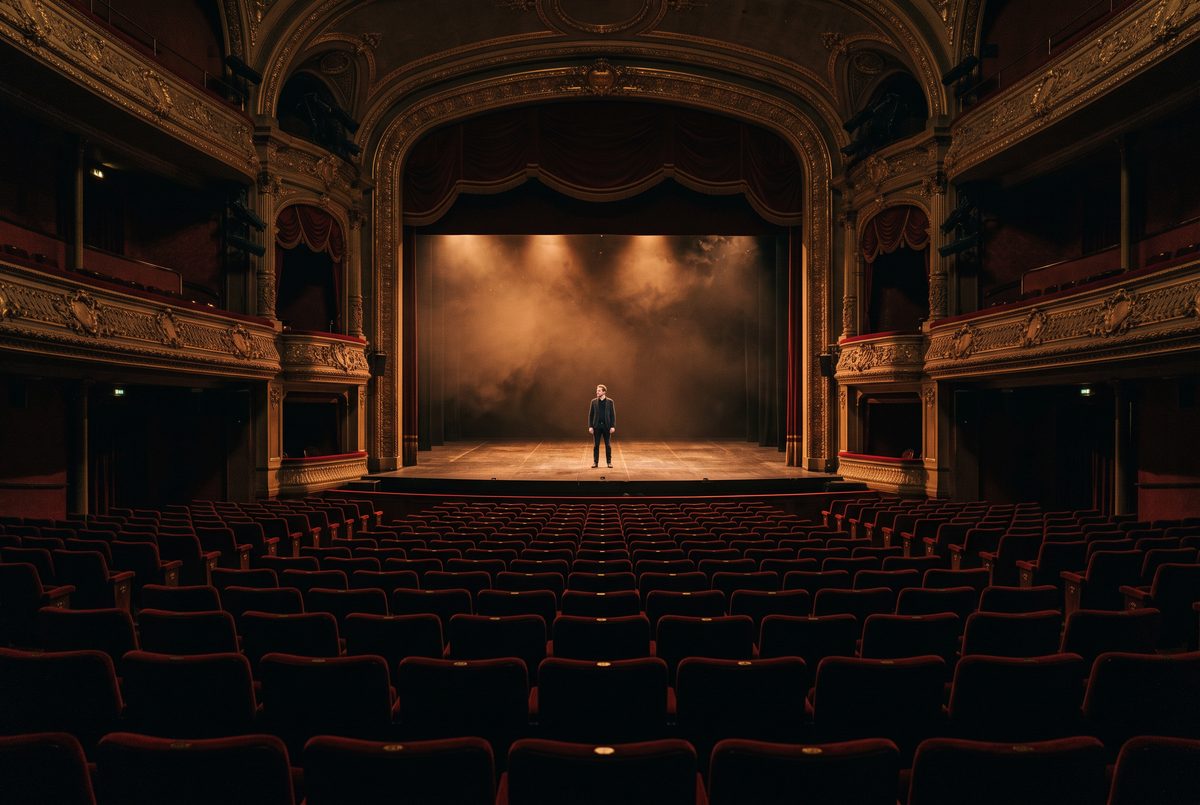
The same performance has to reach the last row of this room. Nothing is amplifying it except the actor.
The correction that makes the standard note usable
“Am I too big?” is the wrong question. Too big for which shot?
The camera does not magnify you by a fixed amount. It magnifies you by however much of you is in the frame, and that changes with every setup of the day.
The whole body tells the story and the frame amplifies almost nothing. Small facial work is simply not visible here.
Hands and posture are working, but the face has started carrying most of the meaning.
A change of mind is an event. A gesture at mid-shot scale becomes something the audience notices instead of the scene.
Why subtraction on its own does not work
There is no neutral face on screen.
This is the second half of the correction. It explains why actors who dutifully do less often end up looking absent rather than truthful.
An audience watching a face is actively interpreting it. Give them nothing and they do not receive nothing — they read the blankness, usually as absence, boredom or concealment. Doing less does not move you toward zero. It moves you toward being read differently, and the reading is out of your hands.
The evidence usually wheeled out for this is the Kuleshov effect. The honest version of that story is more useful than the legend.
[The audience] raved about the acting … the heavy pensiveness of his mood over the forgotten soup, were touched and moved by the deep sorrow with which he looked on the dead child, and noted the lust with which he observed the woman. But we knew that in all three cases the face was exactly the same.Vsevolod Pudovkin, describing Lev Kuleshov's experiment with a single unchanging close-up of Ivan Mozzhukhin
The original footage is lost. Kuleshov never formally documented the experiment himself. The account above comes from Pudovkin more than a decade after the fact, and retellings disagree about which three shots were even used. Then the first serious replication failed to find the effect at all. That was Prince and Hensley in 1992, with 137 participants, though their design has since been criticised as noisy.
Later work is better. An fMRI study found it in 2006. And Barratt and colleagues (2016), working with 36 participants across 24 sequences, concluded carefully that “some sort of Kuleshov effect does in fact exist”. That is a sentence worth quoting with its hedge left in.
So: the idea is real and supported. The famous 1920s demonstration is an undocumented anecdote about film nobody can watch. Both things are true.
Stop treating “less” as the goal. The thing that replaces scale is specificity of attention — what you are doing to the other person, right now, in this frame.
Which is the same answer this course keeps arriving at from every direction. It is also why every casting director quoted anywhere in this Academy says the thing they watch for is listening.
The most-quoted material in screen acting
Michael Caine, correctly.
The 1987 BBC workshop and the book that came out of it are the canonical text for this chapter. They are also the most misquoted source in the field, and two of the lines everyone repeats turn out not to be his.
Start with what he does say. On blinking in a sustained close-up:
If I keep blinking, it weakens me, but if I'm talking to you, and I don't blink, and I just keep going… you start to listen to what I'm saying.Michael Caine, BBC workshop, 1987 — published as Acting in Film, ed. Maria Aitken, Applause, 1990, revised 1997
It weakens me. Caine is describing what blinking does to a specific effect. It dissipates authority in a held close-up, and the contrast he draws is between a strong person and a flustered one.
He is not saying never blink. Taken as a permanent rule it produces the glassy stare, which reads as strange rather than powerful. Blink like a person, unless the moment gives the character a reason not to.
The other half of the same note, and this one is exact.
The fault Caine is describing is a gaze that will not settle. His word for it is changing eyes.
You never change eyes, what you do is you pick an eye.Michael Caine, same workshop, on watching actors flick between their partner's two eyes
It looks like nothing in life. On a large screen it reads as evasion. So pick one of your partner's eyes and stay on it. Conventionally that is the eye nearer the camera, which keeps your own face open to the lens. That refinement is standard practice rather than Caine's own wording, so we are not putting it in his mouth.
And the note James Cagney gave him, which is not what it is usually reported as.
When the director tell you to run from over there right toward the camera and past it, run like hell when you're far away, and as you get near the camera, slow down.James Cagney's advice to Michael Caine, as Caine reports it
It circulates as a general principle about slowing down near the lens. It is not one. It is a specific note about running at the camera and past it, so that the operator can hold you. The advice is good and the scope is narrow.
Two lines get reproduced everywhere with his name attached. One is “Film acting is, in large part, reacting and listening”. The other is the rehearsal test about a crew member being able to tell you are rehearsing rather than talking. Both are bold section headings from a 2012 No Film School article summarising the workshop. They are the writer's own distillation, in a piece where none of the ten “lessons” are quoted speech. There are no quotation marks in the original because nothing is being quoted.
The underlying idea is genuinely his and the book contains real material on listening. But we are not printing a blogger's headline in quotation marks with a famous name on it. Chapter nine had the identical problem with a Stanislavski line, and chapter four had it with a Yale study. If a striking quote's only trail leads to a blog subheading, it is usually the blogger's sentence.
The layer nobody teaches until you are already on set
Marks, light, coverage and eyelines, in plain English.
Everyone on a set assumes you know this. Almost nothing in stage training covers it, and all of it is learnable in an afternoon.
The mark, and whose job you are protecting.
A mark is a small piece of tape on the floor showing where you stand. Outdoors it might be a stick or a stone. It exists because several people have built something for a specific patch of floor.
The 1st AC (or Focus Puller) has one of the hardest jobs on the set.Oliver Stapleton, BSC — cinematographer
The standard reference on the camera-department side is David E. Elkins's The Camera Assistant's Manual, which has a section called simply “Marking Actors”. Worth knowing it exists, because it tells you this is a documented craft rather than set folklore.
The drill you can do tonight.
Put a piece of tape on your living-room floor. Then use the method the working screen actor Bill Coelius gives in Backstage, which is better than staring at the floor.
Count your steps to and from your mark. Walk backward counting your steps until you're off camera, then count them into the scene.Bill Coelius, screen actor and teacher, in Backstage
Once you can land on it every time, make it harder. Walk to it while saying your lines out loud. That is the actual job: landing accurately while your attention is entirely somewhere else.
Stopping short — braking early because you do not trust the distance. Commit and count. Overshooting — adrenaline carrying you past the tape, so rehearse the stop rather than the walk. Abandoning the mark once the scene gets emotional, as though precision and feeling cannot occupy the same body. And right feet, wrong body — perfect foot position while angled slightly off the light or the eyeline.
We have set these out because they are useful and consistent with how the job works. They are not a published taxonomy, and we are not pretending otherwise.
Coverage, and why they keep doing it again.
Coverage is all the footage shot to capture one scene: a master or wide, mid shots, close-ups, over-the-shoulders, plus cutaways and inserts. The same scene, from every angle they will need.
They are collecting the pieces. It is worth knowing this on your first job, because take eleven of an identical setup feels like failure and almost never is.
Eyelines, and the invisible geography.
Cut together, each character has to appear to be looking at the right person. So the camera stays on one side of an imaginary line between the two of you. That is the 180-degree rule, and it keeps one character consistently frame right of the other. Cross it carelessly and the two of them appear to be looking the same way instead of at each other.
In practice your partner may be standing beside the lens. Or in the wrong place. Or replaced by a piece of tape on a stand. Your job is to treat the assigned point as though the person is genuinely there. Which is exactly the discipline self-taping already teaches, and it transfers straight onto a set.
Continuity, and one correction.
Say you pick up the glass on one line in the wide shot, and on a different line in the close-up. Those two shots now cannot be cut together at that moment. Match your actions and your timing across sizes.
The real reason to be consistent is better and smaller. It makes you easy to cut — and being easy to cut is most of what “professional” means on a set.
The hardest skill in the medium
Doing it again, twelve times, without it dying.
Ask the Royal Academy of Dramatic Art what its screen course teaches and the answer is not “being smaller”.
RADA's own description of its acting-for-camera course lists truthful engagement on camera and active listening on set. Then, in its own words, techniques to remain present in the moment during multiple takes. The problem the Royal Academy names is repetition, not scale.
A nearly forgotten piece of craft
Robert Donat drew a graph of his character in 1938.
Shooting out of order is the thing every stage actor asks about first. There is an eighty-year-old answer to it, and it is sitting in a university archive in Manchester.
Robert Donat was one of the finest screen actors Britain produced, and he won the Academy Award the following year. While making King Vidor's The Citadel in 1938 he made a document that survives, catalogued as the Emotion Chart.
A graph on which Donat plotted the development of his character, Dr Andrew Manson, across the film. It was made, in the archive's own description, in order to maintain continuity when shooting films out of sequence.
It is item FRD/1/13/1/1 in the Papers of Robert Donat at the University of Manchester Library. It is discussed properly in Vicky Lowe's article “Acting with feeling: Robert Donat, the ‘Emotion Chart’ and The Citadel (1938)”, in Film History 19:1 (2007).
The version you can actually make.
You do not need Donat's chart to use his idea. Before you shoot, write three lines for every scene.
The event still pressing on this character as they walk into the scene.
Early caution, rising pressure, the break itself, or the aftermath of it.
The one thing that is different by the time this scene ends.
Mark each scene one to five. It lets you find your place quickly on a Tuesday morning when they are shooting the end of the film. The number is a reminder of where you are, not an instruction about what to do.
You still return to the circumstances. Nobody has ever given a good performance by playing “level four”.
Screen is not one medium
Seven pages a day, or eighty.
Almost everything written about screen acting means feature film. A great deal of the actual work is not, and the differences are enormous.
On average, on a movie you film between 7 to 11 pages a day… On a soap, we do like 80 pages a day. It's very fast-paced. There's not much room for error on a soap.Victoria Konefal, Days of Our Lives, interviewed by Johnathon Kornblee in Parade, 29 March 2026
The British soaps do not publish a pages-per-day figure at all. The nearest hard number we found comes from the Royal Television Society. Coronation Street broadcasts five episodes a week, and those five take 66 hours to film. Roughly 110 minutes of transmitted drama a week, against a feature that shoots for three months to deliver the same 110 minutes.
And then there is the one that behaves like a play.
Multi-camera comedy is the odd one out, and almost nothing written about screen acting accounts for it. This is the sitcom, shot on a proscenium set in front of a live studio audience, with four cameras running at once.
Actors spend several days rehearsing and doing run-throughs while the writers rework the script, then shoot across a day or two. Backstage describes the style as heightened and a little theatrical. It describes the setup as four cameras lined up in front of the set, like an audience watching a play.
Which means three of our four structural differences partly collapse. It is far less fragmented, it is not unwitnessed, and much less of it is assembled after the fact. Multi-camera comedy is the hybrid, and a stage-trained actor is often unusually good at it.
Single-camera television is the opposite. Days are long, things move quickly, and there is rarely time to rehearse beyond showing the scene to the crew. And the older testimony holds up. An actor working in daytime in 2001 put it plainly. A show like ER gets seven or eight days for an episode, with time to work out the emotional shape with a director — “but here, you've got one day.”
The other half, properly sourced
What the stage asks for that a camera never will.
Most writing on this subject is screen-weighted because the sources are. Here is the other side from people who have done both at the highest level.
Sustain, and the actor who walked away from it.
Anthony Hopkins left the stage and has never gone back. His reason is worth reading closely, because it inverts the axis this whole chapter runs on.
I will never go back to the stage, categorically never. It's boring and repetitious.Anthony Hopkins, interviewed by Ruthe Stein, San Francisco Chronicle, September 1997
He also said Antony and Cleopatra finished him. Acting on stage every night is simply a lot of work, he said, where films are, in his word, easy. Notice what he does not say. He does not complain that the stage is too big or too loud. He says it is repetitious, which is precisely the charge normally laid against screen acting.
Screen repeats the take — twelve versions of ninety seconds, matched, in one afternoon. Stage repeats the event — the whole two hours, eight times a week, for months.
Which one exhausts you is close to a temperament question. It is also a better way to choose between them than asking which is harder.
Nothing catches you.
When the curtain goes up you have to do it, the real art is there's no cuts, there's no retakes — the only retake is tomorrow and that's actually a new take.Dulé Hill, quoted by Gilad Thaler, CBS News, 18 June 2014
Which changes what rehearsal is for. Ian McKellen, asked whether he attempts a difficult emotional scene in rehearsal rather than saving it, answered with the reason.
Oh certainly I have a go during rehearsal. If not how could I be certain I could do it in performance when it would be too late to discover that I couldn't.Ian McKellen, answering a question on his own website, 28 August 2002
On stage, rehearsal is where you find out whether you can, because opening night is too late. On screen there is no such deadline. You often find out on take four, in front of everybody, which is a different kind of nerve.
The audience is information.
There's nothing else like working onstage because you can feel the audience, moment to moment, and it affects your performance.Bryan Cranston, quoted by Gilad Thaler, CBS News, 18 June 2014
Cranston is the right witness precisely because he is overwhelmingly a screen actor describing the thing screen does not give him. A camera never laughs, never goes quiet, never leans forward. A stage actor is inside a feedback loop and a screen actor is not. That is a difference in available information rather than in effort.
It is a lovely finding. It also had twelve participants. It was commissioned by a ticket-selling company, and it was published as a press release rather than in a peer-reviewed journal. You will see it quoted elsewhere as proof that audiences synchronise. It is a nice detail and a bad foundation, and both of those things are worth saying out loud.
Voice, and the thing everybody gets wrong about projection.
Patsy Rodenburg ran voice at the National Theatre for sixteen years and at Guildhall for more than thirty. Her correction to the assumption that stage voice means volume is the useful one.
You don't need to be loud. You can be very clear in space as long as those three things are in place.Patsy Rodenburg, interviewed by Terry Gross on Fresh Air, NPR, 27 November 2000 — the three being a free voice, supported breath, and clarity
And Kristin Linklater states the two-medium demand in a single sentence. An actor needs a voice that can carry from the stage to the balcony. It must also communicate the subtleties of inner psychological truth to a camera and a microphone. One instrument, two jobs. The training that builds it is stage training, which is why the voice chapter of this course does not have a screen-only version.
Both directions
Which way is harder to travel?
The received wisdom worries about stage actors being too theatrical for camera. The harder journey is almost certainly the other one, and nobody writes about it.
Adrien Brody's account of his first stage job names the thing exactly. Films are not easy, he said, but you have a lot at your disposal to assist when things don't flow. On screen the apparatus catches you: another take, a different angle, an editor with options. On stage there is no apparatus and the responsibility does not move.
None of which makes the transfer impossible, and assuming it does actors no favours. Ivo van Hove directed Saoirse Ronan in her Broadway debut. After two days of rehearsal, he reported, he told her it was as if she was born in the theatre.
The schools, at least, are unambiguous that this is two disciplines. RADA runs a separate acting-for-camera course. Bristol Old Vic Theatre School runs a whole MA in Screen Acting with a module called “You and the Camera”. LAMDA runs screen acting as its own strand. If the difference were only volume, it would be a masterclass rather than a Master's.
A generation the writing has not caught up with
If you have only ever self-taped, here is what a set adds.
More and more actors reach a professional set having done all their screen work alone in a bedroom. That is not a deficit, and it is not nothing either.
The self-tape era has trained a generation genuinely well in three of the things a set demands. Working to a lens rather than a room. Being economical inside a tight frame. And taking a direction that arrives as a written note. Those are not small.
What it has not trained is precision under other people's technical constraints. That is the one thing on this page you can practise alone tonight, with a strip of tape.
Where the sources genuinely disagree
The contradictions, laid out.
Six real disputes, and we have taken a position on each, with the reasoning set out above.
Is screen acting just smaller?
Caine“In movies, you dump the acting and become.” The scale difference is real and he states it plainly.
In practiceIt is a shot-size instruction. A master shot is nearly stage scale, and one size played across every setup is wrong in most of them.
Should you do less?
The universal noteEvery stage actor arriving on a set is told to bring it down.
The problemThere is no neutral. Subtract without replacing and you get blankness, which the audience reads anyway — usually as absence.
Don't blink?
Caine's most famous ruleNot blinking holds attention and reads as strength.
Read the whole sentenceHe says blinking weakens me in that moment. It is an effect for a purpose, not a permanent state.
Is the technical stuff separate from the acting?
It feels like adminMarks, matching and eyelines are somebody else's department.
The realityThey are the conditions under which the acting survives to be seen. A great take that was out of focus is not in the film.
Is repetition the screen actor's problem?
Usually framed that wayTwelve takes iron the humanity out of it, and RADA teaches staying present across them.
HopkinsLeft the stage because it was “boring and repetitious”. Both media repeat; they repeat different units.
Whose performance is it?
Schoonmaker“The decisions that go into building a character, a performance.” The edit constructs it.
SerkisThe performer “is authoring the role” — argued hardest in the medium where it is easiest to deny.
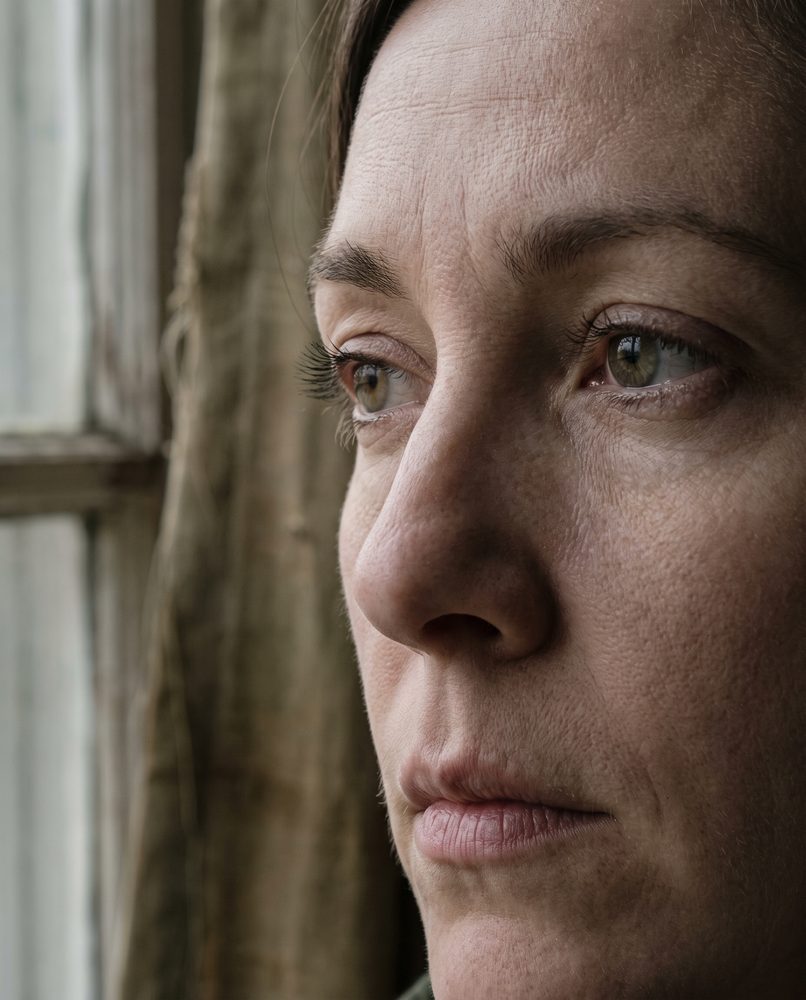
Put a piece of tape on the floor.
Count your steps to it and back. Land on it five times without looking down. Then do it again while saying your lines out loud.
Ten minutes, no equipment, and it removes the single most common way a stage-trained actor embarrasses themselves on a first film job.
The technical side of the tape