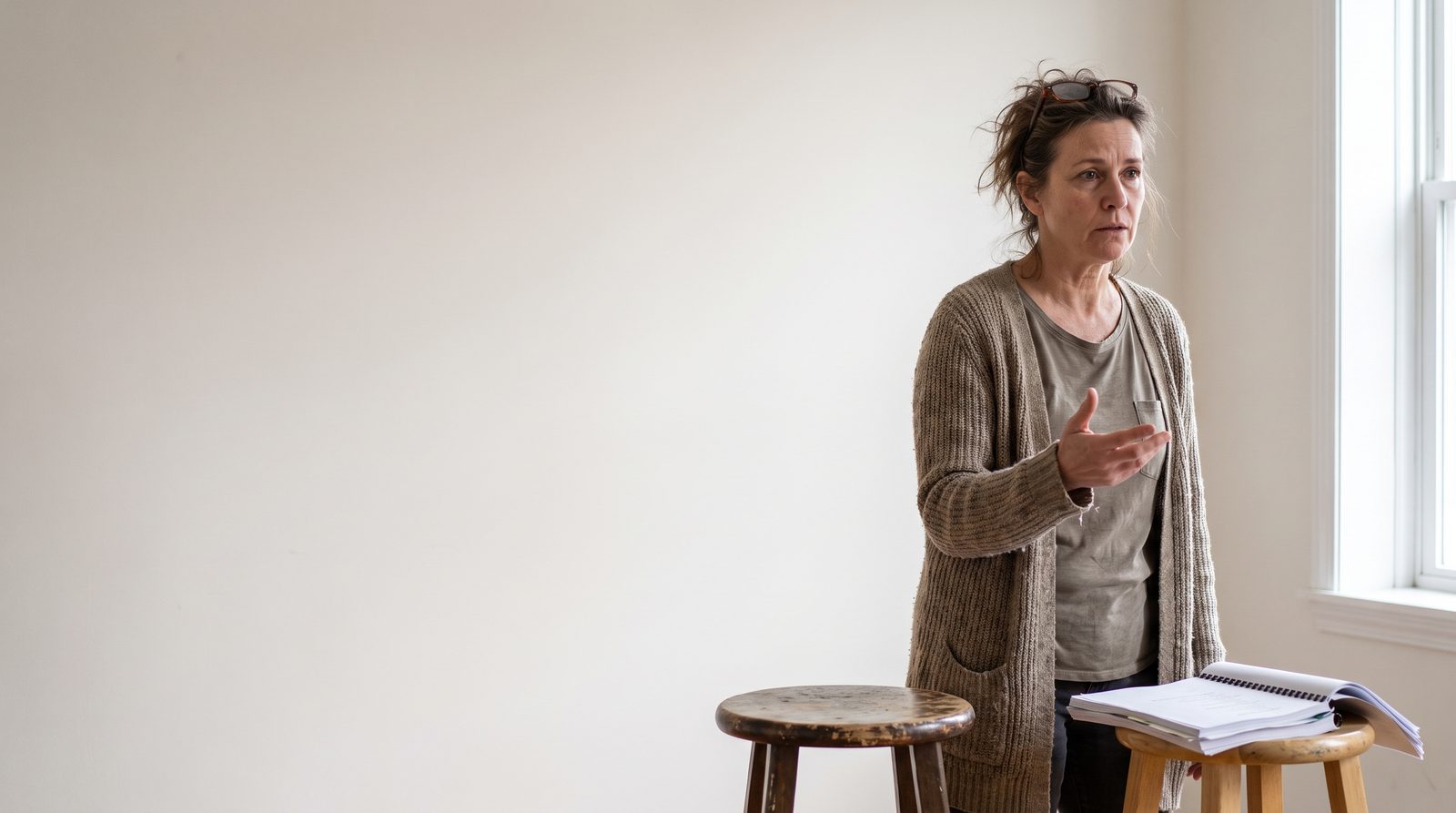
Replace the list with the question
Six answers, and every technique you have heard of is one of them.
Strip away the vocabulary and the schools stop competing and start dividing up a problem. Here is the map. Every page you will read on this subject is somewhere in this table.
The previous chapter found four independent fields agreeing that acting is attention directed outward. Now read the table again.
The techniques that put the impulse outside the actor — the partner, the body, the task, the social meaning — sit comfortably with that evidence. The one that puts it inside is the one the field has spent a hundred years arguing about. That is not a coincidence, and it is worth holding onto for the rest of this chapter.
Why all the famous names cluster
Almost everything modern comes from one Russian.
Konstantin Stanislavski, at the Moscow Art Theatre, is the root of essentially every Western technique on the map. His system reached America with the theatre’s tour, and was then interpreted — differently, and incompatibly — by three of his students’ students.
Short, because the map is doing the work
What each one actually asks you to do.
Read each of these with its row on the map in mind. The question is never “is this good” — it is “where is this asking the impulse to come from”.
The pattern nobody names
For a century, the founders kept walking away from personal memory.
This is the most useful thing on the page and you will not find it assembled anywhere else. Four separate people, four separate decades, all moving in the same direction — and one of them was moving away from her own technique.
“Is there a technique for someone who does not want to dig around in their own emotions?” It gets asked as though it were a request for the easy option.
It is not. It is the direction the field itself travelled. Adler, Meisner, Chekhov, late Hagen, late Stanislavski and the whole of Practical Aesthetics are all answers to it. Somebody who does not want to use their own pain is not opting out of serious training — they are standing in a mainstream, century-old lineage.
The alternative, and where it came from
The major Western alternative began with an essay about Chinese acting.
Brecht is usually filed as the political one, taught next to Stanislavski as the opposite corner. What almost nobody mentions is where his idea actually came from.
1936
“Alienation Effects in Chinese Acting”
That is the title of the essay in which Brecht first used the term Verfremdungseffekt. The counter-tradition to Western psychological realism was arrived at by watching Chinese opera — which is a far better answer to “are there non-Western acting techniques” than a paragraph appended at the end about Noh and Kathakali.
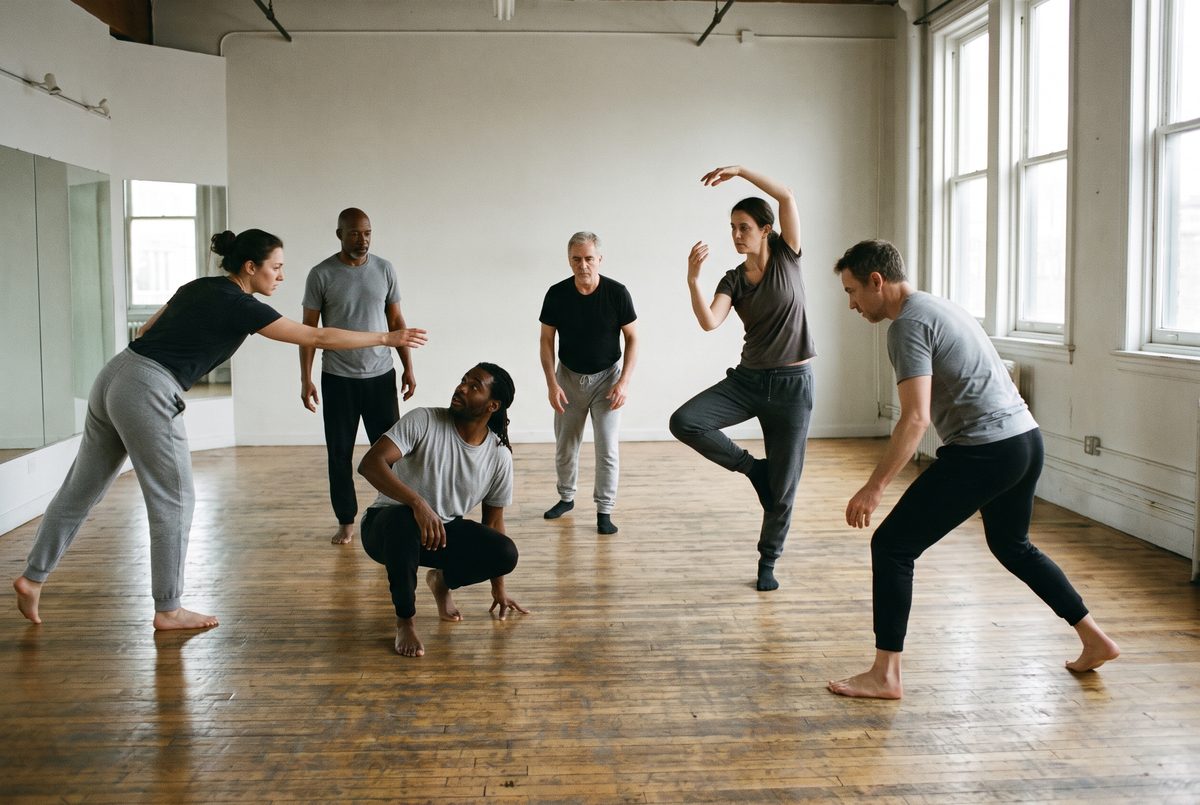
The “impulse from the body” row, in a room. Chekhov, Laban, Viewpoints and Suzuki all live here.
What Brecht wanted was performance in which the audience is hindered from simply identifying itself with the characters, so that accepting or rejecting what a character does happens on a conscious plane rather than in the subconscious. That is epic theatre: a provocation to thought rather than a bath of feeling. The devices are familiar once named — placards, direct address, narration, montage, historicisation, split roles.
Brecht asked actors to perform physical gestures and attitudes that reveal a character’s social relations and their position in the world. Not body language for its own sake — making the social meaning of the behaviour visible.
And here is a claim of our own: that is quietly useful for screen work. Casting is very often reading exactly that — who is this person in the world, what do they do, where do they sit. Brecht is filed under stage and politics, and half of him belongs in a self-tape.
The question you came with
Which one should you learn?
The guides all say the same thing: study several, they become building blocks, and match the technique to your temperament. That is true and it is not much help when you can afford one class.
A more useful answer
You do not choose a technique. You choose a teacher.
The technique comes attached to the person. And from our acting-classes research: teaching acting is an unlicensed profession, price does not correlate with teaching quality, and the only reliable filter anybody has is auditing the room before you pay.
Which means a brilliant Meisner teacher beats a mediocre Chekhov teacher for a Chekhov-suited actor, every single time. The label on the door is the least informative thing about the class behind it.
Audit what is actually available near you. Judge the teacher, not the school. Learn whatever they teach. And use the map at the top of this page to understand what you are being asked to do and where the impulse is supposed to be coming from.
Do professionals pick one?
No. And nothing is locked out.
This is the anxiety underneath most of the question, so here is the plain version: most working actors blend techniques depending on the role, and training in one does not close any door.
On film specifically, a common combination is Meisner listening with Hagen realism — one keeps you responsive, the other keeps the behaviour detailed under technical constraints. Chekhov’s technique is described as having been studied by Anthony Hopkins, Robert De Niro and Meryl Streep, actors routinely associated with entirely different approaches, which rather makes the point.
We found no evidence that any technique produces better actors than any other. None. If somebody tells you otherwise they are selling a class.
What techniques give you is a repeatable route to the impulse — something to do on a Tuesday when it is not happening by itself. That is not a small thing. It is most of what training is. But choosing correctly does not determine a career, and a page implying it does would be inventing a certainty the field does not have.
This site has a view, and here is the argument for it
Which of them survive a self-tape?
A tape has no audience, no adjustment and often nothing but a reader beside a lens. That is a hard test, and the techniques do not all pass it equally.
The honest state of the evidence
Where the field genuinely disagrees.
Should emotion come from your own life?
YesStrasberg, and Hagen’s early substitution.
NoLate Stanislavski, Adler, Meisner, Chekhov and late Hagen all moved away from it.
Should the audience be absorbed?
CompletelyStanislavski: total absorption in the fiction is the goal.
NoBrecht: that merely produces escapism. Identification should be hindered.
Is there a best technique?
ImpliedEvery school implies its own, and every school sells classes.
No evidenceWe found none that any produces better actors. Professionals blend.
Is the technique the thing to choose?
The premiseOf every “which acting technique” article ever written.
Our viewYou choose a teacher, and the technique comes attached to them.
Are movement systems acting techniques?
Listed as suchLaban, Suzuki and Viewpoints appear on every practitioner list.
Different questionThey train the instrument. They overlap with Chekhov but answer something else.
Is the canon Western?
Presented asA Russian-to-American lineage, self-contained.
Not quiteIts most influential dissent begins with an essay on Chinese acting.

Play the same speech twice.
Once with the impulse coming from a memory. Once with it coming from the other person’s face. Film both. You will learn more from that in ten minutes than from another article listing fifteen techniques.
Then find a good room, learn whatever they teach, and use the map to understand what you are being asked for.
How to judge a class