
Stage fright does not wear off, and that is better news than it sounds
Most advice about nerves assumes you will grow out of them. Somebody actually measured that in professional actors, and the assumption did not hold.
In 2014, Goodman and Kaufman surveyed 151 elite working actors — union members with Broadway, television and film credits. They were looking for what predicts stage fright in people who have already made it.
It was not age. It was not years of experience, and it was not how successful the actor was. Those associations, which everyone assumes, were not what the data showed.
What predicted stage fright was lower emotional stability and an external locus of control — that is, the sense that what happens to you is decided by things outside your control.
Related reporting on the same study noted that more than eight in ten professional actors reported experiencing stage fright at least once.
Read the second finding carefully, because it is the useful one. The strongest predictor was a feeling about control, which is a thing that can be changed in the next minute. Not a personality you are stuck with, and not a number of years you have to serve.

Three kinds of stillness, and two of them read as absence
Acting writing treats stillness as one thing. The research on how bodies respond to threat separates it into three, and the distinction turns out to be exactly the one actors need.
The framework comes from the defence-response literature, where these states are described precisely. They look alike from outside and they are physiologically different.
That framework is real and it is properly published. The description above is close to the wording used in a 2017 paper in Frontiers in Psychiatry, which draws in turn on two well-regarded reviews of the defence cascade. It is not something an acting teacher invented.
A note about the title of this page
The page is called Stillness That Breathes, and the research we were given said the breath is what physically separates good stillness from frightened stillness. We went looking for that, and it is not there.
The claim was that in freezing, breathing becomes shallow and controlled, as though you were trying not to draw attention to yourself. It is a wonderful sentence. It comes from a psychology blog, and it is an inference rather than a finding.
The markers the published literature actually uses to tell these states apart are heart rate and muscle tone, not breathing pattern. We checked three separate reviews of this literature and none of them lists respiration as the thing that distinguishes attentive stillness from freezing.
Going blank is not a memory failure
This is the most useful thing on the page for anyone who has stood there with nothing in their head, and unlike most of what gets said about it, it is very well established.
Acute stress measurably interferes with memory. This is one of the better-studied areas in stress neuroscience, and a meta-analysis in Psychological Bulletin in 2017 pulled the evidence together across a large number of studies. Stress hormones sharpen some systems while disrupting the hippocampal and prefrontal work that encoding and retrieval depend on.
There is also research on performers specifically, and it names the thing. A 2021 study of 258 pianists examined what actually goes wrong when musicians choke under pressure, and identified failure of memory recall as its own distinct factor — separate from the motor errors that come from feeling rushed.
Forgetting your lines when you are frightened is a physiological consequence rather than a character failure or a sign you did not prepare.
It is also why lines learned purely by rote tend to collapse under pressure while lines learned as responses to a cue hold up. The cue survives when the recall does not.
And the mechanism is genuinely known in performers, not just in laboratories. You are not the only person this happens to, and it is not evidence about your talent.
One useful correction to how freezing gets described. It is not inertness. Human studies show heart-rate slowing during it, along with narrowed visual exploration, and both predicted faster escape responses. Related work found that this state improves the perception of coarse visual features. Freezing is your attention system working extremely hard in the wrong direction.
How to get out of it, in about thirty seconds
The interventions are very small, which is the point. You are not trying to become calm. You are trying to change what the arousal is pointed at.
Deliberate small movement is used clinically to interrupt this state, on the reasoning that it re-engages motor pathways. Nobody in the room can see you doing it.
Longer out than in. Do it because it gives you something concrete to do with thirty seconds, not because one breath will reset your nervous system.
A door handle, a mark on the wall, the reader’s face. This is the move that converts inward scanning into orienting, and it is the one that matters most.
Attention with a direction and a purpose. That is orienting, and it is the state you were trying to reach the whole time.
And the instruction that runs underneath all four steps. Do not try to calm down. Research on reappraising anxiety as excitement found that treating the arousal as fuel beat trying to remove it, and although that work was done on public speaking and karaoke rather than acting, the direction of travel is the useful part. You are not trying to become still. You are trying to change what the stillness is pointed at.
Fidgeting, hands, and the wrong way to fix both
If freeze is one failure, fidgeting is the other. The obvious fix for fidgeting produces the first failure, which is why this needs saying carefully.
The casting director Todd Thaler makes the positive case briefly and well. “Don’t be afraid of ‘doing nothing.’ Stillness in frame can be very powerful”, and he points at Jessica Chastain in Zero Dark Thirty as the example. In a tight frame your hands are usually outside it anyway, so they are for stability rather than expression.
Why a self-tape makes all of this worse
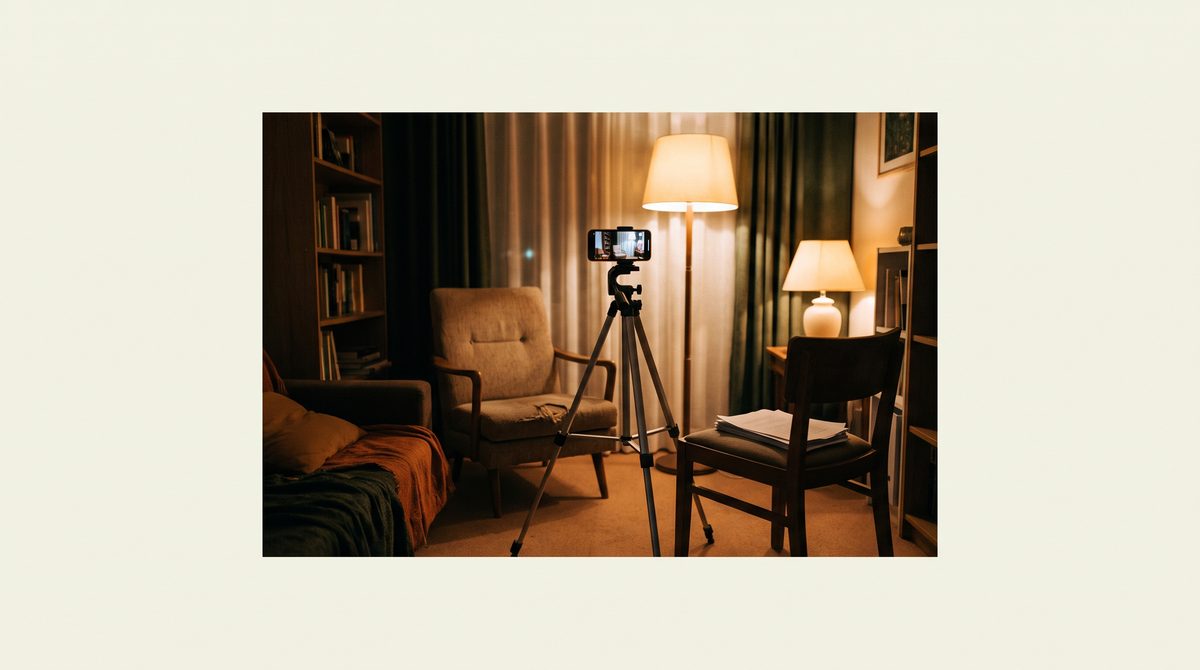
Every condition that produces the wrong stillness is concentrated in a bedroom with a phone in it.
Orienting requires a stimulus. A flat reader, or no reader, removes the thing your attention was supposed to go to, so the state defaults inward.
Chest-up means breath is visible and hands are gone. Everything you would use to discharge the energy is outside the shot.
On a set somebody quietly says take it down. Alone, no one says you have stopped breathing, and you will not feel it from inside.
Repetition without stakes drifts toward the wrong immobility. Cap the takes deliberately rather than grinding until something dies.
A live human beside the lens. It is the highest-leverage variable in a tape, and this page explains why: you cannot orient toward nothing.
A held breath is real human behaviour and fine as a choice. The test is whether you decided to, or whether it simply happened to you.
The diagnostics are free and take one viewing each. Watch a take with the sound off and look only at whether the chest is moving. Then look for the small adjustments. If absolutely nothing has moved for ten seconds, that is suppression rather than attention.
Nerves are not trauma
Most of the physiology on this page comes from research done with people who had been through serious things. Borrowing the mechanism is not the same as borrowing the diagnosis, and we want to be clear about that.
Ordinary audition nerves are not trauma. An actor who goes stiff on “action” is not having a clinical episode, and nothing on this page is a diagnosis of anything. These states sit on a very wide continuum and most actors, most of the time, are near the mild end of it.
The vocabulary is here because it is more precise than what actors usually get offered. “Orienting” and “freezing” tell you what to change. “Try to relax” does not, and it points at the wrong state anyway.
On whether it improves, the honest answer has two halves. The orienting response habituates, which is well established, so a camera does become less novel with exposure. But the study we opened with found that stage fright in professional actors did not track experience. The thing that moved with it was a sense of control, which is why this page is a list of small things you can decide to do rather than a promise about time.
Grading the sources
This page rests on several peer-reviewed papers and a number of clinical blogs. Three claims we were given did not survive checking, and one of them was the mechanism in the title.
One more thing we softened rather than dropped. The claim that stillness reads as authority is weaker than it sounds. A large meta-analysis of nonverbal behaviour found that people’s beliefs about which cues signal status are considerably stronger and more consistent than the actual measured relationships. So stillness is widely read as authority, which is what matters for an audience, but the underlying link is messier than the confident version implies. It is also read differently across cultures, which is worth knowing if you work internationally.
Where we differ from the standard account
Does stage fright fade with experience?
Commonly saidYes. Do enough of them and it goes away.
What we foundIn 151 professional actors it did not track experience, age or success. It tracked how much control they felt.
Is stillness the same as being relaxed?
Commonly saidCalm down and the stillness follows.
What we foundFreezing is not relaxation. Aiming at calm aims at the wrong state, and produces the stillness that reads as withholding.
Is any stillness good stillness?
Commonly saidDo nothing. It is powerful on camera.
What we foundThree distinct states, and two of them read as absence rather than presence.
What tells them apart?
Commonly saidThe breath, and our own research said so too.
What we foundHeart rate and muscle tone are the documented markers. The breath claim came from a blog, and we are not passing it on as science.
Should you suppress small movements?
Commonly saidYes. Fidgeting reads as amateur.
What we foundSmall adjustments toward what you are attending to are the signature of listening. Suppress them and you get rigidity.
Is going blank a memory problem?
Commonly saidYou did not learn it well enough.
What we foundAcute stress measurably impairs encoding and retrieval, and memory failure is a named factor in performer choking research.
How do you fix it in the moment?
Commonly saidBreathe and calm yourself down.
What we foundGive the attention a direction. Reappraising the arousal beats removing it, and the arousal was never the problem.
Try this tonight and it costs you two minutes. Film sixty seconds of yourself listening to someone with no lines at all, then watch it with the sound off and ask only two questions. Is the chest moving, and did anything shift toward the person you were listening to? If the answer to both is no, you were not still. You were holding on.