The one correction that matters
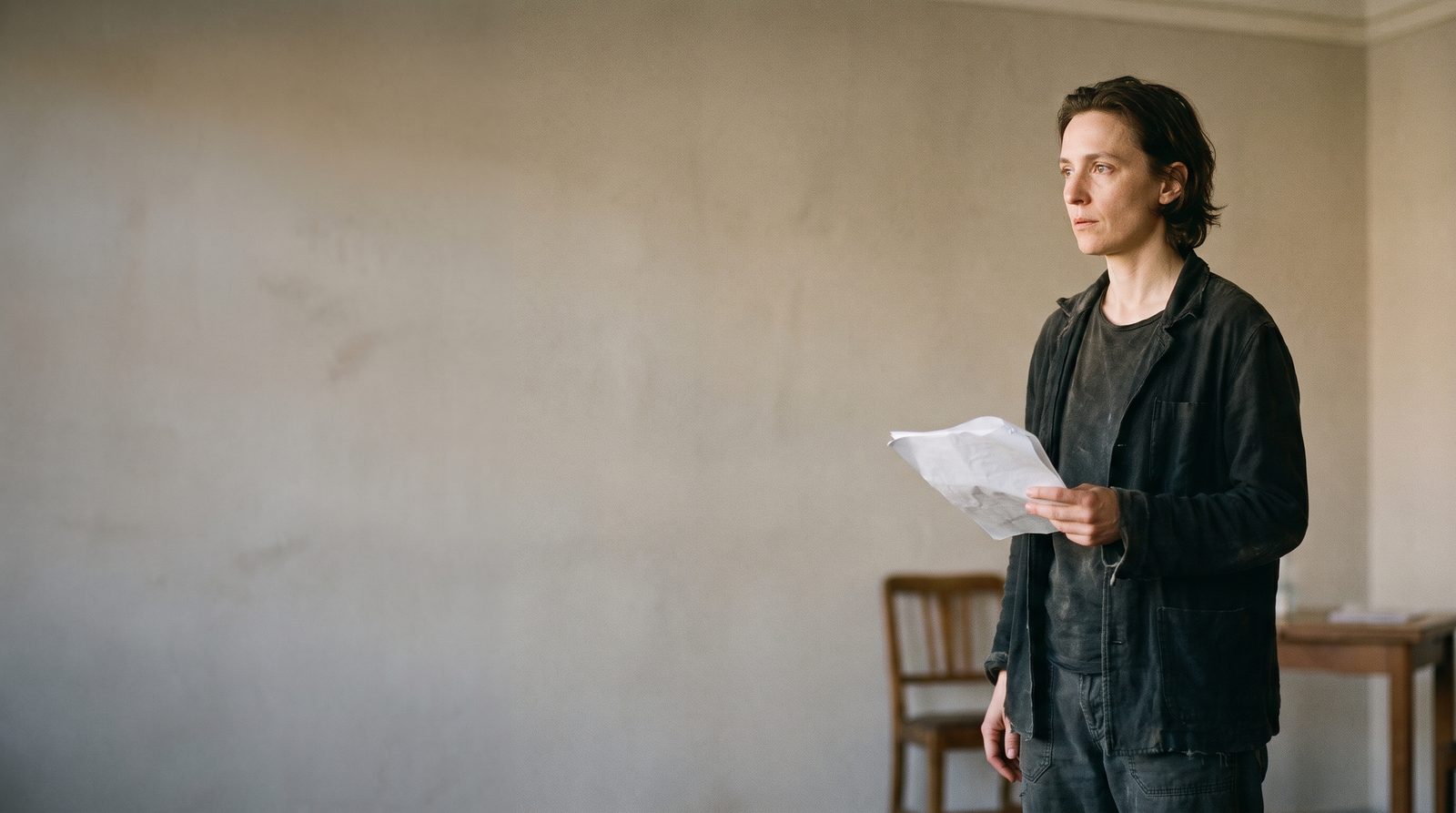
Before anything else, a note on the phrase itself. In the wider world, cold reading means the trick a fake psychic uses to guess things about a stranger. This page is about the other kind: being handed a script you have never seen and having to act it.
Now the correction. The instinct almost everybody has is to read ahead during the other person's lines, getting your own line ready. Then you lift your head to deliver it. It feels efficient. It is the single most damaging thing you can do in a cold read.
The clearest statement of the alternative comes from Seydways Acting Studios, founded in 1991 by Richard Seyd. He trained at the Bristol Old Vic, founded Red Ladder Theatre in Britain, and was Associate Artistic Director at the American Conservatory Theater. His studio's instruction is exact.
The principle is older than the studio blogs it currently lives in. Alice Spivak taught for decades at HB Studio in New York, the school Herbert Berghof and Uta Hagen built. She put it in six words: “Always put your attention on the listener.” And: “Looking and listening is first and foremost.”
One note on vocabulary, because it will save you confusion. Some teachers call this stealing and some call it lifting, and one widely copied page presents “lifting” as a formal named technique. It is not a formal anything. It is a plain description of glancing down, taking a phrase, and looking up.
Why it works, which nobody in acting seems to have noticed
This next part is our own connection between two bodies of work that have never been introduced to each other. We think it is right, and we want to be clear that it is ours rather than something the industry has established.
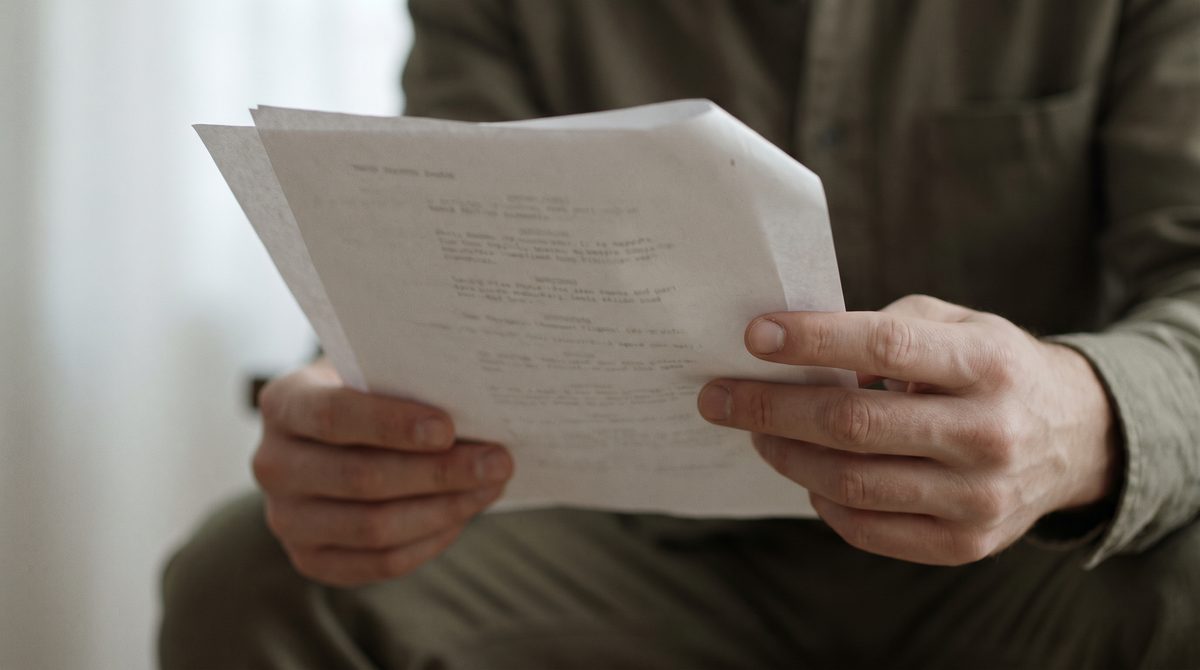
Reading researchers have a name for the gap between where your eyes are and what your mouth is saying. It is called the eye‑voice span, and it has been measured since 1920. That year Guy Buswell found that college-age readers ran about fifteen letters — two to three words — ahead of their own voice.
At the moment your eye lands on a word, it is running 16.2 letters ahead of your voice, which is about 561 milliseconds. By the time the eye leaves that spot the gap has closed to 9.7 letters, roughly 254 milliseconds.
And the finding that matters most for an actor: readers actively regulate that gap. When it grows too large they slow a fixation down or flick the eye backwards to recover. The buffer is not passive. It is managed.
Put that beside the technique and the technique stops looking like a trick. You are already holding a buffer of two or three words that you have seen and not yet said. Stealing a line is simply making that buffer bigger on purpose, and spending the borrowed time looking at another human being instead of at paper.
The honest limits. Nobody has studied actors doing this. No researcher has looked at reading aloud while holding eye contact with a camera or a scene partner. The eye-voice span work is all laboratory reading from a page. We think the connection is sound and useful. We are not going to pretend somebody has proved it.
There is a second thing the research explains, though, and this one is better established. Actors who go flat and monotone in a cold read almost always describe the same experience: they were concentrating hard on reading accurately. That is attention turned inward, onto your own performance, and the motor-learning literature is unambiguous that internal focus degrades what you do. The fix is not to read better. It is to have somebody to talk to.
When it actually happens, and why it is usually good news
Cold reading is not the first hurdle. Look at the list of situations where it turns up and one thing they share becomes obvious.
Almost every one of those is a situation where they already want you, or the production is under strain. A cold read is rarely a filter. It is usually a sign of interest or of chaos, and knowing that should take some of the fear out of it.
On how long you get, the honest answer is that the published figures are all over the place and none of them is a survey. Charlie Sandlan, who co-founded the Maggie Flanigan Studio in New York, says ten to fifteen minutes, “though some auditions allow only seconds.” Others say five to ten. One says thirty seconds to twenty minutes. Plan for five and be delighted by more.
What they are buying with it is not a reading test. They are finding out how you think on your feet. How fast you can decide, and whether you can take a note under pressure. A cold read is a directability test with the preparation removed, which is why casting people value it considerably more than actors do.
How to hold the pages
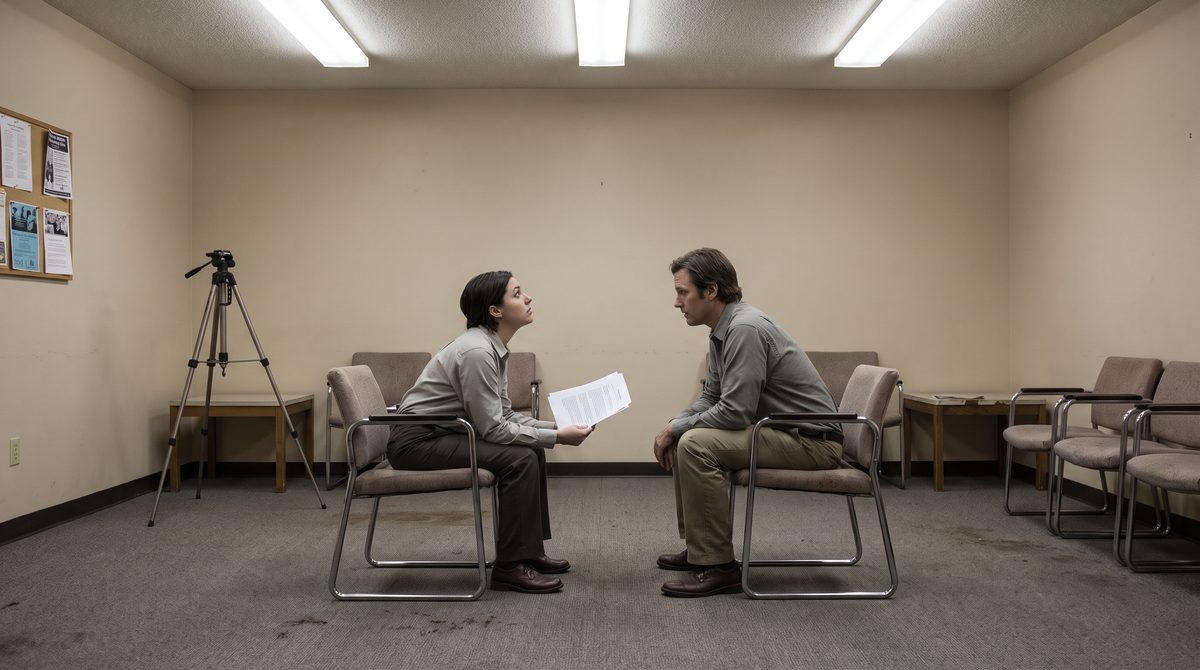
This is the most consistent material in the whole subject, which is unusual. Matt Newton, a Los Angeles acting coach, gives the version most often quoted.
High enough that your face stays visible to the camera or the room, low enough not to block it. Not in your lap, and not down by your side.
Newton's warning is the memorable one: avoid “the famous two-handed, desperate, white knuckle ‘I'm gonna win an Oscar!’ death grip”. If you are right-handed, hold the pages in your left and leave your strong hand free.
Do not rustle, wave or roll them. Movement is distracting, and it wrecks your hand-eye coordination so you lose your place more often.
Track down the right-hand edge as the scene moves, so you can look up and come back without hunting.
Newton again: “a small fold at the corner of the page so you can easily flip it without disruption.” A five-second hunt for your place kills the scene. A fold takes two.
Newton suggests spending one of your few minutes on exactly this, “to allow yourself a strong eye contact-filled delivery”. The first line sets the impression and the last one resolves it. Neither should be delivered into paper.
One choice, and make it a specific one
The second most common failure has nothing to do with reading. It is hedging, and the argument against it is the best-made point in this whole subject.
Most actors go into a cold read trying to discover the character as they go. Tentative, careful, waiting for the script to tell them who this is. The result is general competence with no point of view, delivered in the hope that vagueness is safer than a wrong choice.
Topher Keene, an American acting and voice coach, puts the counter-argument in five words. “Vagueness is the worst choice you can make.” Casting directors have seen vagueness ten thousand times this month. They will remember a specific, committed, slightly odd choice even when they decide it is wrong for the part. At least there was something there to react to.
The choice can be tiny and it works better when it is. “This person doesn't believe what they are saying.” That is enough to organise an entire scene, and it takes about four seconds to decide. Keene's own framing of the skill is worth carrying too: “The actors who excel at cold reading aren't naturally gifted. They've trained a specific muscle.”
When it goes wrong, which it will
This is the fear that brings most people to this page, so here is the reframe first. Cold reading is not a reading skill. It is a nerve skill.
The disaster pattern is specific and it is not the stumble. It is what comes after. An actor trips on a word, stops, apologises, and starts the line again. That breaks the scene completely. It also tells the room something far worse than a mispronunciation would have, which is that you cannot hold your nerve when something goes wrong.
What the union actually protects
This gets repeated inaccurately almost everywhere, including in the brief we were working from, so here is what the contract says and what it does not. Then the part that changed this summer.
The 2023 SAG‑AFTRA television and theatrical agreement contains identical language in two places. For self-tapes, at section 47.D.(3), and for virtual interviews, at 47.E.(3): “Performers may not be asked to memorize any materials nor be prohibited from holding sides and/or using a prompting device.”
Under the 2023 agreement, at 47.D.(11), any performer invited to self-tape could ask to be seen live instead. The producer had to provide a window of time for performers to interview on a first-come, first-served basis. That was a broad right and it sunset on 30 June 2026.
The agreement that replaced it is narrower on both counts. It now requires producers to “make a good faith attempt to accommodate” a request, rather than to guarantee it. And it applies only when casting series regulars, recurring roles, Major Role Performers, Modified Deal Performers and Modified Guest Performers. Directions for requesting one appear in the self-tape request itself.
So the honest position as of now: ask for a live read, because for the bigger roles the producer is obliged to try. But a broad entitlement for everyone invited to tape is not what the contract says any more.
One more honest finding. Neither SAG‑AFTRA nor Equity has contract language that addresses cold reads as such. There is nothing about how much time you must be given, or whether sides must arrive in advance of an in-person read. What the unions regulate is page counts, turnaround windows and whether you may hold the paper. The cold read itself is unlegislated.
If you are British, you may know this by another name
The vocabulary here splits, and the split is less tidy than we expected.
And it is not informal. LAMDA uses it in its own graded examination syllabus, where sight-reading a text is a named component of the Reading for Performance exam.
Spotlight uses the American phrase in its own advice pages, and so does Backstage's UK edition. The two terms now run alongside each other.
Backstage UK is direct about it: you may be asked to read a scene on the day that is different from the sides you were sent.
RADA, LAMDA and Central entrance auditions run on prepared speeches, not cold reads. Do not confuse the entrance audition with the exam board's sight-reading test.
The Casting Directors' Guild code says no actor should be asked to learn more than six pages for a first self-tape, with three to six days to do it.
No named British casting director on the record about cold reads specifically. Plenty about self-tapes. Nothing about this. If you know of one, tell us.
How to practise it, including the odd one
This is a trainable mechanical skill and almost nobody trains it, which is why so few actors are good at it. Two of these cost nothing.
Start with the person who has taught this longer than anyone. Margie Haber has run cold reading workshops in Los Angeles since the late 1980s. Her clients have included Brad Pitt, Halle Berry, Vince Vaughn and Téa Leoni. Heather Locklear wrote the foreword to her 1999 book. Her method breaks a scene into phrases so an actor can work from the page without stumbling over it. It exists because she noticed the same thing this page is about. The problem is not the words. It is what the words do to your attention.
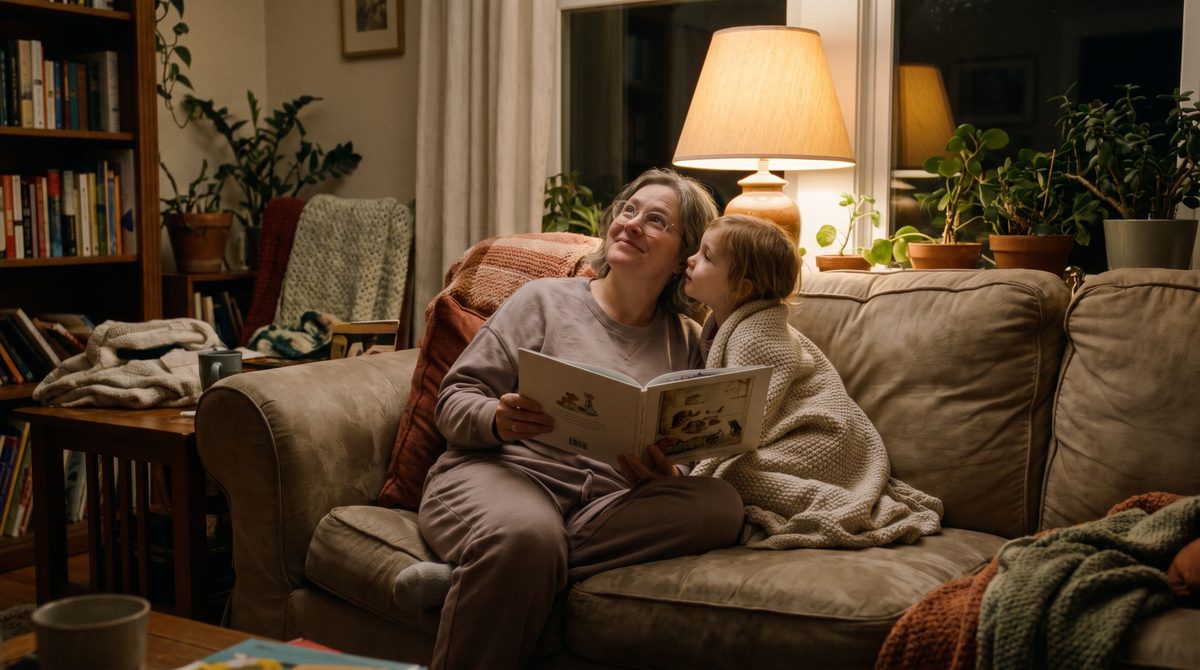
Alice Spivak, of HB Studio in New York: “Reading bedtime stories to children is an especially good exercise, since you're inspired to make the story as real to them as possible.”
It sounds like a joke and it is not. Reading to a child demands the exact thing an audition demands — taking words in off a page and giving them out to someone who is watching your face. You cannot cheat it, because a child who is bored will tell you immediately. That makes them the most honest feedback available anywhere in this industry.
Do not read ahead. That is the entire point, and it is the step people skip.
Read it once for what happens, learn the first and last lines, and decide one thing about who this person is. Then stop.
A partner, a phone camera, or a child. Steal only during your own lines and keep your eyes available through every one of theirs.
Then keep going without acknowledging it. This is the actual skill, and it is the one nobody rehearses because rehearsing failure feels strange.
You are looking for one thing only: the moments you left. Adjust the eye journey, not your acting.
Do that once a week and it becomes automatic, which is the point. Under audition nerves you will not be able to think about technique at all, so the technique has to already be in your body. That is true of every physical skill and it is especially true of this one.
Grading the sources
This subject has a source-quality problem worse than any other chapter we have written. One finding here is serious enough that we are going to spell it out. This takes our running count of claims tracing to a blog, a forum or marketing copy to forty.
Two things worth saying plainly about all that. The first is that the underlying advice on this subject is unusually consistent, and it survives the sourcing problem. The studios with real teachers behind them say the same things as the ones without. The second is less comfortable. Cold reading is a subject where almost every page you will find was assembled by somebody with no standing, increasingly by software. The good material is buried underneath all of it.
One correction to our own working assumption, too. We began by believing no named casting director had spoken on the record about cold reads. That turned out to be wrong. Several have, including commercial casting directors interviewed by Backstage two decades ago. So has Erica Arvold, who has recorded material on it with SAG‑AFTRA itself. The field is thinner than it should be. It is not empty.
Where we differ from the standard account
Where should your eyes be?
Commonly saidRead ahead while they speak, look up for your line.
What we foundBackwards. Steal during your own lines and never during theirs, because their lines are when you are actually being watched.
Is cold reading a reading skill?
Commonly saidSome people are just good at reading aloud.
What we foundIt is a nerve skill and a trainable one. What fails is rarely the reading; it is the reaction to a mistake.
Should you hide the sides?
Commonly saidIt looks unprofessional to be seen reading.
What we foundYou are supposed to be holding them, and for self-tapes and virtual auditions the union agreement says you cannot be stopped.
Can you always ask for a live audition instead of a tape?
Commonly saidSAG-AFTRA guarantees it since 2023.
What we foundNot any more. From July 2026 it is a good-faith attempt, and only for series regulars, recurring and other major-role categories.
Does exact wording matter?
Commonly saidAlways say the line as written.
What we foundIn prepared work, yes. In a cold read the priorities invert: continuity beats accuracy, so paraphrase and keep moving.
Is a careful, neutral read the safe option?
Commonly saidDo not risk a wrong choice on material you have just met.
What we foundA wrong specific choice can be redirected. A vague one gives them nothing to work with, which is worse.
Is a cold read a bad sign?
Commonly saidThey are testing whether you can cope.
What we foundUsually the opposite. Most cold reads happen because somebody wants to see you for something else, or because the production is under pressure.
Find a page of dialogue you have never read, give yourself two minutes, and read it aloud to somebody — looking at the page only while you are the one speaking. That is the whole technique, and ten minutes a week is enough.