
The reframe the rest of the chapter depends on
“Beneath” is the wrong preposition.
The standard definition — what a character means beneath what they say — sounds harmless. It is the source of almost every bad piece of subtext acting you have ever seen.
The word beneath tells an actor there is a hidden layer down there. So the actor goes and gets it, and then faces an impossible second task: displaying a thing that is by definition not said. There is only one way to do that, and you start decorating the line.
Every one of those is an actor commenting on their own character. It is the most common note in every rehearsal room in the world, and the word beneath is what causes it.
Not beneath. Instead of. The line is a strategy, and the subtext is what the strategy is for. A character talking about the weather is not hiding a speech about the weather. They are using the weather — to delay, to deflect, to keep you at a distance, to stop you asking the next question.
That version is playable. “Hidden meaning” is not.
The best account anyone has given
There are two silences, and one of them is very loud.
In 1962 Harold Pinter gave an address to the National Student Drama Festival in Bristol. It was later reprinted as the introduction to his collected plays, and this is the paragraph.
There are two silences. One when no word is spoken. The other when perhaps a torrent of language is being employed. This speech is speaking of a language locked beneath it. That is its continual reference. The speech we hear is an indication of that which we don't hear. It is a necessary avoidance, a violent, sly, anguished or mocking smoke screen which keeps the other in its place. When true silence falls we are still left with echo but are nearer nakedness. One way of looking at speech is to say that it is a constant stratagem to cover nakedness.Harold Pinter, Writing for the Theatre, 1962 — collected in Various Voices, p. 25
Silence one
No word is spoken.
The one everybody already counts. The character refuses, stalls, freezes, or leaves the space open so the other person has to fill it.
Silence two
A torrent of language.
The character will not stop talking. Details, jokes, corrections, anecdotes, the trains, the harvest, the weather. None of it is the subject.
Pinter's word for this is a smoke screen, and he says exactly what it is for: it keeps the other person in their place.
The second silence is the useful half, because nothing marks it in the script. A long speech looks like a character being open. Sometimes it is the opposite, and the length is the evasion.
And he rejects the phrase everyone attaches to his work.
Pinter had spent years being told his plays were about the failure of communication. He disagreed, in print, and the correction matters more than the compliment.
I think that we communicate only too well, in our silence, in what is unsaid, and that what takes place is a continual evasion, desperate rear-guard attempts to keep ourselves to ourselves.Harold Pinter, same address, on the “tired, grimy phrase” fixed to his work
It is not a failure. It is a strategy, and it works. The character is not struggling to express themselves and falling short — they are successfully doing something else, on purpose, and the other person understands.
This also answers a question actors ask a lot: is subtext the same as lying? No. Lying conceals a fact. This conceals a self. The character is not deceiving anyone about the weather.
Confessional or combative.
The director Carey Perloff, then artistic director of San Francisco's American Conservatory Theater, has staged Pinter repeatedly. Her diagnosis of what actors get wrong is the sharpest sentence in the field.
Pinter characters use language to skewer each other. American actors tend to use language confessionally rather than combatively. And nothing in Pinter is confessional.Carey Perloff, interviewed in Backstage, 2001
Perloff's instruction follows from that, and it is the most portable line in this chapter. “You have to know who you're sending every line to, and what its effect is going to be.” Not what the line reveals about you. What it does to them.
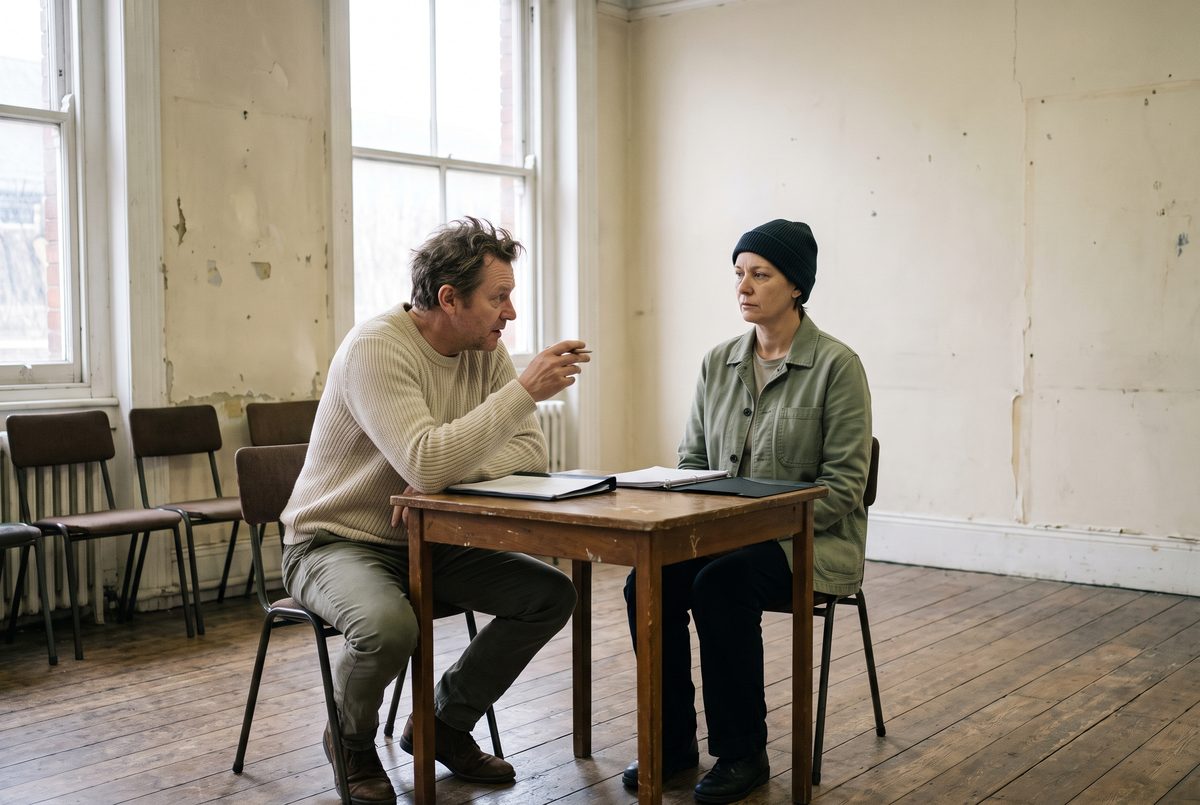
Language as a weapon rather than a window. The listening half of the frame is doing as much work as the talking half.
The section no other page on this subject has
There is a science of not saying what you mean.
Between 1955 and 1987, five people built a precise account of how a sentence carries a meaning it does not contain. None of them were writing about acting. All of them were writing about scenes.
Grice, and the four things we all silently agree to do.
H. P. Grice gave the William James Lectures at Harvard in 1967. The lecture called Logic and Conversation was published in 1975, and it starts from a simple observation. Conversation works because both people assume the other is cooperating, and Grice wrote that assumption down.
Make your conversational contribution such as is required, at the stage at which it occurs, by the accepted purpose or direction of the talk exchange in which you are engaged.H. P. Grice, the Cooperative Principle — Studies in the Way of Words, Harvard University Press, 1989
Underneath it sit four maxims, and they are not rules of etiquette. They are what we assume of each other by default.
And then the part that matters. There are different ways to break one.
Grice separates them, and the separation is the most useful thing on this page. Three of the four are worth knowing by name.
Grice's own word for it is unostentatious — the speaker breaks a maxim and covers the break.
“I'm not going to talk about that.” The speaker steps outside the conversation openly.
The breach is obvious, it is meant to be obvious, and that is the whole design.
He may FLOUT a maxim; that is, he may BLATANTLY fail to fulfill it. … the hearer is faced with a minor problem: How can his saying what he did say be reconciled with the supposition that he is observing the overall CP?H. P. Grice, Logic and Conversation — on how an implicature is generated
Subtext is not hidden. Subtext is blatant on purpose. The character is not concealing the meaning from the other character — they are sending it by a route other than the words, and they expect it to arrive.
Grice makes that a condition: the speaker must think the hearer is able to work it out. Nothing accidental counts.
The example is a job reference, and it is a scene.
Grice's own illustration is four lines long: a philosophy student needs a letter, and his tutor writes one.
Dear Sir, Mr. X's command of English is excellent, and his attendance at tutorials has been regular. Yours, etc.Grice's example of flouting the maxim of Quantity, 1989, p. 33
Then Grice reasons it out, and his reasoning is script analysis. He cannot be opting out, because why write at all? He cannot be unable to say more, because the man is his pupil. He knows more was wanted. So he must want to say something he is reluctant to write down — and only one supposition fits. He thinks the student is no good at philosophy.
Nothing critical was written. Everything critical arrived. That is subtext, described in 1967 by a man who had no interest whatsoever in acting.
The tool you can use tomorrow
Fifteen ways a line can mean something else.
Before the list, one more idea, because it is the cleanest description of what an actor calls text and action.
John Searle published Indirect Speech Acts in 1975 — in the same book as Grice's lecture, in the very next chapter. His claim is that a single sentence performs two acts at once.
In indirect speech acts the speaker communicates to the hearer more than he actually says by way of relying on their mutually shared background information, both linguistic and nonlinguistic, together with the general powers of rationality and inference on the part of the hearer.John Searle, Indirect Speech Acts, 1975 — reprinted in Expression and Meaning
His example takes two lines. One person says let's go to the movies tonight, and the other says I have to study for an exam.
Which is the distinction actors already work with, only stated precisely. The secondary act is what is typed. The primary act is what the character is doing, and it is the one you play.
Now the list.
Penelope Brown and Stephen Levinson were studying politeness, not drama. Their 1987 book sets out the strategies people use when they want to do something socially risky without going on record about it. They found fifteen, and here is the elegant part: they organised them under Grice's four maxims. Going off the record just is flouting a maxim, sorted by which one gets flouted.
- 1Give hints. Raise something adjacent and stop.
- 2Give association clues. Mention what is connected to the thing, never the thing.
- 3Presuppose. Bury the claim inside a sentence that is about something else.
- 4Understate. “It was fine.” The size of the gap is the message.
- 5Overstate. Too big, too warm, too emphatic to be meant.
- 6Use tautologies. “Boys will be boys.” Literally empty, and never empty.
- 7Use contradictions. Two things that cannot both stand.
- 8Be ironic. The oldest one, and the one actors overplay most.
- 9Use metaphors. Literally false. That is what makes them carry.
- 10Use rhetorical questions. A demand wearing a question mark.
- 11Be ambiguous. Two readings, both available, neither chosen.
- 12Be vague. “Someone.” “A while ago.” “Things.”
- 13Over-generalise. A rule about everyone, aimed at one person.
- 14Displace the hearer. Say it to the wrong person, so the right one hears it.
- 15Be incomplete. Ellipsis. Stop the sentence before the dangerous half.
Number fourteen deserves its own sentence, because it is every dinner-table scene ever written. You address the remark to your sister. It is for your husband. Nobody at the table is confused, and nothing can be proved.
It replaces a useless note with a usable one. “There's subtext here” becomes “she is using a rhetorical question to make a request she can deny making.”
Take a scene and go through it line by line. Most oblique lines will match one of the fifteen. The ones that match nothing are usually the lines that mean exactly what they say — which is useful information too.
Brown and Levinson also list a strategy the acting tradition never quite counts. Do not perform the act at all — the swerve, the change of subject, the thing left unsaid. It is not a failure to speak. It is a move, sitting in the model alongside the other four.
Where subtext will be dense, and where it will not
Three dials predict how indirect a scene will be.
This is the part that turns theory into a reading of a script. But it starts with one more idea, and it is the oldest of the five.
In 1955 the sociologist Erving Goffman published an essay called On Face-Work. His definition of face is the one everyone has used since.
The term face may be defined as the positive social value a person effectively claims for himself by the line others assume he has taken during a particular contact.Erving Goffman, On Face-Work, 1955 — collected in Interaction Ritual, 1967, p. 5
Read the important part slowly. Face is a claim, made in public, that other people have to accept. It is not self-esteem and it is not private. A character can lose face without changing their opinion of themselves at all, which is exactly why it makes a scene.
Brown and Levinson split it in two, and the two halves pull against each other.
Most acts worth putting in a play threaten one or the other. Requests, refusals, criticisms, confessions, apologies, offers, even compliments. Brown and Levinson call them face-threatening acts, and the bigger the threat, the more indirect the speaker goes.
And they wrote down how the size is calculated.
Three factors, added together. It is a model rather than a measurement, but it turns the dial in a direction you can read off a page.
Distance. Roughly the inverse of familiarity, so strangers go indirect and intimates should be blunter.
Power. And note the direction — it is the hearer's power over the speaker that counts.
The size of the ask — how big an imposition this particular act is, here, in this world.
The distance dial has a second use, and it runs the way people do not expect. If a scene between two intimates is thick with indirection, the model says something has spiked. Either the ask has become enormous, or they have somehow become strangers. That is the event of the scene, and you have just found it by reading the language rather than guessing at feelings.
None of that damages the fifteen strategies or Grice's flouting. It does mean this is a model with contested reach, most safely applied to the Anglophone drama you are likely to be auditioning for. We are presenting it as a way to read a script, not as a law of human behaviour.
The practical payload
Six ways to find it without inventing it.
The unproductive question is what is he really thinking?, because you can answer that with anything. The productive one is narrower.
Every word in that sentence is load-bearing. It keeps you tied to the scene the writer built, and it is very hard to answer with private invention.
Look for the mismatch
Where do the words and the situation fail to fit? Somebody discussing the trains during a catastrophe is the classic tell. In Grice's terms you are hunting for a flout — a line that is obviously too little, untrue, irrelevant or obscure.
Ask what is being avoided
Pinter's version of the question. If this harmless line vanished, what would have to be said instead? Name that sentence, because it is usually the thing the scene is about.
Find the target and the effect
Perloff's instruction, and it is not optional. Who is this line being sent to, and what is it meant to do to them? A line with no target is a line being played confessionally.
Price the true thing
What would it cost this character to say it straight — shame, rejection, the job, the marriage, safety? No cost, no subtext. High cost, and the whole scene bends around it.
Mark every change of subject
Subject changes are where the pressure got in. Somebody has just been made uncomfortable, and the swerve is the evidence, so circle them before you do anything else.
Check both silences
The printed pauses, and the speeches that will not end. Then run the three dials. Distance, power, size of the ask — and see whether the indirection in the writing matches what they predict.
Two tests keep the answers honest, and both are quick.
That second one deserves defending, because nobody says it. Subtext is not evenly distributed across drama. It is dense in Chekhov, in Ibsen, in Pinter and in most naturalistic screen writing. It behaves quite differently in farce, in Brecht, in soap and in verse, where speed, clarity and direct address are the point. A line that means what it says is not a failure of writing, and it is not your job to fix it.
The paradox everybody gets stuck on
How do you play the thing you do not say? You don't.
This is the question that stops people, and most teaching answers it with a shrug. The answer is actually simple, and it is slightly disappointing.
Which means the most common failure is not underplaying. It is illustrating — producing behaviour whose purpose is to tell the audience that something is underneath.
And the playwright agrees, which is the surprising part.
Pinter directed the actor Lawrence Pressman in the late 1960s. The note he gave him is the opposite of what the word subtext implies.
Emphasise certain words in the speech, Pinter told him, and do not worry about the meaning. Do that, and you find yourself using speech “as a weapon, a cover, a wooing device, a beating of a fist upon a door.” The man who wrote the most famously subtextual dialogue in English told an actor to play the surface.
Do you think it, or say it differently?
Both, and the order is what matters. You think something different underneath so that the words come out differently, and not the reverse. The moment you begin arranging the delivery to signal the meaning, you are illustrating, and the audience can always hear it.
The strongest cases are the flat contradictions, like “I'm fine” from somebody who plainly is not. But notice what carries that: the circumstances carry it, not the delivery. Played knowingly, it becomes a wink.
How do you know your reading is right?
You do not, and you do not need to. Subtext is not a puzzle with a solution the writer hid and marked. It is a space the writer left. The test is whether your reading is supported by the text and produces behaviour worth watching. Two actors can play the same scene differently and both be right.
Getting it onto paper
One line per beat, and it must be something you do.
Long inner biographies pull your attention away from the scene — which is the exact failure the critics of this whole approach are aiming at, and they are not wrong about it.
Phrase every note as what I am doing instead of saying it. Then apply the test from the previous chapter: if you can delete the note and the scene plays identically, it was not subtext. It was commentary.
The rehearsal exercise worth stealing.
Speak the unspoken thought out loud. Run the scene and narrate the character's actual train of thought between the lines, aloud, in front of somebody. It is an old Stanislavski-tradition staple and it does two things quickly. It exposes the beats where you have no idea what is happening. And it shows you the moments where your narration contradicts what your body is doing, which is usually where the scene lives.
It is a rehearsal-room tool and never a performance mode. You narrate to find it, and everything in this chapter says the finished work should contain no trace of the search.
The site's angle
The close-up is the medium subtext was waiting for.
And it is also the medium in which indicating is most punished. Both facts come from the same property of the lens.
On stage, subtext has to be inferable from twenty metres. It travels through action, rhythm and the shape of the scene, because the audience cannot see a flicker. On camera they can see everything. That is why screen writing can be far more elliptical than stage writing, and why “I'm fine” can carry an entire film.
Casting sees your face at a size no theatre audience has ever seen it. So the temptation to help the subtext along is stronger, and the penalty for doing it is higher. Let the thought affect you. Do not demonstrate that it affected you.
Three pages of sides, and no script.
You often cannot know what the writer buried, because you have not been given the story, but three things still work.
That last one is worth more than the other two combined. Casting says repeatedly that what they are watching is whether you are actually listening. Less context means less evidence — not unlimited permission to invent.
Where the idea came from
Subtext was a tool built for a specific problem, and the problem was Chekhov.
This matters practically, because it explains why the technique does not apply evenly to everything you will ever be cast in.
Chekhov created a difficulty that had not existed before. His characters talk at length about the weather, the harvest, the trains and the price of things, while the actual event of the scene goes entirely unspoken. The acting vocabulary of the day — declaim the line, express the sentiment — produced nonsense on that material.
Chekhov also refused to explain his own texts, which forced Stanislavski to develop ways of playing what is not said. That is the honest version of the origin story, and it is a claim about practice.
What Stanislavski actually wrote about it.
The verified material is narrower than the popular version, and more useful. From An Actor's Work, in the chapter on voice and speech.
There should be no soulless, emotionless words in the theatre. Neither should there be unthinking, actionless words. … This means that the words, the dialogue, aren't valuable in and for themselves but for their content, their subtext.Konstantin Stanislavski, An Actor's Work, trans. Jean Benedetti, Routledge 2008, p. 402
And then the part almost nobody quotes, which is a direct rebuke to how most actors work on a speech. Stanislavski separates logical pauses — the grammatical ones that divide a text into speech bars — from psychological pauses. He is emphatic about the order.
Work on speech and words must always start with dividing up into speech bars, or, in other words, placing the logical pauses. Until you've done that it is pointless your undertaking … communicating the illustrated Subtext of a speech.Stanislavski, An Actor's Work, p. 413
Putting meaningful pauses into a speech before you have worked out the plain sense of the sentences is the single most common way actors go wrong on text. Stanislavski says it is pointless, and he says it in that order for a reason.
Note his own phrase in passing: the illustrated Subtext. Even the man the whole tradition rests on treats it as something the words illustrate rather than something you perform.
If you have seen that sentence attributed to Stanislavski, that is where it came from. The two quotations above are the real thing, and the page numbers are from the Benedetti translation.
The case against, stated properly
The strongest objection is aimed at something real.
A serious body of opinion says this entire apparatus is a mistake. It deserves a fair hearing rather than a straw man, and the loudest voice in it is David Mamet.
True and False: Heresy and Common Sense for the Actor came out in 1997, and it is short and furious. The position, in his words.
His practical instruction is four things: learn the lines, find your mark, look the other person in the eye, and say the words simply. Everything else, in his view, is an academic bluff designed to keep actors uncertain and paying tuition.
What he attacks is the psychological apparatus actors build in order to play subtext: emotion memory, character biography, the imagined inner life. That is a genuine and citable position, and it is a real warning. But it is not an argument that subtext does not exist, and we are not going to present it as one.
One related trap, since it catches people: A Practical Handbook for the Actor, which does take a hard line against this kind of work, was not written by Mamet. It is by six of his students. He contributed a preface.
And the two sides agree about more than they think.
Read carefully, the argument is not about whether people mean more than they say, because nobody disputes that. It is about whether the actor should be constructing anything.
There is a pleasing irony in it as well. Mamet's own plays are among the most subtext-dense in modern drama; Glengarry Glen Ross is almost entirely people not saying the thing. He did not remove subtext from drama. He wrote a great deal of it, and then told actors not to add any more.
Where the sources genuinely disagree
The contradictions, laid out.
Six real disputes, and we have taken a position on each, with the reasoning set out above.
Is it hidden?
The traditionSubtext is the concealed meaning under the line, and the actor's task is to uncover it.
GriceA flout is blatant by definition. The speaker expects the hearer to work it out, and concealment is a different act entirely, whose name is lying.
Is it a failure to communicate?
The standard readingChekhov and Pinter dramatise people who cannot say what they mean.
Pinter, emphatically“We communicate only too well.” The evasion succeeds. It is a strategy, not a shortfall.
Should the actor construct it?
Stanislavski's lineIt is what the actor must infer beyond what the playwright has provided.
MametInvent nothing. Characterisation is the author's job. Note that he is attacking the apparatus, not the concept.
Do you play the subtext?
The name implies you doAnd most training talks as though the hidden layer is something you perform.
Pinter, directingEmphasise the words and do not worry about the meaning. Play the surface and let the speech become a weapon.
Is it everywhere?
Taught as universalA feature of all good writing, and a tax every line must pay.
In practiceDense in Chekhov, Ibsen, Pinter and screen naturalism. Sparse in farce, soap, Brecht and verse, where some characters simply mean it.
What about the pauses?
The signature moveWeighted silences are what subtext acting looks and sounds like.
StanislavskiDo the logical pauses first, because until the grammar is sorted, working on the subtext is pointless.

Take one scene and mark the flouts.
Go through it line by line. Circle every line that is obviously too short, untrue, off the subject or unclear — obviously enough that the other character is meant to notice.
Then name each one from the list of fifteen. You will have found the subtext of the scene in about ten minutes, and you will not have invented a word of it.
Given circumstances