
How one book became two, and why it matters
Almost everything actors believe about Stanislavski comes from an accident of publishing, and once you know it a lot of confusing arguments stop being confusing.
He wrote a single volume about the actor's work on themselves, in which the first part dealt with the inner work and the second with the physical. He intended them to be read together, as one continuous training.
That is not how they arrived in English at all.
- 1930sWorking on a single volume on the actor's work on themselves, inner and physical parts together.
- 1934–38Develops the Method of Physical Actions, working from the body toward feeling, and moves away from emotion memory.
- 1938Dies, with the whole work unpublished in Russian.
- 1948Part two finally appears in Russian, ten years after his death.
- 1936An Actor Prepares. The inner half, published alone and read as the whole system.
- 1930s–40sStrasberg builds the American Method with only that half available to him.
- 1949Building a Character. The physical half, delayed by the war, arrives long after the Method has set.
- 2008Jean Benedetti reunites both halves in one volume, An Actor's Work, as intended.

This is not a conspiracy and nobody hid anything. Both halves have been available for seventy-five years. But the first half arrived first, it arrived alone, and it arrived in the country that would go on to export acting training to the world.
In every physical action there is something psychological, and in the psychological, something physical.Stanislavski, quoted by Sharon Marie Carnicke, who argues he was never the inside-out theorist the American tradition made him
What is in the half you were not taught
Having said all that, the second half is still the part almost nobody reads, and it is full of things an actor can use tomorrow.
Here are its sixteen chapters in Hapgood's 1949 translation. Read the list slowly, because the emphasis is not what you would expect from the man who is supposed to have invented inside-out acting.
The book opens with a student saying exactly what a lot of readers of this page are thinking. He understands the inner work in principle, but not how to turn it into something an audience can see.
If you do not use your body, your voice, a manner of speaking, walking, moving, if you do not find a form of characterization which corresponds to the image, you probably cannot convey to others its inner, living spirit.Kostya, the student narrator, in Stanislavski's Building a Character, trans. Elizabeth Reynolds Hapgood, ch. I
The teacher agrees with him, and his reply is the sentence to take away. Note the second half of it, which usually gets cut when the line is quoted.
Without an external form neither your inner characterization nor the spirit of your image will reach the public. The external characterization explains and illustrates and thereby conveys to your spectators the inner pattern of your part.Tortsov, the fictional Director, in the same chapter
That second sentence keeps the external in its place, because it explains and conveys the inner pattern. It is a delivery mechanism rather than a substitute.
The story worth stealing
Tortsov describes an acquaintance he knew well: a man with a deep bass voice, long hair, a heavy beard and a thick moustache. The man cut his hair and shaved, which exposed small features, a receding chin and protruding ears, and then pitched his voice high to hide the bass.
This went on for half the meal and I talked with him as though he were a stranger.Tortsov, Building a Character, ch. I
Half a meal passed with someone he knew well, and he did not recognise him. That is the strongest argument for physical character work anywhere in the literature, and it comes from the tradition everyone cites for the opposite.
The biography trap
Here is the most common way character work fails, and it does not look like failure at all. It looks like diligence.
An actor answers every question on a character questionnaire, then writes two pages of history: the childhood, the siblings, the first heartbreak. They feel thoroughly prepared, and then perform the scene exactly as they would have without any of it.
That is not laziness but a category error. Information about a person is not the same thing as a constraint on their behaviour, and only the second kind changes what a camera sees.
Everything in the right-hand column is filmable. Everything in the left-hand column is a fact you happen to know, and a camera cannot photograph a fact you happen to know.
The case that there is no such thing as character
This position is held seriously by serious people and it deserves a proper hearing rather than a dismissal.
David Mamet argues in True and False that character work is the playwright's job, that time spent on a character's biography is wasted, and that the actor's task is to show up, say the lines, and pursue the goal. His summary of the whole book is four instructions.
Invent nothing, deny nothing, speak up, stand up, stay out of school.David Mamet, True and False: Heresy and Common Sense for the Actor
And the harder line, the one that gets quoted most and misquoted almost as often.
There is no character. There are only lines upon a page.Mamet, True and False, p. 9
Two things support Mamet's position, and we should say so plainly rather than hurrying past it.
The first is the casting reality. A great deal of screen casting is looking for a person rather than a construction, which is why the working slang for being cut on appearance alone exists at all. The second is that nothing in this entire research project has demonstrated that elaborate character construction actually produces better performances.
Three layers, and backstory is not one of them
This is our framework rather than anyone's published model, and we are labelling it as such. It reconciles the argument above into something you can actually work with.
What is true and pressing right now. Comes from the text, plus what you supply where the text is silent.
The testDoes it change what you do in this scene?What this person does that another person in the same situation would not. Comes from observation and from choice.
The testIs it visible? Could a camera photograph it?Body, voice, rhythm, dress. This is the subject of the half of the book you were not taught.
The testDoes it read at the scale you are actually playing?Not a layer. It is raw material for the first two, and it has no independent existence in a performance. If a piece of history is not producing a circumstance or a behaviour, it is not doing anything.
Note that this settles the inside-or-outside argument by refusing it. Layer one is inside and layer three is outside, and both of them are legitimate entrances to the same building.
The physical toolkit
This is layer three, and it is the half most actors never learned. Each of these is a dial you can turn deliberately, which is different from doing an impression.
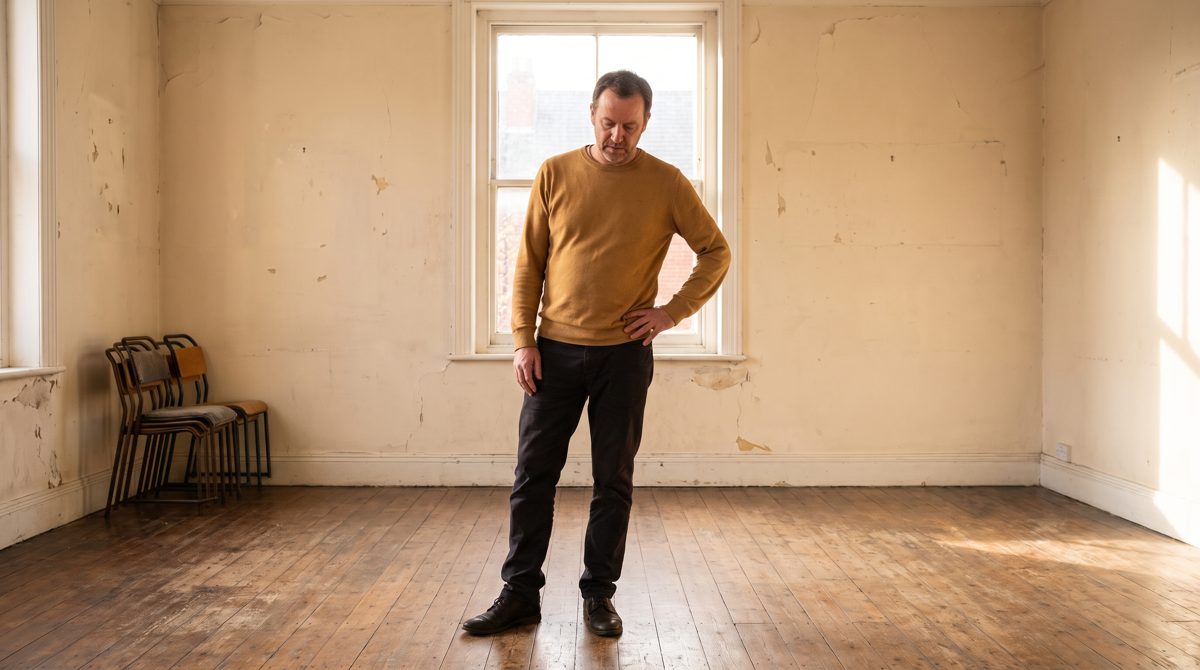
What the screen takes away
Almost every book on character was written for the stage, and the camera removes most of what those books are about. Very few pages say so.
A chest-up frame contains no walk. It also contains no posture below the shoulders and no costume beyond a collar. The techniques that read at twenty metres are precisely the ones a close-up magnifies into caricature. So layer three, the subject of Stanislavski's second half, is largely unavailable to you on screen.
That is not a counsel of despair, though. It means the weight moves to layers one and two, plus a very small number of physical things that do survive a tight frame.
- Tempo of thought — how quickly this person arrives at things. Completely visible.
- The eyes — where they go while a decision is being made.
- Breath — in frame, audible, and characterful.
- Stillness, or the lack of it.
- Status — relational, observable, and it survives a tight frame better than almost anything.
Building a character from three pages
This is the situation most readers of this page are actually in, and it is served by almost nothing written on the subject.
You have three pages, a one-line breakdown, and about forty-eight hours, so a character questionnaire is useless here and so is anything that takes a week. Here is what fits instead.
Not “my boss”. The person who passed me over. Relationships are specific or they are decorative.
In this scene, from this person, in the next ninety seconds. Not what the character wants in life.
If nothing is in the way there is no scene, so find it, even if you have to supply it.
The moment before. This is the single most reliable source of a first line that does not sound like a first line.
A tempo, a weight, a place they hold themselves. One. One parameter is enough to make you not-you. Three is a costume drama.
The four-line part
A co-star role with four lines has no room for interpretation, which sounds like a limitation and is actually a clarification.
The whole job at that scale is one question: who is this person when nobody is watching them? The nurse at the end of a long shift. The officer who has been on that door since six. Answer that one question and everything else follows in about ninety seconds.
One circumstance, one want, one physical parameter. That is the complete method at this size, and it is the difference between a real person and a plot function, which is exactly what a casting director is deciding when they watch a co-star tape.
Where the sources disagree
Every chapter on this course ends here. On this topic the disagreements are unusually old and unusually live.
Did Stanislavski teach inside-out?
Commonly saidHe is the founder of inside-out acting.
What we foundThat reputation comes from the Method, built on the first half of a two-part book. His own late work runs from physical action toward feeling, and scholars argue the system was always psychophysical.
Is Building a Character a separate book?
Commonly saidIt is the second volume of a trilogy.
What we foundHe wrote it as the second half of one volume. Benedetti reunited the two halves in 2008 as An Actor's Work.
Does the outside affect the inside?
Commonly saidAssumed to run one way, inside to out.
What we foundStanislavski describes the inner faculties responding to an external image and adjusting to it. Both directions, reciprocally.
Is there such a thing as a character?
Commonly saidThe premise of the whole enterprise.
What we foundMamet: there is no character, there are only lines upon a page. Taken seriously, it is a real position with real support.
Is backstory useful?
Commonly saidThe standard homework, and the standard questionnaire.
What we foundOnly where it produces a circumstance or a behaviour. Delete it and see whether the scene changes.
Can you prepare too much?
Commonly saidMore preparation is always better.
What we foundAn over-built character is hard to redirect, and directability is what is being assessed in the room.
Does physical transformation work on screen?
Commonly saidIt is what “character acting” means.
What we foundA chest-up frame contains no walk. The layer Stanislavski's second half is about is largely unavailable to you.