
Status is something you do
Keith Johnstone noticed this while teaching at the Royal Court in 1963, and the sentence he wrote about it is the most useful thing in this chapter.
He had a problem. His actors could not reproduce ordinary conversation on stage, and everything came out either flat or overheated. What he found underneath it was a constant, invisible negotiation that people conduct all the time and never mention.
Status is a confusing term unless it's understood as something one does. You may be low in social status, but play high, and vice versa.Keith Johnstone, Impro: Improvisation and the Theatre, Methuen Drama, 1981, from the Status section
That distinction is the whole technique. A duke can play low and a servant can play high, and Johnstone's own note is that audiences enjoy exactly that contrast between the status played and the social status.
Suddenly we understood that every inflection and movement implies a status, and that no action is due to chance, or really ‘motiveless’.Johnstone, Impro
Two consequences follow, and they are what make this a tool rather than an observation. The first is that it is always happening. Two actors who have not decided anything are still transmitting something, so deciding is the only variable you control.
The second is that it is normally invisible.
Normally we are ‘forbidden’ to see status transactions except when there's a conflict. In reality status transactions continue all the time.Johnstone, Impro
The see-saw
Johnstone's word for the mechanism is the one to keep, because it contains the whole idea in three syllables.
We soon discovered the ‘see-saw’ principle: ‘I go up and you go down’.Johnstone, Impro
If status is a see-saw then every move alters both people, which gives you exactly four things you can do at any moment.
Take the space, take the time, decline to explain. The obvious one, and the one actors reach for first because it looks like power.
Correct them, finish their sentence, answer a different question from the one they asked. Often crueller than raising yourself, and much more watchable.
Apologise, defer, make the small joke at your own expense. This is a strategy, not a defeat, and it gets people things.
Ask their advice, hand them the decision, defer publicly. It can be generous and it can be a trap, and the audience cannot always tell which.
Johnstone on the eyes
He got to the eyes himself, decades before we found the psychology, and his version is oddly practical.
In animals the pattern of eye contacts often establishes dominance. A stare is often interpreted as an aggressive act — hence the dangers of looking at gorillas through binoculars. Visitors to zoos feel dominant when they can outstare the animals. I suggest you try the opposite with zoo animals: break eye contact and then glance back for a moment.Johnstone, Impro, Status section
The glance back is the detail. It is not the staring that lowers you, in his account, but the involuntary checking afterwards, and he says so directly: if you ignore someone your status rises, and if you feel impelled to look back then it falls. He adds that dark glasses raise status because they hide the submission of the eyes.
What the psychologists measured
There is a research literature on exactly this, running from 1975, and it is genuinely interesting. It is also much thinner than the way it gets quoted suggests.
The measure is called the visual dominance ratio. You take the proportion of time someone spends looking at their partner while speaking, and divide it by the proportion they spend looking while listening. A ratio near 1.0 means they look about equally in both modes. A low ratio means they look much more while listening than while talking.
The original observation came from a study of military cadets and officers: officers scored around 1.06, cadets around 0.61. Then in 1988 a team ran the experiment properly, handing some participants expertise or the power to award credits, and measuring what their eyes did. Here is what they got.
Read down the columns and the good news is real. When the woman held the power, her ratio went up and his went down. The pattern follows the power and it fully reverses, which is the strongest thing in the paper.
Both men and women low in expertise or reward power looked more while they were listening than while they were speaking, producing a relatively low visual dominance ratio.Dovidio, Ellyson, Keating, Heltman & Brown, 1988
The mechanism runs the other way from the advice
This is the correction that actually changes what you would do in a take, and almost every summary of this research gets it the wrong way round.
Look at the high-power numbers again: 0.98, 1.03, 1.08, 1.20. They cluster around one, which means those people looked at their partner roughly as much while speaking as while listening. That is not a striking behaviour. It is ordinary.
Now look at the low-power numbers: 0.54, 0.60, 0.61, 0.70. Those people were not looking less while speaking so much as looking a great deal more while listening — in some conditions over seventy per cent of the time.
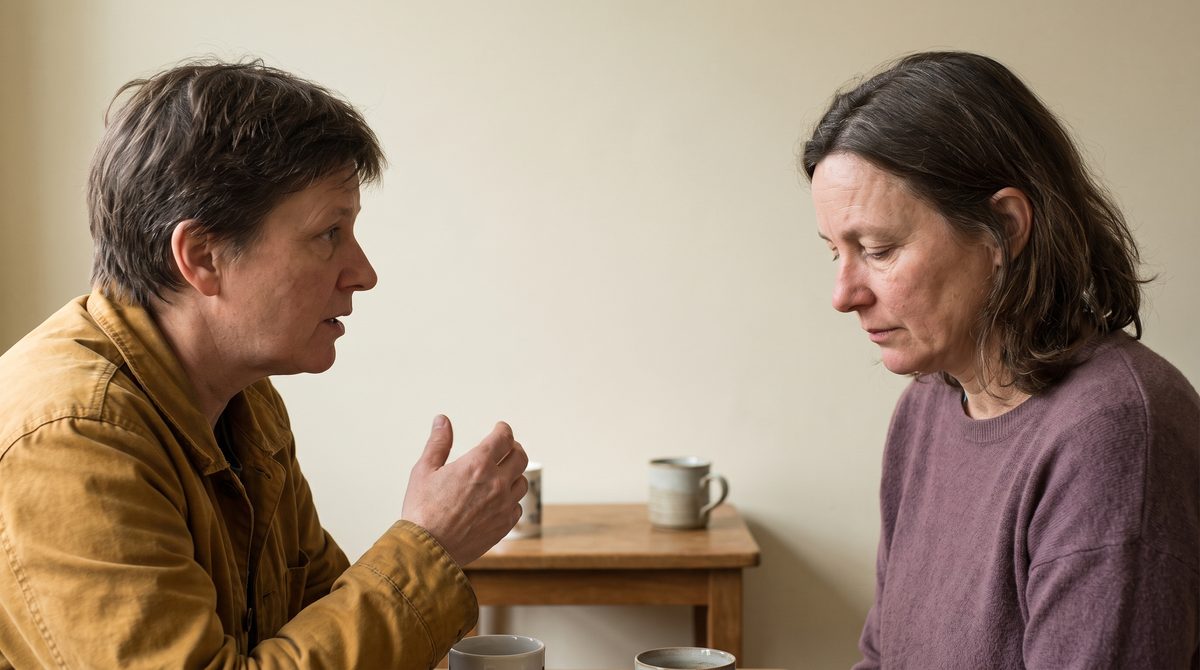
The part of that study nobody quotes
Go back to the bottom row of the table, the one where nobody was given any power at all. It is the most important row and it is almost never reported.
With no power difference in the room, men produced 1.23 and women produced 0.70. The men's figure is the highest in the entire dataset — higher than the men who had actually been handed reward power. So in this data, sex predicted the gaze pattern at least as strongly as the experimental manipulation did.
And it does not travel
If you are submitting self-tapes internationally, this section matters more to you than any of the technique above.
Researchers tested Finnish and Japanese participants looking at live faces through a screen, measuring both their bodies and their judgements. Both groups agreed on one thing: a direct gaze reads as more dominant than an averted one. That part appears to be shared.
What they did not agree on was whether that was a good thing. The Finnish participants rated a direct gaze as more approachable. The Japanese participants went the other way, rating direct-gaze faces as angrier, unapproachable and unpleasant.
The cue that actually works, and nobody teaches it
While checking the gaze research we found something better evidenced sitting right next to it, and it is easier to control.
A 2009 study analysed real recorded meetings and tested which behaviours predicted how observers rated people's dominance. Gaze measures did reasonably. Speaking time did better.
On camera, and the self-tape problem
Status is unusually well suited to screen work, for a structural reason. But there is a catch specific to self-tapes that nobody mentions.
A close-up removes the walk, the entrance, the spatial relationship and most of the classical status vocabulary. What it leaves is the face, the voice and the timing — which is where several of the better status signals happen to live.
Your status in the audition itself
Everybody wonders about this and almost nobody writes it down. Most of the standard advice quietly instructs you to play low.

Be grateful, do not ask questions, apologise for taking up the room. The evidence gathered across this Academy points somewhere else. Casting directors on record say a genuine question is welcome, that a redirect means they liked you enough to ask for another version, and that what they are assessing is whether you would be straightforward to work with.
What to practise
Three of these need a partner and two do not. The first one is worth more than the rest combined.
One scene, played twice, with the status relationship reversed. Change nothing else — same lines, same objectives. You get two different plays out of one page, and it takes five minutes.
Take a single exchange and play it four ways: raise myself, lower them, lower myself, raise them. Most scenes use all four, and finding which one each line is doing is the analysis.
Run the scene once trying to fill every silence, then once letting every silence sit. Film both. This is the best-evidenced cue on the page and the difference is obvious on playback.
Any two-hander. Work out who has the power from the pictures alone, then turn the sound on and see whether the words agree. They often do not, and that gap is the whole subtext chapter.
A shop, a meeting, a family lunch. Watch for who raises and who lowers. He says these transactions run constantly and we are trained not to see them, so the practice is simply looking.
Where the sources disagree
Every chapter on this course ends here. On this one, several things you may have been taught as settled are not.
Is status a character trait?
Commonly said“He's high status” is how it is usually taught.
What we foundJohnstone's actual position is that status is something one does. You can be low in social status and play high.
Is more eye contact more powerful?
Commonly saidHold their gaze while you speak.
What we foundThe high-power pattern is unremarkable. The signal is in low-status people over-looking while they listen.
How solid is the gaze research?
Commonly saidForty years of findings.
What we foundTwenty and twenty-four pairs, no direct replication in thirty-six years, no preregistration, and one larger unpublished attempt that failed.
Does it work the same for everyone?
Commonly saidOne instruction for all actors.
What we foundWith no power difference at all, men and women produced very different baselines. The same behaviour is a more marked act on some actors than others.
Is high status better?
Commonly saidActors reflexively assume so.
What we foundLowering yourself is an active strategy that gets people safety, sympathy and help. It is a move, not a defeat.
Does gaze read the same everywhere?
Commonly saidEye contact signals confidence.
What we foundDirect gaze reads as dominant across cultures tested, but as approachable to Finnish viewers and unpleasant to Japanese ones.
Which cue should you actually use?
Commonly saidThe eyes.
What we foundIn the one study that compared them directly, speaking length beat every visual cue — and it does not need a partner in frame.