Two different things share the name
Before anything else it is worth separating them, because criticisms of the one keep getting read as criticisms of the other.
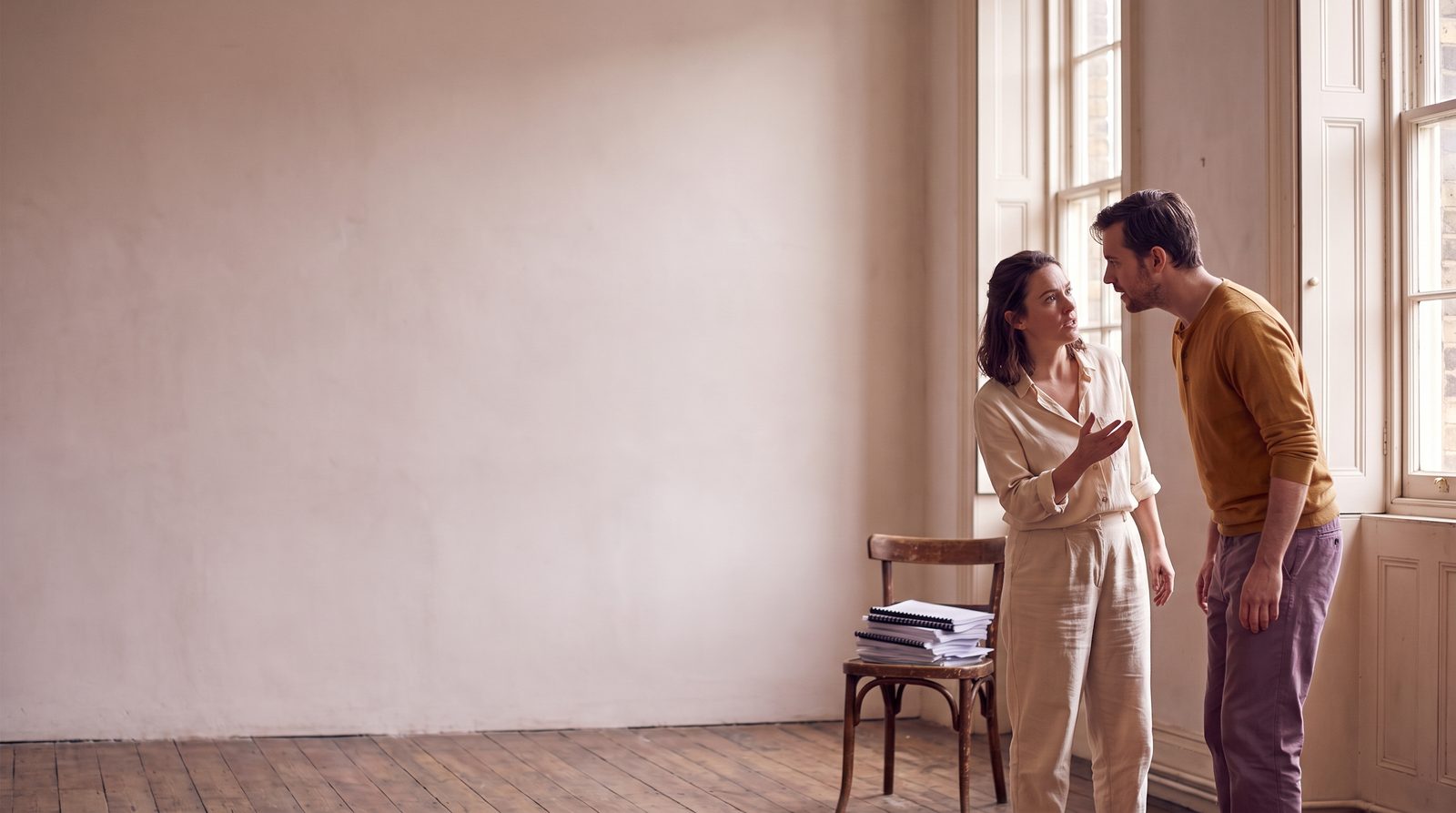
Scene study is a method — how you work on a scene — and it is also a class format, the dominant American acting-class model in which pairs prepare a scene, present it, get notes, and everybody else watches.
The format has real problems, which this page gets to at the end, but the method is a separate question and mostly a better one.
The order almost everyone uses
Here is the standard sequence, and you will recognise it, because it is what nearly every class, every book and every rehearsal room does.
Read the scene, then analyse it for given circumstances, objectives, obstacles and beats. Make your decisions, rehearse the decisions, and present. It is orderly, it feels like work, and it has three predictable failure modes.
Stanislavski knew about this problem, and in his last years he did something about it. Between 1934 and his death in 1938 — working on Three Sisters, Carmen and Molière, then in the Opera-Dramatic Studio he founded in 1935 — he began inverting the sequence.
The best analysis of a play is to take action in the given circumstances.Stanislavski, in Jean Benedetti's account of his final period
The étude
The unit of this method is a small structured improvisation, and it is the thing almost nobody trained in English has been shown.
An étude is not a run of the scene and it is not free improvisation. It is an attempt to do what happens in the scene, on your feet, in your own words, with the written text mostly absent. Early ones are often silent, then a few improvised words arrive, and then gradually the actual lines do.
Here is a version that works for two people with a page of dialogue and an hour.
No stopping, no discussion, no pencil. You are getting the shape, not the meaning.
Not what the scene is about — what occurs in it. Something changes between these two people. Say what, in one sentence, out loud.
Same event, same relationship, your own words, about two minutes. It will feel clumsy. That is not a sign it is going badly.
What did you do that the text does not? What does the text do that you skipped? The gap is the analysis, and you now have it without having argued about it.
One line, one beat, one piece of information from the page. Not the whole scene. One thing.
At which point the words are resting on something, and you have learned most of them without trying.
Step two is the one people get wrong, so here it is worked through. “What it is about” produces a theme, which you cannot play. “What happens” produces an event, which you can.
Everything in the right-hand column has a clock on it and somebody it happens to. Everything in the left-hand column is an essay title, and you cannot act an essay title.
What happened to Maria Knebel
This method has a name — Active Analysis — and a history that is worth telling accurately, because the version that circulates is tidier than the truth.
Knebel was Stanislavski's student and collaborator in that final studio, and after his death she carried the work forward. It is largely through her that it survives at all. Her students included Anatoly Efros, Oleg Yefremov and Anatoly Vasiliev.
Meanwhile Mikhail Kedrov, who had also worked with Stanislavski at the end, took a different route with the same material.
- 1949Appointed Artistic Director of the Moscow Art Theatre, the most powerful position in Soviet theatre.
- The labelCoins “the Method of Physical Actions”, citing Stanislavski's manuscripts for authority.
- Why it fittedA name emphasising the actor's physicality suited Marxist materialist expectations rather well.
- The resultThis is the version that became familiar in the West.
- 1949Dismissed from the Moscow Art Theatre. Salary suspended, productions pulled from the repertory.
- The contextStalin's campaign against “cosmopolitans”. She was Jewish. Her brother was arrested as an enemy of the people, and colleagues began avoiding her in the corridors.
- 1950–55Directing at the Central Children's Theatre, becoming its Artistic Director. She kept using Active Analysis there.
- 1961Chair of the directing programme at GITIS, Russia's leading theatre school.
But that does not explain why you were taught the other one
Here is the correction we most wanted to make, because the tidy version of this story is very appealing and it does not survive a calendar.
The appealing version says: Anglophone actors inherited the Method of Physical Actions rather than Active Analysis because of what happened in Moscow in 1949. It is a good story, and the problem with it is that American actor training had already been decided by then.
The Moscow Art Theatre toured America in 1923 and 1924, and two of its actors, Richard Boleslavsky and Maria Ouspenskaya, stayed on and began teaching. Lee Strasberg learned from them, and by the mid-1930s the American Method was substantially built. A 1949 appointment in Moscow cannot explain a transmission that had already happened.
How good is the evidence for it?
We wanted to tell you there was a study, and there is something, but it is worth being precise about what that something is.
In 2019 Sharon Carnicke published an account of a workshop she ran at a symposium with fifteen actors. They did open improvisations, and then études structured around what she calls a map of the scene's dynamics, after which she reported what they said.
The actors unanimously reported feeling more secure in the etudes than in the improvisations, because the dynamic structure of the map better allowed them to focus on character relationships.Sharon Carnicke, “Improvisations and etudes: an experiment in Active Analysis”, Stanislavski Studies 7(1), 2019
That is a genuinely interesting result, and it points somewhere useful, which is that structure is what makes freedom usable. Actors given a map could spend their attention on each other, while actors given open freedom spent it inventing plot.
A working process for one scene
This is assembled from everything above, and it is deliberately shorter than you would expect.
Read it aloud once. Name what happens. Each of you privately answers four questions: who is this person to me, what do I want, what is in the way, what just happened. Then one étude, and compare.
A second étude, taking one or two lines from the text where they are needed. Then run the scene as written, once. Then change one variable — a want, a status choice, a tempo — and run it again.
Run it, and stop. The ceiling arrives earlier than instinct suggests, and everything after it is sanding.
Not fluency. You can be interrupted and recover, and a change from your partner does not derail you. Smoothness is what over-rehearsal produces on the way past readiness.
Is the class worth the money?
This is the question the format half of the chapter has to answer, and it deserves a straight answer rather than a defensive one.
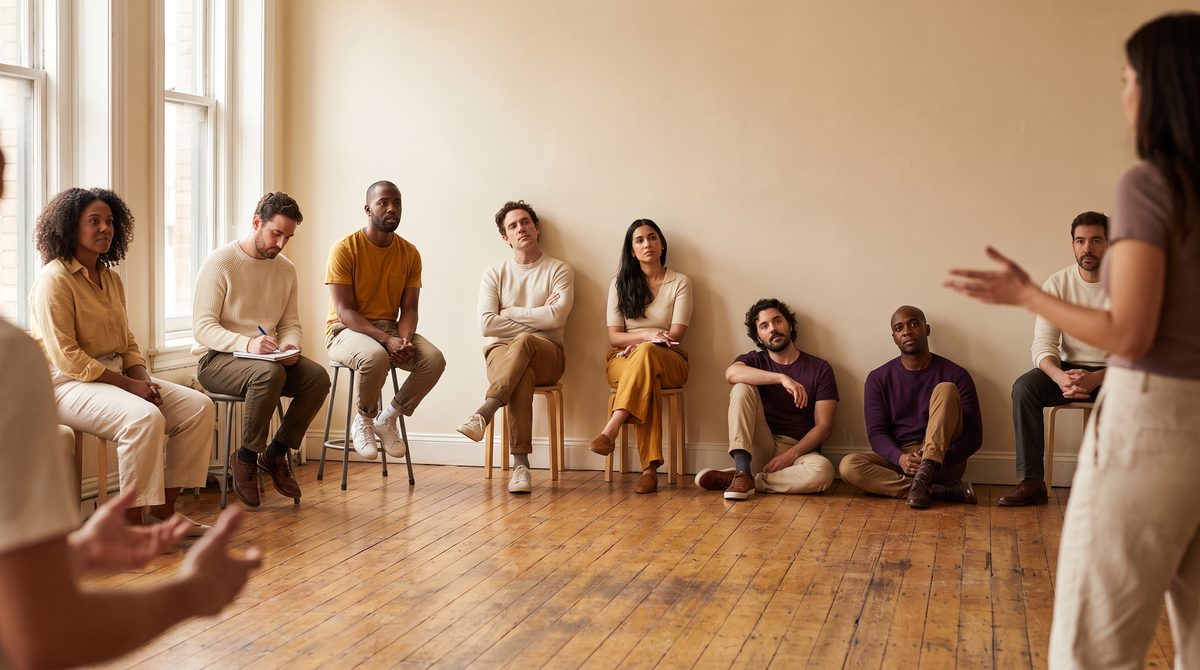
In a typical scene-study class you present every second or third week, which means most of your time is spent watching other people. For the money, the ratio of your own repetitions to hours in the room is poor — and what the training evidence supports is deliberate practice with immediate feedback, of which you get comparatively little.
The defence of the format is also real, and it is certainly not nothing.
Scene study when there is no scene partner
Most readers of this page have three pages, forty-eight hours and nobody to work with. The method compresses better than you would think.
Everything the screen research on this course established says that screen work removes rehearsal, context and continuity, which means the analytical work has to happen faster and more privately. That is an argument for working this way rather than an argument against it.
- Name what happens. Two minutes, and it is the highest-value thing you will do all day.
- Do one étude alone. Speak the scene in your own words, out loud, to the empty room. It feels ridiculous. It takes ninety seconds and it will show you instantly which beats you do not understand.
- Take the text back. You will find you now know what the lines are for, and that you half know them.
- One variation before you record. The ability to do it differently is what gets assessed later, so build it now rather than discovering you cannot.
Where the sources disagree
Every chapter on this course ends here. On this one, one of the disagreements is between us and our own research.
Analyse then act, or act then analyse?
Commonly saidRead, analyse, decide, rehearse. The order nearly every class uses.
What we foundStanislavski's late practice inverts it: take action in the given circumstances, and let the analysis come out of the doing.
When do you learn the lines?
Commonly saidFirst, so you can work freely.
What we foundLater. Build what has to be said, then the playwright's words rest on something — and you will have learned most of them on the way.
Is Active Analysis a lost method?
Commonly saidAlmost nobody in English knows it, thanks to Soviet politics.
What we foundIt is in the standard actor-training textbook and three scholarly books. It is uncommon in commercial classes, which is a different claim.
Was it suppressed?
Commonly saidBanned by the regime while a rival method was sanctioned.
What we foundNo technique was ever formally sanctioned or banned. Knebel was dismissed in 1949 during the campaign against “cosmopolitans”, and carried on elsewhere.
Are the two methods even different?
Commonly saidTwo names for one thing.
What we foundCarnicke and Merlin say they are substantially different. Benedetti treats them as the same. Unresolved.
Is there evidence études work better?
Commonly saidAn experiment found actors felt more secure in études.
What we foundOne workshop, sixteen people, no control, run by the technique's leading advocate. Interesting, not evidence.
Does more rehearsal help?
Commonly saidObviously.
What we foundOnly up to a point that arrives early. After it, repetition without a change is decay.