
The most useful sentence in this course
“Instead of seeing people as untalented, we can see them as phobic.”
Keith Johnstone ran the Royal Court studio through the 1960s. In 1964 he read Joseph Wolpe on the treatment of phobias, and it reorganised his teaching. Here is the passage in full. Every version you will find online has been cut.
My view is that we have a universal phobia of being looked at on a stage, and that this responds very well to ‘progressive desensitisation’ of the type that Wolpe advocates. Many teachers seem to me to be trying to get their students to conceal fear, which always leaves some traces — a heaviness, an extra tension, a lack of spontaneity. I try to dissipate the fear by a method analogous to Wolpe's, but which I really got from Anthony Stirling. The one finding of Wolpe which I immediately incorporated into my work was the discovery that if the healing process is interrupted by a recurrence of the total fear — maybe a patient being treated for a phobia of birds suddenly finds himself surrounded by fluttering pigeons — then the treatment has to be started again at the bottom of the hierarchy. I therefore constantly return to the very first stages of the work to try to pull in those students who remain in a terrified state, and who therefore make hardly any progress. Instead of seeing people as untalented, we can see them as phobic, and this completely changes the teacher's relationship with them.Keith Johnstone, Impro: Improvisation and the Theatre, Faber and Faber, 1979 — from “Notes on Myself”
And this completely changes the teacher's relationship with them. Without it the line is a slogan. With it, it is an argument about how you should be taught.
The reframe is not “be kinder to nervous students”. It is that the diagnosis was wrong, and a wrong diagnosis produces the wrong treatment.
One correction, and it makes the story better.
It is usually written that Johnstone got his method from Wolpe. He is more careful than that, and more generous. The method, he says, came from Anthony Stirling. What he took from Wolpe was one finding. An interruption of total fear sends the treatment back to the bottom of the hierarchy.
He is explicit about the date, too. “When (in 1964) I read of Wolpe's work in curing phobias, I saw a clear relationship with the ideas I'd got from Stirling, and with the way I was developing them.”
The same move, twenty years earlier
Modern improv was invented for immigrant children who did not share a language.
Almost nobody tells this story, and it changes what the discipline looks like.
Viola Spolin studied from 1923 to 1926 under the sociologist Neva Boyd. Boyd's training school was inside Hull House, Jane Addams's settlement house on Chicago's near west side. Folk games, storytelling, dance, group work. Boyd's principle was that play does something no other behaviour does.
Play involves social values, as does no other behavior. The spirit of play develops social adaptability, ethics, mental and emotional control, and imagination.Neva Boyd, sociologist, Hull House — Spolin's teacher
In 1939 Spolin became a drama supervisor for the WPA Recreational Project in Chicago. She worked with children and recent immigrants in poor neighbourhoods, and her students frequently had no language in common. So she built exercises that could be taught by doing rather than by explaining.
The games emerged out of necessity. I didn't sit at home and dream them up.Viola Spolin, on where theatre games came from
From Improvisation for the Theater, published by Northwestern University Press in 1963 — sixteen years before Impro:
“Everyone can act. Everyone can improvise. Anyone who wishes to can play in the theater and learn to become ‘stage-worthy.’” And, more precisely: acting can be taught to the average as well as the talented, if the teaching makes the techniques intuitive enough that they become the student's own.
Two people, two countries, no contact between them, arriving at the same conclusion: the thing standing between a person and this work is not talent.
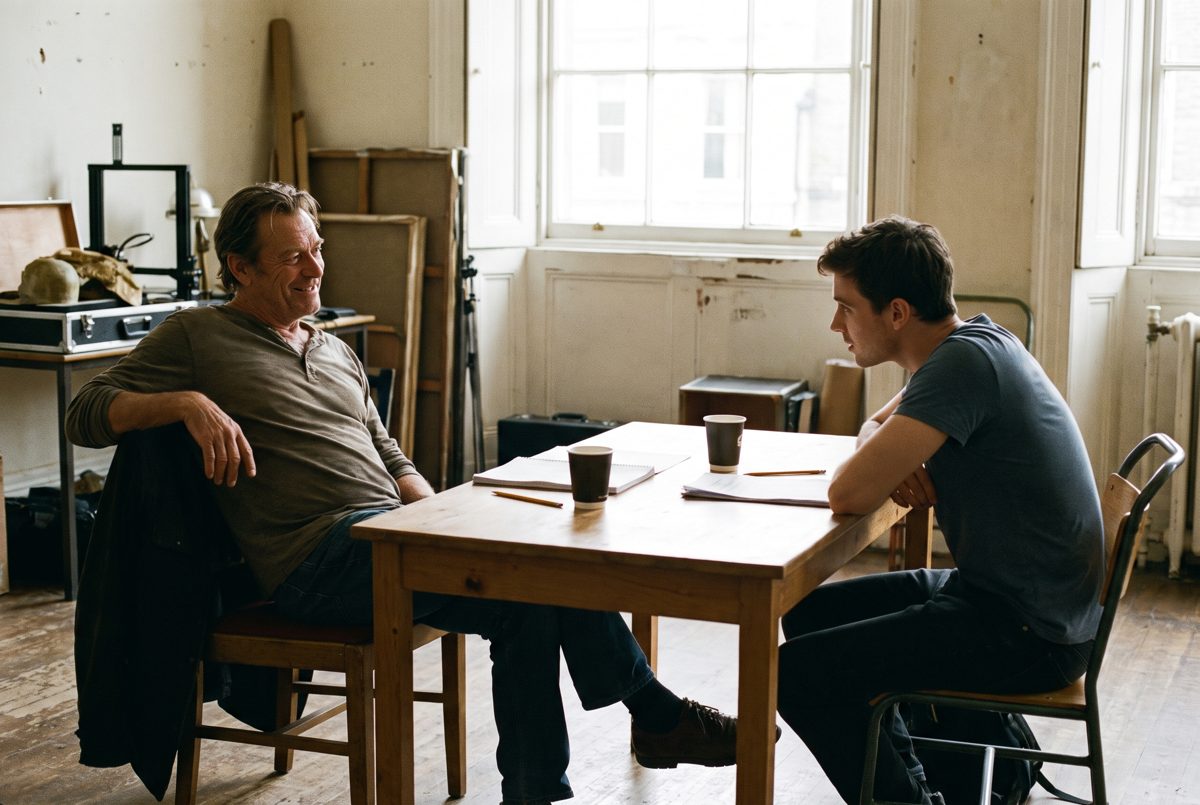
Status, which is the most immediately useful thing in this chapter for anyone working on camera.
A correction to our own thesis
Two lineages, and both of them drifted toward comedy.
We were going to tell you that Chicago produced comedy and Johnstone produced actor training, and that actors get sent to the wrong one. We checked it properly. It is not that clean, and the true version is more interesting.
- 1923Spolin trains under Neva Boyd at Hull House.
- 1939Builds the games for immigrant children on a WPA project.
- 1955Her son Paul Sills co-founds the Compass Players.
- 1959The Second City opens. Spolin runs its workshops until 1965.
- 1963Improvisation for the Theater — a university press, subtitled a handbook for teachers and directors.
- 1967Del Close and The Committee perform the first Harold.
- 1990UCB founded, out of Chicago, in New York.
- 1956Commissioned as a playwright at the Royal Court by George Devine and Tony Richardson.
- 1964Reads Wolpe. Concludes that blocked students are phobic rather than untalented.
- 1966Leaves the Court after ten years, latterly an Associate Director.
- 1967Co-founds The Theatre Machine, touring Europe.
- 1975Teaching at the University of Calgary, where he stays until 1995.
- 1977Co-founds Loose Moose. Theatresports follows, modelled on professional wrestling.
- 1979Impro published by Faber and Faber.
It is that both are now taught, in both countries, almost entirely by comedy schools to people who want to be funny. The actor-training use that both founders originally had in mind survives mainly in books rather than in classrooms.
Which is a better reason to read Impro than to sign up for anything.
And the comedy tradition's own manual agrees with us.
Del Close taught at Second City and later co-founded iO with Charna Halpern. Truth in Comedy, the 1994 manual he wrote with Halpern and Kim Johnson, is the foundational text of American long-form. Its central claim is not about jokes.
The truth is funny. Honest discovery, observation, and reaction is better than contrived invention.Halpern, Close & Johnson, Truth in Comedy, Meriwether, 1994
And the warning that follows from it: “When players worry that a scene isn't funny, they may resort to jokes. This usually guarantees the scene won't be funny.” The comedy tradition's own handbook says the route to comedy is not comedy. That is worth knowing before you decide you cannot do this.
We should also say that at least one experienced Spolin practitioner draws this line somewhere else entirely. He groups Johnstone's methods with “yes, and” as head-led popular improv, against Spolin's games. The argument about who is the serious one is live, and we are not pretending to have settled it.
Real studies, read honestly
What the research actually shows, and what it cannot.
There is peer-reviewed evidence here and almost nobody in the acting world cites it. There are also design limitations, and the same people who ran the studies are the ones who point them out.
You will see it written that “improv training reduces social anxiety through better tolerance of uncertainty”. That sentence is from a university press release, not from the paper, and the word doing the work is through. It asserts a causal mechanism that a study with no control group cannot establish, and whose own authors decline to claim it.
And a smaller one: the 2019 study is often reported as finding increased social self-efficacy. It is creative self-efficacy. Those are different measures and the substitution has been copied from source to source.
Here is the honest sentence. Participation was associated with these changes. The designs mostly cannot separate improv from the passage of time, or from simply spending ten weeks in an organised social activity. That is still worth knowing, and it is not a proof.
One thing the field says about itself is worth quoting, because it is unusually candid. Research on improv's benefits, the 2020 authors write, has “generally lacked the rigor of randomized experiments”. They write that as the reason for running the randomised experiments that follow — so quote it as a motive, not as a verdict.
Why this matters to somebody auditioning
Auditioning is almost entirely an exercise in tolerating uncertainty.
Which is the one thing improv has published evidence for improving, and it is a better reason to do it than anything the field usually offers.
Intolerance of uncertainty is not a folk concept. It is an established construct in clinical psychology. Since Carleton's 2016 review it has been treated as a transdiagnostic factor — something that runs across anxiety and depression rather than belonging to one diagnosis.
Johnstone borrowed it from therapy; therapy came back and measured something that looks a great deal like it. Each link in that chain is sourced. The chain itself is our construction, none of the researchers cites Johnstone, and the studies cannot carry a causal claim. We think it is true and we are telling you it is an argument rather than a finding.
The most misunderstood idea in the subject
“Yes, and” does not mean agreeing with everything.
This misconception does real damage, because it makes actors think improv is incompatible with conflict — and scenes are made of conflict.
Johnstone's vocabulary is simple. Anything an actor does is an offer, and each offer can be accepted or blocked. The distinction that matters is not agreement.
Bad improvisers block action, often with a high degree of skill. Good improvisers develop action.Keith Johnstone, Impro, p. 115
Your character can refuse, argue, walk out, say no, lie, threaten and slam a door, and none of that is blocking, because the action develops. Blocking is cancelling your partner's reality — denying that the thing they established exists at all.
A scene in which everybody agrees is not good improv. It is usually not a scene.
Two more of his lines are worth having, because they name the emotional truth of it. “Blocking is a form of aggression.” And, more forgivingly: “The motto of scared improvisers is ‘when in doubt, say NO’.” Blocking is what frightened people do. Which brings you straight back to the first section.
The best tool here for camera work
Status, which is happening whether you play it or not.
Readers of Impro routinely name the status chapter as the best thing in the book. For a screen actor it is also the most immediately usable.
Suddenly we understood that every inflection and movement implies a status, and that no action is due to chance, or really ‘motiveless’.Keith Johnstone, Impro — opening of the Status chapter
And here is the observation that makes it useful rather than merely true.
Normally we are ‘forbidden’ to see status transactions except when there's a conflict. In reality status transactions continue all the time.Johnstone, same chapter
Then the finding from the studio floor. This is the one that should make you want to try it. “As soon as I introduced the status work at the Studio, we found that people will play one status while convinced that they are playing the opposite.”
Take any scene and play it twice. Once playing high status, once low, with nothing else changed — same lines, same objective, same blocking.
You get two completely different scenes, it costs nothing, and it requires no comic ability whatsoever.
Spontaneity, and the trap of being clever
The more obvious you are, the more original you appear.
Johnstone's account of why students freeze is not about a shortage of ideas. It is the opposite, and it is very hard to argue with.
The student hesitates not because he doesn't have an idea, but to conceal the inappropriate ones that arrive uninvited.Keith Johnstone, Impro, on the “…oh… aahh… um…” that follows every request for an idea
If you have not gone blank — if you have in fact rejected something — then the useful note is not think of something. It is say the thing you already thought of and dismissed.
That is genuinely actionable, and it is the exact opposite of what a frozen person believes they need.
The three realisations he takes students through.
He puts them in his own numbered form, and the ordering is the argument. “That we struggle against our imaginations, especially when we try to be imaginative; that we are not responsible for the content of our imaginations; and that we are not, as we are taught to think, our ‘personalities’, but that the imagination is our true self.”
The personal source of all of it is in the opening pages of the book.
I tried to resist my schooling, but I accepted the idea that my intelligence was the most important part of me. I tried to be clever in everything I did… In the end I was reluctant to attempt anything for fear of failure, and my first thoughts never seemed good enough.Keith Johnstone, Impro, “Notes on Myself”
What improv is for, if you do scripted work
Mike Leigh builds entire films this way. He also hates the word.
If you want a single answer to “why would a screen actor learn this”, it is here — because in Leigh's process, improvisation is not a warm-up. It is the writing.
Actors commit before there is a subject. On Vera Drake, Leigh says, the only actor who knew the premise was Imelda Staunton.
Not playing them — using them as a starting point. Leigh: “I usually pick somebody as the jumping off point for the character. There is some root, some reality so that the actor's got something to work from.” Then you invent outward, in enormous detail, for months.
This is the part that sounds invented and is not. The costume designer Lindy Hemming, who has worked on his films for decades, describes it exactly.
“People do open a door, in Mike's rehearsals, and really don't know who or what is going to be on the other side.”
Leigh: “We do that by improvising and then pinning it down and distilling it and then finally writing it through rehearsal.” He builds each scene in the location, because he cannot write it without seeing the room.
By the time the camera turns over, the dialogue is fixed. Lesley Manville: “When we shoot we're not improvising. Once we're filming it, the dialogue is absolutely set.”
He is blunt about this, and the quote is the correction the whole subject needs.
He was asked directly whether he is still improvising by the time he shoots.
Certainly not… I don't like shooting improvisation, actually, I mean I don't like improvisation as such. It's a means to an end, not an end in itself.Mike Leigh, interviewed by Bette Gordon, BOMB, Winter 1994
He adds: “By the time the camera rolls — there is only one camera — it is absolutely precise.” He has also said he wishes he had credited himself as writer earlier rather than as deviser. The improvisation produced writing.
Improvisation here is a method of preparation, not a performance style. It produces precision rather than looseness. And Manville is clear that the words are still the actors' own: “All of the dialogue, all of the words, actually come from the actors as well.”
Her other line is the honest cost of it: “You have to give yourself up to it, though. Leave your ego at home.”
Leigh is unromantic about it from his side too: “I hate the rehearsals because it's donkeywork and you haven't got anything to show at the end of the day.” We found no actor on record calling the process abusive or saying they regretted it. We did find people saying it was very hard, and we would rather report that than imply either a scandal or an idyll.
In the room, and on tape
Should you improvise in an audition?
Serve the text first. Then, if you want, offer something extra — as an addition, never as a substitute.
There is a real commercial casting director named Kirkland Moody, who does talk about improv. But he says something different and narrower. Improv matters, he says, as “just having the willingness to play and not get stuck in your one way of doing something”. That is a fair thing to quote, and it is not the same claim, so we are not stretching it into one.
What to do, and where
Practise, and where to actually go.
Most of this needs one other person, and that is the single cheapest thing you can arrange.
One scene played high then low. Then build a story alternating sentences, accepting everything — and then again, letting the characters disagree while still developing the action.
Speak or write without premeditation and refuse to edit. Then watch real conversations and name who is raising and lowering status.
Take any prompt and deliberately say the first, plainest thing. Notice how strongly you want to improve on it.
Where to train, honestly.
In the UK the Chicago tradition is institutionalised and the Johnstone tradition mostly is not. The Free Association and Hoopla are the large schools, and both teach the American long-form vocabulary. The Johnstone line survives through individual practitioners, and through Improbable. Their Lifegame is a Johnstone form they developed with him directly.
That is not a reason to avoid it. It is a reason to be clear about what you are buying. It is craft and a comedy network, rather than access to dramatic casting.
And a closing thought from an unlikely place. Hoopla is a comedy school, and it publishes a history of the two traditions. It concludes that treating them as rivals is like deciding to run using only one of your feet. That is a comedy school arguing against the comedy-versus-craft binary, and it is more generous than the version we started with.
Where the sources genuinely disagree
The contradictions, laid out.
Six real disputes, and we have taken a position on each, with the reasoning set out above.
Is improv a comedy skill?
The public formSecond City, UCB, Theatresports. All of it is comedy, all of it is competitive or commercial.
Both foundersSpolin built it for immigrant children on a relief programme. Johnstone built it to loosen up writers at the Royal Court. Neither started with jokes.
Are the two traditions really different?
Yes, in originIndependently invented, different countries, different vocabulary — improv and impro.
Not in destinationSpolin's games became a nightclub revue. Johnstone's became a scored competition modelled on wrestling. Both drifted.
Does “yes, and” mean agreeing?
The slogan says soAnd beginners are taught it that way for a reason — they block reflexively.
JohnstoneBad improvisers block action; good improvisers develop it. Your character can refuse, argue and leave.
Is freezing a talent problem?
The universal fearAnd the reason a lot of actors avoid the whole subject.
Johnstone, 1964See them as phobic rather than untalented, and return to the bottom of the ladder whenever somebody is stuck there.
Does improv work?
Widely claimedConfidence, creativity, presence, being better in the room.
The evidenceDivergent thinking, positive affect, uncertainty tolerance and social anxiety. Not better acting — nobody has tested that.
Is the evidence strong?
Real and peer-reviewedThree studies, one of them randomised with matched social controls.
And limitedTwo of the three have no control group, and their own authors say a controlled replication is needed before attributing change to improv.
This is the fifth chapter in which a striking quotation turned out to be a blog's own prose with a famous name attached. If a line's only trail leads to a book-summary site, it is usually the summariser's sentence.
You are not bad at this. You are at the bottom of a ladder.
Find one other person. Play one scene twice, once high status and once low, and change nothing else. Then say the first thing that comes into your head and refuse to improve on it.
Nobody has to be funny, nobody is watching, and it is the only exercise in this course with published evidence that it makes uncertainty easier to bear.
Taking a redirect