The claim we chased, and what was at the end of it
One line was going to shape this entire page. It is quoted everywhere. It appears to have come from nobody.
The line is that forgetting to slate is the most common mistake actors make, and that casting directors regularly skip self-tapes that do not slate. It is frightening and specific and it makes you act. So we went to find who said it.
What we found at the sourceAnd what it means
The site is a crew-hire marketplaceNot a casting resource
Weak
It sells sign-ups. No author byline anywhere. No publication date. Not one external link on the page — every link goes back to its own sign-up pages.
The quotes have no namesUnder a heading promising names
Serious
A block headed “What casting directors have said, in their own words” carries five quotes and not one of them is attributed to anybody. No name, no production, no link.
And the specific numbers are invented“Cut at second 12”
False
There is no study, no method and no source behind “decisions in the first thirty seconds” or “cut at second twelve”. A precise number with nothing under it is a persuasion technique.
And the named source says the reverseA trade magazine, quoting a named coach
On record
“You should slate for a self-taped audition only if the casting director’s instructions request it. Otherwise, leave it out.” With a named coach adding that always slating is a rookie mistake.
So the whole framing was upside down, and we want to be careful about how far we take that. It does not prove that no casting director has ever skipped an unslated tape. It proves that the person telling you they do is anonymous, undated, and selling something, and that the one identifiable professional in the pile says leave it out unless asked. What we are not going to do is repeat a scary sentence because it makes for a better opening. The honest position is this: an unrequested slate costs you a few seconds and is unlikely to be held against you. A missing one, where it was asked for, is a failure to read. So slate when the brief is silent, keep it short, and stop treating it as a trap.
The part nobody quotes, which is the only part that is binding
Every guide on this subject argues about slate etiquette. There is a contract that settles it, and none of our sources mentioned it once.
American union self-tape auditions are governed by terms agreed after the 2023 strike. They cover what a slate needs to contain, and a good deal more that actors are not told.
1
What a slate needsSlates need only include name, height, city of residence, current location, age and birthday for minors, and information about special skills. That is the list. Everything past it is optional.
2
How much they can ask you to prepareEight pages of sides for a first self-tape, twelve for later ones, and five on low-budget agreements. Not unlimited.
3
How long you getForty-eight hours for adults. Seventy-two for minors. A same-day turnaround on eight pages is not a normal ask.
4
And you do not have to be off bookThere is no memorization requirement, and you cannot be required to own particular equipment or to buy editing software. Nobody tells actors this.
5
Accommodations existPerformers with disabilities can request reasonable adjustments, including materials in an accessible format, and disabled performers, seniors and minors get priority for a live alternative to a self-tape.
Read the first item again, because it quietly answers the question the rest of the internet argues about. Every guide tells you not to volunteer your height unless asked, as though it were a matter of taste. It is not taste. Height and current location are on a negotiated list of what a slate may be asked to contain. So the useful version of the advice is: these are the things that can legitimately be wanted, and you give the ones the brief asks for. If you find yourself adding your agent, your availability and a short account of your training, you are not being thorough. You are being asked for a handshake and delivering a curriculum vitae.
Two honest limits on this. It applies to union work — not to non-union projects, student films, or an open call you found online. And there is a newer provision on live virtual auditions which is narrower than actors think: producers must make a good faith attempt to accommodate a request, and only for the bigger role categories. Good faith is not a guarantee.

The brief beats everything on this page
A casting director collected the actual instructions she was seeing. Reading them side by side is more useful than any rule, because they contradict each other.
One brief says slate is mandatory, in your natural accent, once only, with full name, height, home base and a full body shot. Another asks for the full body slate as a separate clip from the scenes. A third wants you framed tight from just above the head to mid chest, says please do not look directly at the camera, and wants each scene posted as an individual clip because one combined file is too big to upload.
Two corrections to how this evidence gets used, including by us.
These briefs are older than they look. The page collecting them was published in 2021 and touched again in 2025. We were about to date them to last year. They are a four-year accumulation, not a snapshot of current practice.
And several of those instructions come from the same brief, not different ones. The mandatory slate, the framing, the individual clips and the file limit are one document. Presenting them as four separate briefs would overstate how much variation we had actually demonstrated. There is still plenty. It is just not as much as a careless reading suggests.
Her own conclusion is the part worth keeping: you will be getting anything and everything thrown your way, there is so much variation, and there is no one right way to do things.
Which produces the only instruction on this page that never loses. Read the brief twice. Do exactly what it says, including the parts that seem wrong. The wrapper round your performance is not testing your taste. It is testing whether you can follow an instruction, which is most of what the job turns out to be.
Britain does this differently, and better in one respect
Fifth chapter running that our research has been entirely American. This time the British answer is not a smaller version of the American one. It is a different thing with a different name.
British actors do not slate. They record an ident. The industry directory that most UK casting runs through defines it as a purely technical part of the process, and the default content is not what an American actor would expect.
What goes in it
United StatesName, height, and where you are based. Representation is rarely mentioned.
BritainYour name and your agent, or that you are self-represented. Height and location are the occasional extras rather than the core.
Orientation
United StatesContested. One well-known casting director suggests filming the slate vertically if you are using a phone.
BritainLandscape, always, stated twice in the same guidance because portrait causes problems with casting workflow. A firmer rule than anything in the American material.
An extra nobody in America asks for
The guild guideFull name, height, nationality, and whether you hold a valid passport.
WhyRight to work. It appears in none of the American briefs and it will catch out anybody following an American guide.
Is it always expected?
BothNo. It is a separate deliverable you check the brief for, not an automatic part of every tape.
And here is the thing that genuinely surprised us, because it runs the opposite way to every other chapter in this Academy. Britain has a negotiated code of best practice for self-tapes, agreed jointly by the casting directors’ guild, the actors’ union and the agents’ bodies. It sets real limits: a maximum of six pages to learn for a first self-tape, a minimum four-day turnaround, no more than two roles, two scenes per role and two takes per scene, and it states that a reader does not have to be paid or professional. The United States has no equivalent for this. American practice runs on individual casting directors’ briefs, which is exactly why they contradict each other. Usually we find the British actor has less protection. Here they have more, and almost nobody tells them it exists.
The one distinction people actually get wrong
If you take one thing from this page, take this. It is a single sentence and it is the difference between a tape that looks professional and one that does not.
The slate is direct address. The monologue is not.
For the slate you look straight down the lens. You are saying hello to a person. That is what the lens is for.
For the speech you do not. Your eyeline goes just past the lens, to your reader, sitting one to two feet from the camera and off frame, slightly to one side. One real brief puts it in capitals: please do not look directly at the camera.
The exception is when the material is written as direct address — a piece to camera, or a commercial. If the brief does not say so, assume it is not.
On framing, chest up is the working default and the disagreements are small. Some guidance says leave about an inch above your head, other guidance says leave none. The honest answer is a little, not a lot, and the brief decides. Start already in frame rather than walking in, and stay on one mark unless you are told to move.
One rule we are removing from this page rather than repeating. There is a widely quoted idea that Michael Caine set out ratios for scaling a performance down — half for a medium shot, three quarters off for a close-up. It is not in his book and it is not in his filmed masterclass. It traces to a single subscription newsletter, which is also the only source of an unverifiable quote attributed to another actor. This is the third page on which that source has produced something we could not find anywhere else, and we are not citing it again. The underlying advice — that a close-up wants less — is sound. The numbers were made up.
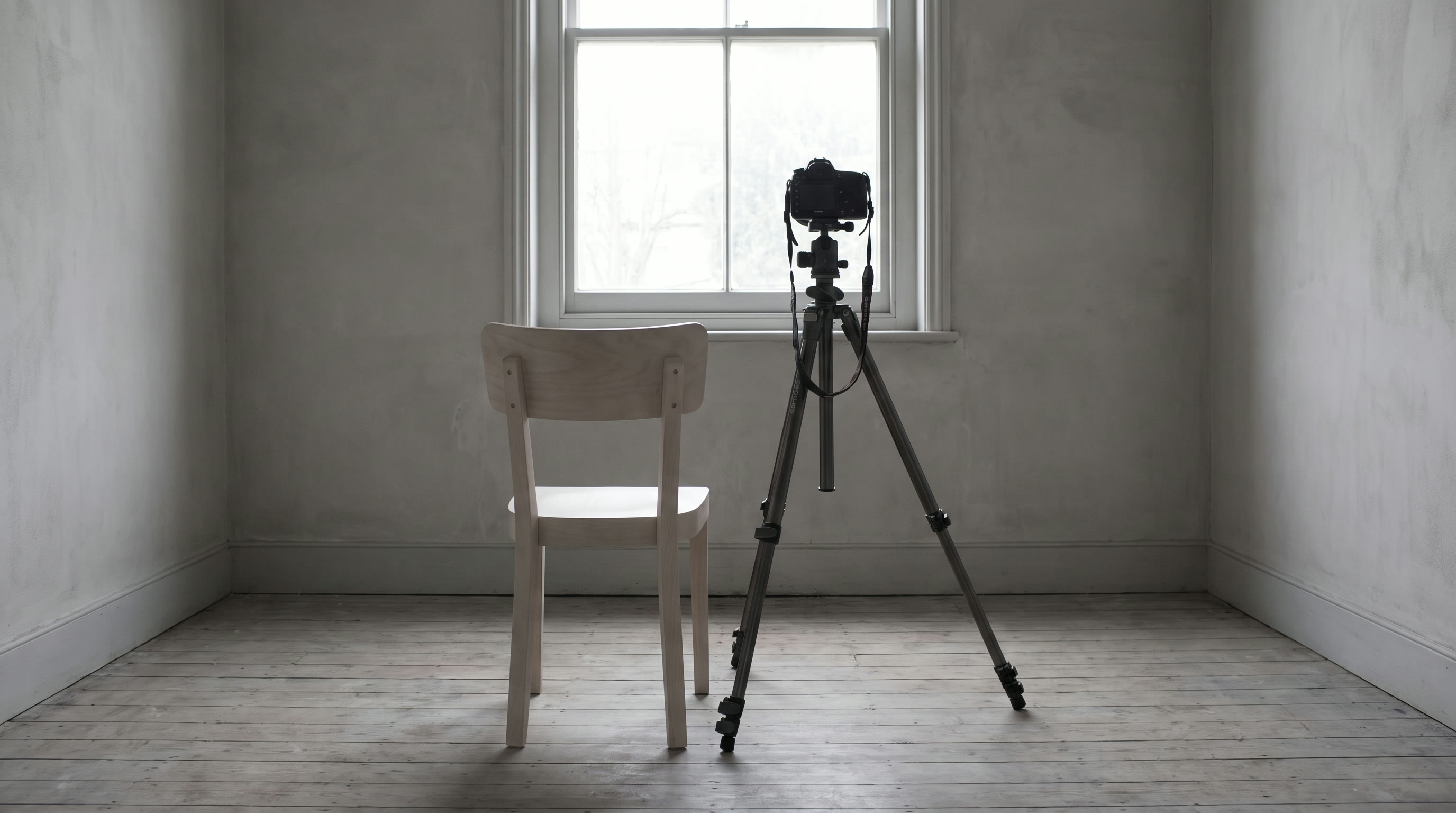
You still need a reader, and a monologue is the reason why
This is the most counterintuitive instruction on the page. A monologue has one voice, so it feels like the one situation where nobody else is required.
It is the opposite. A monologue is not a speech. It is a scene with one person missing, and your job is to put them back. You do not need a reader to feed you lines. You need one to be the person you are talking to, and that is the entire task. A bedroom is very good at removing them.
Put them one to two feet from the camera, off frame, just to one side, so your eyeline sits close to the lens without being on it. They are not in the slate. And per the British code, they do not have to be a professional or be paid, which is worth knowing if you have been apologising to a flatmate.
How many takes to send
Two working casting directors gave a number, and two entirely separate industry bodies arrived at the same one.
The quote is “we can tell that they’ve done twenty-plus takes or whatever, and they’ve ironed out all of the humanity”, followed by a direct recommendation of no more than three takes, unless you really messed something up. That three is theirs rather than our inference, which matters.
Who says itAnd what they land on
Two working casting directorsTrade press, March 2025
Three
Named, credited, currently casting. Over-taping is the mistake they see most.
The main British directoryIts own published guide
Three
If you cannot get it in three, stop, pause, and come back to it rather than grinding.
The British casting directors’ guildIts self-taping guidance
Two
A couple of different takes, two at most ideally. Three independent bodies, one answer.
And what to sendFrom the real briefs
What was asked
One take per scene where that is specified. Sending more than requested is not enthusiasm. It is a failure to read the brief.
On editing: start rolling before you begin and stop after you finish, then trim to the edges of the performance rather than into it. Casting deliberately watch the moments either side. Do not cut between beats to assemble a best-of. One take is one take.
Files, and the number we were about to over-generalise
Our research gave a 250 megabyte limit. It is real. It is also one casting director’s brief, and we nearly printed it as a standard.
The actual platform limits are mostly much larger, and none of them is 250.
Where you are uploadingWhat they publish
The main American submission platformIts own help pages
1 GB
Accepts up to a gigabyte, but recommends staying under 500 megabytes for a reliable upload. Prefers MP4; flags that MOV sometimes causes trouble.
The other American platformHelp centre, current
300 MB
Three hundred for general media — but uploads against a specific casting request were made unrestricted in 2024.
The British directoryTechnical specifications
No cap
Publishes no size limit at all. It gives you a broadband speed test instead, which is a more honest answer to the real problem.
The British guild’s own guideIts self-taping PDF
70 MB
Far smaller than anything American. One guild document’s guidance, not a platform rule — and we are flagging it exactly as we flagged the 250.
So the useful rule is not a number. None of the four platforms publishes any slate requirement of its own — slate content is entirely a matter for the individual brief on both sides of the Atlantic. And the file size that matters is whatever the brief says, then whatever your upload can actually manage. Where nothing is specified, send a link rather than an attachment, and make sure it opens without an account, a password or a permission request. A casting director who has to ask you for access has already moved on.
What happens if the standard advice does not fit you
A brief that demands a full body slate assumes a body that stands up. We went looking for guidance on that and found almost nothing, which is worth saying out loud.
The best document that exists is British — an accessible auditions guide produced by the casting directors’ guild with the union’s deaf and disabled members committee. It is real, it is specific, and it is aimed at casting rather than at actors. One line stands out: there are many examples of wheelchair users being asked to perform tricks at audition, and if you are asking for a physical demonstration you should know what you are actually asking for and be able to say why.
But it does not answer the direct question, and neither does anything else we could find. Nobody has published what a wheelchair user does when a brief says full body slate. Nobody has published a convention for slating in sign language, or for captioning a tape. And nothing at all exists on recording when the plain wall, quiet room and good light assumption simply does not hold. That is not us failing to look. It is an absence, and we would rather name it than paper over it. What does exist: the union provisions above allow you to request reasonable accommodations and materials in an accessible format, and put disabled performers, seniors and minors first in line for a live alternative to a tape. Asking is a right rather than a favour, and that is the single most useful sentence we can offer here.
Grading the sources
The line this page was going to be built around has no author, no date and no named speaker. The thing that actually answers the question is a contract nobody quoted.
The claim, and where it came fromWhat we found
Casting directors regularly skip tapes with no slateOur research, as the headline
Unsourced
A crew-hire marketplace with no byline, no date, no external links, and five casting-director quotes with no names attached. Not one identifiable person says this.
Cut at second twelve, decided in thirty secondsThe same site
Invented
No study, no method, no source. False precision, which is a persuasion technique rather than a finding.
The Caine ratios for scaling a performanceA subscription newsletter
Fabricated
Not in his book, not in his filmed masterclass. Third time this one source has produced something unfindable anywhere else. Removed.
The collected briefs are from last yearOur own dating
Wrong
Published 2021, updated 2025. And several instructions we would have shown as separate briefs come from the same document.
What a slate must containA negotiated union agreement
Primary
Name, height, city of residence, current location, plus age for minors and special skills. Along with page caps, turnaround times and no memorization requirement. Our research had no union source at all.
The British code of best practiceFour industry bodies jointly
Primary
Six pages, four days, two takes, readers unpaid and non-professional. Real, negotiated, and with no American equivalent.
An ident is not a slateThe British directory’s own guide
Primary
Different name, different default content — agent rather than height — and a much firmer rule about landscape. Actively maintained.
No more than three takesTwo working casting directors
Primary
Named, credited, March 2025, and three is their own number. Independently matched by two British bodies.
Slate only if askedA trade magazine, quoting a named coach
Good
Dated and attributed. The clearest counterweight to the unsourced claim above.
Slate vertically, and put it at the endA named casting director
Stale
She is real and well credited. But the advice is from 2018, last touched in 2023, and it runs against every other source. One person’s preference, carried forward.
The handshake, and do not apologiseAn app founder’s blog
Fair
Named, dated, and a real working actor and director — but not a casting director, and it is an opinion piece for a product he is building. Good advice, honestly presented, not authority.
What a disabled actor does with a full body slateNobody
Absent
One good British guide addresses the surrounding behaviour. Nothing anywhere answers the question itself, or covers slating in sign language.
Where we differ from the standard account
Do you have to slate?
Commonly saidAlways, or your tape gets skipped.
What we foundThat warning has no named source. The named source says slate only when asked. Slate anyway if the brief is silent, and stop worrying about it.
How much should you say?
Commonly saidNever volunteer your height, as a matter of etiquette.
What we foundHeight and location are on a contractual list of what a slate may contain. Give what the brief asks for and nothing else.
Do you have to be off book?
Commonly saidObviously.
What we foundNot on a union self-tape. There is no memorization requirement, and there are caps on pages and turnaround too.
Is British practice the same?
Commonly saidNobody asks.
What we foundIt is called an ident, the default is name and agent, landscape is a hard rule, and there is a negotiated code the United States has no equivalent of.
Where do you look?
Commonly saidAt the camera.
What we foundFor the slate, yes. For the speech, just past it, to your reader. This is the thing most tapes get wrong.
Do you need a reader for a monologue?
Commonly saidIt is one voice, so no.
What we foundA monologue is a scene with one person missing. The reader is not there to feed you lines.
How many takes?
Commonly saidSend your best few.
What we foundTwo or three, from three separate industry bodies. Twenty takes is visible, and what it looks like is nothing.
Is there a standard?
Commonly saidEvery guide gives one.
What we foundThere is so much variation that there is no one right way. The brief is the standard.
Do one thing tonight. Open the brief you are working from and read it twice, with a pen, writing down every instruction as a separate line. Then count how many of them you were about to get wrong out of habit. That list is the actual test. Everything else on this page is what to do when the list is empty.