
The reason movement training feels opaque
Three questions, three columns, and nobody tells beginners this.
Someone sent to a Suzuki class expecting to learn character physicality will be baffled. Someone sent to Alexander expecting to get stronger will be equally lost. They are not bad classes. They are answers to questions that were not asked.
Stop getting in my own way
Get the capacity to do this at all
Become physically someone other than me
The strongest evidence base in this entire course
One of these has randomised controlled trials. It is the one actors treat as optional.
We have now researched voice methods, acting techniques, line-learning and movement across this course. Nothing else has evidence like this — and the honest limits are just as worth knowing.
The ATEAM trial — Little, Lewith, Webley and colleagues, BMJ 2008 — randomised 579 patients with chronic or recurrent low back pain across 64 GP practices. The arms were normal care, massage, six Alexander lessons, or twenty-four Alexander lessons. Half of each group was also randomised to exercise prescription.
One to one lessons in the Alexander technique from registered teachers have long term benefits for patients with chronic back pain. Six lessons followed by exercise prescription were nearly as effective as 24 lessons.Little, Lewith, Webley et al., ATEAM randomised controlled trial, BMJ 2008;337:a884 — the conclusion, verbatim
A systematic review the following decade — Woodman & Moore, International Journal of Clinical Practice, 2012 — screened 271 publications and selected eighteen, including three randomised controlled trials. Its verdict:
Strong evidence exists for the effectiveness of Alexander Technique lessons for chronic back pain and moderate evidence in Parkinson's-associated disability.Woodman & Moore, Int J Clin Pract 2012;66(1):98–112
And NICE, in its Parkinson's disease guideline NG71 (2017, recommendation 1.7.4), says: “Consider the Alexander Technique for people with Parkinson's disease who are experiencing balance or motor function problems.”
One — the evidence is for pain and function, not for acting. Nobody has shown that Alexander lessons make you a better actor. What has been shown is that a discipline explicitly about reducing habitual muscular tension produces measurable, durable clinical benefit.
Two — the same review says the posture claims are not supported. Its exact words: preliminary evidence suggests lessons may improve balance in the elderly, general chronic pain, posture, respiratory function and stuttering. But “there is insufficient evidence to support recommendations in these areas”. If somebody sells you Alexander lessons for your posture, that is not what the literature says.
Three — “consider” is NICE's weakest recommendation strength, it is conditional on balance or motor problems, and it sits inside a physiotherapy section. It says nothing about healthy actors.
Four — and we are correcting our own brief here. Our research said the British Association for Performing Arts Medicine endorses the Alexander Technique for performers. It does not. BAPAM's own site states plainly that it “does not recommend or endorse any specific treatment or therapy”. Alexander teachers are listed in BAPAM's practitioner directory alongside other disciplines. That is a listing, not an endorsement. We found the endorsement claim only on practitioners' own websites. It is out. Worth noting too that both authors of the systematic review are Alexander-affiliated, and its “strong evidence” rests essentially on the one BMJ trial.
What the technique actually trains is unglamorous. Reducing muscular tension during ordinary activity — sitting, standing, walking. Cutting the overuse of superficial muscles in posture. Increasing proprioceptive awareness, and attending to the body's warning signs of tension and compression. It is taught through verbal instruction and hand contact, which is the one item in this chapter you genuinely cannot learn from a video.
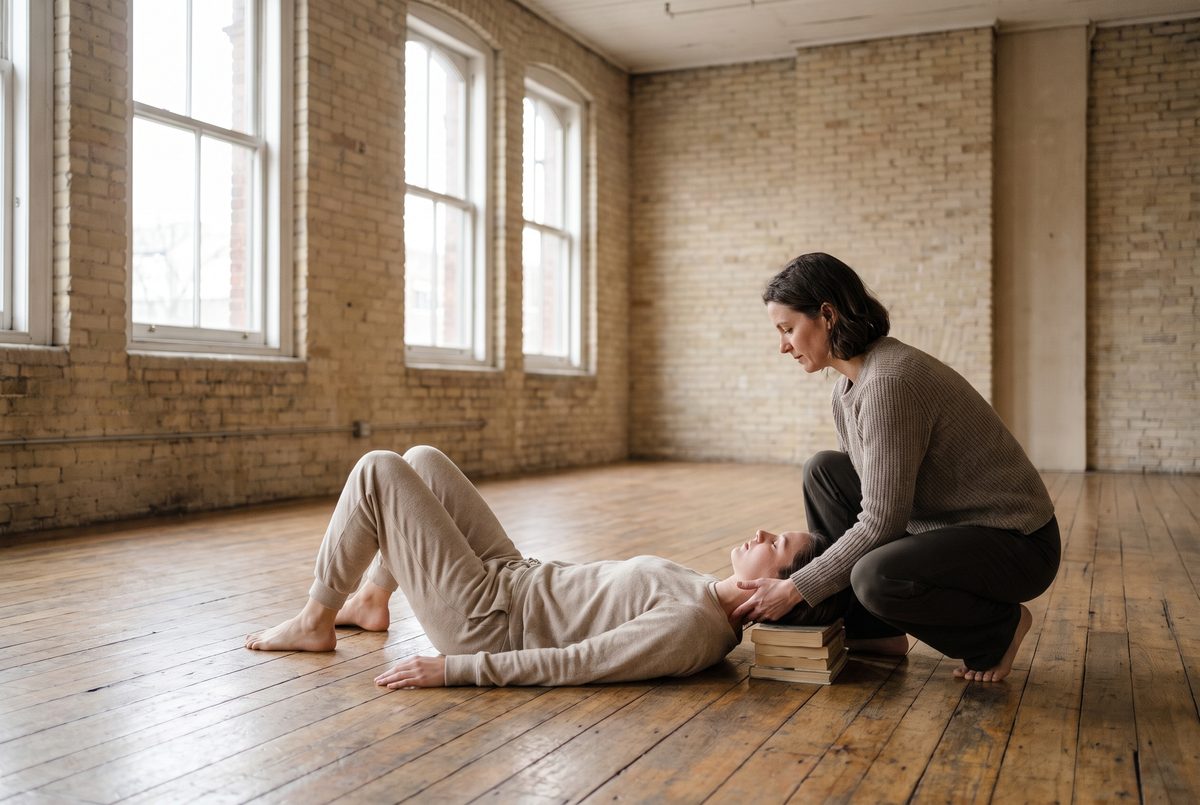
Semi-supine. Not stretching, not fixing — noticing. The cheapest version of the undo column, and it needs no teacher to begin.
The section a beginner will actually use tomorrow
Laban gives you axes instead of adjectives.
Chapter three established that “be angry” is unplayable because it names a result. The same trap swallows physical direction. “Play him nervous” produces an imitation of nervousness. Four dials produce the real thing as a by-product.
Rudolf Laban (1879–1958) was a Hungarian dance theorist. His work became one of the two major sources of movement training in Britain and America. It was carried into actor training by Yat Malmgren at Drama Centre London, and by Trish Arnold, Kristin Linklater's long-time collaborator at Shakespeare & Company. It is usually taught as BESS: Body, Effort, Shape, Space. The part you will use is Effort, and Effort is built from four motion factors, each with two poles.
Space. Does this person go straight at what they want, or circle, scan and approach it sideways?
Time. Do they answer immediately, or let a thought stretch out before anything happens?
Weight. Do they press into the world, or barely disturb it as they pass through?
Flow. Is the energy carefully held and checkable, or allowed to keep travelling once it starts?
Combine those and you get the eight Efforts. They are described as the eight basic actions from which all conscious human movement is formed, and Laban held that each one carries its own emotive quality.
Float — indirect, sustained, lightPunch — direct, quick, heavyGlide — direct, sustained, lightSlash — indirect, quick, heavyDab — direct, quick, lightWring — indirect, sustained, heavyFlick — indirect, quick, lightPress — direct, sustained, heavy
Suppose a director asks for delicate buoyancy and you have no idea what to do with your body. The system tells you that quality lives in float — indirect, sustained, light. You can go away and actually rehearse that.
Pick a scene. Turn one dial by a small amount and run it again. Not all four, and not to an extreme. That is usually enough to change your rhythm, your eyeline and your voice without turning the scene into a demonstration. It is the action verb from chapter three, applied to the body.
The rest of the names, briefly, because the map is doing the work
Where the other systems fit.
Chapter two had to point out that the Western acting canon presents itself as self-generated while its most influential dissent — Brecht — came from an essay about Chinese performance. Movement training does not have that problem to the same degree. Suzuki names martial arts, Noh, Kabuki and the Greek chorus openly. The surrounding discourse names Hula and Kalarippayattu. Lecoq and Laban are traced as European lineages rather than as universal defaults.
That is what it looks like when a field is honest about where it got its ideas. Though crediting a source is not the same as engaging with it on its own terms. Noh, Kabuki, Kathakali and Kalarippayattu are complete training systems, not raw material. This chapter treats them as the latter, which is exactly the problem it is half-solving.
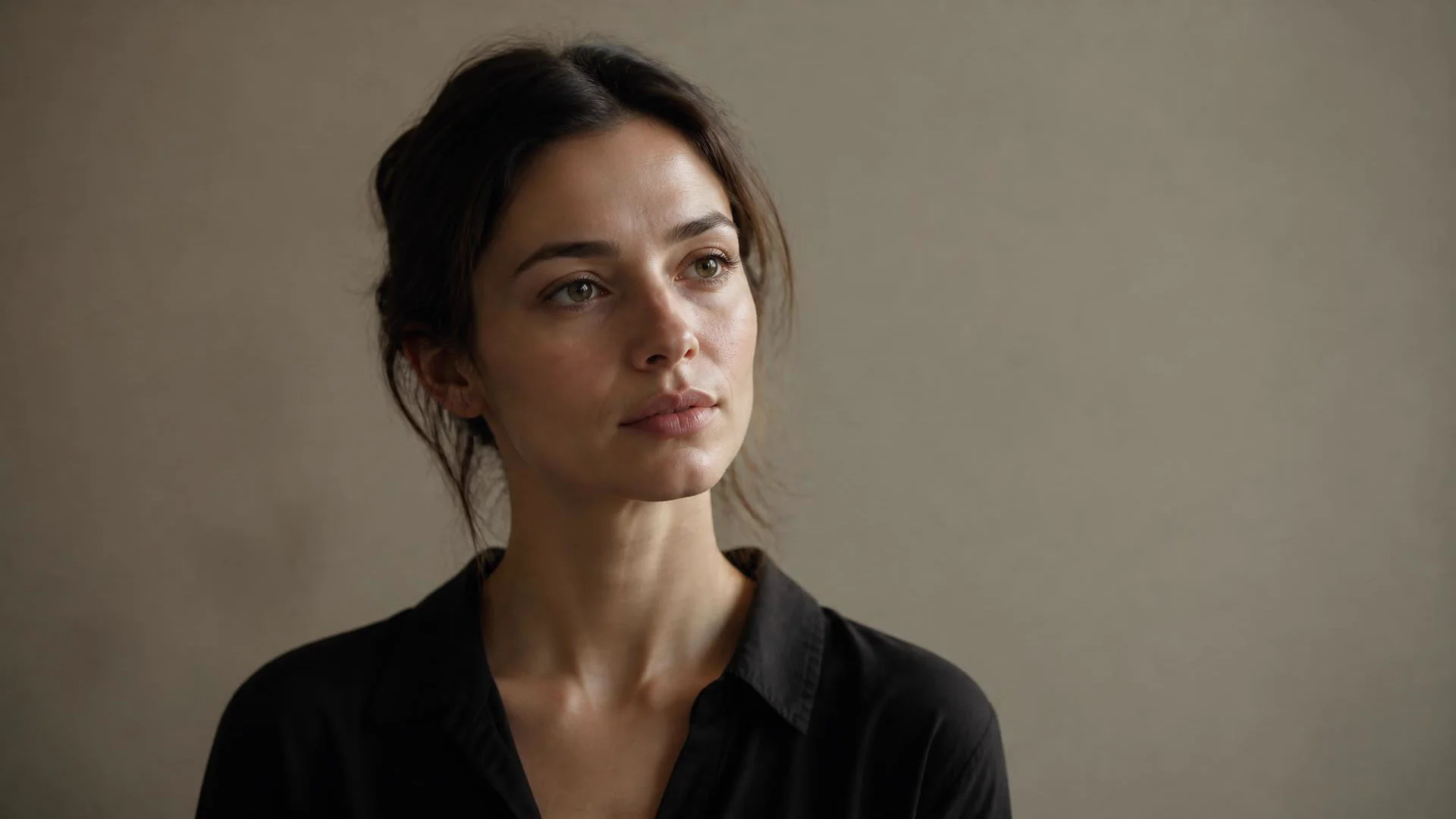
This is the whole window. Head, neck, shoulders, breath, eyes — and whatever your hands do if they enter it.
Why a movement chapter belongs on a self-tape site
On camera, movement does not disappear. It becomes tension.
Almost everything above was built for a stage — a whole body, seen from twenty metres, in a space. A self-tape shows you chest-up, from six feet, for ninety seconds. So does any of it matter?
Film one line twice. First, hold yourself deliberately still. Then plant your feet, let the breath go, and simply listen before you speak.
The second take will look quieter and feel more alive. That is the entire distinction between rigidity and stillness, and you cannot un-see it once you have watched it back.
The connection this course can make and a pile of articles cannot
Three departments. One error.
Put the chapters side by side and something falls out that none of them says on its own.
A claim the acting world repeats and should stop
Does standing differently change how you feel?
Yes — but almost certainly not in the direction, or for the reason, you have been told. This one is worth getting right, because the popular version is one of psychology's best-known cautionary tales.
“Power posing” entered acting training from a 2010 study. It reported that two minutes in an expansive posture raised testosterone, lowered cortisol and increased risk-taking. In 2015 a larger replication found the hormonal and behavioural effects were simply not there. Only felt power survived. Then a 2017 analysis of the wider literature reached a blunt conclusion. The existing evidence was “too weak to justify a search for moderators or to advocate for people to engage in power posing to better their lives”.
I do not have any faith in the embodied effects of “power poses.” I do not think the effect is real.Dana Carney, first author of the original 2010 power-posing paper, in a public statement on her Berkeley faculty page, September 2016
A 2022 meta-analysis pulled together 73 studies on expansive and contractive posture. What it found was asymmetric, and the asymmetry is the whole point. Collapsing measurably dampens how you feel. Expanding adds essentially nothing over a neutral posture. The authors' conclusion is that it is the absence of contractive displays, rather than the presence of expansive ones, that changes affective and behavioural response.
Read that against the three columns above. The supported finding is not “strike a powerful pose”. It is “stop collapsing” — which is precisely, unglamorously, what the undo column has been teaching all along.
What else is defensible: Alexander participants report improvements in balance, posture and walking alongside increased coping and reduced stress, and the technique's stated mechanism includes raising proprioceptive awareness. And from chapter five, lines learned with appropriate movement were more readily recalled — a documented body-to-cognition effect. Your body and your state are coupled is well supported. Two minutes in a pose changes your hormones is not, and repeating it would undermine everything else this course has been careful about.
Pain is information, not commitment
Your body is not an obstacle to be overcome.
This is the same message as the voice chapter, and it needs saying twice because the culture pushes the other way twice.
Small, and more use than a survey of six systems
What to actually practise.
Five minutes daily in semi-supine
Lie on your back, knees bent, feet flat, head on a small stack of books. Notice where you are holding. Not stretching, not fixing — noticing. It is the cheapest version of the undo column and it needs no teacher to begin.
Weekly, turn one dial and film it
Take a character and change one of the four Laban factors. Direct to indirect. Quick to sustained. Watch it back with the sound off, then with the sound on. Notice what the body did to the voice.
Walk the scene instead of sitting with it
Two chapters of this course now point the same way: movement aids recall, and it finds the physical life at the same time. Sitting in a chair with a script is the least productive way to do either.
Watch back with one question
Not “did I look good”. Ask where am I holding? Then run it again with slightly less effort everywhere. A general verdict produces self-criticism; one question produces a note.
The one thing you cannot do alone
Alexander Technique is delivered through verbal instruction and hand contact. That is not learnable from a video, and it is the single item on this list where a teacher is not optional.
The honest state of the evidence
Where the field genuinely disagrees.
Does movement training work?
A centuryOf practice, and every conservatoire in the world teaches it.
EvidenceOnly Alexander has RCT evidence — and that evidence is for pain and function, not for acting.
Does Alexander improve posture?
AssumedIt is what almost everybody thinks it is for.
The reviewPreliminary evidence only, and explicitly insufficient to support a recommendation.
Is more physical effort better?
SuzukiTakes the body to the brink of exhaustion, deliberately.
Also SuzukiExpression comes through the resonance of energy, not through force. Both are true at once.
Does posture change how you feel?
Widely repeatedIn acting training, usually via power posing.
Not thatThe original author disavowed it. What survives is that collapsing dampens affect — not that expanding lifts it.
Is this a theatre-only subject?
By originEvery system here was built for a body seen whole, in a space.
On cameraIt becomes tension in the neck, shoulders and jaw — the only region a chest-up frame contains.
Can every body do this?
Taught as universalThe exercises are presented as though everyone can perform them.
AbsentDisabled and chronically ill actors are essentially missing from the literature.
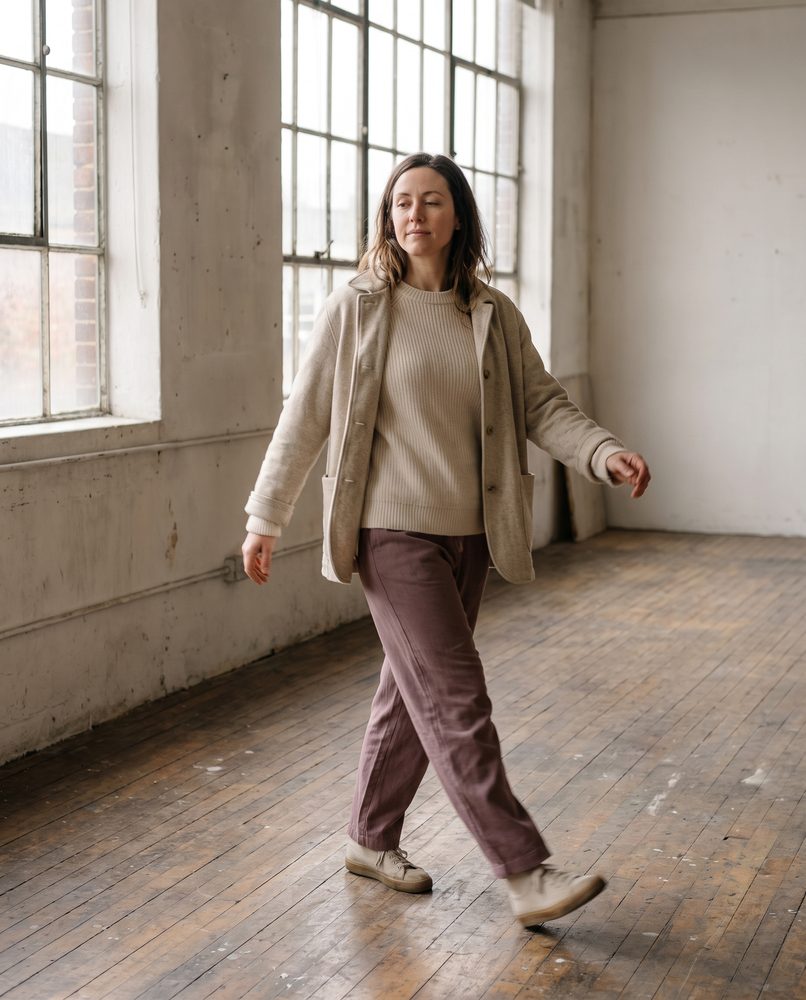
Film the same line four times.
Keep the intention identical and change only the movement quality. Direct and sustained. Indirect and quick. Heavy and bound. Light and free.
Watch them back with the sound off first, and see which one tells the clearest story. Then turn the sound on, and notice what the body did to the voice without being asked.
Chapter four: voice & speech