
It is a question, not a command
Most bad acting notes are assertions: be angrier, look heartbroken, you are a king so be kingly. An assertion asks you to make something true by insisting on it, and your body knows you are insisting.
An if does something different: it asks a question, and questions are easy to answer. You handle dozens of hypotheticals a day without effort — what would I do if I missed this train, and if she says no, what then? Nothing in your mind resists a hypothetical, because you are not being asked to believe anything.
That is the whole mechanism. It is also why a word as ordinary as a conjunction ended up with “magic” attached to it.
Notice that every answer in the right-hand column is a thing you could film. The left-hand column describes weather inside you, which nobody can see and you cannot switch on.
Here is the passage, from Jean Benedetti's translation of Stanislavski's An Actor's Work. The speaker is Tortsov, the fictional teacher through whom Stanislavski wrote the book.
You now know that our work begins by introducing the magic “if” into the play and role, and this lifts the actor out of everyday life into the world of the imagination. The play, the role, are stories, a series of magic and other “ifs”, Given Circumstances which the author has made up.Stanislavski, An Actor's Work, trans. Jean Benedetti, Routledge, 2008, p. 60
And the image everyone quotes is a lever. This one is worth getting right, because it is almost always cited to the wrong book.
Second: if acts as a lever to lift us out of the world of actuality into the realm of imagination.Stanislavski, An Actor Prepares, trans. Elizabeth Reynolds Hapgood, ch. 3, p. 46
Benedetti translates the same Russian sentence more plainly, and his version is arguably the more useful one for an actor.
For actors, “if” is the lever which lifts us out of the world of reality into the only world where we can be creative.Stanislavski, An Actor's Work, trans. Benedetti, p. 48
Does imagining actually do anything?
This is the question that decides whether the Magic If is a technique or a superstition. It has an answer, and the answer is a number on a sensor.
Put an electrode on someone's fingers and you can measure how much they sweat. It is called skin conductance, it moves without permission, and you cannot decide to do it. In 2021 a team at the University of New South Wales used it to test whether imagining something frightening produces a real physical response.
It does, and in one group it does not.
Read that control condition again, because it is the part that stops the finding being misused. People with aphantasia are not emotionally flat, and if you show them something frightening they respond exactly like everyone else. What is missing is the response to material they have to generate internally.
For an actor, three things follow at once, the first being that imagining has a physical signature you can put a sensor on. That signature runs through imagery, because removing the imagery removes the response. And so the Magic If is a real technique with a real mechanism. That is a better defence of Stanislavski than a century of people asserting that it works.
Not everyone imagines the same way, and nobody mentions it
Ask a room of thirty actors to picture a kitchen. You will assume they are all doing roughly what you are doing. They are not, and the range is wider than almost anyone in the room suspects.
In 2015 Adam Zeman and colleagues published a short letter in Cortex. It named a condition that had never had one: the inability to form voluntary mental images. They called it aphantasia, and the opposite end — imagery experienced almost as vividly as looking — is hyperphantasia. Most people sit between them.

Scale that to a room. In a drama school year of thirty, roughly one student forms no voluntary images at all, and one more sees only something faint. Two more are at the far end, seeing almost as clearly as looking. Four people in that room are having internal experiences the other twenty-six would not recognise, and none of them know it.
What else travels with it
The research on aphantasia is a decade old and still moving, so this list is a snapshot rather than a settled account. Some of it is well supported, and some of it rests on a single study.
What Stanislavski actually said about seeing
Our own research brief built an argument on one sentence, and when we went to the book the sentence had been rearranged. This section is the correction, and the corrected version is more useful than what we started with.
The famous line defines imagining as a visual act, it is quoted constantly, and it is real. But it is almost always printed in the wrong order, with a qualifier removed. Here is what Benedetti actually has on page 73, in sequence.
So, all I have to do is set a theme for you and you begin to see pictures with what we call your mind's eye. In our actors' jargon we call these mental images, the inner eye. … Judging from personal experience, to imagine, fantasize means above all to see the things one is thinking about with the mind's eye.Stanislavski, An Actor's Work, trans. Benedetti, p. 73
Three things were being done to that passage, the first being that the two halves were printed in reverse order. The words “Judging from personal experience” were dropped, which turns one man's report into a definition. And “in our actors' jargon” went too, which turns studio slang into a claim about how minds work.
Then, two pages later, he says this.
The same thing happens with hearing. We hear imaginary sounds not with outer but with our inner ears, but we identify the source of these sounds, in most cases, as not inside but outside ourselves.Stanislavski, An Actor's Work, trans. Benedetti, p. 75
So imagining was never only pictures. He does give sight priority, but he says why. The reason is practical rather than philosophical. Feelings are “elusive, capricious, mutable and cannot be pinned down”, whereas sight is easier to work with. He recommends the visual route because it is the most controllable one he has, not because it is the only door.
If the pictures never come
Some readers will have reached this page because “see it in your mind's eye” has never once worked. They assumed the problem was effort. It is not effort, and it is not talent.
If that instruction produces nothing at all, your imagination is not weak — it is not pictorial, and those are different, only one of them being a problem. The Magic If asks what you would do, and answering it requires no picture whatsoever.
Here is the translation, instruction by instruction, where the left column is what you were told. The right column is the same request, rewritten so it can actually be answered.
Every answer on the right is about position, fact, consequence or want, and none of them needs an image. And notice how many of them are better notes even for an actor whose imagery is vivid.
Six routes that do not need pictures
You can know that something is the case without seeing it. If I were being followed, what would I do? is a question about behaviour and consequence. This is arguably closer to Stanislavski's actual question than the visual gloss is.
Spatial imagery is typically unaffected in aphantasia. You may not see the room, but you can know where things are. Blocking, distance and proximity are spatial rather than pictorial.
Late Stanislavski built his whole method of physical action on this, and Chekhov's psychological gesture works the same way. Move first and discover second, because you are not required to picture it and then perform the picture.
Put the circumstance into one written line and let the language carry it. She has already decided and this is a courtesy. That sentence changes a performance without producing a single image.
If internal imagery is unavailable, externalise it: a real object, a real temperature, a real sound, a real distance. The prop in your hand does not need imagining.
Attention outward needs no internal image at all. Listening, noticing and responding are the whole job, and they are happening in the room rather than behind your eyes.
What remains genuinely open is narrower, and it is a real gap. Nobody appears to have measured imagery vividness in actors as a group, so we cannot say whether actors self-select for vivid imagery. Nor is it known how many working actors have total aphantasia. But the question of whether any do has an answer, and it is yes.
I create wonderful images for them with my words and … they can see the landscapes and characters that I conjure up during performances. Yet I see nothing. … I think that lacking the ability to “see” the story enables me to “inhabit” it. This means that rather than describing what I see, I become it.Katrice Horsley, former UK National Storytelling Laureate, writing in Medical News Today, 2021
She goes further than tolerance, and says her aphantasia is a benefit in performance. That is one person's account rather than evidence. It is still worth more than a shelf of reassurance, because it comes from somebody who does this for a living.
How to use it, in about five minutes
The Magic If is a lever in Stanislavski's own image, and a lever is meant to move something quickly. This is minutes of work, not an afternoon.
Who are you with, where are you, what just happened, what do you need now? This is the given circumstances chapter, and the Magic If has nothing to act on without it.
Not “if I were sad”. Try “if she had just told me that, here, with no warning, what would I do?” The specifics are load-bearing.
Reassure, corner, distract, charm, protect, stall, make them say it out loud. An action you could aim at another person, not a mood you hope to feel.
Do not demonstrate the answer — chase it, and notice what changes in how you listen.
A vague if produces a vague answer, so add a detail that raises the stakes and ask again, without pushing for the feeling.
Ask it again at the moment before, and at each point where the scene changes direction. One if for a whole scene is not enough.
“What would I do”, not “what would they do”
This looks like a small distinction. It is not, and Stanislavski is unusually explicit about which side he is on.
In that case, say to yourself, this is me, but if I were an oak, if around me and within me the circumstances were such and such, what would I do?Stanislavski, An Actor's Work, trans. Benedetti, p. 77
Hapgood's translation of the same moment is blunter, and it is the version worth remembering.
Why don't you say to yourself: “I am I; but if I were an old oak, set in certain surrounding conditions, what would I do?”Stanislavski, An Actor Prepares, trans. Hapgood, p. 65
The subject is you, not a character you are speculating about from outside, which produces commentary and impressions. Three things follow from that.
Imagination instead of memory
This is the Magic If's most important job in this course, and it is a safeguarding point as much as a craft one.
Emotional recall asks you a question about your own life: what happened to me that felt like this? The Magic If asks a question about a situation: if this were happening, what would I do? The first requires you to have lived something comparable and to go back into it. The second requires nothing from your history at all.
So the answer to “what if I have never experienced anything like this scene?” is that you do not need to have. That is precisely what the technique is for, and it is why Adler and Chekhov built their systems around imagination rather than recall.
On camera, where almost nothing is real
The Magic If matters more on screen than on stage, for a simple reason: less of the fiction is physically present.
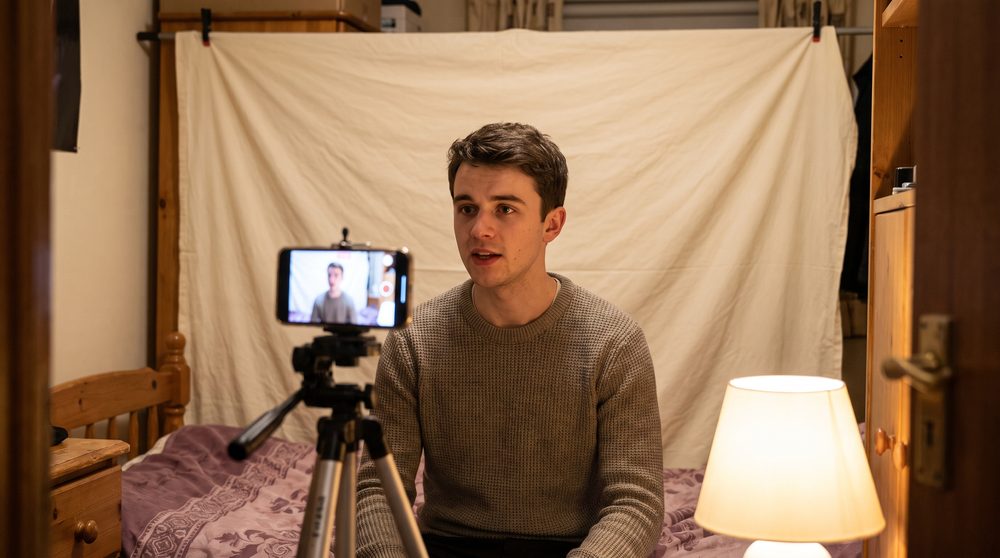
On stage you are inside a built world with other people in it. On camera the set stops at the frame edge, the audience is absent, and you may be playing to a mark on a lens. In a self-tape there is even less — a bedsheet, a lamp, a phone, and a friend reading flatly from beside the camera.
The instinct is to try to imagine the whole world of the script, but almost all of the useful work is in one place.
- I know exactly what has just happened, in one sentence.
- I know what I want from the other person.
- I can say my action as a single verb.
- My eyeline has a person in it, not a spot on the wall.
- I am ready to listen rather than recite.
- If I picture nothing at all, I have used a route from the list above instead.
If you teach this
One request, and it costs nothing.
Ask the room what happens when they imagine, rather than assuming you already know. The range in any group of thirty is enormous and completely invisible, and the students at the far ends have no idea they are unusual. The one who sees nothing has probably concluded, silently and for years, that they lack imagination. They do not. Theirs is not pictorial, and the note they need is a different note, not a louder version of the same one.
One of my friends said that he uses the images in his head to enhance role play. When I asked him to explain this in more detail it became clear that he — and everyone else in the room — could easily create an image in their head and use that as the backdrop for the role play.Mary Wathen, a solicitor from Gloucestershire, describing how she found out, University of Exeter, 2024
That is how most people discover this about themselves. Not from a test, but from a stray remark in a room. Then comes a long recalculation of everything they had assumed was difficult for everyone.
Where the sources disagree
Every chapter on this course ends here. These are live disagreements, not settled questions, and you should know which is which.
Is imagining visual?
Commonly saidStanislavski's most quoted line says see it with the mind's eye.
What we foundTwo pages later he extends it to hearing, and about 1% of people form no voluntary images at all.
Does imagining do anything?
Commonly saidOften treated as a mental trick with no physical reality.
What we foundReading frightening stories changes skin conductance — but not in people with aphantasia.
Talent or skill?
Commonly saidTeachers treat imagination as trainable.
What we foundThere are neurophysiological differences and a familial pattern. Specificity is trainable; the modality you were born with is not.
Do you have to believe it?
Commonly saidThe naive reading of “living truthfully” says yes.
What we foundAudiences sweat at films they know are fiction, so imagery evidently works without belief in the fiction.
Whose behaviour are you asking about?
Commonly saidCharacter-first is most actors' instinct.
What we foundStanislavski's formulation is I, placed in their circumstances. “I am I; but if I were an old oak…”
Is imagining safer than remembering?
Commonly saidBoth are described as “using yourself”.
What we foundRetrieval can destabilise a real memory, while imagining a fiction does not.
Has anyone applied this to actors?
Commonly saidOur own brief said nobody had.
What we foundA 2021 Routledge chapter did. What is still missing is any measurement of imagery vividness in actors as a group.