How Actors Can Check Whether a Gig Is Real
A practical way to verify a casting approach before you submit: check the people, the paperwork, the payment terms and the rights you are being asked to sign.
By Sal Framondi
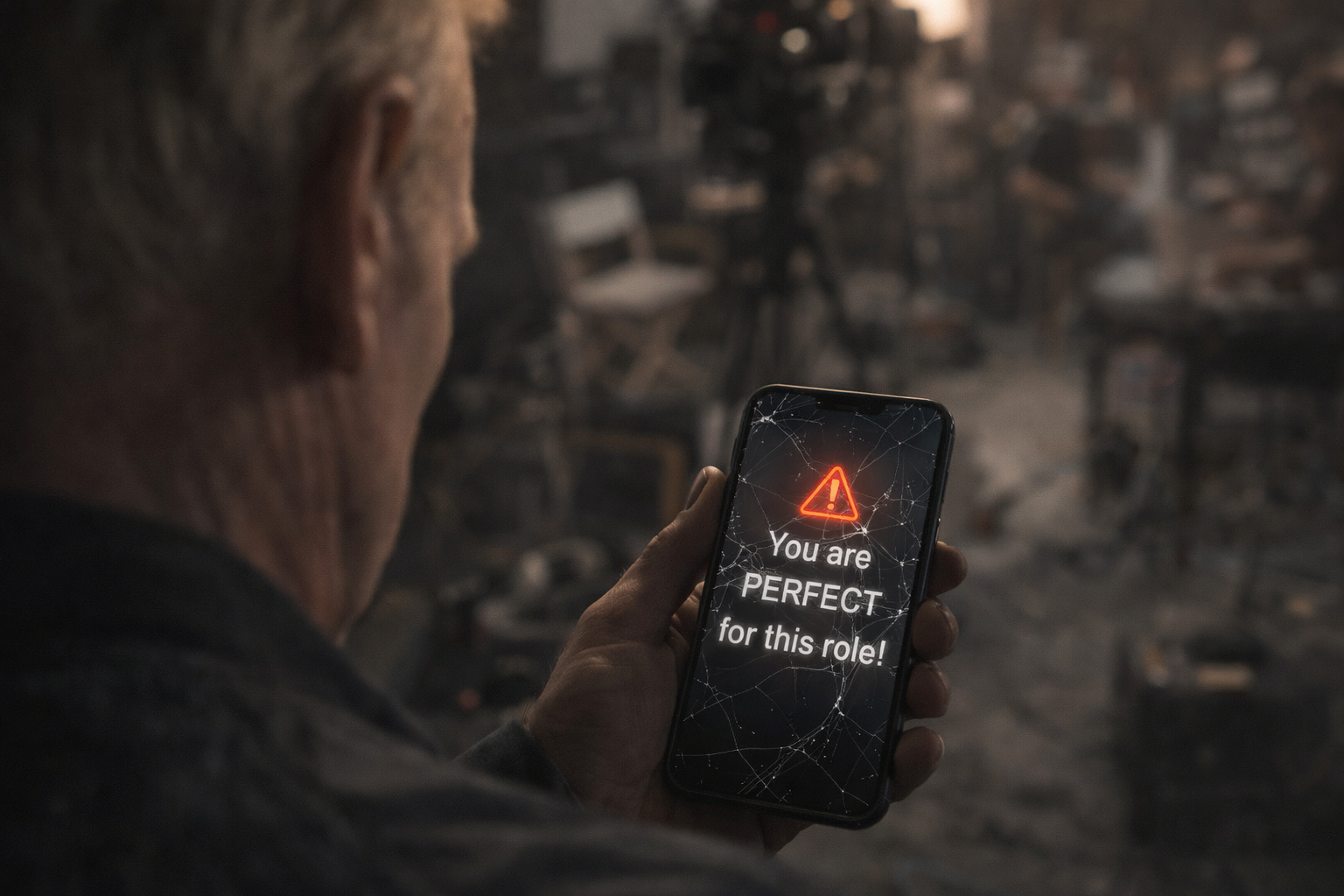
The way to tell a real gig from a fake one is to check it before you feel anything about it. Look up the people named, confirm the production exists somewhere outside the message you received, read what you are being asked to sign, and refuse to send money or personal documents to anyone who cannot be verified.
This post is a verification routine you can run in about twenty minutes. For the wider picture of how these schemes are structured, the Academy covers common acting scams and how to work out whether a casting call is real.
Why the pitch works
Being wanted feels good, especially after a quiet stretch. A message that says someone saw your profile and thinks you are right for a role arrives as validation first and information second. That gap — between feeling chosen and knowing anything — is where the risk sits.
The fix is not to become cynical. It is to put a fixed process between the message and your reply, so that your decision does not depend on how flattered you are that day.
Step one: check the people
Take every name in the message — the caster, the producer, the production company — and search for each one independently. You are looking for a trail that exists apart from the email you were sent: a company that has made things, a professional profile with a history, credits you can confirm on an industry database.
Signs to slow down for:
- Impressive credits that you cannot confirm anywhere independent.
- A company name that returns nothing, or returns a site created very recently.
- An email address on a free consumer domain when the person claims to represent a company.
- A profile photo or biography that appears elsewhere under a different name.
- Someone who reacts badly to being asked normal questions.
A legitimate production expects to be researched. Nobody serious is offended by a professional asking who is producing.
Step two: check the project
Ask for the basics in writing: the project title, the production company, the shoot dates, the location, the role, the rate, and who to contact. A real project can answer all of that. If the answers stay vague after you have asked directly, you have your answer.
If a union is named, verify it with the union itself rather than taking the claim at face value. Unions maintain the means to confirm whether a production is a signatory, and a project that genuinely is will not mind you checking. If someone resists that, step away before you send anything.
Where a casting call appeared matters too. An approach sent through a social media direct message, with no matching listing on any established board or the production's own channels, deserves more skepticism than one that exists in several places.
Step three: check the money direction
Money in this industry flows towards the actor for work performed. Treat any reversal of that as a stop sign.
- You are asked to pay to audition, to be considered, or to be added to a list.
- You are told to buy equipment, training, headshots or a website from a specific supplier they recommend.
- You are sent a cheque or transfer and asked to forward part of it to someone else. This pattern is a fraud in every industry it appears in.
- You are asked for bank details, a passport scan or a tax number before any contract exists or any role is confirmed.
- Payment is offered in gift cards, cryptocurrency, or through a personal account rather than a company one.
Paying for genuine services such as a casting platform subscription or your own headshots is normal. Paying a specific person, at their insistence, to access a specific role is not.
Step four: read what you are signing
Your likeness, your voice and your recorded performance are assets, and a contract is where control of them moves. Before you sign, find out:
- What exactly is being licensed — footage, stills, voice, name, or all of it.
- For how long, in what territories, and in what media.
- Whether the rights are exclusive, and whether they can be transferred to someone else.
- Whether the material can be used to train or generate anything, and whether that requires separate consent and payment.
- What the fee is, when it is paid, and what happens if the project is cancelled.
If you have representation or a union, send the agreement to them before signing. If a phrase is unclear, ask for it in plain language in writing. A production that will not put terms in writing is telling you something useful.
Step five: protect yourself during the audition itself
Some requests are wrong regardless of how legitimate the project looks. You should never be asked to audition alone in a private home or hotel room, to remove clothing for a self-tape, or to send material that was not described in the breakdown. Nudity and intimate content in a real production come with a written agreement, a specified process, and professional oversight, agreed long before anyone records anything.
If a request makes you uncomfortable, you are allowed to decline and leave. You do not owe an explanation, and you do not need to be certain it is a scam to walk away from it.
A twenty-minute verification checklist
- Search every named person and company independently.
- Look for the project in a second place outside the message you received.
- Ask in writing for title, company, dates, location, role, rate and contact.
- Verify any claimed union status with the union directly.
- Confirm that no money, equipment purchase or personal document is being requested from you.
- Read the rights and usage terms before signing anything.
- Send the agreement to your agent, manager or union if you have one.
- Check that nothing in the request is something you would not do on a professional set.
Saying no is part of the job
Turning down an unverifiable approach does not cost you a career. It costs you one message from someone who could not answer basic questions. The tapes you did not send, the documents you did not hand over and the contracts you did not sign are real protection for a career you intend to have for decades.
Run the checks every time, even when the timing is bad and the role sounds perfect. Especially then.