The Triangle Method for Multi-Character
Master eyeline placement for complex self-tapes using the Triangle Method to create realistic 3D space on camera.
By Sal Framondi
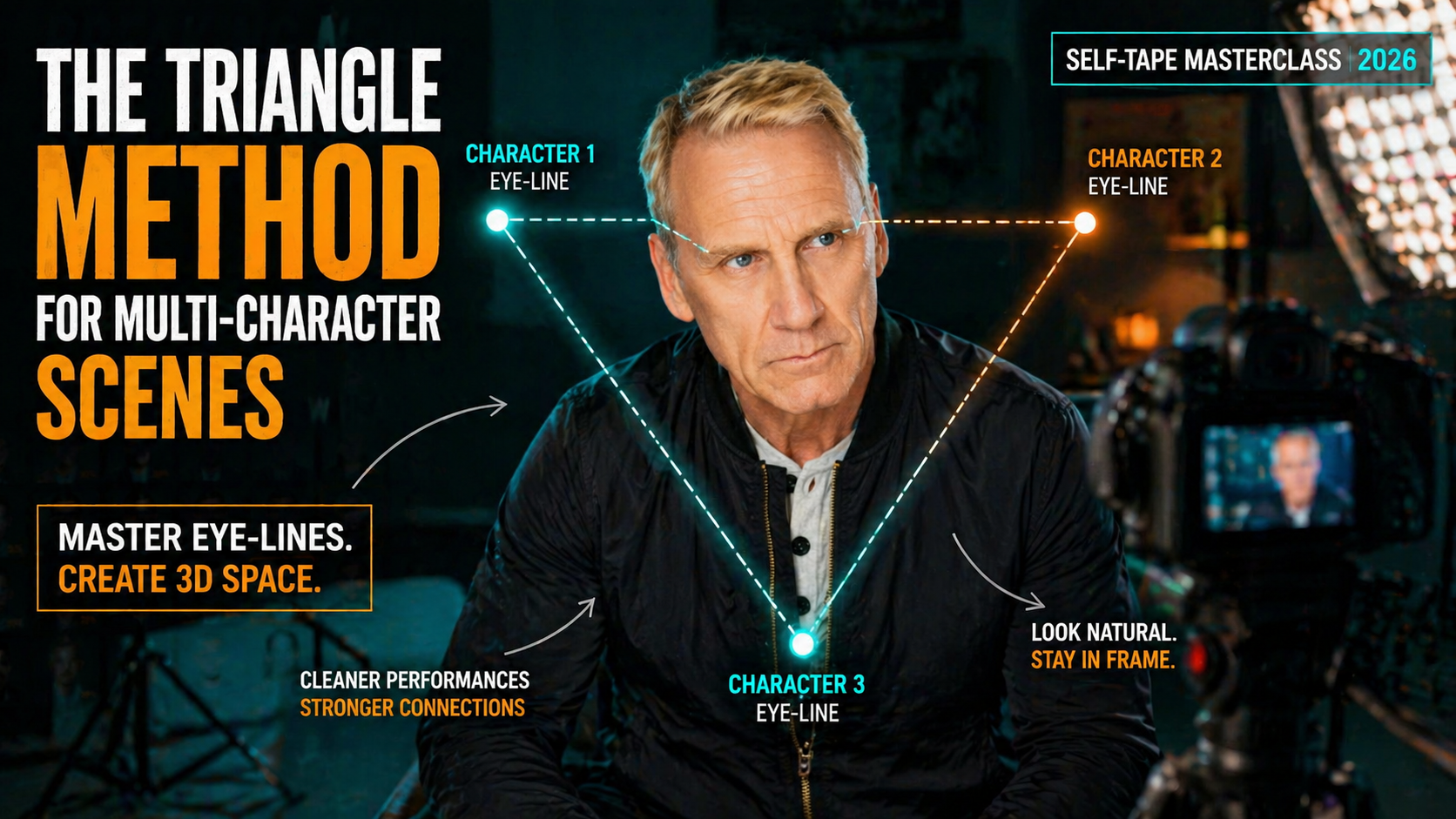
Most actors know how to handle a single eyeline. They place a mark, focus, and deliver the scene. But the moment a script introduces two or more additional characters, everything starts to break down. Eyelines become inconsistent, eye movement feels random, and the performance loses clarity. What should feel like a grounded interaction instead looks flat and amateur on camera.
The issue is not acting ability. It is spatial awareness. In a self-tape environment, the actor is responsible for creating the illusion of multiple people existing in a shared space. Without a clear system, that illusion collapses quickly.
Why Two Dimensions Need Three-Dimensional Thinking
A camera records in two dimensions, but strong performances feel three-dimensional. When multiple characters are involved, the actor must create depth, distance, and relationship using only eyeline placement and subtle physical adjustments. If all eyelines are clustered in the same position, the scene feels compressed and unrealistic. If they are scattered randomly, the scene feels disconnected.
This is where most actors lose control of the frame. They treat each line as an isolated moment instead of building a consistent spatial map. The audience may not consciously notice it, but casting directors do. It signals a lack of technical understanding.
The Triangle Method Explained
The Triangle Method solves this problem by giving actors a clear geometric structure for eyeline placement. Instead of using a single mark, the actor establishes three distinct points that form a triangle around the camera. Each point represents a different character in the scene.
This creates immediate separation between characters. One eyeline may sit slightly left of camera, another slightly right, and a third just above or below the lens line. The exact positioning depends on the scene, but the principle remains consistent: each character occupies its own space within a defined geometric structure.
By returning to the same points consistently, the actor builds a believable world. The audience begins to feel the presence of multiple people, even though only one person is on screen.
Creating Depth Through Eyeline Distance
The Triangle Method is not just about direction. It is also about distance. Not every character should feel equally close. One eyeline may represent someone standing directly in front of you, while another may represent someone across the room. This can be adjusted through subtle changes in focus, eye intensity, and timing.
These variations create depth within the frame. Without them, every interaction feels like it is happening at the same distance, which flattens the scene. With them, the performance gains dimension and realism.
The Neck Pivot: Staying Inside the Frame
One of the biggest technical mistakes actors make in multi-character scenes is over-rotating their head. When the eyeline shifts too far, the actor drifts out of the ideal framing, especially in a medium close-up. This breaks continuity and pulls attention away from the performance.
The solution is controlled pivoting. Instead of turning the entire head dramatically, the actor makes small, precise adjustments using the eyes first, followed by minimal neck movement. The goal is to shift focus without losing framing. The audience should feel the shift in attention without seeing the mechanics behind it.
This is where technical discipline meets performance. The movement must feel natural, but it must also remain contained within the camera’s composition.
Consistency Is What Sells the Illusion
The power of the Triangle Method comes from consistency. Each time the actor looks to a specific point, it must represent the same character. If the eyelines drift or change mid-scene, the illusion breaks immediately. The audience loses track of who is speaking, and the scene becomes confusing.
Maintaining these positions requires preparation. Actors must map out their eyelines before recording and commit to them throughout the take. This level of control is what separates professional self-tapes from amateur ones.
Why This Matters in Modern Casting
In today’s casting environment, self-tapes are evaluated quickly and often without context. Casting directors are looking for clarity, control, and professionalism. When an actor demonstrates strong spatial awareness and clean eyeline work, it immediately signals experience.
Multi-character scenes are often where actors lose that edge. But they are also where actors can stand out. A clean, technically precise performance in a complex scene shows mastery of both craft and camera.
The Real Advantage
The Triangle Method is not just a trick. It is a system for thinking about performance in a camera-driven environment. It allows actors to create structure where there would otherwise be chaos. It turns a difficult scene into something controlled, repeatable, and believable.
In a casting landscape where small details determine outcomes, this level of precision matters. It is the difference between looking like someone trying to figure it out and someone who already understands how the frame works.
Because in modern self-taping, you are not just performing the scene. You are constructing the space around it.