The Director Who Cast on Facebook
Christin Baker and Stacy Powell reveal how to build a real film career outside Hollywood — and what actually gets you cast.
By Sal Framondi
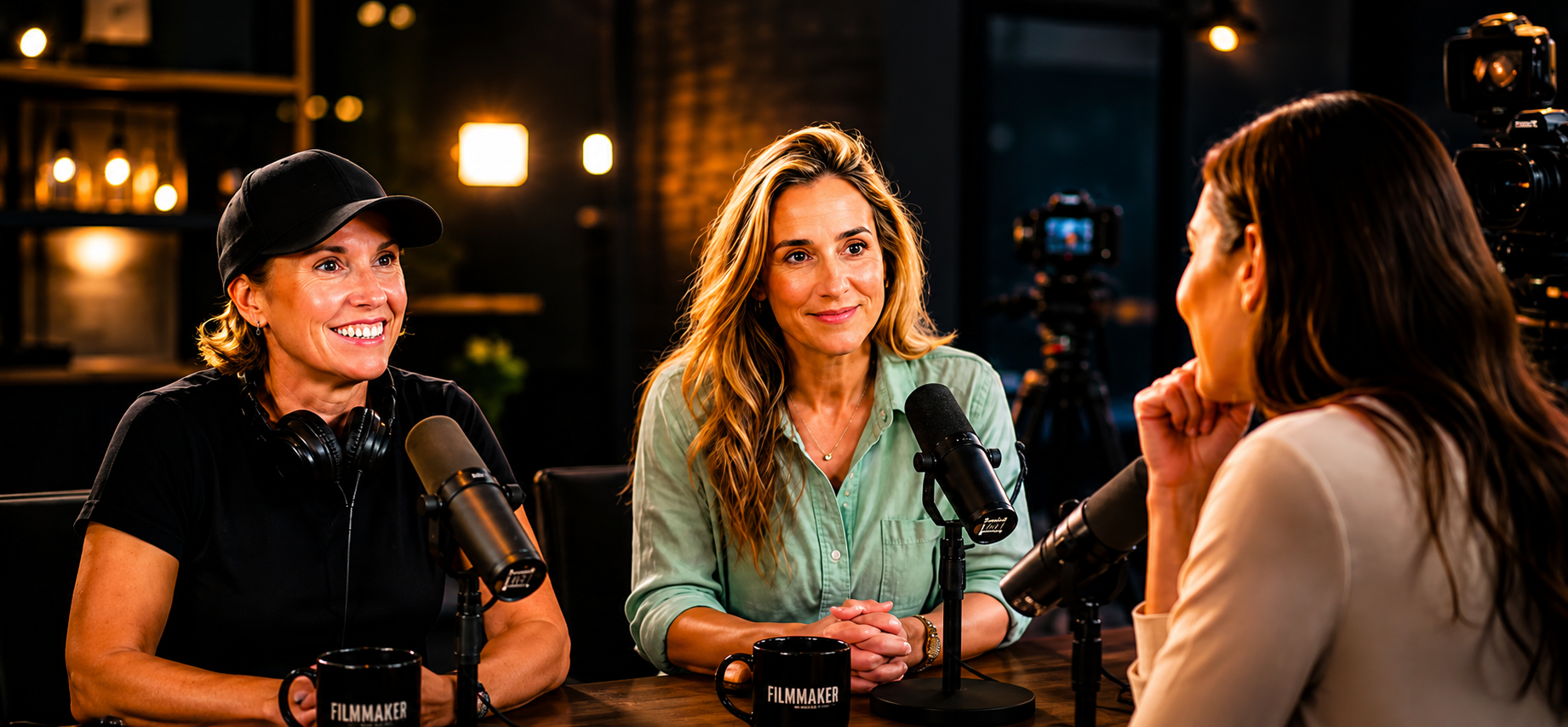
Christin Baker and Stacy Powell have been doing what most people said couldn't be done — building a successful, sustainable film career entirely outside of Los Angeles. As the founders of Tello Films, the longest-running LGBTQ+ streaming platform, they have spent over a decade proving that geography is no longer a barrier to telling meaningful stories at a professional level.
In a recent episode of Between the Takes with host Briana Oppenheimer, Christin and Stacy broke down exactly how they build films, find actors, and navigate an industry that has been completely transformed by streaming, smartphones, and artificial intelligence. What they shared is essential for every actor, filmmaker, writer, and producer trying to build a career on their own terms.
The Economics of Hollywood Changed Forever — And That Is Actually Good News
Christin has been in the industry for over twenty years, and she remembers exactly what the old system looked like. Films went to theaters, then DVD, then paid cable channels like HBO and Showtime, then into syndication. The studios understood those economics completely and controlled every step of the process.
Then Netflix arrived. Streaming arrived. DVDs disappeared. And the entire economic foundation of Hollywood shifted underneath everyone's feet at once.
What Christin sees in that disruption is not a tragedy — it is an opportunity. For the first time in the history of the industry, a filmmaker can go directly to their audience without a studio as a gatekeeper, without a distribution company as a middleman, and without being beholden to the narrow tastes of a small group of decision makers who historically excluded diverse voices. The data-driven approach of tech companies like Amazon, Apple, and Netflix has actually opened doors that were previously sealed shut to independent creators.
You Do Not Need to Be in Los Angeles
One of the most persistent myths in the film industry is that a real career requires a Los Angeles zip code. Christin started making web series and short form content in Chicago nearly twenty years ago and built her film family there — a trusted group of crew members including a DP, gaffer, wardrobe person, and makeup artist who she could call on project after project.
When she eventually moved to Nashville, she did the same thing again. Tax incentives have spread film production across the country, creating robust local communities of actors and crew in cities that had almost no industry presence a decade ago. Regional filmmaking, Christin says, is at its best right now because the people in those communities genuinely want to work, want to tell stories, and are not burned out by the volume and politics of a major production hub.
The one technical requirement she insists on no matter where you shoot is good sound. She will film on a smartphone before she will compromise on audio. Bad sound pulls an audience out of a story faster than any visual imperfection ever could.
The Exact Casting Process Christin Uses — Including Facebook
When Christin casts her films, she does not rely solely on the traditional casting platforms. She posts directly on Facebook acting groups, writes a specific breakdown of the character, and gives applicants clear instructions — what to put in the subject line, what to attach, what not to send unless asked. Nothing frustrates her more than a submission that ignores the directions, because following instructions is itself a demonstration of professionalism.
From those submissions, she reviews headshots and resumes first, then sends sides to the actors she is interested in with instructions for a self-tape. The process is straightforward, accessible, and deliberately designed to lower the barrier to entry for actors who are not yet connected to major agencies or casting directors.
What Makes a Bad Self-Tape
Christin has seen a lot of self-tapes, and she is direct about what does not work. Filming in your car is the most common mistake — unless the scene literally takes place in a car, the location pulls her completely out of the performance before it even begins. The environment of a self-tape should serve the story, not contradict it.
The other issue she sees consistently is actors reading opposite themselves — recording their scene partner's lines, playing them back, and trying to react in the gaps. It is a workaround that almost always shows. She can see it. It interrupts her ability to evaluate the actual performance happening on screen.
Why AI Tools Are Making Self-Tapes Better
Christin is not resistant to artificial intelligence in the filmmaking and auditioning process. Her position is practical — AI is not going away, and fighting it is a waste of energy that could be directed toward using it well.
What she wants to see from actors is anything that legitimately elevates the performance. A teleprompter that helps an actor stay present instead of scrambling to remember lines. An AI reader that delivers the scene partner's dialogue in the correct gender and with neutral timing so the actor can focus entirely on their own performance. These tools, used correctly, give the casting director a cleaner window into what the actor can actually do.
She specifically mentioned HowToSelfTape.com as a platform built for exactly this purpose — giving actors who cannot afford a self-tape studio or a scene partner access to professional-level tools that put the focus back where it belongs, on the performance.
How Christin Got a Career-Defining Performance With One Question
One of the most memorable moments in the conversation was Christin describing how she directed actress Dia Frampton through a deeply emotional scene on the set of I Hate New Year's. There was a game being played nearby with a buzzer going off every few seconds. Rather than push through and burn takes, Christin called a thirty-minute break and waited for the game to end.
When they came back, Dia was not getting to the emotional place the scene required. Christin did not give a line reading. She did not say something is not working. She walked up to Dia quietly, away from the crew, and simply asked her about love — whether she had ever been in it, how she wrote love songs when she had not experienced it firsthand. She asked as a friend, not as a director, and she watched Dia begin to feel something real.
The moment she saw it happening, she ran back to the camera and called action. The take was everything the scene needed.
The lesson is not a technique that can be applied identically to every actor in every situation. It is something deeper — knowing your actors well enough to understand what each one needs to access their best work, and being patient enough and human enough to meet them there.
Why Your Social Media Profile Can Get You Cast
Christin was direct about something that actors often underestimate. When two performers deliver comparable auditions, the deciding factor can be social media. She looks at profiles. She pays attention to what actors post, how they present themselves, and whether their online presence reflects the kind of professional they are.
This is not about follower counts. It is about intentionality. Every post should be a deliberate representation of who you are as an artist and a professional. Random, inconsistent, or damaging content is noticed — and it costs people roles.
The Bigger Picture
What Christin and Stacy have built with Tello Films is a proof of concept for a new kind of film career — one built on community, consistency, storytelling that serves underrepresented audiences, and a willingness to use every tool available to compete at the highest level possible without waiting for permission from the traditional system.
That is the same philosophy behind HowToSelfTape.com. Start your free seven-day trial today — AI script analysis, teleprompter, AI readers, audition tracking, and more. Full access. No credit card required.