How to Self-Tape When You Have Kids at Home
Kids at home do not have to kill your audition. Here is the complete system for recording professional self-tapes around your family.
By Sal Framondi
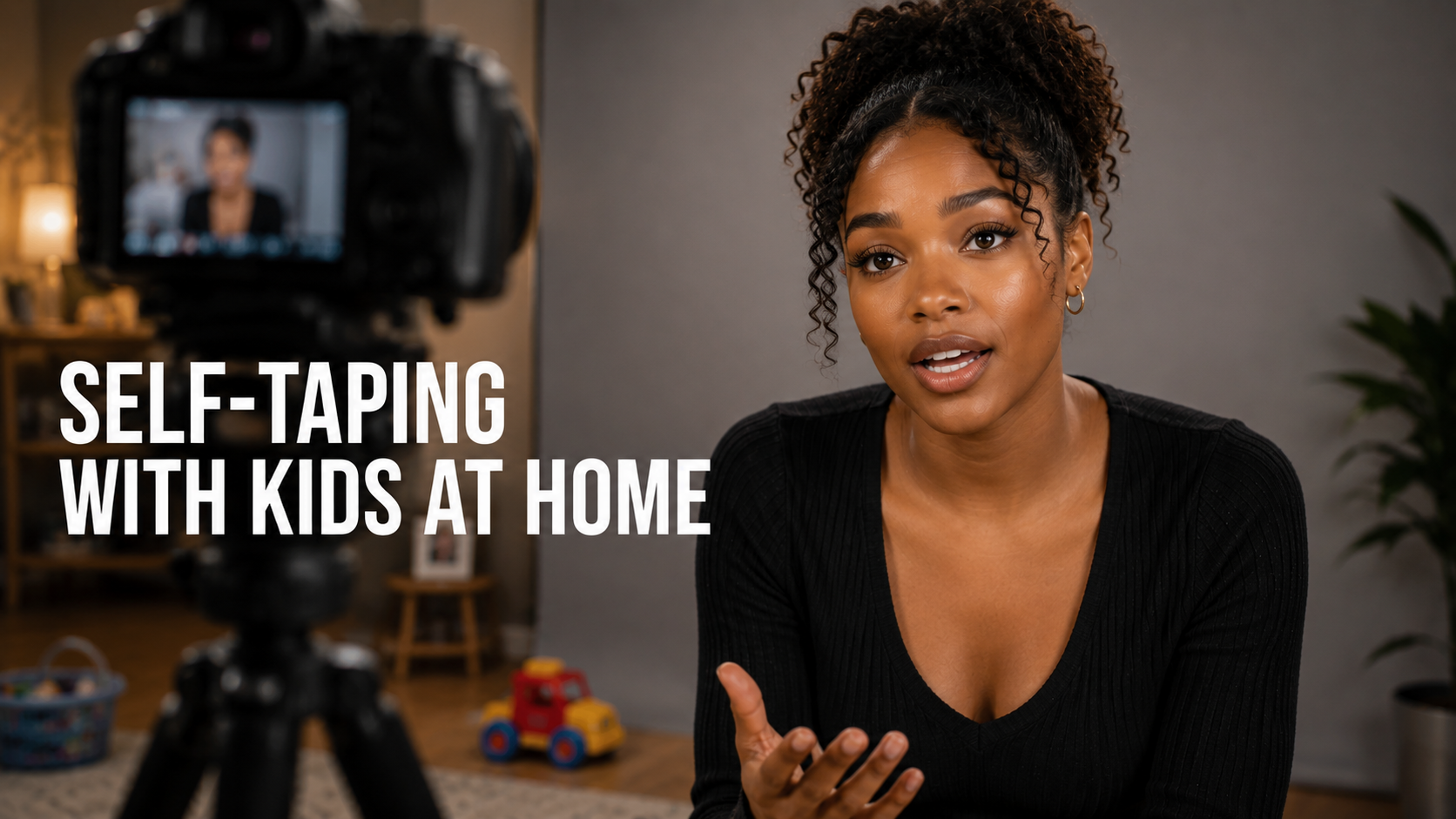
Nobody told you when you decided to keep pursuing acting as a parent that the two worlds would eventually collide in the most inconvenient way possible. The breakdown comes in at nine in the morning with a four-hour turnaround. Your child is home. The baby is napping on a schedule that has nothing to do with your availability. The toddler has opinions about the volume of the television and all of them are loud. And you have a self-tape due by one o'clock that could change the trajectory of your career. This is the reality of being an actor with children at home in 2026, and it is a reality the industry does not acknowledge nearly enough.
The good news is that this is a solvable problem. Not a perfect problem, not a quiet problem, but a solvable one. What it requires is a system built specifically for your circumstances — not the generic self-tape advice written for actors living alone in studio apartments with controllable environments and unlimited quiet time. This is the guide that was written for you.
The Scheduling Window — Work with the Clock, Not Against It
The single most powerful tool a parent-actor has is the nap schedule, the school schedule, or any predictable window of quiet that your child's routine provides. Before anything else, map those windows for your week. If your child naps from twelve to two, that is your primary self-tape window. If school runs from eight-thirty to three, that is your recording day. If bedtime is reliably seven-thirty, the ninety minutes after that is your backup slot. These windows are not ideal — they are not the open-ended recording sessions you imagined when you signed up for acting class. But they are real, they are predictable, and they are enough.
The mistake most parent-actors make is trying to record around an unpredictable schedule rather than building a system that works within a predictable one. When a breakdown arrives, your first move should not be to immediately set up and record. Your first move should be to look at your schedule, identify your window, and protect it. Everything else — learning your lines, setting up your space, doing your technical checks — happens before the window opens, so that when it does you are recording, not preparing.
Setting Up Your Space Permanently
One of the biggest time losses for parent-actors is the setup and breakdown of a self-tape space around family life. If you are spending twenty minutes moving furniture, positioning lights, and finding your backdrop every time a breakdown comes in, you are burning a significant portion of your available recording window before you have recorded a single take. The solution is a semi-permanent setup.
Find the corner of a room, a section of a bedroom, or even a dedicated closet space that can hold your self-tape setup without being fully dismantled between sessions. Your backdrop — whether it is a purchased photography backdrop, a plain wall, or a fabric hung from a tension rod — should stay in place. Your light, if you have one, should stay positioned. Your phone mount or camera tripod should stay at the correct height. The goal is a setup you can walk into and begin recording within five minutes of your window opening. When you have children at home, five minutes of setup time is the difference between a submitted tape and a missed audition.
Managing Noise — The Practical Reality
Noise is the primary technical threat to self-tapes recorded in homes with children, and it is worth being honest about what you can and cannot control. You cannot guarantee silence. What you can do is reduce the probability of noise landing in your takes and build a recording approach that accounts for the noise you cannot eliminate.
The first layer of noise management is environmental. Close every door between your recording space and wherever your child is. Soft furnishings — rugs, curtains, upholstered furniture, even blankets hung on walls — absorb sound and reduce the echo and resonance that make background noise more audible in recordings. If you have a partner, a family member, or a babysitter available during your recording window, use them to keep your child in a different part of the home with a screen, a snack, or an activity that reliably holds attention for the duration of your takes.
The second layer is your recording approach. Do not try to capture a single perfect take in one long unbroken session. Record in short bursts. Get one solid take, pause, listen for the house, record another. This approach means that a noise event — a cry, a door, a dropped toy — interrupts one take rather than your entire session. It also means you are accumulating options rather than gambling everything on a single recording. Most casting directors cannot tell whether your submitted tape was recorded in one take or assembled from the best of twelve. What they can tell is whether the audio is clean and the performance is present.
The Nap Window Recording Protocol
If your primary recording window is a nap or sleep period, treat the first five minutes of that window as your technical setup and audio check, not your performance time. Get into your space quietly, confirm your framing, run a ten-second audio test and listen back on headphones, and verify your lighting. Do all of this before you run a single performance take. The nap window is finite, and you cannot afford to discover a technical problem halfway through it.
Keep your takes short and decisive. Do not spend the first forty minutes of a sixty-minute nap window warming up and running partial takes. Know your material before the window opens — lines should be off book before you step into your recording space, not during it. Your recording window is for recording, not for learning lines or making performance decisions. Those happen earlier, during moments when your child is occupied, during a park trip, during a meal, during any pocket of time that does not require you to be in a quiet space.
When the Kids Interrupt Anyway
They will. This is not a failure of your system. This is parenting. The thing that matters is how you respond to it. If your child wakes early, comes into the room, or creates noise during a take, stop the take cleanly, address your child, and reset. Do not try to push through a take while a child is audibly present in the background. Casting directors notice everything in a quiet recording, and a child's voice in the background of your self-tape — while entirely understandable as a human being — is a technical flag that can work against you in competitive submission situations.
If an interruption eats into your window significantly, do not panic and rush your remaining takes. A rushed performance submitted on time is rarely better than a clean performance submitted slightly late with a brief professional note to casting. Most casting directors in 2026 are human beings who understand that actors are not recording in professional studios. A brief message that says your submission is coming within the hour is almost always received better than a technically compromised tape submitted at the deadline.
The Kit Every Parent-Actor Needs
Your self-tape kit as a parent needs one additional item that most self-tape guides do not mention: a set of over-ear headphones for your child. A reliable pair of children's headphones connected to a tablet with a downloaded show or audiobook is the single most effective noise management tool available to a parent-actor. It is not a permanent solution, and it is not appropriate for every age, but for children old enough to use a device independently it buys you the quiet window your recording requires. Combine it with a snack that takes time to eat, and you have extended your reliable recording window significantly.
Beyond the headphones, your kit is the same as every other self-tape setup — a phone or camera, a stable mount, a light source, a clean background, and an external microphone if your budget allows. The difference for parent-actors is not the equipment. It is the discipline of having it permanently set up, technically tested, and ready to use the moment your window opens.
You Are Not Behind — You Are Building Something Harder
The actors who record in quiet apartments with no obligations and no interruptions have one advantage over you: predictable availability. That is the only advantage. They do not have more talent. They do not have more drive. They do not understand the material more deeply or bring more to the performance. What they have is time that is easier to control, and in 2026 the self-tape system described in this guide levels that advantage almost entirely. The actor who has built a semi-permanent setup, mapped their quiet windows, learned their lines in stolen moments, and developed a short-burst recording approach is not behind the actor with more time. They are more disciplined, more resourceful, and more prepared for the reality of a professional set — where interruptions happen, schedules compress, and the ability to reset quickly and deliver is exactly what gets you hired again.